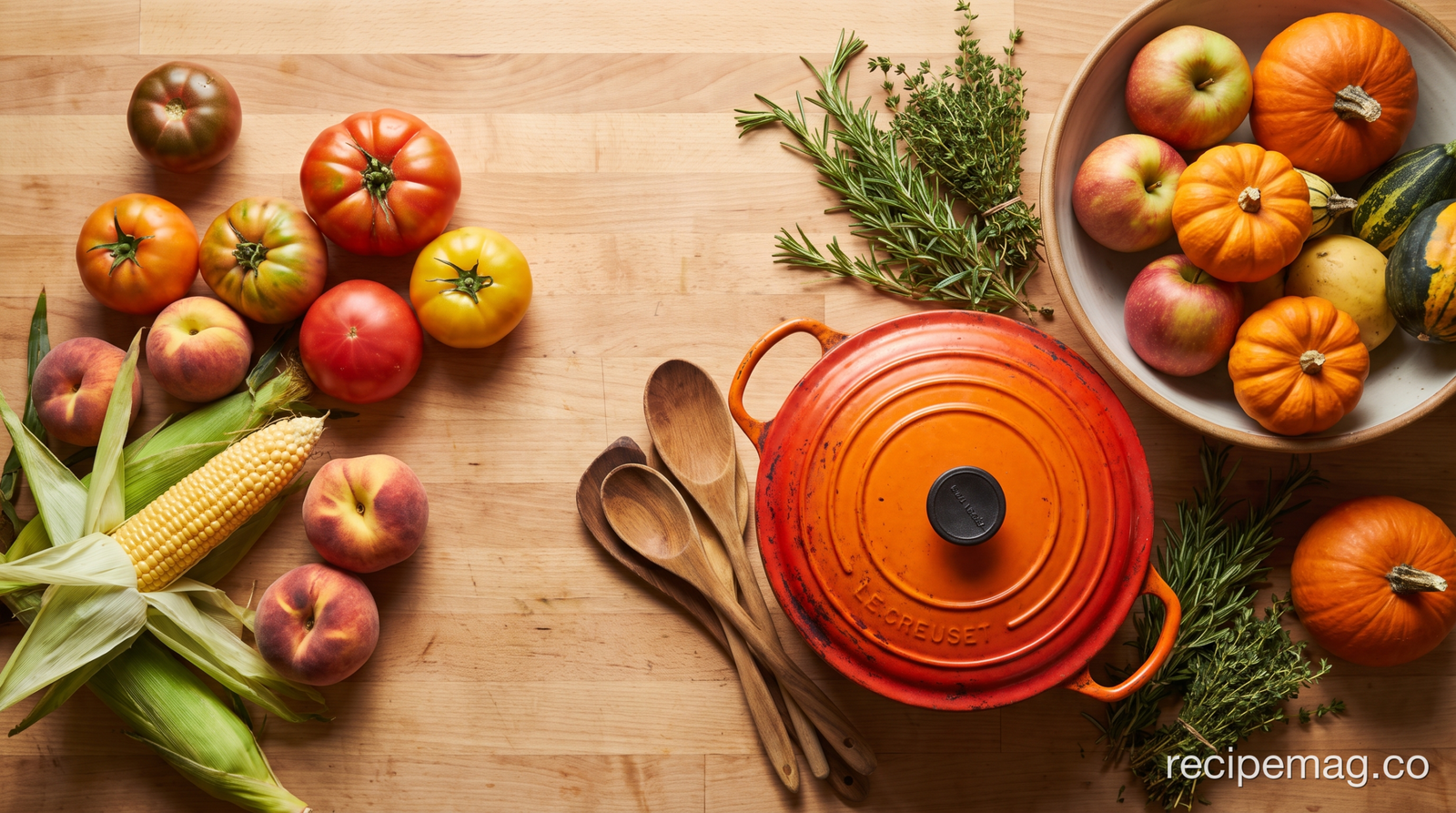
Late August is the only stretch of the year when two seasons sit on the counter at once: the last tomatoes and corn next to the first winter squash and apples. The practical move is not to switch over on September 1 but to cook the overlap, using summer produce in warmer preparations. It also matters for waste, since USDA estimates food loss and waste at 30 to 40 percent of the U.S. food supply, and the fastest household reduction is using what is already in the house before buying more (USDA, 2023).
Key Takeaways
- Late August overlaps two seasons; cook summer produce in fall preparations rather than switching abruptly.
- Preserve first, restock second. Freezer and pantry work now pays off in January.
- Shift cooking methods before you shift ingredients: roast and braise the same vegetables you were grilling.
- Audit the pantry now, while the freezer still has room for the season’s last produce.
- Food loss and waste is estimated at 30 to 40 percent of the U.S. food supply (USDA, 2023).
Step One: Deal With What Is Already Here
Before buying a single thing for fall, empty the crisper drawer onto the counter and look at it honestly. Late-summer produce declines faster than anything else in the year, and the pile you are ignoring is the pile that will be compost by Friday.
Sort it into three groups. Eat now: anything soft, split, or fully ripe, which means peaches, tomatoes, and berries go into tonight’s dinner or a dessert. Preserve this week: corn, green beans, peppers, and zucchini, all of which freeze well after a short blanch. Keep as-is: onions, garlic, potatoes, and hard squash, which are storage crops and will wait months.
Our guide to preserving summer produce covers the mechanics of each method and, importantly, which foods must not be canned without a pressure canner. If tomatoes are the bulk of the problem, roasting them into freezer tomato sauce clears the most volume for the least effort.
Step Two: Change the Method, Not the Ingredients
The most useful trick in this transition is that the same vegetables taste completely different depending on how you cook them. You do not need new produce to make food feel like fall. You need heat applied differently.
Zucchini that was grilled all July becomes something else entirely simmered into a soup. Corn that lived on the cob becomes chowder. Tomatoes that were sliced raw with salt become a slow-roasted sauce. Peppers that went on skewers get roasted until their skins blister and slip off.
Practically, this means moving from the grill to the oven and the Dutch oven. Start roasting instead of grilling. Start braising instead of searing. Bring back the soup pot, which is exactly what our end-of-summer minestrone is for: an unmistakably autumn preparation built entirely from August vegetables.
The same applies to protein. A Sunday braise of short ribs with late-summer tomatoes is the first real cold-weather meal of the year, and it uses fruit that will be gone in three weeks.
Step Three: Audit and Restock the Pantry
Summer cooking runs on fresh things and short cooking times, so pantries drift by late August. Now is when to reset, before the fall cooking calendar starts making demands.
Check and replace what has quietly run out: dried beans and lentils, canned tomatoes, stock, rice and grains, flour, and baking staples. Baking powder and baking soda both lose potency after about six months open, and there is no worse time to find that out than the morning of a Thanksgiving pie.
Then check what has quietly gone stale. Ground spices lose their punch in roughly a year, and the ones you barely touched all summer, cinnamon, nutmeg, allspice, and cloves, are precisely the ones fall cooking leans on. Smell them. If a jar smells like dust, replace it.
Freezer inventory matters just as much. Take everything out, write down what is actually in there, and eat down the oldest items over the next two weeks. You need the space for blanched corn, frozen peaches, and tomato sauce, and you cannot store any of it in a freezer packed with mystery containers from March.
Step Four: Rebuild the Weekly Routine
Summer schedules are loose. September’s are not, and the households that cook well in fall are the ones that rebuild a routine before they need it rather than after.
Pick one afternoon a week for batch work. Roast a tray of vegetables, cook a pot of grains, make a sauce, and portion proteins. Our guide to make-ahead meals for busy weeks works just as well in September as it did in July, and make-ahead back-to-school lunches covers the packed-lunch half of the problem.
Rebuild a short rotation of five or six weeknight dinners you can cook without thinking. This is not about ambition; it is about removing the daily decision. Our easy weeknight pasta dinners are a reasonable starting set, and most of them adapt straight to whatever the market has.
Finally, set the September anchor point. Labor Day on September 7 is the last cookout of the season for most people, and planning it now means the grill gets one proper send-off rather than being quietly abandoned. Our Labor Day cookout timeline handles that end of it.
What to Buy in the Next Two Weeks
Some things are about to disappear for a year, and they are worth buying in quantity right now rather than at their tail end in mid-September.
- Peaches and stone fruit. Peak now, gone by mid-September in most regions. Buy a case and freeze slices.
- Sweet corn. Sugars convert to starch within days of picking, so buy local and blanch it immediately.
- Tomatoes. Cheapest of the year right now. Roast and freeze what you cannot eat.
- Basil. First frost kills it. Make pesto and freeze it in cubes.
- Peppers. Roast, peel, and freeze in oil.
Meanwhile, start easing in the early fall crops as they appear: winter squash, apples, pears, hardy greens, and the first brassicas. Buy small amounts and cook them alongside the summer produce rather than instead of it. That overlap, for about three weeks, is genuinely the best eating of the year.
The Equipment Shift
Seasonal cooking changes tools as much as ingredients, and late August is the moment to move things around before you need them.
What comes forward: the Dutch oven, the roasting pan, the stockpot, and the sheet pans. Fall cooking is oven cooking, and anything you have to dig out from the back of a cabinet is something you will not use.
What goes back: the ice cream maker, the popsicle molds, and the cooler, though not the grill. Do not put the grill away in August. September and October are frequently the best grilling weather of the year, with none of the humidity, and a covered grill in October is one of the more pleasant places to cook.
This is also the right week to service equipment. Deep-clean the grill grates while the weather is still warm enough to do it outside comfortably. Sharpen knives, which will get heavy use once squash season starts. Check that your instant-read thermometer still reads accurately in ice water, where it should show 32°F.
And if you are going to buy one thing for the season, make it a second sheet pan. Nearly every fall vegetable preparation is improved by not crowding the pan, and crowding is almost always a symptom of owning too few of them.
What Not to Rush
The temptation in late August is to declare the season over and pivot hard. Resist it. The single biggest waste in a seasonal kitchen happens when cooks abandon summer produce two weeks before it actually ends, then buy expensive, underripe fall produce that is not at its peak yet either.
Tomatoes, corn, peppers, and stone fruit all have real time left, and this is when they are cheapest. Winter squash, by contrast, is only just arriving and is often better in October than it is now. Apples in late August are early varieties that will be outclassed by what comes in six weeks. Buying them now is paying a premium for a preview.
The right move is overlap rather than replacement. Keep buying the summer produce that is still excellent, start using fall methods on it, and let the two seasons share the kitchen for a few weeks. Roasted late tomatoes, braised summer beans, and grilled stone fruit are all examples of exactly that hybrid.
Give it until roughly mid-September before making the full switch. By then the last tomatoes will genuinely have turned mealy, the corn will have gone starchy, and the squash will be worth buying. Until then, the overlap is the entire point of the month.
Frequently Asked Questions
When does summer produce actually end?
It varies by region, but most areas lose tomatoes, corn, and stone fruit between mid-September and first frost. Late August is the last reliably abundant stretch, which is why it is the right time to preserve.
What is the single most useful thing to preserve right now?
Tomato sauce. It takes the most counter space, declines the fastest, and is the ingredient you will reach for most often between November and March.
How do I make summer vegetables feel like fall food?
Change the cooking method. Roast, braise, and simmer instead of grilling and serving raw. The same zucchini, corn, and tomatoes read as autumn food in a soup or a braise.
How often should I replace dried spices?
Ground spices are best within about a year of opening, and whole spices last two to three. Trust your nose over the date: if there is no aroma when you open the jar, there will be no flavor in the dish.
Should I clean out the freezer before or after preserving?
Before. Blanched vegetables and frozen fruit need to freeze fast in a single layer, and a packed freezer both slows that and leaves you nowhere to put the results.
Is it worth buying produce in bulk at the end of the season?
Yes, if you have a plan for it that same week. End-of-season prices are the lowest of the year, but bulk produce that sits on the counter unprocessed becomes waste rather than savings.
