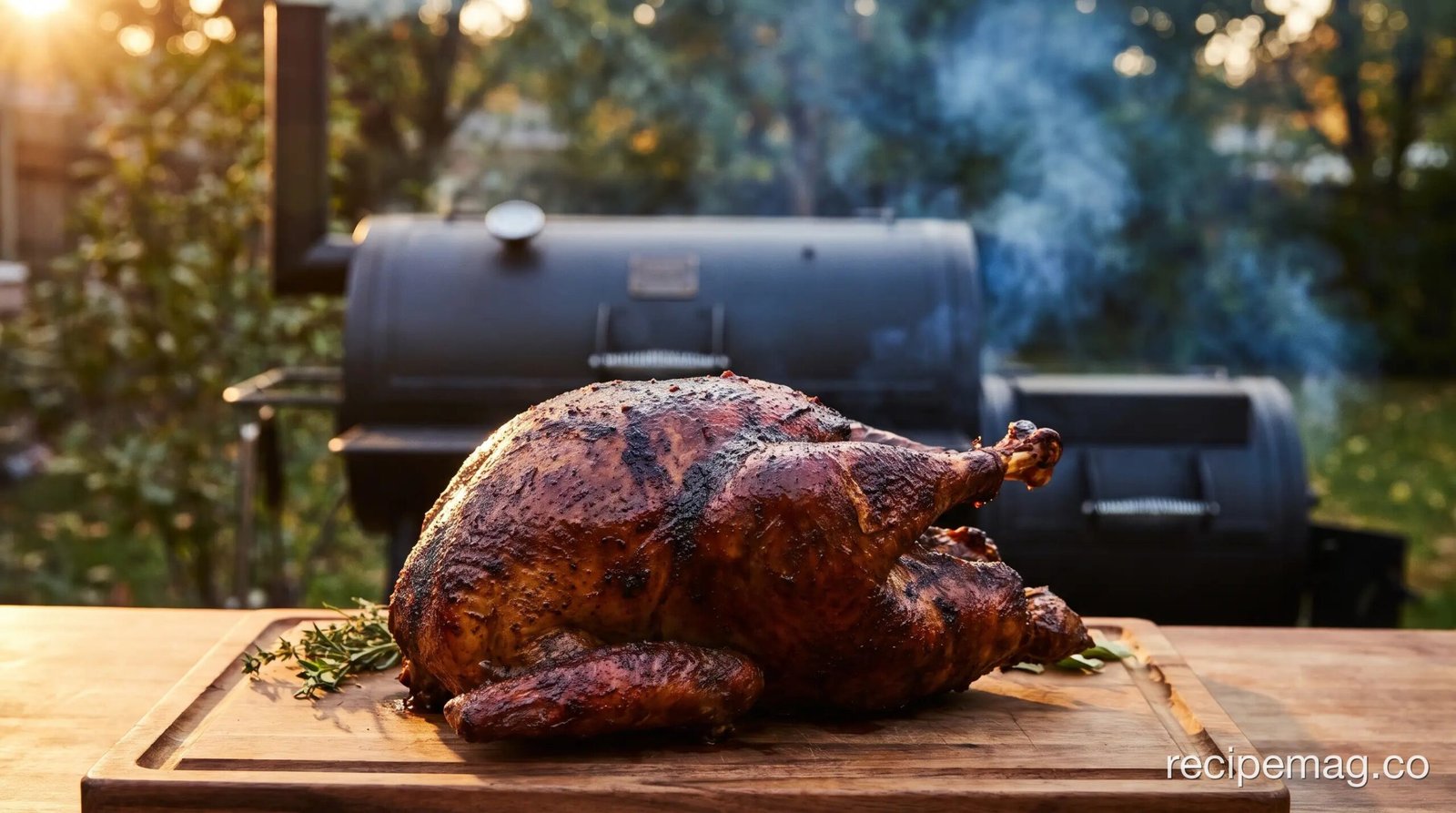
A smoked turkey is a whole bird cooked low and slow over wood until it reaches 165°F in the thickest part of the breast and the innermost thigh and wing, the safe minimum set by USDA FSIS (USDA FSIS, 2025). For a first try, keep it simple: a 10- to 12-pound turkey, a smoker held near 275°F and a leave-in thermometer. Plan on 3½ to 5 hours, and your oven stays free for the sides.
Key Takeaways
- Choose a 10- to 12-pound turkey, never bigger than 14 pounds.
- Run the smoker at about 275°F; USDA FSIS advises 225°F to 300°F for smoking.
- Use mild apple or cherry wood, and only for the first 2 to 3 hours.
- Never stuff a turkey you’re smoking.
- It’s done at 165°F in the breast, thigh and wing; a pink smoke ring is normal.
What Do You Need to Smoke a Turkey?
Any smoker that holds a steady temperature works: pellet, offset, kamado, electric or a charcoal kettle set up for indirect heat. You also need two thermometers. USDA FSIS advises keeping the smoker between 225°F and 300°F and tracking both the smoker and the meat, because lid dials are often inaccurate. Our meat thermometer guide covers leave-in probes and instant-reads.
The bird matters more than the smoker. At 275°F, a 20-pounder spends hours warming through, and the breast dries out before the thighs are done. Feeding a crowd? Smoke two 10- to 12-pound turkeys side by side. They cook in about the same time as one, and you get four drumsticks.
Which Wood Is Best for Smoked Turkey?
Turkey soaks up smoke easily, so start mild. Apple and cherry give a sweet smoke and a deep red-brown skin, and pecan is a little stronger. Skip mesquite, which turns bitter on poultry, and never burn softwood or treated lumber.
Ingredients
Serves 8 to 10. Prep time 25 minutes, plus 12 to 24 hours salting. Cook time 3½ to 5 hours, plus 30 minutes resting. Total time 4½ to 6 hours, plus salting.
For the Rub
- 2½ tablespoons Diamond Crystal kosher salt (or 1½ tablespoons Morton kosher salt)
- 1 tablespoon packed brown sugar
- 1 tablespoon smoked paprika
- 2 teaspoons freshly ground black pepper
- 2 teaspoons garlic powder
- 2 teaspoons onion powder
- 1 teaspoon dried thyme
- ½ teaspoon cayenne pepper (optional)
For the Turkey and Smoker
- 1 whole turkey (10 to 12 pounds), fully thawed, neck and giblets removed
- 4 tablespoons unsalted butter, melted
- 1 medium yellow onion, quartered
- 1 lemon, halved
- 4 sprigs fresh thyme
- 4 to 6 fist-size chunks of apple or cherry wood (or the pellets your smoker uses)
- 4 cups hot water for the water pan, plus more as needed
Equipment: a smoker, a rimmed sheet pan with a wire rack, a leave-in probe thermometer, an instant-read thermometer and heat-resistant gloves.
Brined the bird in our apple cider brine, or bought a kosher or “enhanced” turkey? Leave the salt out of the rub.
How to Smoke a Turkey, Step by Step
- Salt it the day before. Pat the turkey dry with paper towels; USDA FSIS advises against rinsing raw poultry (USDA FSIS, 2025). Mix the rub ingredients. Loosen the skin over the breast and thighs, rub about a third of the mix underneath and sprinkle the rest over the outside.
- Chill it uncovered. Set the turkey on the wire rack in the sheet pan and refrigerate it, uncovered, for 12 to 24 hours.
- Set up the smoker. Pour the hot water into the water pan. Light the smoker for indirect heat, so the bird won’t sit over the fire, and bring it to 275°F. Let it hold steady for 15 minutes.
- Add the wood. Add 2 chunks of wood, or load the pellets. Wait until the smoke runs thin and bluish, not thick and white.
- Prep the bird. Loosely fill the cavity with the onion, lemon and thyme sprigs. Tuck the wing tips behind the back and leave the legs untied so heat reaches the thighs. Brush all over with the melted butter.
- Insert the probe. Push the leave-in probe into the thickest part of the breast, keeping it off the bone.
- Smoke. Set the turkey on the grate breast side up, thighs toward the hotter side. Close the lid and hold the smoker between 250°F and 300°F. Add 1 wood chunk every 45 minutes to 1 hour for the first 2 to 3 hours, then stop. Keep the lid shut, topping up the water pan and fuel as needed.
- Start checking at 3 hours. Use the instant-read in the thickest part of the breast, the innermost thigh and the innermost wing. If the skin is getting too dark, tent the breast loosely with foil.
- Pull it at 165°F. It’s done when all three spots read at least 165°F.
- Rest and carve. Move the turkey to a board, tent it loosely and rest 20 to 30 minutes. Then follow our guide on how to carve a turkey.
How Long Does It Take to Smoke a Turkey?
At 275°F, plan on about 20 to 25 minutes per pound, or 3½ to 5 hours for a 10- to 12-pound bird. Treat those as planning numbers: wind, cold weather and a lid that keeps opening all add time. Doneness is set by temperature alone, 165°F per USDA FSIS (2025).
| Turkey weight | Approximate time at 275°F | Start checking at |
|---|---|---|
| 8 to 10 lb | 3 to 4 hours | 2½ hours |
| 10 to 12 lb | 3½ to 5 hours | 3 hours |
| 12 to 14 lb | 4 to 5½ hours | 3½ hours |
For a 4 p.m. dinner on Thursday, November 26, light the smoker by 9 a.m. and have a 12-pound bird on by 10. Finished early? Keep it loosely tented, and serve within 2 hours of it coming off the heat.
Tips for Smoked Turkey
- Never stuff it. Stuffing in a slow-cooking bird lingers too long between 40°F and 140°F, where bacteria multiply rapidly (USDA FSIS, 2025). Bake it in a dish.
- Want crisper skin? Smoked skin turns soft and deep brown. Once the breast reads about 150°F, move the bird to a 425°F oven until it hits 165°F.
- Make gravy ahead. Smoker drippings can taste ashy, so our make-ahead turkey gravy is the safer bet.
- Smoke outdoors only, on a level, nonflammable surface well away from the house. Never in a garage.
We always do a test run with a whole chicken the weekend before. It shows you how your smoker behaves in November weather, which is nothing like July. Ours ran noticeably cooler on a windy morning until we moved it out of the breeze.
Make-Ahead and Storage Notes
Refrigerate smoked turkey within 2 hours and eat it within 3 to 4 days, according to USDA FSIS (USDA FSIS, 2025).
- Rub: mix it up to 1 month ahead and store it airtight.
- Smoke a day early: carve and refrigerate the meat within 2 hours, then reheat it covered with a splash of broth at 325°F until it reaches 165°F.
- Leftovers: store sliced meat in shallow containers, or freeze it for soup and sandwiches.
Frequently Asked Questions About Smoked Turkey
What temperature should I smoke a turkey at?
About 275°F. USDA FSIS advises keeping a smoker between 225°F and 300°F, and 275°F sits in that range while cooking fast enough for decent skin. At 225°F, the skin turns rubbery and the cook can stretch past 6 hours. Whatever the setting, pull the bird at 165°F.
Why is my smoked turkey pink inside?
Smoke reacts with the meat’s pigment and leaves a pink ring under the skin, even when the turkey is fully cooked. USDA FSIS notes that color isn’t a reliable doneness test for poultry. If the breast, innermost thigh and wing all read 165°F, the pink is just smoke.
Can I smoke a brined turkey?
Yes, and it’s a good match. Pat the brined bird dry, let it air-dry in the fridge overnight and leave the salt out of the rub. Cider-brined skin browns faster, so tent the breast with foil if it darkens before the meat reaches 165°F.
Do I need a water pan?
It helps, especially for beginners. A pan of water steadies the temperature and keeps the air moist, so the surface doesn’t dry out. Pellet and electric smokers hold heat well without one, but kettles and offsets run more evenly with it. Refill it with hot water.
Fire Up the Smoker This Weekend
The best smoked turkey starts with a practice run. Smoke a chicken this weekend, note how well your smoker holds 275°F, and you’ll walk into Thanksgiving with a plan instead of a guess.
Then keep it simple: salt the bird Wednesday, keep the wood mild and let the thermometer decide when it’s done.
