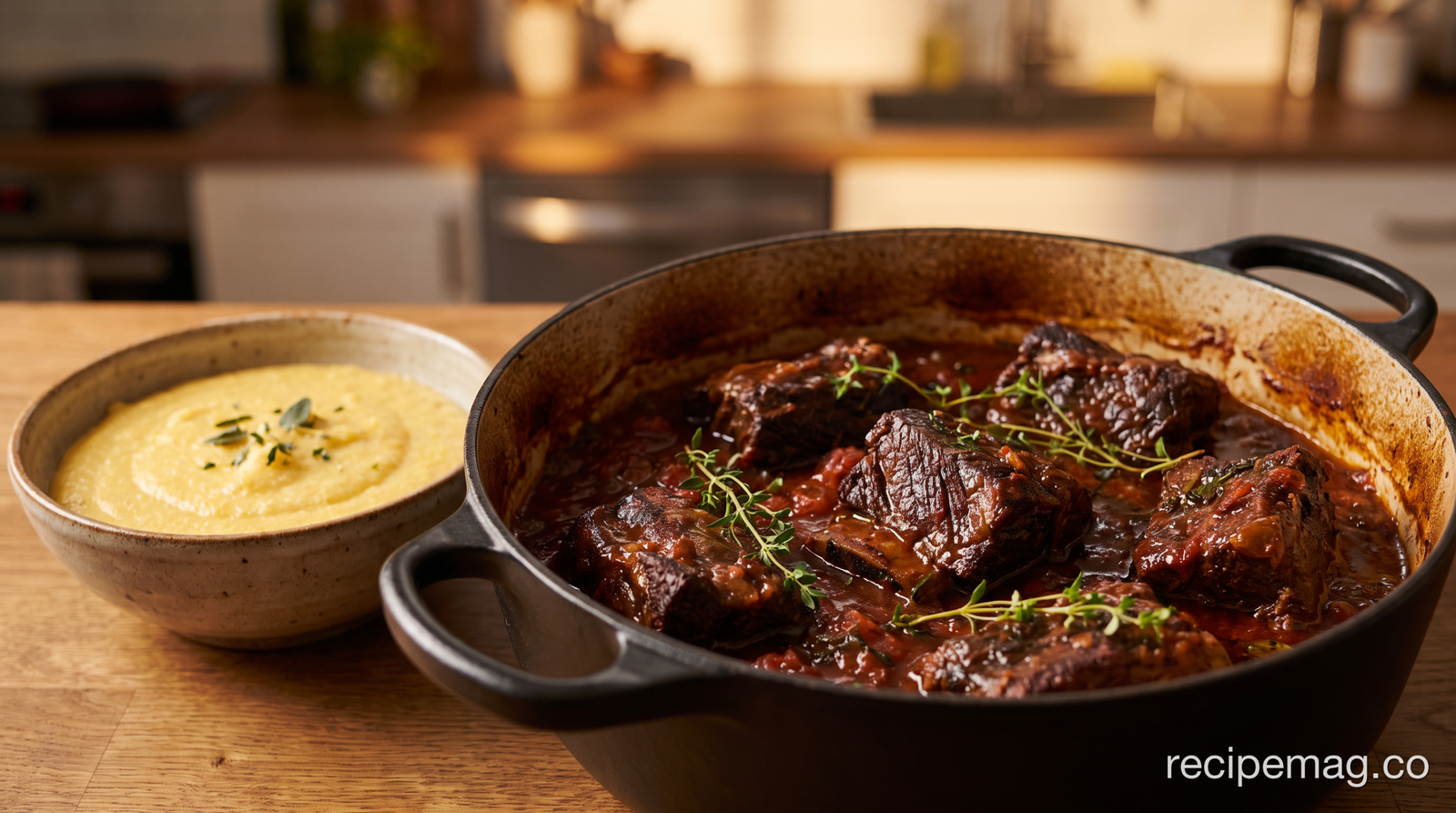
Short ribs are the cut that rewards patience and punishes speed. They are dense with collagen, and collagen only converts to gelatin after hours above roughly 160°F, which is why a short rib is tough at 145°F and falling apart at 200°F. Late August is the right moment to make them, because the last ripe tomatoes of the season cook down into a braising liquid that no canned tomato in February will match.
Key Takeaways
- Bone-in English-cut short ribs are the right cut; flanken-cut is for grilling, not braising.
- A hard sear before braising builds the browned foundation the sauce is built on.
- Braise at 300°F for about 3 hours, until a fork twists in the meat with no resistance.
- Done is a texture, not a temperature, though it lands near 200°F internal.
- Made a day ahead, the fat solidifies and lifts off cleanly and the flavor improves.
Ingredients
Serves 4 to 6. Active time 40 minutes. Total time 4 hours.
- 4 lbs bone-in English-cut beef short ribs, about 6 pieces
- 2 tsp kosher salt, plus more to taste
- 1 tsp black pepper
- 2 tbsp neutral oil
- 1 large onion, diced
- 2 carrots, diced
- 2 celery stalks, diced
- 6 garlic cloves, smashed
- 3 tbsp tomato paste
- 1 1/2 lbs ripe tomatoes, chopped, or one 28-oz can
- 1 cup dry red wine
- 2 cups beef stock
- 4 sprigs thyme
- 2 sprigs rosemary
- 2 bay leaves
- 1 tbsp red wine vinegar, to finish
Ask for English cut, where the bone runs along a single thick block of meat. Flanken cut, sliced thin across several bones, is meant for Korean-style grilling like our galbi, and it will fall apart into shreds in a braise.
How to Make It
1. Season and temper. Season the ribs generously on all sides with the salt and pepper and let them sit at room temperature for 30 minutes. Pat them completely dry before searing; surface moisture is what prevents browning.
2. Sear hard. Heat the oil in a heavy Dutch oven over medium-high until it shimmers. Sear the ribs in batches, about 3 minutes per side, until each face is deeply brown. Do not crowd the pot. Two batches that brown properly beat one batch that steams. Set the ribs aside.
3. Build the base. Pour off all but two tablespoons of fat. Add the onion, carrot, and celery and cook 8 minutes until softened. Add the garlic and cook one minute, then the tomato paste, stirring for two minutes until it darkens noticeably.
4. Deglaze. Pour in the wine and scrape the bottom of the pot hard with a wooden spoon. Every browned bit stuck there is flavor, and the wine’s job is to dissolve it. Simmer 4 to 5 minutes until reduced by about half.
5. Assemble and braise. Add the tomatoes, stock, thyme, rosemary, and bay leaves. Return the ribs bone side up, nestling them so they are about two-thirds submerged rather than drowned. Bring to a bare simmer, cover, and transfer to a 300°F oven.
6. Cook until it gives. Braise 3 to 3.5 hours. Start checking at 3 hours: a fork inserted into the meat should twist with no resistance at all. If it fights you, it is not done, and another 30 minutes will not hurt it.
7. Finish the sauce. Lift the ribs out and set them aside. Skim the fat from the surface, discard the herb stems and bay leaves, and simmer the liquid uncovered for 10 to 15 minutes until it coats a spoon. Stir in the red wine vinegar off the heat, which sharpens everything that three hours of cooking has rounded off. Taste and salt aggressively.
Why the Method Works
Three decisions do most of the work here, and each one is worth understanding rather than following blindly.
The sear is not about sealing in juices. That idea has been thoroughly debunked. What searing actually does is create browned compounds through the Maillard reaction, and those compounds dissolve into the braising liquid and become the sauce. Skip the sear and you get boiled beef in tomato water.
The oven beats the stovetop. A burner heats from one point below, which creates hot spots and a liquid that boils in patches. An oven surrounds the pot with even, gentle heat, holding the braise at the bare simmer that keeps the meat tender rather than seizing it.
Partial submersion is deliberate. Meat fully covered in liquid poaches. Meat two-thirds submerged braises, with the exposed top browning further in the oven’s dry heat and adding another layer of flavor to the pot.
The acid at the end matters more than it sounds. Long cooking flattens flavors, and a tablespoon of vinegar stirred in off the heat restores the brightness that makes a rich dish keep tasting good past the third bite.
Make It Ahead, Then Serve It
This is genuinely better on day two, and the practical reason is fat. Chilled overnight, the fat rises and solidifies into a cap you can lift off in one piece, which is far cleaner than skimming a hot pot. The meat also reabsorbs liquid as it cools in the sauce.
Cool the ribs in their liquid, refrigerate up to four days, then lift the fat, and reheat gently at 325°F for about 40 minutes. It freezes well for three months, ribs and sauce together.
For serving, you want something soft and starchy under the sauce. Creamy polenta is the classic and the best. Mashed potatoes, buttered egg noodles, or white beans all work. Then put something sharp and green on the plate, since a rich braise needs contrast: a bitter salad, or charred broccolini with lemon.
If you froze roasted tomato sauce earlier in the season, this is an excellent place to spend it. Substitute two cups of our roasted tomato sauce for the fresh tomatoes, and start it as a first course after end-of-summer minestrone for a proper Sunday dinner.
Buying Short Ribs Without Overpaying
Short ribs have gotten expensive as restaurants popularized them, but there is still real value in the cut if you know what you are looking at.
Look for pieces at least two inches thick with a visible layer of meat sitting on top of the bone. Thin pieces with a sliver of meat are a poor deal at any price, since most of the weight is bone. A good English-cut rib is roughly two-thirds meat by volume.
Marbling matters more here than in a steak, because the fat renders through the braise and enriches the sauce. Heavy exterior fat caps, however, are just waste that you will skim off later, so trim thick caps down to about a quarter inch before searing.
Boneless short ribs cost more per pound and give you less. The bones contribute collagen and marrow to the braising liquid, which is a meaningful part of why the sauce has body. If boneless is all you can find, add a beef marrow bone or a split veal bone to the pot.
The cheaper alternative worth knowing is chuck roast, cut into large chunks. It has a similar collagen structure, costs substantially less, and behaves nearly identically in this braise. It will not have the bone, and the presentation is less dramatic, but the eating is close.
Building the Braising Liquid
The liquid is not a cooking medium here; it is the finished sauce, and it should be composed with that in mind from the start.
Proportion matters first. You want roughly equal parts wine-and-stock to tomato, and enough total liquid to come two-thirds up the ribs. Too much and the sauce is thin and needs aggressive reduction later. Too little and the exposed meat dries out before the collagen breaks down.
The wine should be something you would drink, though it need not be expensive. A dry red with real structure, a Chianti, a Côtes du Rhône, a decent Cabernet, reduces into something with backbone. Cooking wine, which is salted and oxidized, makes a sauce that tastes vaguely of vinegar and nothing else.
The tomatoes are where late August earns its place. Ripe fresh tomatoes bring sweetness and acidity in balance, and they break down completely over three hours into a sauce with none of the sharp edge canned tomatoes carry. If you are using canned out of season, choose whole peeled San Marzano-style tomatoes and crush them by hand rather than buying pre-diced, which are treated with calcium chloride to keep them firm and will stay in stubborn cubes.
Finally, keep the herbs whole and on the stem. Loose leaves disintegrate and turn the sauce muddy and speckled, while whole sprigs release their oils and then lift out cleanly in one piece.
Frequently Asked Questions
What cut of short rib should I buy?
Bone-in English cut, where each piece has one bone under a thick block of meat. Flanken cut, sliced thin across the bones, is for fast grilling and will shred in a braise.
How do I know when short ribs are done?
By feel, not temperature. A fork should twist in the meat with zero resistance. That usually happens around 200°F internal, but time at temperature is what converts collagen, so texture is the only reliable test.
Can I make these in a slow cooker or pressure cooker?
Yes. Sear and build the base on the stove first, then slow cook on low for 7 to 8 hours, or pressure cook for 45 minutes with a natural release. Reduce the sauce on the stove afterward either way.
Can I substitute the red wine?
Use an extra cup of beef stock plus a tablespoon of balsamic vinegar or tomato paste for acidity and depth. The result is slightly less complex but perfectly good.
Why is my braise greasy?
Short ribs are a fatty cut and the fat renders into the liquid. Chill the braise so the fat solidifies and lift it off in one piece, which is far more effective than skimming while hot.
Can I use boneless short ribs?
Yes, though the sauce loses some body, since the bones contribute gelatin. Reduce the braise time by about 30 minutes and check for tenderness earlier.
