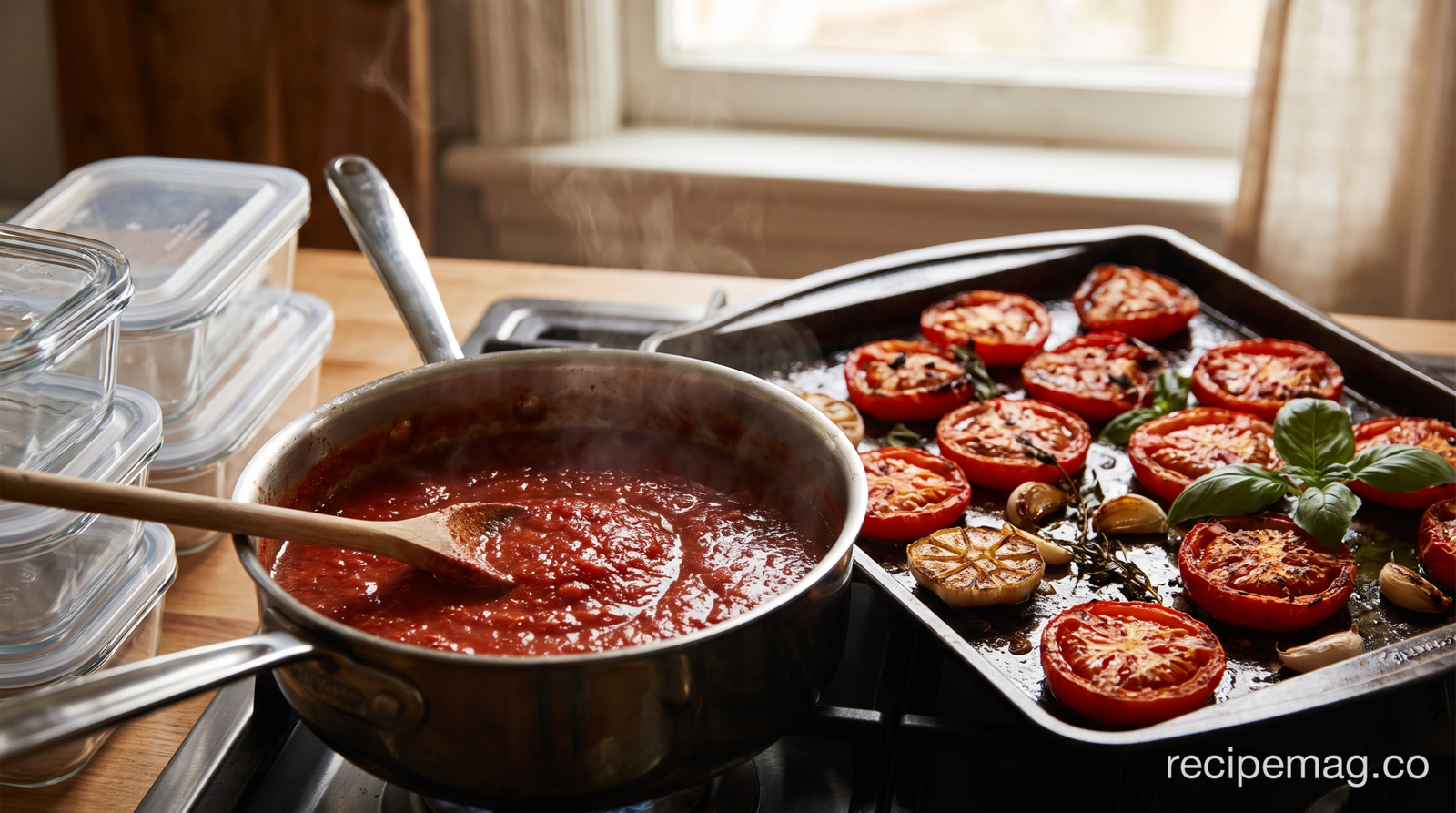
Roasting is the best thing you can do with a surplus of late-August tomatoes, because it solves the problem that ruins most homemade sauce: water. Slow oven heat drives off moisture and concentrates sugars while the tomatoes caramelize at the edges, giving you a sauce with real depth from fruit that might otherwise be a day from the compost. Freezing it is safe indefinitely at 0°F, though quality is best inside a year (USDA FSIS, 2023).
Key Takeaways
- Roasting concentrates flavor and removes the excess water that makes stovetop sauce thin.
- Any tomato works, including cracked, overripe, and oddly shaped ones that are unsellable but perfectly good.
- 5 lbs of tomatoes cooks down to roughly 4 to 5 cups of finished sauce.
- Freeze flat in bags and the portions stack like files and thaw in minutes.
- Freezing avoids the acidification requirement that applies to canned tomatoes (NCHFP, 2024).
Ingredients
Makes about 4 to 5 cups. Active time 20 minutes. Total time 2 hours.
- 5 lbs ripe tomatoes, any variety
- 1 whole head garlic, cloves separated and peeled
- 1 medium yellow onion, cut into thick wedges
- 1/4 cup olive oil
- 2 tsp kosher salt
- 1 tsp sugar, only if the tomatoes are underripe
- 4 sprigs fresh thyme or 1 tsp dried oregano
- 1 large handful fresh basil, added at the end
- Black pepper to taste
Plum tomatoes give the thickest sauce because they carry less water and fewer seeds. But this recipe exists precisely so you can use whatever you have, and a mixed pan of beefsteaks, cherry tomatoes, and heirloom seconds makes excellent sauce.
How to Make It
1. Heat the oven to 400°F. Halve the tomatoes, or quarter them if they are very large. Leave cherry tomatoes whole. There is no need to peel or seed anything, since the blender handles it later.
2. Fill the pans. Spread the tomatoes cut side up across two large rimmed sheet pans. Crowding is the enemy here, because tomatoes packed too tightly steam instead of roast. Tuck the garlic cloves and onion wedges into the gaps.
3. Season and roast. Drizzle everything with olive oil, sprinkle with salt and the sugar if you are using it, and scatter the thyme over the top. Roast for 60 to 90 minutes, until the edges are browned and blistered and the tomatoes have visibly collapsed. Do not pull them early. The browning is the entire point.
4. Blend. Scrape everything on the pans into a blender or a large pot, including every bit of the darkened juice, which holds most of the flavor. Add the fresh basil. Blend until smooth, or pulse briefly for a rustic texture. If you dislike the skins, pass the sauce through a food mill instead.
5. Taste and adjust. Season with black pepper and more salt. If the sauce tastes sharp, a pinch of sugar rounds it. If it tastes flat, a splash of red wine vinegar wakes it up.
How to Freeze It
Cool the sauce completely before it goes anywhere near the freezer. Warm sauce raises the freezer’s internal temperature and puts everything around it at risk, and it also forms larger ice crystals that damage texture.
Portion it into quart or pint freezer bags, then lay each bag flat on a sheet pan to freeze. Once solid, the flat slabs stand upright in a bin like files, take almost no room, and thaw in about 20 minutes under cool running water. Label every bag with the contents and the date, because by February all frozen red things look identical.
Rigid containers work too, but leave an inch of headspace since the sauce expands as it freezes. Ice cube trays are the move if you want small amounts for finishing a pan sauce or a soup: freeze, pop out, and store the cubes in one bag.
Frozen at 0°F, this stays safe indefinitely, and it holds its quality for about a year (USDA FSIS, 2023). Freezing also sidesteps the acidification step required when canning tomatoes, since tomatoes hover near the pH threshold for safe boiling-water processing (National Center for Home Food Preservation, 2024). For the full comparison, see our guide to preserving summer produce.
What to Do With It Later
The most direct use is pasta. Warm a portion in a skillet, add a splash of pasta water, and toss. It is far better than any jarred sauce and takes the same ten minutes. It is also the base for a proper creamy tomato basil pasta once you stir in cream or mascarpone.
Beyond pasta, it becomes tomato soup with stock and cream, shakshuka with eggs poached directly into it, pizza sauce reduced a little further, or the braising liquid for meat. A batch is exactly what you want under braised short ribs in October, when fresh tomatoes are a memory.
Two or three sheet pans on an August evening is genuinely the difference between a good winter of cooking and a mediocre one. If your counter is still buried, eight ways to use a glut of summer tomatoes handles the rest.
Choosing and Prepping the Tomatoes
This is a forgiving recipe by design, and that is worth leaning into. The tomatoes that make the best roasted sauce are frequently the ones nobody wants to slice: split shoulders, sunscald spots, odd shapes, and fruit that has gone one day past prime. Cut away anything bruised or moldy, and the rest roasts down into something indistinguishable from a pan of perfect specimens.
Variety matters less than ripeness, but it does shift the result. Plum and Roma tomatoes carry the least water and produce the thickest sauce fastest. Beefsteaks give a brighter, looser sauce with more acidity. Cherry and grape tomatoes are the sleeper choice, since their concentrated sugars caramelize hard at the edges and add a sweetness the larger fruits cannot match. A mixed pan is genuinely the best of all three.
Late-season tomatoes are often the cheapest of the year, and farmers markets frequently sell canning boxes or seconds by the half-bushel in the last two weeks of August. That is the moment to buy 20 pounds rather than five. The oven does the same work either way, and the marginal cost of filling a fourth sheet pan is nearly nothing.
Variations Worth Making
Make one batch plain and the rest flavored, because a neutral base is the most useful thing in the freezer. That said, a few directions are worth dedicating a pan to.
Arrabbiata base. Add a teaspoon of red pepper flakes and two extra heads of garlic to the pan before roasting. The heat mellows in the freezer and blooms again when reheated.
Roasted red pepper. Replace a quarter of the tomatoes with halved red bell peppers. The sauce turns sweeter and rounder, and it is excellent under chicken or stirred into a soup.
Smoky. Add two chipotles in adobo to the blender. This version becomes the base for chili, braised beans, or a barbecue-leaning pan sauce.
Herb-forward. Skip the thyme, roast as usual, and blend in a large bunch of basil plus a handful of parsley off the heat. Fresh herbs added after roasting stay green and bright rather than turning dull and stewed.
Frequently Asked Questions
Do I need to peel the tomatoes first?
No. Roasting softens the skins completely and a blender breaks them down. If you want a perfectly silky sauce, run it through a food mill after blending, which removes both skins and seeds.
Can I use cherry tomatoes?
Yes, and they roast exceptionally well because their high sugar content caramelizes fast. Leave them whole and check the pan a little earlier, since they collapse sooner than large tomatoes.
How long does the sauce keep in the freezer?
It stays safe indefinitely at 0°F. For the best flavor and texture, use it within about a year.
Can I can this sauce instead of freezing it?
Not as written. Canned tomato products require a tested recipe with added bottled lemon juice or citric acid to guarantee safe acidity. This recipe is formulated for the freezer.
Why does my sauce taste watery?
The tomatoes were probably pulled from the oven too early, or the pans were crowded so they steamed. Return the blended sauce to a wide pan and simmer it down until it thickens.
Can I roast the tomatoes at a lower temperature for longer?
Yes. Three hours at 300°F produces an even sweeter, more concentrated result. It is the better choice if you are not in a hurry and want maximum depth.
