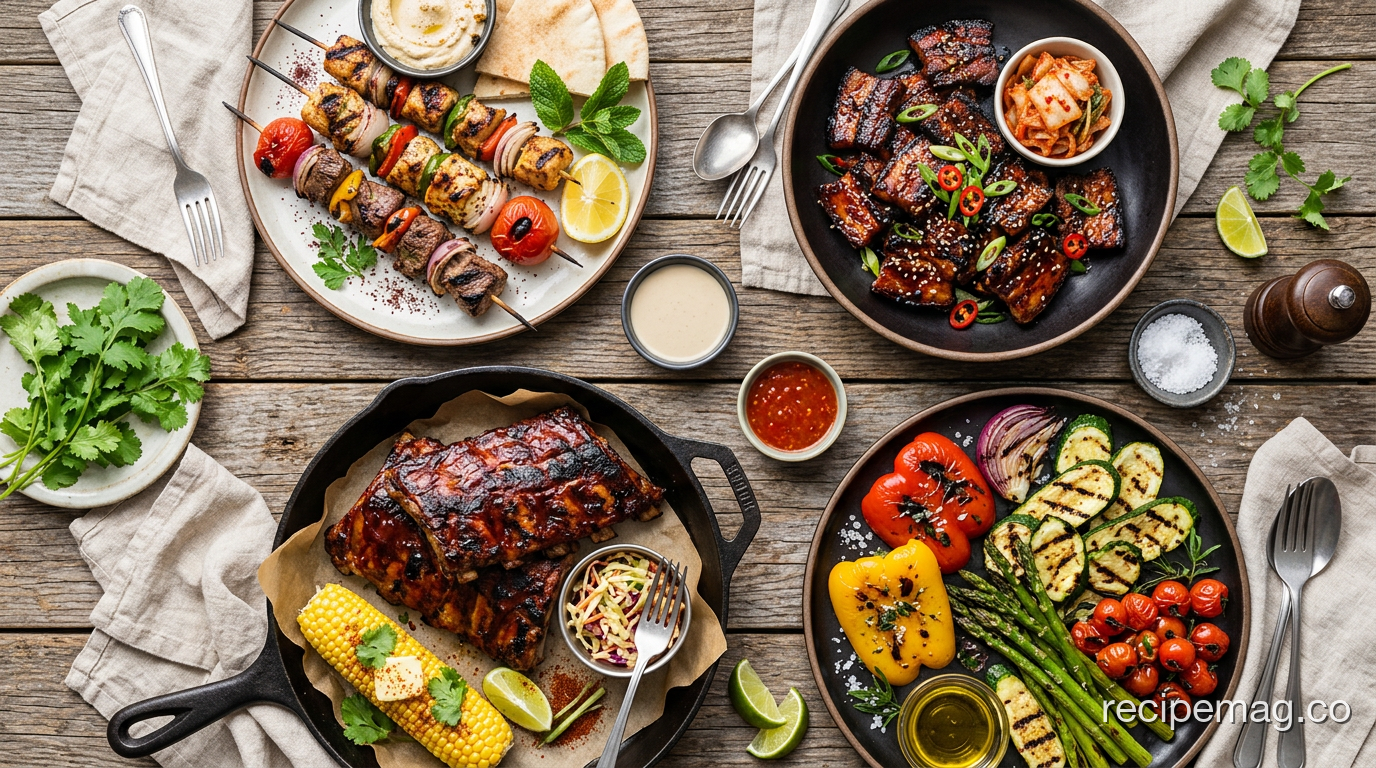
Barbecue isn’t one thing. It’s a family of live-fire cooking traditions that developed independently across six continents, each shaped by local meat, fuel, and climate. Grilling is also genuinely popular: 68% of American households own an outdoor grill or smoker, according to the Hearth, Patio & Barbecue Association (HPBA, 2023). This tour walks through 10 global BBQ styles, what makes each distinct, and how to bring the technique home.
Key Takeaways
- “Barbecue” splits into two camps: low-and-slow smoking (Texas, Carolina) and hot-and-fast grilling (Korean, Argentine, Japanese).
- 68% of U.S. households own a grill or smoker, and grilling is a global tradition, not an American one. ([HPBA](https://www.hpba.org), 2023)
- Wood choice defines regional flavor: post oak in Texas, hickory in the Carolinas, binchotan charcoal in Japan.
- Marinade-forward styles (Korean, Jamaican, Middle Eastern) build flavor before the fire; rub-and-smoke styles build it during.
- Most of these styles are achievable on a standard backyard grill with small technique changes.
What Counts as Barbecue Around the World?
Barbecue means different things depending on where you stand. In the American South it implies low-and-slow smoking over wood; in most of the world it simply means cooking over live fire. The word itself comes from the Taino “barbacoa,” a raised wooden frame recorded by Spanish colonists in the Caribbean in the 1500s (Oxford English Dictionary, 2023). That single word branched into dozens of traditions.
The useful way to sort them is by heat and time. Some styles cook tough cuts for hours at low temperatures to break down collagen. Others sear tender cuts fast over roaring coals. Knowing which camp a style belongs to tells you almost everything about how to cook it.
The 10 styles below span both camps and five continents. Read them as a map, not a ranking.
1. Texas Brisket (United States)
Texas barbecue is a monument to patience: a whole packer brisket smokes for 10 to 16 hours over post oak until the connective tissue melts. Collagen begins converting to gelatin around 160°F and continues through a long cook, which is why low-and-slow works (Serious Eats, 2022). Central Texas tradition keeps the seasoning almost aggressively simple.
What defines it
- Cut: Whole packer brisket (point and flat).
- Rub: Coarse black pepper and kosher salt, roughly equal parts. That’s it.
- Wood: Post oak, prized for steady, clean smoke.
- Technique: Smoke at 225-275°F, wrap in butcher paper past the stall, rest for at least an hour.
The bark, that dark peppery crust, is the signature. Don’t rush the rest. Slicing a brisket straight off the smoker dumps the juice onto your cutting board instead of keeping it in the meat.
2. Carolina Pulled Pork (United States)
The Carolinas built their barbecue identity on pork shoulder and vinegar. A bone-in shoulder smokes for 8 to 12 hours over hickory until it pulls apart with a fork. Eastern North Carolina serves it with a thin, tangy vinegar-and-pepper sauce that cuts the richness of the fatty pork. It’s a study in contrast: heavy meat, sharp sauce.
East versus West
- Eastern NC: Whole hog, thin vinegar-pepper sauce, no tomato.
- Western NC (Lexington): Pork shoulder, vinegar sauce with a touch of ketchup.
- South Carolina: Famous for a mustard-based “Carolina Gold” sauce.
The vinegar isn’t a garnish. It’s the point. The acidity balances the fat and keeps every bite from feeling heavy.
3. Korean Bulgogi and Galbi (South Korea)
Korean barbecue flips the American model: flavor goes in before the fire, and cooking is fast. Thin-sliced beef marinates in soy, sesame oil, garlic, and grated Asian pear, whose enzymes tenderize the meat in under an hour (America’s Test Kitchen, 2022). Then it hits a screaming-hot grill for barely a minute per side.
Two staples to know
- Bulgogi: Thin-sliced marinated beef sirloin or ribeye, sweet and savory.
- Galbi: Marinated short ribs, often butterflied so they cook quickly.
The whole experience is communal. Meat cooks at the table, then goes into a lettuce wrap with rice, ssamjang, and pickled sides. It’s grilling as a group activity.
4. Argentine Asado (Argentina)
Asado is Argentina’s national ritual, and it treats fire as the main ingredient. Meat cooks slowly over hardwood coals or an open wood fire on an angled grill called a parrilla, often for two hours or more. Argentina has one of the highest beef consumption rates in the world at roughly 47 kilograms per person annually (OECD-FAO, 2023). Beef is a national language here.
What lands on the parrilla
- Cuts: Short ribs (asado de tira), flank, sweetbreads, and sausages (chorizo, morcilla).
- Seasoning: Coarse salt, applied simply. Flavor comes from the fire.
- Sauce: Chimichurri, a bright blend of parsley, garlic, oregano, vinegar, and oil.
The asador tends the fire the entire time, moving coals to control heat. There’s no thermostat. Just skill and attention.
5. Jamaican Jerk (Jamaica)
Jerk is defined by its spice paste and its smoke, both intense. Chicken or pork marinates in a fiery blend of Scotch bonnet peppers, allspice (pimento), thyme, and scallion, then cooks slowly over pimento wood. Allspice berries and wood give jerk its unmistakable warm, peppery aroma, a flavor tied specifically to Jamaican pimento (Saveur, 2021). The heat is real.
Building jerk flavor
- Heat: Scotch bonnet peppers, among the hottest common chiles.
- Aromatics: Allspice, thyme, scallion, ginger, garlic.
- Smoke: Traditionally pimento (allspice) wood; hickory or oak substitute at home.
No pimento wood in your backyard? Toss a handful of whole allspice berries onto the coals. It’s an imperfect but genuinely effective stand-in.
6. Japanese Yakitori (Japan)
Yakitori is precision grilling on a stick. Bite-size pieces of chicken, often every part of the bird, thread onto skewers and grill over binchotan, a dense white charcoal that burns clean and extremely hot. Binchotan produces intense radiant heat with almost no smoke or flame, which is why it’s prized for delicate skewers (Serious Eats, 2021). Seasoning stays minimal.
The two finishes
- Tare: A sweet-savory soy-based glaze brushed on during cooking.
- Shio: Simply salt, letting the chicken and char speak.
Yakitori rewards restraint. Small pieces, hot fire, close attention. It’s the opposite of walk-away smoking, and it’s every bit as much a craft.
7. South African Braai (South Africa)
A braai is less a recipe than a social institution: an open-flame wood fire where friends gather for hours. The word means “grill” in Afrikaans, and the fire is almost always wood, not gas or briquettes. South Africa even marks National Braai Day each September, underscoring how central the tradition is to national culture (Britannica, 2023). The cooking is patient and social.
Braai staples
- Boerewors: A coiled, coriander-spiced farmer’s sausage.
- Sosaties: Marinated skewers with roots in Cape Malay cooking.
- Chops and steaks: Cooked directly over wood coals.
The fire comes first. You build it, let it burn down to coals, and only then start cooking. Rushing the coals is the classic beginner mistake.
8. Middle Eastern Kebabs (Levant and Turkey)
Kebab traditions across Turkey, Lebanon, and the wider Levant turn ground and cubed meat into fast, fragrant grilling. Lamb and beef season with cumin, sumac, garlic, and parsley, then cook over charcoal on flat metal skewers. Sumac and cumin are foundational to the region’s grilling profile, lending tang and warmth (Bon Appetit, 2022). Speed and spice define the style.
Common forms
- Kofta/kefta: Spiced ground meat pressed onto skewers.
- Shish kebab: Cubed marinated lamb or beef.
- Shish taouk: Yogurt-marinated chicken skewers.
Yogurt marinades do quiet work here. The acidity and enzymes tenderize while keeping lean chicken juicy over high heat.
9. Brazilian Churrasco (Brazil)
Churrasco is Brazil’s skewer-and-fire tradition, famous worldwide through churrascaria steakhouses. Large cuts of beef, especially picanha (top sirloin cap), thread onto long swords and roast over wood or charcoal, then get sliced tableside. The method leans on coarse salt and rendered fat rather than marinades. It’s beef-forward, generous, and built around the cap of fat that bastes the meat as it cooks.
The star cut
- Picanha: Top sirloin cap with the fat layer left on.
- Seasoning: Coarse rock salt, nothing more.
- Technique: Curved onto skewers, fat side out, roasted then sliced thin.
The fat cap isn’t trimmed. It renders down, self-bastes the meat, and delivers most of the flavor. Cutting it off would defeat the entire method.
10. Australian Barbie (Australia)
Australian barbecue is the most casual style on this list, built around the flat-top grill and easy backyard gatherings. Sausages (“snags”), lamb chops, prawns, and burgers cook over gas or charcoal, often on a flat plate rather than open grates. Grilling is deeply embedded in Australian life, with the barbecue functioning as a default mode of casual entertaining across the country’s long summers. Simplicity is the whole appeal.
What hits the barbie
- Snags: Beef or pork sausages, the unofficial national grill food.
- Lamb: Chops and cutlets, a genuine Australian specialty.
- Seafood: Prawns and fish, cooked fast on the flat plate.
There’s no dogma here. The Australian barbie is about gathering people outdoors with minimal fuss, which is arguably the original point of cooking over fire anyway.
How Do You Bring These Styles Home?
Most of these traditions are achievable on standard backyard equipment with small adjustments. A 2023 HPBA survey found that 64% of grill owners want to experiment with new global flavors and techniques rather than repeat the same recipes (HPBA, 2023). The two variables that matter most are heat management and wood or fuel choice.
For low-and-slow styles like Texas brisket and Carolina pork, set up your grill for indirect heat: coals on one side, meat on the other, lid down, vents controlling temperature. For hot-and-fast styles like Korean, Japanese, and Middle Eastern grilling, do the opposite. Build the hottest fire you can and cook small pieces quickly.
Marinades and rubs are where you’ll get the fastest wins. A jerk paste, a bulgogi marinade, or a cumin-sumac rub transforms familiar cuts without any new hardware. Start there before you invest in a smoker.
Frequently Asked Questions About Global BBQ Styles
What’s the difference between grilling and barbecue?
In American usage, grilling means cooking hot and fast over direct heat, while barbecue means cooking low and slow with wood smoke. Globally, the distinction blurs, and “barbecue” often just means any cooking over live fire. Texas brisket is true barbecue; Korean bulgogi and Japanese yakitori are technically grilling. Both belong to the same broad live-fire family.
Which global BBQ style is easiest for beginners?
Korean bulgogi and Middle Eastern kebabs are the most forgiving for beginners. Both use thin cuts that cook in minutes over direct high heat, so there’s no long temperature management. The marinade does most of the flavor work before the meat ever touches the grill. You get restaurant-level results without a smoker or hours of attention.
Do I need special wood for authentic barbecue flavor?
Wood helps, but substitutions work well. Post oak, hickory, and pimento wood each define a regional flavor, yet you can approximate them. Oak and hickory chunks are widely available, and a handful of whole allspice berries on the coals mimics jerk’s pimento wood. Start with what your local store carries before hunting specialty woods.
Can I cook these styles on a gas grill?
Yes, most of them. Hot-and-fast styles like Korean, Japanese, Brazilian, and Middle Eastern grilling suit gas grills perfectly. For smoke-driven styles like Texas or Carolina barbecue, add a smoker box with wood chips and set up indirect heat by lighting only one side. It won’t fully match a wood smoker, but it gets you convincingly close.
What’s the best all-purpose meat for trying global styles?
Chicken thighs and pork shoulder are the most versatile starting points. Thighs stay juicy under high heat and take jerk, yakitori, and shish taouk seasonings beautifully. Pork shoulder handles both low-and-slow Carolina smoking and Korean-style marinades. Both cuts are affordable and forgiving, which makes them ideal for experimenting across several traditions.
Pick a Style and Light the Fire This Weekend
Ten traditions, five continents, one shared idea: fire makes food better. You don’t need to master all of them. Pick the one that sounds best, whether that’s a patient Texas brisket or a fast plate of Korean galbi, and start there.
The beauty of a global approach is variety. Rotate through a few styles across a summer and your backyard grill stops being a one-note machine. Marinate on Monday, smoke on Saturday, sear on Sunday.
Fire, salt, smoke, and time. Every culture on this list figured out its own version of that equation. This summer, borrow a few of them.
