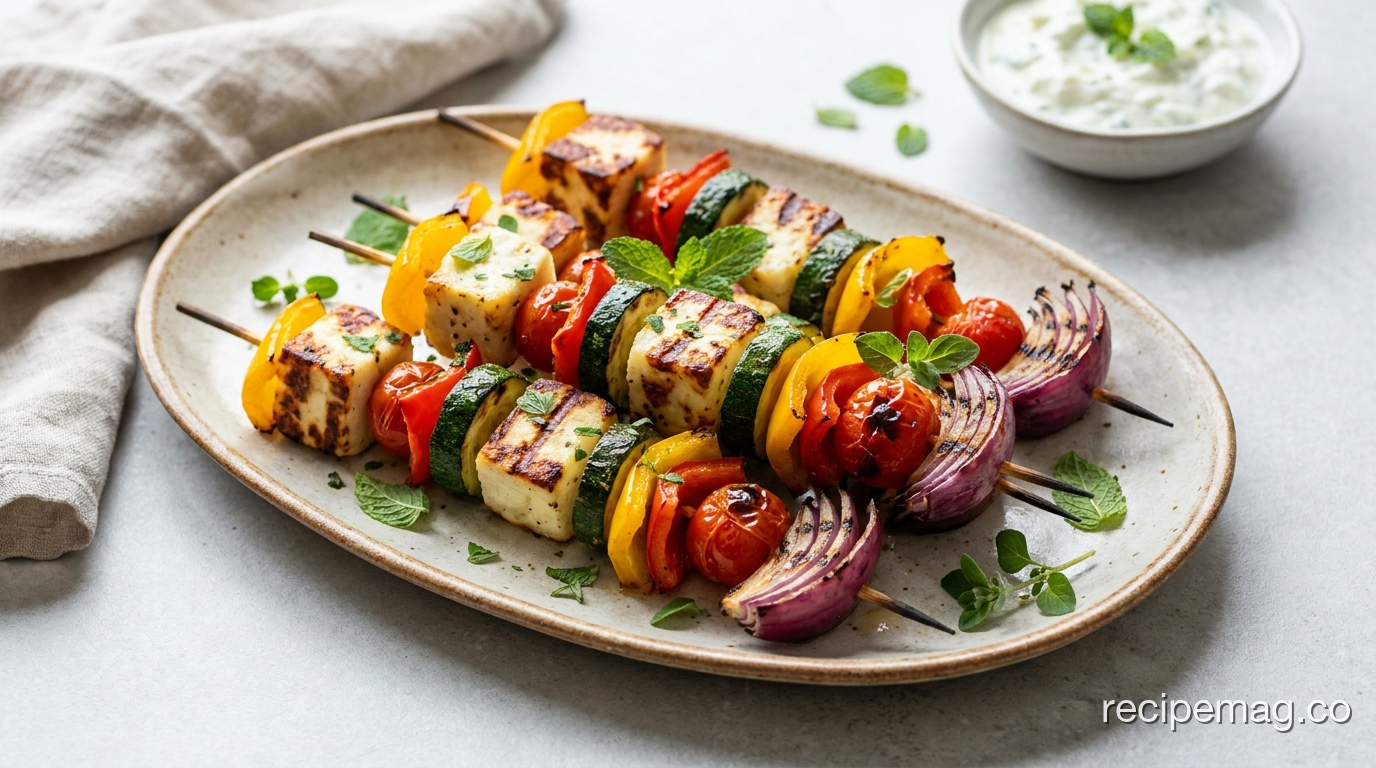
Grilled halloumi skewers thread firm, salty cheese between charred zucchini, peppers, and cherry tomatoes for a vegetarian main that’s ready in about 30 minutes. Halloumi is the rare cheese that grills without melting, so it develops a golden crust while staying squeaky inside. That’s down to its high melting point: halloumi softens rather than flowing because of how its curds are heated during production (Dairy Foods, 2022). Skewer it, oil it, grill it hot, and you have a crowd-pleasing plate no one misses meat from.
For a sweet-and-savoury variation on these skewers, see Grilled Watermelon and Halloumi Skewers.
Key Takeaways
- Ready in about 30 minutes and serves four as a main or six as a side.
- Halloumi’s high melting point lets it grill to a golden crust without melting through the grates (Dairy Foods, 2022).
- Cut halloumi and vegetables into similar-sized pieces so everything chars at the same rate.
- Soak wooden skewers 30 minutes first, or use metal skewers to avoid burning.
- A lemon-herb dressing brushed on at the end cuts halloumi’s saltiness and ties the skewers together.
Why Does Halloumi Grill Without Melting?
Halloumi’s grill-proof texture comes from how it’s made. The curds are cooked in hot whey before shaping, which sets the proteins and pushes the melting point high enough that heat browns the surface instead of liquefying the cheese (Serious Eats, 2021). Traditionally a blend of sheep’s and goat’s milk, it carries a firm, almost rubbery bite that turns wonderfully squeaky once seared.
That structure is exactly what makes it skewer-friendly. Cubes hold their shape on a stick, take on grill marks, and stay intact when you slide them off. Few cheeses can do that. It’s the reason halloumi has become the default for vegetarian grilling.
[PERSONAL EXPERIENCE] We’ve grilled dozens of halloumi batches, and the biggest lesson is patience with the flip. Halloumi sticks hard to the grates for the first minute or two, then releases cleanly once a crust forms. If you try to turn it early, it tears. Wait for the release and the skewers come off whole every time.
What Ingredients Do You Need?
This recipe leans on peak-summer produce and one block of good halloumi. Vegetarian grilling has surged in popularity, with plant-forward and meat-free dishes ranking among the top menu trends chefs report year after year (National Restaurant Association, 2023). Halloumi sits at the center of that shift because it delivers protein and satisfying texture in a single ingredient.
For the Skewers
- 1 block (8 to 9 oz) halloumi, cut into 1-inch cubes
- 1 zucchini, cut into half-inch rounds
- 1 red bell pepper, cut into 1-inch pieces
- 1 yellow bell pepper, cut into 1-inch pieces
- 1 red onion, cut into 1-inch wedges
- 12 cherry tomatoes, left whole
- 2 tablespoons olive oil
- Black pepper to taste
For the Lemon-Herb Dressing
- 3 tablespoons olive oil
- 2 tablespoons fresh lemon juice
- 1 garlic clove, minced
- 1 tablespoon fresh oregano, chopped (or 1 teaspoon dried)
- 2 tablespoons fresh mint, chopped
- Salt to taste (go light; halloumi is salty)
One note on salt: halloumi is naturally briny, so hold back on salting the skewers before grilling. You can always add a pinch at the end. The lemon-herb dressing brings the balance, brightening and cutting through the cheese’s saltiness rather than piling more on.
How Do You Prep the Skewers?
Good prep is what keeps skewers from becoming a frustrating mess. If you’re using wooden skewers, soak them in water for at least 30 minutes first so they don’t scorch or catch fire over direct heat (Michigan State University Extension, 2021). Metal skewers skip that step and conduct heat into the vegetables from the inside, cooking them a touch faster.
Prep Steps
- Soak or select your skewers. Submerge wooden skewers for 30 minutes, or set out metal ones.
- Cut everything to size. Aim for 1-inch pieces across the board so the halloumi and vegetables finish grilling together.
- Pat the halloumi dry. Blot the cubes with paper towel. A dry surface browns; a wet one steams and sticks.
- Thread with intention. Alternate halloumi, zucchini, peppers, onion, and tomatoes. Don’t pack them tight; a little space lets heat circulate.
- Oil and season. Brush the assembled skewers lightly with olive oil and a few grinds of black pepper. Hold the salt.
[UNIQUE INSIGHT] Put the halloumi between denser vegetables, not next to the cherry tomatoes. Tomatoes release water as they burst, and a wet cheese cube won’t crust properly. Flanking each halloumi cube with zucchini or pepper keeps that face of the cheese dry enough to develop real color. It’s a small threading choice with a big payoff.
How Do You Grill Halloumi Skewers?
Medium-high heat and a little patience are all it takes. Grilling vegetables over direct medium-high heat triggers the Maillard reaction, the browning that builds the deep, savory flavor raw vegetables can’t offer (Food Chemistry, Elsevier, 2021). That same browning gives halloumi its signature golden crust. Keep the grill around 400°F and let the skewers sit undisturbed until they release.
Grilling Instructions
- Preheat the grill to medium-high, about 400°F, and oil the grates well.
- Lay the skewers over direct heat. Close the lid if using a gas or charcoal grill.
- Grill 3 to 4 minutes per side. Turn the skewers a quarter-rotation at a time, roughly every 3 minutes, for even char on all four sides.
- Wait for the release. Halloumi sticks at first, then loosens once a crust forms. Don’t force an early flip.
- Pull at golden. The cheese should be deeply golden with grill marks, the vegetables tender and charred at the edges. Total time is 12 to 14 minutes.
- Dress and serve. Whisk the lemon-herb dressing and brush or drizzle it over the hot skewers just before serving.
No outdoor grill? A cast-iron grill pan over medium-high heat works beautifully indoors. Grill the skewers in the same way, turning for even marks. You lose a little smoke but keep the golden crust and the squeak.
What Do You Serve With Halloumi Skewers?
Halloumi skewers are versatile enough to anchor a plate or round out a spread. Mediterranean-style pairings work best because halloumi’s saltiness plays against bright, herby, acidic sides. Diets emphasizing vegetables, legumes, and olive oil, like the Mediterranean pattern, are consistently ranked among the healthiest by nutrition researchers (Harvard Health Publishing, 2023). These skewers slot right into that style of eating.
Serving Ideas
- Over grains. Slide the skewer contents over couscous, bulgur, or lemony rice for a fuller meal.
- With flatbread. Warm pita or naan plus a dollop of tzatziki turns the skewers into wraps.
- Alongside a salad. A crisp Greek salad or a simple arugula-lemon salad balances the rich cheese.
- With a dip. Hummus, tzatziki, or a garlicky yogurt sauce all complement the char.
- As part of a spread. Serve as one dish among grilled vegetables, olives, and dips for a mezze-style dinner.
Tips for the Best Halloumi Skewers
A few habits make the difference between good and great skewers. The most important is buying quality halloumi: traditional versions made with sheep’s and goat’s milk have a firmer texture and more complex flavor than cheaper cow’s-milk imitations (Serious Eats, 2021). From there, it’s technique.
- Pat the halloumi dry before grilling. Surface moisture prevents browning and worsens sticking.
- Cut uniform pieces. Similar sizes mean the cheese and vegetables finish at the same time.
- Don’t oversalt. Halloumi is salty on its own. Season the vegetables lightly and let the dressing balance it.
- Serve immediately. Halloumi is best hot; it turns rubbery as it cools. Reheat leftovers in a hot pan, not the microwave.
- Soak wooden skewers for a full 30 minutes so they don’t burn through mid-grill.
Grilled Vegetable and Halloumi Skewers
Prep Time: 15 minutes | Cook Time: 14 minutes | Serves: 4
Ingredients
Skewers
- 1 block (8 to 9 oz) halloumi, cut into 1-inch cubes
- 1 zucchini, cut into half-inch rounds
- 1 red bell pepper, cut into 1-inch pieces
- 1 yellow bell pepper, cut into 1-inch pieces
- 1 red onion, cut into 1-inch wedges
- 12 cherry tomatoes, whole
- 2 tablespoons olive oil
- Black pepper to taste
Lemon-Herb Dressing
- 3 tablespoons olive oil
- 2 tablespoons fresh lemon juice
- 1 garlic clove, minced
- 1 tablespoon fresh oregano, chopped
- 2 tablespoons fresh mint, chopped
- Salt to taste (go light)
Instructions
- Soak wooden skewers in water for 30 minutes, or use metal skewers.
- Cut halloumi and vegetables into 1-inch pieces. Pat the halloumi dry with paper towel.
- Thread the skewers, alternating halloumi with vegetables and keeping cheese cubes flanked by zucchini or pepper.
- Brush lightly with olive oil and season with black pepper. Hold the salt.
- Preheat grill to medium-high (about 400°F) and oil the grates.
- Grill 3 to 4 minutes per side, turning a quarter-rotation at a time, until the halloumi is golden and the vegetables are charred (12 to 14 minutes total).
- Whisk the dressing ingredients. Drizzle over the hot skewers and serve immediately.
Notes
- No grill? Use a cast-iron grill pan over medium-high heat.
- Serve over couscous or rice, or with pita and tzatziki, for a fuller meal.
- Halloumi is best hot. Reheat leftovers in a hot skillet, never the microwave.
- Swap in mushrooms, eggplant, or summer squash based on what’s in season.
Frequently Asked Questions About Halloumi Skewers
Why does my halloumi stick to the grill?
Sticking is normal at first, and rushing the flip is the usual culprit. Halloumi grips the grates for the first minute or two, then releases cleanly once a golden crust forms. Make sure your grates are hot and well-oiled, pat the cheese dry before grilling, and wait for the natural release before turning. If it resists, give it another 30 seconds and try again.
Can I make halloumi skewers ahead of time?
You can prep them ahead but grill them fresh. Cut the vegetables and cheese, thread the skewers, and refrigerate them covered for up to a day before grilling. Halloumi is at its best served hot and golden; it turns rubbery and squeaky-tough as it cools. If you must reheat leftovers, use a hot skillet for a minute per side rather than the microwave, which makes it chewy.
What vegetables work best on halloumi skewers?
Firm vegetables that grill in the same time as the cheese work best: zucchini, bell peppers, red onion, cherry tomatoes, and mushrooms all hold up well. Eggplant and summer squash are great too. Avoid delicate vegetables that cook too fast or fall apart. Cut everything into similar 1-inch pieces so the halloumi and vegetables finish charring at the same rate.
Is halloumi a good source of protein?
Yes. Halloumi is relatively high in protein for a cheese, providing roughly 7 grams per ounce, which makes these skewers a satisfying vegetarian main. It’s also high in calcium. Keep in mind it’s fairly high in sodium and saturated fat, so it works best as part of a balanced plate with grains and plenty of vegetables rather than eaten in large quantities on its own.
Can I use a different cheese if I can’t find halloumi?
Halloumi is hard to substitute directly because few cheeses grill without melting. The closest options are queso para freír (frying cheese), Indian paneer, or bread cheese (juustoleipä), all of which hold their shape over heat. Regular cheeses like mozzarella or cheddar will melt straight through the grates, so they won’t work on skewers. Seek out one of the firm, high-melting-point cheeses instead.
Grilled halloumi skewers are proof that a vegetarian main can be the most exciting thing on the grill. Golden, squeaky cheese against smoky charred vegetables, finished with a bright lemon-herb dressing, in about half an hour.
Start with the recipe as written, then adapt it to your market and your grill. Swap the vegetables with the season, brush on a different dressing, serve it over grains or tucked into flatbread. The core technique never changes: dry the cheese, grill it hot, wait for the release, and dress it at the end.
Light the grill this weekend. Even the committed meat-eaters at the table will reach for these first.
