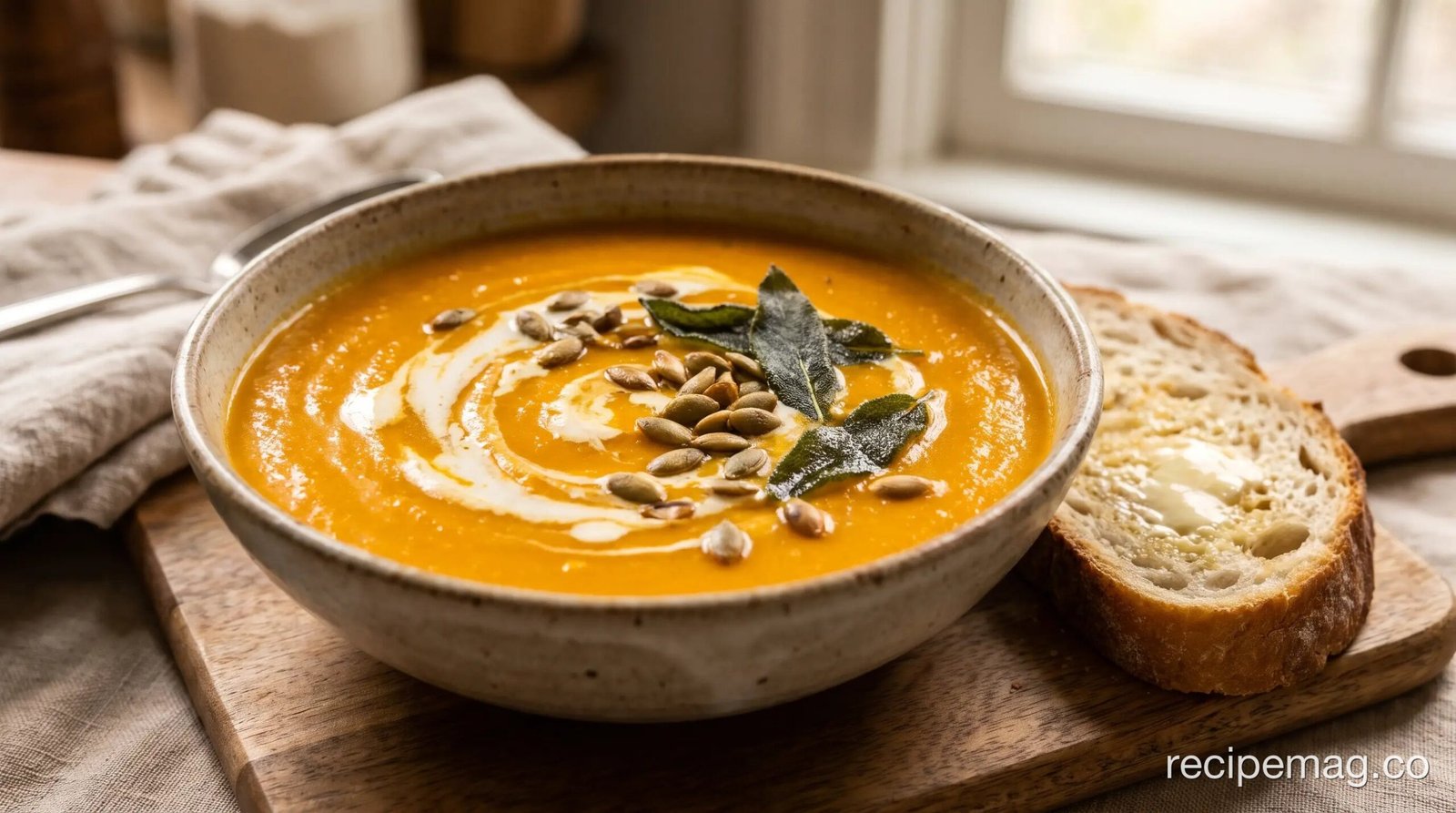
Roasted butternut squash soup tastes best when the squash spends its time in the oven, not the pot. Cubes roasted at 425°F until their edges brown give the soup a deeper, sweeter flavor than simmered squash ever can, and the whole recipe takes about 1 hour 15 minutes. It’s light, too: a cup of baked butternut squash has about 80 calories, according to USDA FoodData Central (2025).
Key Takeaways
- Roast the squash in cubes at 425°F. The browned edges carry the flavor.
- A tart apple and a teaspoon of cider vinegar keep the soup from tasting flat.
- A cup of baked butternut squash has about 80 calories, per USDA FoodData Central.
- Serves 8 as a starter and reheats on one burner, leaving the oven to the turkey.
- Make it up to 3 days ahead, or freeze it before adding the cream.
On Thanksgiving, this soup solves a real problem: it’s a warm starter you make days ahead and reheat on one burner. Made with vegetable broth, it also fits our vegetarian Thanksgiving menu.
Why Roast the Squash for Soup?
Roasting does two things a pot of simmering broth can’t. It drives off water, which concentrates flavor, and it browns the outside of every cube. Blend those browned edges into the soup and it tastes rich with just half a cup of cream. So why simmer it pale?
Cube the squash instead of roasting it in halves. Halves steam under their own skins and barely brown, while cubes give you dozens of edges.
Most squash soups taste flat because they’re all sweetness and no contrast. We fix that twice: a tart apple roasts with the squash, and a teaspoon of cider vinegar goes in at the end. Neither makes the soup taste like apple or vinegar. They wake up the squash the way lemon wakes up a stew.
Ingredients
Serves 8 as a starter (about 1 cup each) or 6 as a main. Prep time: 20 minutes. Cook time: 55 minutes. Total time: about 1 hour 15 minutes.
For the Soup
- 1 large butternut squash (about 3 pounds), peeled, seeded and cut into 1-inch cubes (7 to 8 cups), or 2½ pounds pre-cut squash
- 1 large yellow onion, cut into 8 wedges
- 1 medium tart apple, such as Granny Smith or Braeburn, peeled, cored and quartered
- 4 garlic cloves, unpeeled
- 3 tablespoons olive oil
- 1½ teaspoons kosher salt, divided, plus a pinch
- ½ teaspoon freshly ground black pepper
- 3 tablespoons unsalted butter
- 16 fresh sage leaves, divided
- ¼ teaspoon ground nutmeg
- Pinch of cayenne pepper
- 4 cups low-sodium chicken or vegetable broth, plus up to 1 cup more to thin
- ½ cup heavy cream, plus 2 tablespoons for serving
- 1 tablespoon pure maple syrup (optional)
- 1 to 2 teaspoons apple cider vinegar
For Serving
- ⅓ cup raw pepitas (hulled pumpkin seeds)
- Crusty bread
Equipment: two rimmed baking sheets, parchment paper, a large Dutch oven and an immersion or countertop blender.
How to Make Roasted Butternut Squash Soup
- Heat the oven. Set racks in the upper and lower thirds and heat to 425°F. Line two rimmed baking sheets with parchment.
- Season the vegetables. Toss the squash, onion, apple and garlic with the olive oil, 1 teaspoon salt and the pepper. Spread them in a single layer across both pans.
- Roast. Roast 35 to 40 minutes, stirring and swapping the pans halfway, until the squash is tender and browned at the edges. Squeeze the garlic from its skins.
- Toast the pepitas. While the vegetables roast, toast the pepitas in a dry Dutch oven over medium heat, stirring, 3 to 4 minutes, until they puff and pop. Toss with a pinch of salt and move to a plate.
- Fry the sage. Melt the butter in the same pot over medium heat and cook, swirling, 2 to 3 minutes, until it foams and smells nutty. Add 12 whole sage leaves and fry about 30 seconds, until crisp. Lift them onto a paper towel.
- Bloom the spices. Finely chop the remaining 4 sage leaves and stir them into the butter with the nutmeg and cayenne for 30 seconds.
- Simmer. Add the roasted vegetables, garlic and 4 cups broth. Bring to a simmer, scraping the bottom of the pot, and cook 10 minutes.
- Blend. Purée with an immersion blender until completely smooth, 1 to 2 minutes, or blend in batches in a countertop blender filled no more than halfway, with the center cap removed and a towel over the opening.
- Finish. Return the soup to low heat. Stir in ½ cup cream, the maple syrup (if using), ½ teaspoon salt and 1 teaspoon vinegar. Taste, then add more vinegar or salt as needed, and thin with extra broth if it’s too thick.
- Serve. Ladle into bowls, drizzle with the remaining 2 tablespoons cream and top with the pepitas and crispy sage. Serve with crusty bread.
Tips for the Silkiest Butternut Squash Soup
How to Peel a Butternut Squash
Trim both ends, then cut the squash where the neck meets the round bulb so each piece sits flat. Peel with a sharp Y-shaped peeler down to the bright orange flesh, then halve the bulb and scoop out the seeds. At the store, pick a squash with a long, thick neck: it’s solid flesh with no seeds.
Texture and Flavor Tips
- Give the cubes room. Crowded pans steam instead of browning, so use both pans.
- Blend longer than you think. An extra minute takes the soup from smooth to silky.
- Season after blending. Taste for salt and vinegar once the soup is smooth, not before.
- Thin it gradually. Add broth ¼ cup at a time, since the soup thickens as it sits.
- Make it dairy-free. Fry the sage in olive oil and swap full-fat coconut milk for the cream.
Can You Make Butternut Squash Soup Ahead?
Yes, and it tastes even better the next day. Refrigerated, it keeps 3 to 4 days, the window USDA FSIS gives for cooked leftovers (USDA FSIS, 2025), so a Monday batch is fine on Thursday. For longer storage, FoodSafety.gov suggests 2 to 3 months in the freezer for best quality (FoodSafety.gov, 2025).
- Cool it fast. Divide the soup among shallow containers. FSIS says hot food can go straight into the fridge.
- Freeze it before the cream. Dairy can turn grainy after thawing, so add the cream as you reheat.
- Reheat on the stove. Bring it to a boil, stirring often, as FSIS advises for soups.
- Make the toppings separately. Pepitas keep a week airtight; fry the sage on the day.
On Thanksgiving, we pass this around in small mugs as guests arrive. Half a cup takes the edge off hunger without spoiling dinner. Add it to Monday or Tuesday in our Thanksgiving make-ahead guide, then reheat it when the appetizers go out in our Thanksgiving Day timeline and keep it hot over low heat.
Frequently Asked Questions About Butternut Squash Soup
Do I have to peel butternut squash for soup?
For this recipe, yes, because peeled cubes brown best. To skip peeling, halve the squash, scoop out the seeds, brush the cut sides with oil and roast them face down at 425°F for 45 to 55 minutes, until very soft. Scoop out the flesh and carry on. You’ll lose some browning, but the soup still works.
Can I use frozen butternut squash?
Yes. Spread about 2½ pounds of frozen cubes on the lined pans without thawing, toss them with the oil and seasonings, and roast at 425°F. Frozen squash releases more water, so plan on 45 to 50 minutes and expect less browning. Fresh pre-cut squash from the produce section browns better and still saves the peeling.
Is butternut squash soup healthy?
It’s one of the lighter starters on a holiday table. USDA FoodData Central lists about 80 calories in a cup of baked butternut squash, along with more than a full day’s vitamin A. The half cup of cream here works out to about a tablespoon per serving. For a lighter bowl, use whole milk instead.
Why is my squash soup stringy or grainy?
Usually it’s under-blended. Keep the blender going another minute or two, adding a splash of broth if the soup is too thick to move. Squash that wasn’t roasted until fully tender can also leave fibers behind. For the smoothest result, press the soup through a fine-mesh strainer before adding the cream.
Roast a Pan of Squash This Weekend
This soup asks for about an hour and pays you back with a starter that’s done before Thanksgiving week gets busy. Roast the squash until it’s properly browned, and don’t skip that last teaspoon of vinegar.
On a weeknight, a loaf of no-knead Dutch oven bread is all it needs. On the holiday, follow it with our stuffed acorn squash with wild rice and cranberries for a vegetarian main, or with the turkey.
