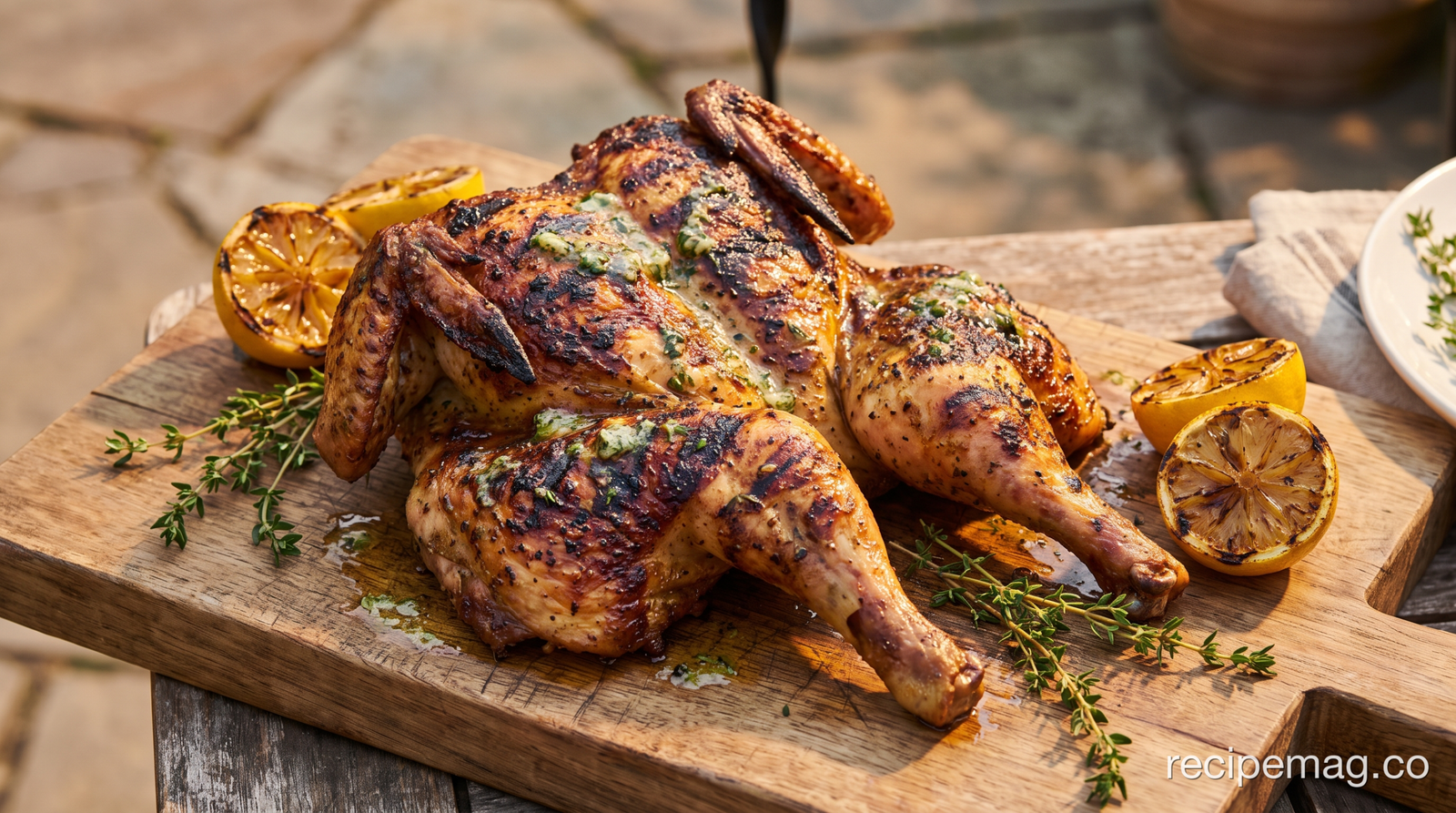
A whole chicken on the grill usually fails for one reason: it is not a flat object, so the thighs are underdone when the breast is dry. Spatchcocking fixes the geometry. Remove the backbone, press the bird flat, and every part sits the same distance from the fire, which cuts grilling time from roughly 75 minutes to about 45 and gives you crisp skin across the whole surface. Chicken is done at an internal temperature of 165°F (USDA FSIS, 2023).
Key Takeaways
- Spatchcocking means removing the backbone and flattening the bird so it cooks evenly.
- Grilling time drops to about 45 minutes for a 4-lb chicken, versus 75 or more whole.
- Two-zone heat is essential: indirect first, then a short sear over direct heat.
- Dry-brine uncovered in the fridge overnight for the crispest skin.
- Pull at 165°F in the thickest part of the thigh (USDA FSIS, 2023).
Ingredients
Serves 4. Active time 25 minutes. Total time 1 hour, plus overnight dry-brine.
For the chicken:
- 1 whole chicken, 3.5 to 4.5 lbs
- 1 tbsp kosher salt
- 1 tsp black pepper
- 1 tsp smoked paprika
- 1 tbsp olive oil
For the herb butter:
- 6 tbsp unsalted butter, softened
- 4 garlic cloves, finely minced
- 2 tbsp finely chopped parsley
- 1 tbsp chopped fresh thyme leaves
- 1 tbsp chopped fresh rosemary
- Zest of 1 lemon, plus 1 tbsp juice
- 1/2 tsp kosher salt
How to Spatchcock a Chicken
1. Remove the backbone. Place the chicken breast side down on a cutting board. Using sturdy kitchen shears, cut up along one side of the backbone from tail to neck, then repeat on the other side. Lift the backbone out. Save it for stock; it is the best part of the bird for that purpose.
2. Flatten it. Turn the chicken breast side up and press down hard on the breastbone with the heel of your hand. You will hear a crack as the keel bone gives way. That crack is the whole point, and the bird should now lie genuinely flat.
3. Dry-brine. Pat the skin completely dry. Mix the salt, pepper, and smoked paprika, then season the bird all over, including underneath. Set it on a rack over a sheet pan and refrigerate uncovered for at least 4 hours and ideally overnight. The uncovered rest dries the skin, which is what makes it crisp rather than leathery.
4. Make the herb butter. Mash the softened butter with the garlic, herbs, lemon zest, lemon juice, and salt. Reserve about a third for finishing and work the rest under the skin of the breast and thighs, sliding your fingers in gently to loosen it first without tearing.
Grilling It
1. Build two zones. On charcoal, bank all the coals to one side. On gas, light half the burners and leave the rest off. Target about 400°F on the indirect side with the lid closed. Two-zone setup is not optional here, because a whole bird over direct heat will burn long before the thighs cook through.
2. Start indirect. Rub the outside of the skin with the olive oil. Lay the chicken skin side up on the cool side, close the lid, and cook for about 35 minutes. Resist opening it. Every peek costs you heat and time.
3. Check temperature. At 35 minutes, probe the thickest part of the thigh. You are looking for about 150°F at this stage. If it is well below, give it another 10 minutes closed.
4. Sear skin side down. Move the bird skin side down over direct heat for 5 to 8 minutes, watching constantly. The rendered fat will flare, so keep the lid off and slide the bird away from any flame that catches. You want deep golden brown, not black.
5. Finish and rest. Pull the chicken when the thigh reads 165°F and the breast reads about 160°F (USDA FSIS, 2023). Move it to a board, brush with the reserved herb butter, and rest 10 minutes before carving. The butter melts into the skin during the rest, which is exactly what you want.
Why the Method Works
Three things are doing the heavy lifting here, and understanding them makes the recipe repeatable with any bird.
The flat shape equalizes distance from the heat. In a whole roasted chicken, the thigh sits deep inside the cavity’s shadow while the breast is fully exposed, which is why the breast overcooks by 15 degrees before the thigh is safe. Flattened, both sit in the same plane.
The dry-brine does two jobs. Salt draws moisture to the surface, then that brine is reabsorbed, seasoning the meat throughout rather than just the exterior. Meanwhile the uncovered refrigeration dehydrates the skin, and dry skin crisps while wet skin steams.
The order of heat matters. Cooking indirect first brings the interior up gently without scorching, and the short direct sear at the end crisps skin that is already rendered. Reverse that order and you get burnt skin over raw thighs, which is the standard whole-chicken-on-the-grill disaster.
The same two-zone logic underpins most whole-cut grilling. If you want the fundamentals, our backyard grilling guide for beginners covers zone setup in more depth.
Variations and What to Serve With It
The herb butter is a template. Swap in harissa and cumin for a North African direction, gochujang and sesame for Korean, or a paste of anchovy, garlic, and lemon for something aggressively savory. Our eight global marinades for grilled chicken all work on a spatchcocked bird with no adjustment beyond timing.
It can also go in the oven. Roast at 450°F on a rack over a sheet pan for 40 to 45 minutes, same target temperatures. That is the better move if the weather turns.
For sides, keep them simple, since the bird is the event. Grilled corn on the cob and a sharp cucumber tomato salad cover it. If this is your Labor Day centerpiece, the overnight dry-brine slots into the day-before column of our Labor Day cookout timeline, and make-ahead baked beans round out the plate.
Carving and Timing for a Crowd
A spatchcocked bird carves faster than a whole one, which is part of why it works for guests. Everything is already flat and accessible, and there is no cavity to navigate.
Work in this order. Cut down between the leg and the breast on each side and pull the leg away; the hip joint is already partly open from the flattening, so it separates with almost no force. Separate the thigh from the drumstick at the joint. Then run your knife along one side of the breastbone and lift each breast off in one piece, and slice it crosswise into thick pieces. Crosswise slicing keeps each portion covered in skin, which is the part people actually want.
For larger groups, two smaller birds beat one large one. Two 3.5-lb chickens cook in the same 45 minutes as one, fit side by side on most grills, and give you twice as much skin per pound of meat. A single 6-lb bird takes over an hour and cooks less evenly.
Timing-wise, this is a forgiving centerpiece. It holds well for 20 to 30 minutes loosely tented on a board, and the rest actually improves it. That makes it easier to schedule than steak, which demands to be eaten immediately, and it is why it slots cleanly into a cookout plan where other things need the grill afterward.
Choosing the Bird and the Equipment
Size matters more than brand here. A 3.5 to 4.5 lb chicken is the sweet spot, because it flattens to an even thickness and fits comfortably on the indirect side of a standard grill. Anything over 5 lbs starts to develop the same uneven-cooking problem spatchcocking was meant to solve, and a bird that large is better roasted.
Air-chilled chicken is worth paying for if your market carries it. Conventional water-chilled birds absorb water during processing, and that moisture works directly against the crisp skin you are trying to build. If air-chilled is not an option, the overnight uncovered dry-brine compensates for most of the difference.
For equipment, sturdy kitchen shears are the only genuinely necessary purchase. Poultry shears are ideal, but any heavy-duty kitchen shears will cut through rib bones. A flimsy pair will fight you and slip, which is the actual safety risk in this recipe.
The second essential is an instant-read thermometer. Grilling a whole bird by time alone is guesswork, because grill temperature swings with wind, lid position, and fuel. A thermometer converts the whole thing from a gamble into a process, and it is the difference between this working every time and working occasionally.
Frequently Asked Questions
What does spatchcock mean?
It means removing a bird’s backbone and pressing it flat before cooking, also called butterflying. The flattened shape cooks faster and far more evenly than a whole bird.
Do I need kitchen shears, or can I use a knife?
Shears are much easier and safer, since you are cutting through rib bones. A heavy chef’s knife works if you are confident, but a boning knife is too flexible for the job.
How long does a spatchcock chicken take on the grill?
About 45 minutes total for a 4-lb bird at 400°F: roughly 35 minutes indirect plus a 5-to-8-minute direct sear. Larger birds add about 10 minutes per extra pound.
Can I skip the overnight dry-brine?
Yes, but the skin will be noticeably less crisp. Even four hours uncovered in the fridge makes a clear difference. If you have no time at all, at least pat the skin bone dry before it hits the grill.
What internal temperature should chicken reach?
165°F in the thickest part of the thigh, measured without touching bone. Pulling the breast around 160°F and letting carryover finish it keeps it juicier.
What should I do with the backbone?
Freeze it for stock. Backbones are dense with connective tissue and make a richer, more gelatinous stock than almost any other part of the chicken.
