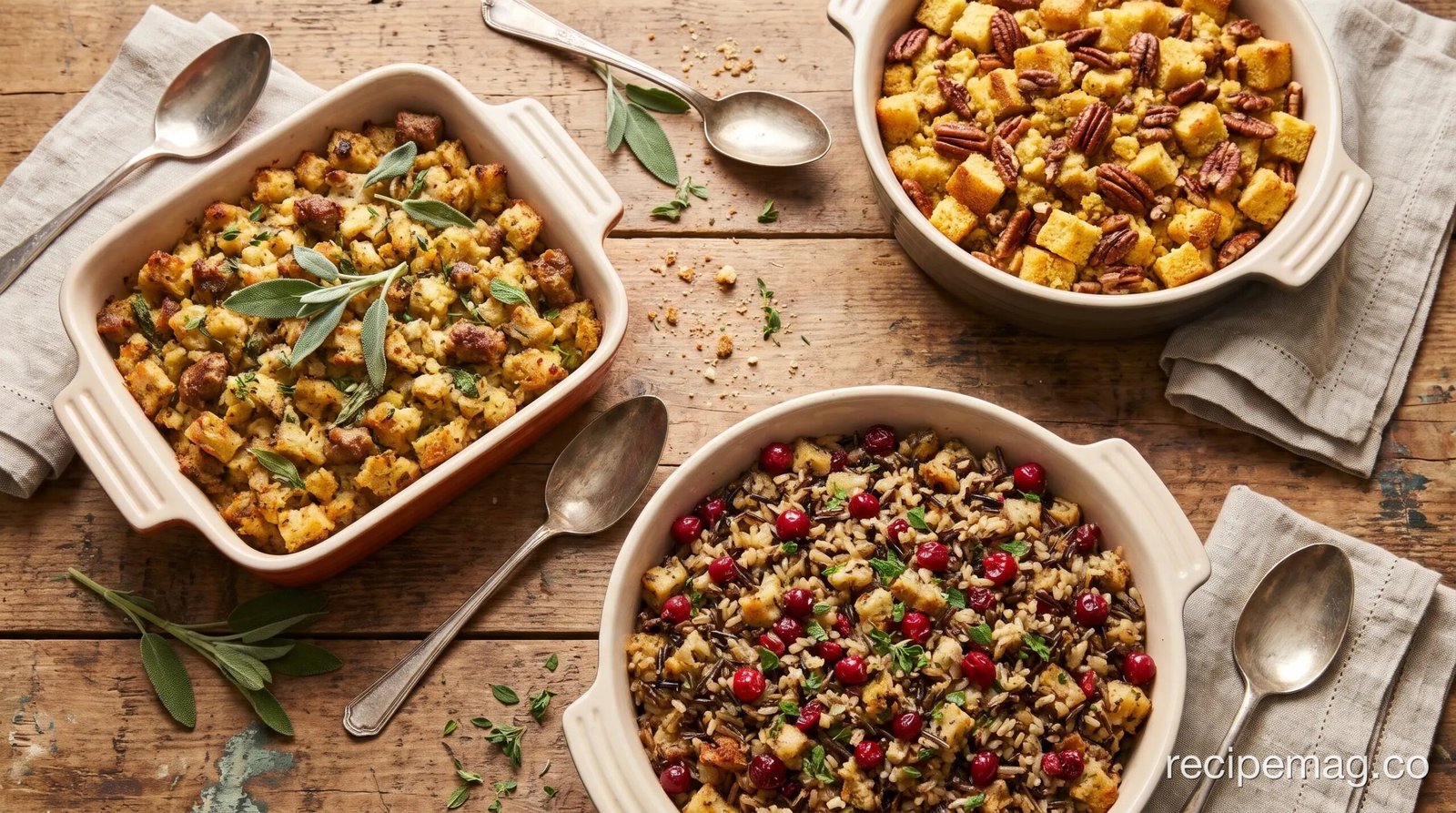
Stuffing and dressing are the same mix of bread, aromatics, butter and stock. Stuffing cooks inside the turkey, dressing bakes in a pan, and most families simply use the word they grew up with. Either way, the USDA Food Safety and Inspection Service says the center must reach 165°F, and it recommends cooking the mixture outside the bird for the safest, most even result (USDA FSIS, 2025). Here are 10 Thanksgiving stuffing ideas, each with a make-ahead note to keep Thursday, November 26, on schedule.
Key Takeaways
- Stuffing cooks inside the bird; dressing bakes in a dish. The recipe can be identical.
- Either way, the center must reach 165°F (FoodSafety.gov, 2025).
- Dry the bread first so it soaks up stock without turning to paste.
- An unstuffed turkey roasts faster, so baking stuffing separately frees up oven time.
- Prep the components days ahead and add the eggs and stock on the day.
What’s the Difference Between Stuffing and Dressing?
The difference is where it cooks. Stuffing goes inside the turkey, dressing goes into a baking dish, and the ingredient list can be exactly the same. Food safety rules treat them alike, too: FoodSafety.gov lists 165°F as the safe minimum for stuffing, whether it’s cooked in the bird or on its own (FoodSafety.gov, 2025).
In everyday speech, the words follow geography more than technique. Across much of the South it’s dressing, often made with cornbread. In New England and the Midwest, stuffing is the usual word and white bread is the usual base. Pennsylvania Dutch cooks call theirs filling. What does your family call it?
| Stuffing | Dressing | |
|---|---|---|
| Where it cooks | Inside the turkey | In a baking dish or skillet |
| Texture | Soft and moist throughout | Crisp top and edges, tender center |
| Done when | Center of the stuffing reads 165°F | Center of the dish reads 165°F |
| Effect on the turkey | Adds roasting time | None |
Should You Cook Stuffing Inside the Turkey?
You can, but it takes more care. FSIS says to stuff the bird loosely, about 3/4 cup per pound, right before it goes into the oven, then check that the center of the stuffing reaches 165°F (USDA FSIS, 2025). Its timetable puts a 12- to 14-pound turkey at 3 to 3 3/4 hours unstuffed at 325°F, and 3 1/2 to 4 hours stuffed.
If you do stuff the bird
- Prep wet and dry separately. Chill the cooked vegetables and stock apart from the bread, and combine them just before stuffing.
- Stuff loosely, and only right before roasting. Never stuff a turkey the night before.
- Check the stuffing, not just the thigh. Heat reaches the center of the bird last, so the meat is often done first. Our meat thermometer guide explains where to take a reading.
- Let it stand. FSIS advises resting the turkey 20 minutes before removing the stuffing and carving.
- Skip it for grilled, smoked or fried birds. The cavity won’t heat evenly.
For a traditional roast like our classic herb-butter roast turkey, we fill the cavity with onion, lemon and herbs and bake the stuffing in a dish. Before its last few minutes in the oven, we spoon about 1/2 cup of the turkey’s pan juices over the top. Stuffing flavor, dressing edges.
What Makes a Good Thanksgiving Stuffing?
Good stuffing balances four things: dry bread, well-cooked aromatics, enough fat for flavor and enough stock to keep it moist without going soggy. Eggs are optional, but they help it set into neat scoops, and the 165°F finish covers them; FoodSafety.gov lists 160°F for egg dishes (FoodSafety.gov, 2025).
Start with dry bread
Stale and dry aren’t the same thing. Bread left out overnight firms up as its starch recrystallizes, but it still holds plenty of water. Truly dry cubes act like a sponge. Cut a sturdy loaf into 3/4-inch cubes and bake them on sheet pans at 275°F for 40 to 50 minutes, stirring once, until crisp but still pale.
Any sturdy loaf works, and challah or brioche makes a richer stuffing. A loaf of no-knead Dutch oven bread, baked the weekend before, is a great choice because its chewy crumb holds up after soaking.
Use a ratio, then trust your hands
For a 9-by-13-inch dish that serves 10 to 12, start with 1 1/2 pounds of dried bread, 2 onions, 4 celery ribs, 1 stick of butter, 2 eggs and 3 to 3 1/2 cups of stock. Season the cooked vegetables until they taste a little too salty on their own, because bread mutes salt.
Add the last of the stock by feel: pour in three-quarters, toss, wait five minutes and squeeze a handful. It should hold together and release a drop or two of liquid. If it crumbles, add more; if it drips, fold in more dry cubes.
10 Thanksgiving Stuffing Ideas to Try This Year
These ten cover the classics, the regional favorites and a few that solve oven problems. Any version made with meat, seafood or eggs follows the same rules: refrigerate it within 2 hours of cooking and eat the leftovers within 3 to 4 days (USDA FSIS, 2025).
1. Sausage and Sage Stuffing
The one most people picture: browned pork sausage, onion and celery softened in butter, lots of fresh sage and a sturdy white loaf. The sausage fat seasons every cube. Sage breakfast sausage keeps it traditional; mild Italian adds fennel.
Make-ahead: Brown the sausage and cook the vegetables up to 2 days early.
2. Southern Cornbread Dressing
Unsweetened buttermilk cornbread, crumbled and mixed with onion, celery, dried sage, eggs and a generous pour of stock. It bakes up golden on top and soft, almost spoonable, in the middle.
Make-ahead: Bake the cornbread 1 to 2 days early; it needs to dry anyway.
3. Wild Rice Stuffing with Cranberries and Pecans
Wild rice is the seed of an aquatic grass native to North America, with a nutty chew that holds up well. Toss it with sautéed mushrooms, celery, dried cranberries and toasted pecans. Skip the bread and use gluten-free stock, and it suits gluten-free guests.
Make-ahead: Cook the rice up to 3 days ahead.
4. Classic Herb Stuffing (Vegetarian)
Onion, celery, parsley, thyme and sage, bound with butter and vegetable stock. It’s the base every other version builds on, and the one to make when the turkey and gravy should do the talking.
Make-ahead: Combine the bread and cooked vegetables in the dish the night before; add the stock and eggs just before baking.
5. Mushroom and Leek Stuffing
Brown cremini and shiitake mushrooms hard, in batches, then add sliced leeks and a splash of dry white wine. The mushrooms bring the savory depth that sausage gives other versions, so meat eaters rarely miss it.
Make-ahead: Cook the mushrooms and leeks up to 2 days ahead.
6. Oyster Dressing
A tradition along the Gulf Coast and the Chesapeake Bay. Shucked oysters and a little of their liquor go into a bread or cornbread base with celery, green onion and parsley, leaving briny, savory pockets throughout.
Make-ahead: Prep the base early, but buy the oysters close to Thursday and fold them in just before baking.
7. Chestnut and Apple Stuffing
Jarred or vacuum-packed roasted chestnuts save an hour of peeling and add a sweet, mellow richness. Tart apples brighten it, and challah or brioche suits it best.
Make-ahead: Chop the chestnuts days ahead; cut the apples on Thursday so they don’t brown.
8. Sourdough Stuffing with Bacon and Caramelized Onions
Sourdough’s tang cuts through a rich plate. Crisp chopped bacon, then use its fat to caramelize the onions slowly, about 40 minutes. The result is sweet, smoky and a little sharp.
Make-ahead: Cook the bacon and onions up to 3 days ahead.
9. Slow-Cooker Stuffing
The fix for a booked oven. Pack any bread stuffing into a greased 6-quart slow cooker, cook on high for the first hour, then on low until the center reads 165°F, usually 2 to 3 hours more. You lose the crisp top but gain an oven rack.
Make-ahead: Assemble everything but the stock and eggs the night before.
10. Stuffing Muffins
Scoop any stuffing into a greased muffin tin and bake at 375°F for about 25 minutes. Every portion gets crisp edges, and they bake fast enough to fit inside a 30-minute rest for the turkey.
Make-ahead: Bake a day early and reheat on a sheet pan at 350°F until the centers reach 165°F.
How Far Ahead Can You Make Thanksgiving Stuffing?
Most of the work can happen days ahead; the one firm rule is never to stuff a raw turkey in advance. FSIS says cooked dishes should be refrigerated within 2 hours, eaten within 3 to 4 days and reheated to 165°F (USDA FSIS, 2025). That leaves room for a relaxed week:
- By Thursday, November 19: Cube and dry the bread, then store it airtight at room temperature.
- Tuesday, November 24: Cook the sausage, vegetables, onions or wild rice. Cool them in shallow containers and refrigerate.
- Wednesday, November 25: Combine the bread and cold cooked mixture in the buttered dish, cover and refrigerate. Keep the stock and eggs separate.
- Thursday, November 26: Whisk the eggs into the stock, pour it over, rest 10 minutes and bake. Add about 10 minutes for a cold dish.
Rather have it completely done? Bake it a day or two early and refrigerate it within 2 hours. On Thursday, drizzle it with 1/2 cup of stock, cover with foil and reheat at 350°F until the center reaches 165°F, uncovering for the last 10 minutes. Our Thanksgiving dinner planning guide maps out the rest of the week.
Frequently Asked Questions About Thanksgiving Stuffing
Can I make stuffing the night before?
Yes, as long as it isn’t inside the turkey. Combine the dried bread and cooked vegetables in the baking dish, cover and refrigerate, then add the eggs and stock on Thursday. FSIS guidance for stuffed turkeys works the same way: prep the wet and dry ingredients ahead, but keep them apart until just before cooking.
How much stuffing do I need?
A 9-by-13-inch dish made with 1 1/2 pounds of bread serves 10 to 12 as one side among several. If you’re stuffing the bird, FSIS’s guideline of about 3/4 cup per pound of turkey limits how much fits: a 14-pound turkey holds roughly 10 1/2 cups. Bake whatever’s left in a buttered dish.
Why is my stuffing soggy or dry?
Soggy stuffing usually means too much stock or bread that wasn’t dry enough. Dry stuffing means too little stock, or a pan that baked uncovered the whole time. Do the squeeze test before baking, keep the dish covered with foil for the first half, then uncover it so the top crisps while the center stays moist.
Can you freeze stuffing?
Yes. Bake it, cool it quickly, then wrap the dish tightly or portion it into freezer containers. FSIS notes that food kept at 0°F stays safe indefinitely, although quality slowly fades, so we aim to use frozen stuffing within a couple of months (USDA FSIS, 2025). Thaw it overnight in the fridge and reheat to 165°F.
Choose Your Stuffing Now and Get Ahead
Stuffing is the easiest Thanksgiving dish to get ahead on. Choose your recipe this weekend, dry the bread the week before, cook the aromatics on Tuesday, and Thursday’s job shrinks to pouring stock over a dish and sliding it into the oven.
Then plan the gravy, because good stuffing deserves it. Our make-ahead turkey gravy needs no drippings, so you can finish it days before the turkey goes in. On the day, grab your thermometer, check for 165°F and get the serving spoons ready.
