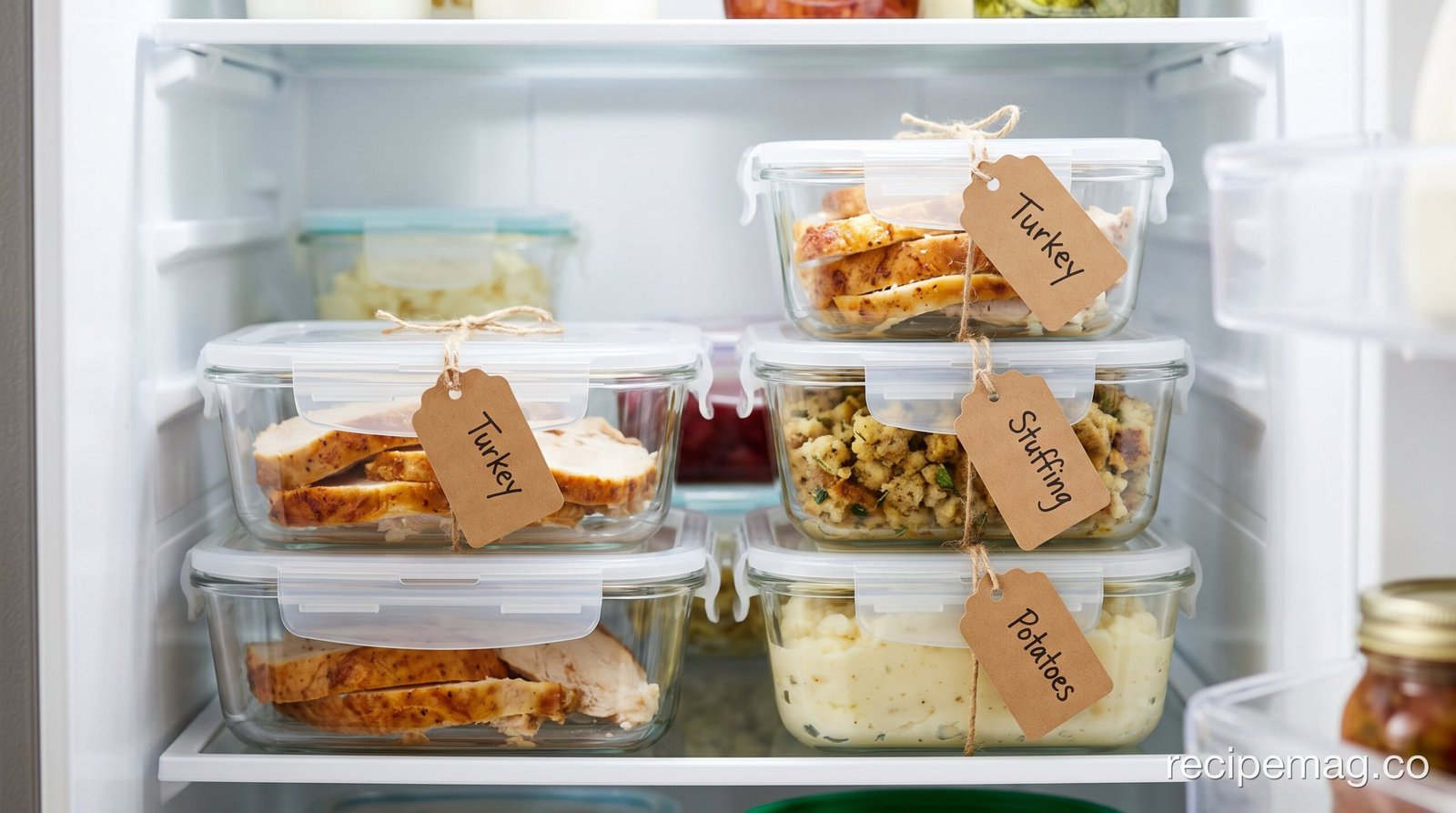
Refrigerate Thanksgiving leftovers within 2 hours of serving, keep them for no more than 3 to 4 days, and reheat them to 165°F before eating, according to USDA FSIS (2025). Follow those three rules and the rest is logistics. This guide covers how to pack each dish, how long it lasts, and how to bring it back to life.
Key Takeaways
- Get leftovers into the fridge within 2 hours, per USDA FSIS. Don’t wait for dishes to cool completely.
- Use shallow containers and carve the turkey off the bones before storing.
- Eat leftovers within 3 to 4 days. Freeze whatever you won’t finish by then.
- Reheat everything to 165°F, and bring gravy to a steaming simmer.
- Label each container with the dish and date, so day 4 never gets guessed.
How Soon Do Thanksgiving Leftovers Need to Be Refrigerated?
Within 2 hours of the food coming out, or 1 hour if the room is hotter than 90°F, as USDA FSIS (2025) explains for the 40°F to 140°F danger zone. That deadline sets the pace for the whole evening, so decide who’s packing before dessert goes out.
Here’s the sequence we use in our own kitchen:
- Set a timer for 90 minutes when dinner is served. It’s your warning bell.
- Clear the table in one pass. Move everything to the counter near your containers.
- Carve the remaining turkey off the carcass and pack it before the bones cool.
- Divide large dishes into shallow containers and refrigerate them right away.
- Leave the dishes out only if you’re still serving them. If not, pack them.
If you’d like to plan the serving side too, our Thanksgiving buffet setup guide covers how to keep food hot and safe while guests eat. And the Thanksgiving quick reference has the full list of temperatures on one page.
How Do You Pack Leftovers So They Cool Quickly?
Use shallow containers and divide big portions. USDA FSIS recommends shallow containers so food chills quickly and evenly, since a deep pot can stay warm in the center for hours (USDA FSIS, 2025). Aim for layers about 2 inches deep, and don’t worry if the food is still warm.
Packing rules that work
- Turkey: slice or pull the meat off the bones. A whole carcass keeps its center hot. Add a spoonful of broth or gravy to keep it moist.
- Stuffing and dressing: spread into a shallow dish or divide between two containers. Never leave it in the bird. Our Southern cornbread dressing reheats especially well with a little added broth.
- Mashed potatoes: flatten them in a shallow dish. Our make-ahead mashed potatoes are built to reheat creamy.
- Gravy: pour into a small, shallow container or a few jars.
- Cranberry sauce: a jar is fine. Cover and chill.
- Vegetable sides and casseroles: cover and chill in the baking dish if it fits in the fridge, or divide.
Keep different dishes in separate containers. Mixing them blurs flavors, and it makes reheating uneven. Our guidance: leave the turkey in its own container. You’ll want it for sandwiches, soup, and everything else on the leftover menu.
The fridge itself
Set the refrigerator to 40°F or below. Leave space around containers so cold air circulates, and don’t pack the fridge so full that the door can’t close. If you’re short on room, clear a shelf before dinner, or move drinks to a cooler on the porch.
How Long Do Thanksgiving Leftovers Last?
Most last 3 to 4 days in the fridge. USDA FSIS puts turkey, stuffing and gravy in that window (USDA FSIS, 2025), and the same rule is a safe default for sides and pies. Count Thursday as day zero. Friday is day one, Sunday is day three, and Monday is your last day.
| Dish | Fridge (40°F or below) | Reheat To |
|---|---|---|
| Sliced turkey | 3 to 4 days | 165°F |
| Stuffing or dressing | 3 to 4 days | 165°F |
| Gravy | 3 to 4 days | 165°F, steaming hot |
| Mashed potatoes and cooked vegetables | 3 to 4 days | 165°F |
| Casseroles (sweet potato, green bean, mac and cheese) | 3 to 4 days | 165°F |
| Cranberry sauce | Up to about 1 week, our guidance | Serve cold or room temperature |
| Custard-style pies (pumpkin, pecan) | 3 to 4 days, our guidance | Serve chilled or at room temperature |
Check the federal cold food storage chart for items not listed here, or try the free FoodKeeper app. The numbers in the cranberry sauce and pie rows are our own conservative guidance, since sugar-heavy sauces keep a bit longer but custard pies are egg-based and need cold storage.
Label everything
Masking tape and a marker are the most useful tools in a leftover kitchen. Write the dish and the date it was cooked, which is Thursday, not the day you packed it. By Sunday evening, no one will remember. Labels stop the “is this still good?” guessing.
What Is the Safest Way to Reheat Thanksgiving Leftovers?
Heat every portion until it reaches 165°F in the center, as USDA FSIS (2025) recommends. That’s true whether you use the oven, stovetop or microwave. A thermometer is the only way to be sure, because cold spots in a casserole look as hot as the rest.
Oven
Best for turkey, stuffing and casseroles. Heat the oven to 325°F, put the food in a baking dish with a splash of broth, and cover tightly with foil. Warm 15 to 25 minutes, depending on the portion, then check the center. Remove the foil for the last 5 minutes if you want crisp edges on stuffing.
Stovetop
Best for gravy, mashed potatoes and soups. Use medium-low heat and stir often. Gravy should reach a gentle simmer and look steaming hot all the way through. Thin it with a spoonful of broth if it has thickened in the fridge.
Microwave
Fast and fine for single plates. Cover the food loosely, stir halfway, and let it stand for a minute so the heat evens out. Then test the center. Arrange food in a ring with the thickest pieces at the edge, and keep the middle open.
What not to do
Don’t reheat leftovers in a slow cooker. USDA FSIS warns that slow cookers heat too slowly and can leave food in the danger zone for too long. Use it only to keep food hot once it’s already steaming, as in USDA’s slow cooker guidance.
How Do You Keep Leftover Turkey Moist?
Keep the meat sliced thick, add moisture, and warm it gently. Turkey dries out because the cooked proteins have already lost water, so a second blast of heat is hard on them. Broth, gravy, and a covered dish bring back what the first roast took away.
- Store with broth. A few tablespoons of turkey or chicken broth in the container keeps slices from drying.
- Reheat covered. Foil traps steam. At 325°F, a covered dish with broth warms slices in 15 to 20 minutes.
- Use it cold. Sandwiches and salads don’t need reheating. Cold turkey kept within the 3-to-4-day window is fine as is.
- Keep the dark meat. Thigh and drumstick meat stays juicy after reheating. Use it first in soups, hash, and casseroles.
Turkey carved cleanly stores better, too. Our guide to carving a turkey shows how to take the breast off in two pieces, which makes for neat, thick slices that stay moist.
In our kitchen, the turkey we pack the same night always tastes better on day three than the turkey packed the next morning. Warm meat left on the counter overnight loses moisture, and it’s also outside the 2-hour window. Pack tonight.
What If You Can’t Eat It All in 4 Days?
Freeze it. Food kept at 0°F stays safe indefinitely, though quality declines with time, according to USDA FSIS (2025). Freeze portions on day one or two, rather than on day four. That way, the food goes into the freezer at its best.
A few quick pointers, since our freezer post follows soon:
- Freeze turkey in meal-sized portions, with a little broth, in zip-top bags with the air pressed out.
- Cool food in the fridge before freezing. Hot containers raise the freezer’s temperature.
- Thaw in the refrigerator, in cold water, or in the microwave. Not on the counter.
- Reheat thawed leftovers to 165°F.
The USDA’s safe defrosting methods page covers all three thawing options in detail.
When to throw it out
When in doubt, throw it out. If food sat out longer than 2 hours, or if you can’t remember when it was cooked, don’t taste-test it. Smell and look can’t tell you whether harmful bacteria are present. It’s a small loss compared with a night of food poisoning.
Most families in our experience lose more leftovers to forgetting than to spoilage. Food shoved to the back of the fridge hits day five untouched. Keeping a single labeled “eat first” shelf at eye level fixes this faster than any storage trick.
Frequently Asked Questions About Storing Thanksgiving Leftovers
Can I leave Thanksgiving leftovers out overnight?
No. USDA FSIS says perishable food shouldn’t sit out more than 2 hours, or 1 hour above 90°F. Reheating overnight leftovers doesn’t make them safe, because some bacterial toxins survive heat. If the food was out all night, discard it, even if it smells and looks fine.
Is it OK to put hot food straight into the fridge?
Yes, when it’s in shallow containers. USDA FSIS says hot food can go straight into the refrigerator, and a fridge at 40°F or below can handle it. Large, deep pots are the problem, so divide them first. Don’t wait for food to cool on the counter, which uses up your 2 hours.
How many times can I reheat leftovers?
Ideally once. Every cycle of cooling and heating gives bacteria another chance and dries out the food. Warm only the portion you plan to eat, and keep the rest cold. Reheated food should reach 165°F each time, and shouldn’t go back in the fridge after sitting out.
How long do pumpkin and pecan pie last?
Both are egg-based custards, so they belong in the fridge after cooling. Our guidance is to eat them within 3 to 4 days, matching the general leftover rule. Cover the pie loosely so it doesn’t pick up fridge odors. Fruit pies such as apple are more forgiving, but chilling still extends their life.
Can I reheat gravy in the microwave?
Yes. Cover it, heat in short bursts and stir between each one so no cold pockets remain. Gravy should be steaming hot and reach 165°F. If it’s too thick, whisk in a spoonful of broth or water. Stovetop reheating gives you more control, but the microwave works fine for a single serving.
Pack Tonight, Cook Tomorrow
The safest leftovers are the ones you pack fast, label clearly and reheat thoroughly. Set the 90-minute timer, carve the turkey off the bones, use shallow containers, and write Thursday’s date on every lid. Two minutes of tape now saves a lot of doubt on Sunday.
Tomorrow morning, the fun part starts. The next few days of this series cover what to do with all that turkey, from soup to sandwiches to a pot pie. Right now, close the fridge, pour yourself a mug of something warm, and call it a day. Happy Thanksgiving.
