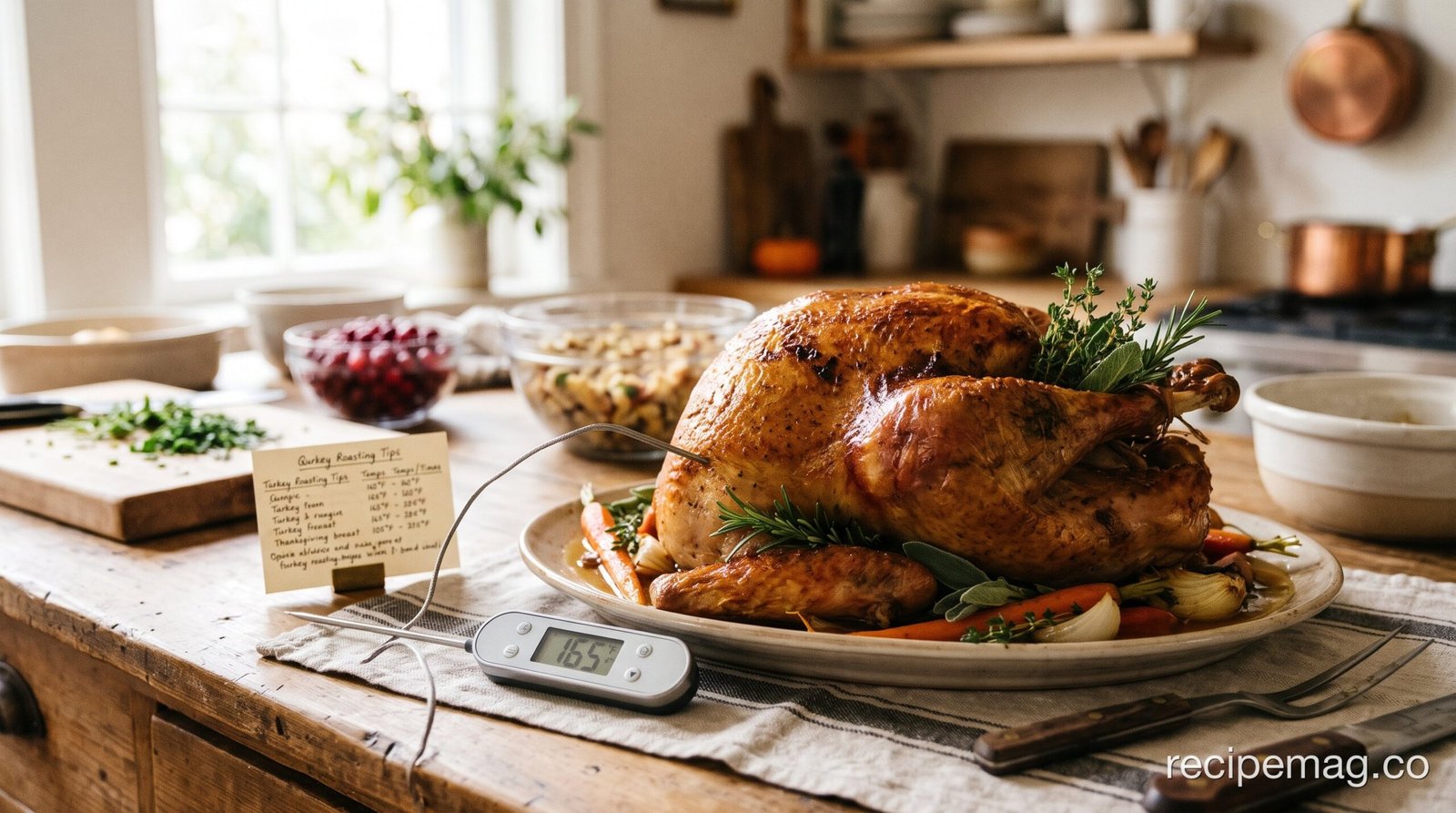
Turkey is safe to eat once it reaches 165°F in the thickest part of the breast, the innermost part of the thigh and the innermost part of the wing, according to USDA FSIS (2025). That’s the number that matters most today. This page gathers every other temperature, time and handling rule you’ll need on one screen, so you can print it and stop second-guessing.
Key Takeaways
- Cook turkey, stuffing and reheated leftovers to 165°F. Check with a thermometer, not the clock.
- Keep hot food at 140°F or above and cold food at 40°F or below, per USDA FSIS.
- Put leftovers in the fridge within 2 hours of serving, and eat them within 3 to 4 days.
- Rest the turkey at least 20 minutes. It gives you time to finish gravy and sides.
- Egg-based dishes such as quiches and custard pies need 160°F inside.
Which Temperatures Matter Most on Thanksgiving?
Five numbers cover almost everything: 40°F, 140°F, 160°F, 165°F and 0°F. USDA FSIS defines the danger zone as 40°F to 140°F, where bacteria multiply fastest (USDA FSIS, 2025). Everything else on Thursday is about moving food through that zone quickly, or keeping it out entirely.
| Food or Situation | Target | Notes |
|---|---|---|
| Whole turkey (breast, thigh, wing) | 165°F | Check all three spots, away from bone |
| Stuffing, in the bird or baked separately | 165°F | Center of the stuffing |
| Oven temperature for roasting | 325°F or higher | USDA’s lowest recommended setting |
| Egg dishes (quiche, custard, casseroles with eggs) | 160°F | Includes savory breakfast bakes |
| Reheated leftovers | 165°F | Every part, not just the edges |
| Hot buffet food | 140°F or above | Chafing dishes, warming trays, slow cookers on warm |
| Cold dishes and the refrigerator | 40°F or below | Deviled eggs, salads, dips |
| Freezer | 0°F | Food stays safe indefinitely, though quality fades |
These targets come from the federal safe minimum internal temperature chart and the FSIS pages linked throughout this post. Our own guidance: buy a digital instant-read thermometer before Thursday, and test it in ice water. It should read 32°F.
How Long Does a Turkey Take to Thaw and Roast?
Plan on 24 hours of refrigerator thawing for every 4 to 5 pounds of turkey, and about 3 to 3¾ hours of roasting at 325°F for a 12- to 14-pound bird. Both numbers come from USDA FSIS (2025). If the bird is still frozen today, there’s a faster route below.
Thawing times
- Refrigerator (40°F or below): 24 hours per 4 to 5 pounds. A 16-pound turkey needs about 3 to 4 days.
- Cold water: about 30 minutes per pound, in a leak-proof bag, with the water changed every 30 minutes. Cook it right after.
- Roasting from frozen: safe, but USDA says it takes about 50 percent longer than a thawed bird.
Our turkey thawing guide has the full chart by weight, plus how much turkey to buy per guest.
Roasting times at 325°F (unstuffed)
| Turkey Weight | Approximate Roasting Time |
|---|---|
| 8 to 12 lb | 2¾ to 3 hours |
| 12 to 14 lb | 3 to 3¾ hours |
| 14 to 18 lb | 3¾ to 4¼ hours |
| 18 to 20 lb | 4¼ to 4½ hours |
| 20 to 24 lb | 4½ to 5 hours |
Treat those as estimates. Ovens run hot or cool, and a bird straight from the fridge cooks slower than one that’s sat out for an hour. Start checking about 45 minutes before the earliest time in your range. If you want the full method, our classic herb-butter roast turkey walks through each step.
What Should You Do While the Turkey Rests?
Rest the turkey for at least 20 minutes, which is the minimum USDA FSIS (2025) recommends. Cover it loosely with foil. The meat stays hot, the juices settle, and your oven is suddenly free for rolls and casseroles. This window is where most dinners get rescued.
Here’s a sequence we’ve found works in a small kitchen:
- Pull the turkey and check it again. It should still read 165°F after you move it.
- Turn the oven up to 400°F for rolls or to reheat sides.
- Strain the pan juices and finish the gravy. Our make-ahead turkey gravy is ready to reheat, so this is a two-minute job.
- Slide casseroles in for 15 to 20 minutes, until bubbling and 165°F in the center.
- Carve last, just before the plates go out.
Not sure how the rest of your day should flow? The Thanksgiving day timeline maps every hour from first coffee to dessert.
How Do You Keep Food Safe While Guests Eat?
Keep hot dishes at 140°F or above and cold dishes at 40°F or below, and don’t let anything sit out longer than 2 hours. USDA FSIS notes that perishable food left in the danger zone beyond that point should be thrown out (USDA FSIS, 2025). On a warm day, or in a hot room, the window is shorter.
The practical fix is to serve in rounds. Put out half of each dish and keep the rest in a 200°F oven, or on ice for cold foods. Swap in fresh portions rather than topping off a dish that’s been sitting. Our Thanksgiving buffet setup guide shows how to arrange the table for exactly this.
Common buffet slips
- Topping off lukewarm dishes. Fresh food mixed with old food resets nothing. Replace the whole dish.
- Leaving deviled eggs and dips out all afternoon. Set them in a bowl of ice, and pull them at the 2-hour mark.
- Letting the slow cooker drift. Use it to hold hot food on warm, not to reheat cold food. FSIS says reheating leftovers in a slow cooker is unsafe because it heats too slowly. See USDA’s slow cooker guidance.
Which Dishes Need Special Handling?
Stuffing, egg dishes, pies and gravy each have their own rule. Stuffing must reach 165°F in the center, whether it’s baked in the bird or in a dish, a point USDA FSIS (2025) stresses. Egg-based foods need 160°F. Here’s the short version for each.
Stuffing and dressing
Baking it in a separate dish is easier to control. A stuffed bird takes longer, and the stuffing must hit 165°F in the middle, which can overcook the breast while you wait. If you do stuff the turkey, pack it loosely just before roasting and test the center with the thermometer.
Egg-based dishes
Quiche, strata, breakfast casseroles and custard-style pies should reach 160°F inside, per the federal chart linked above. A pumpkin pie is an egg custard. Our guidance: cool it, then refrigerate it, rather than leaving it on the counter overnight. Dessert tables are the most common spot where this slips.
Gravy and sauces
Bring gravy to a full simmer when you reheat it, and make sure it’s steaming hot throughout. Stir as you go so no cold pockets remain. Cranberry sauce is high in acid and sugar, but still follows the 2-hour rule in our kitchen once it’s been served.
Raw turkey
Don’t rinse it. FSIS warns that washing raw poultry splashes bacteria onto sinks, counters and nearby dishes. Pat it dry with paper towels, then wash your hands, the board and the pan with hot soapy water. Cooking, not rinsing, is what kills bacteria. Details are in USDA’s explanation of why washing poultry is a risk.
How Soon Should You Pack Up the Leftovers?
Within 2 hours of the food coming out. USDA FSIS (2025) says leftovers stay good in the refrigerator for 3 to 4 days and should be reheated to 165°F. If dinner starts at 3 p.m., the clock runs out around 5, so plan your cleanup around that deadline.
Carve the remaining turkey off the bones before storing it. A whole carcass holds heat in the center. Shallow containers, no more than about 2 inches deep, cool faster than deep pots. Clear a fridge shelf or two before dinner, so the containers have somewhere to go.
A fuller storage and reheating walkthrough follows in our next post.
The 3-to-4-day countdown
- Thursday: cooked and chilled by 2 hours after serving.
- Sunday: last good day for turkey, stuffing and gravy kept in the fridge (day 3).
- Monday: the outer limit (day 4). After that, freeze or toss.
Freeze anything you won’t eat by Sunday. Frozen at 0°F, it stays safe, and the quality is best within a few months.
Your One-Page Thanksgiving Cheat Sheet
Copy this list onto a sticky note and put it on the fridge door. It’s the whole post in 10 lines.
- Turkey: 165°F in breast, thigh and wing.
- Stuffing: 165°F in the center.
- Oven: 325°F or higher for roasting.
- Rest the turkey: at least 20 minutes, loosely covered.
- Egg dishes and custard pies: 160°F.
- Hot food: 140°F or above. Cold food: 40°F or below.
- Nothing out longer than 2 hours.
- Leftovers in the fridge within 2 hours, in shallow containers.
- Eat leftovers within 3 to 4 days. Reheat to 165°F.
- Don’t rinse the raw turkey, and wash your hands often.
Not every home cook has a thermometer on hand, and the FoodKeeper app from the federal government is a free way to look up storage times for almost any food, including whatever you’re cooking.
Here’s what we’ve noticed: most Thanksgiving food-safety slips aren’t about undercooked turkey. They happen at 6 p.m., when everyone is full and tired and the dishes sit out for another hour or two. Set a timer for the end of dinner. It’s the cheapest safety tool in the kitchen.
Frequently Asked Questions About Thanksgiving Cooking Temperatures
What temperature should the turkey be when I take it out of the oven?
Pull it when the thickest part of the breast, the innermost thigh and the innermost wing all read at least 165°F, per USDA FSIS. The temperature may rise a few degrees as it rests. Keep the probe away from bone, which can read hotter than the meat.
Is it safe if the turkey juices run pink but it reads 165°F?
Yes. A thermometer reading of 165°F is the safety test, not the color. Pink can show up in fully cooked turkey, especially near the bone. If any spot reads below 165°F, return the bird to the oven and check again in 15 minutes.
How long can Thanksgiving food sit out?
Two hours is the limit for perishable food, according to USDA FSIS. After that, bacteria can grow to unsafe levels, so refrigerate or discard it. Use ice or warming trays to keep dishes outside the 40°F to 140°F danger zone while guests eat.
Can I reheat leftovers more than once?
It’s best to reheat only what you’ll eat. Each round of cooling and warming adds time in the danger zone, and the quality drops. Warm single portions to 165°F, and keep the rest cold in the fridge or freezer until you need it.
Do I need to thaw a turkey before roasting?
No, but it’s slower. USDA FSIS says a frozen turkey is safe to roast, and takes about 50 percent longer than a thawed one. In our experience, thawing first gives more even results, and you can season and butter the bird properly.
Print It, Post It, and Enjoy the Day
Dinner goes better when the numbers are settled before guests arrive. Keep the thermometer in reach, set one timer for the end of the meal, and let the cheat sheet answer the questions that pop up mid-roast.
Tomorrow, the cooking is done and the leftovers begin. We’ll cover storing and reheating them step by step, so every plate tastes as good on Saturday as it did on Thursday. Happy Thanksgiving.
