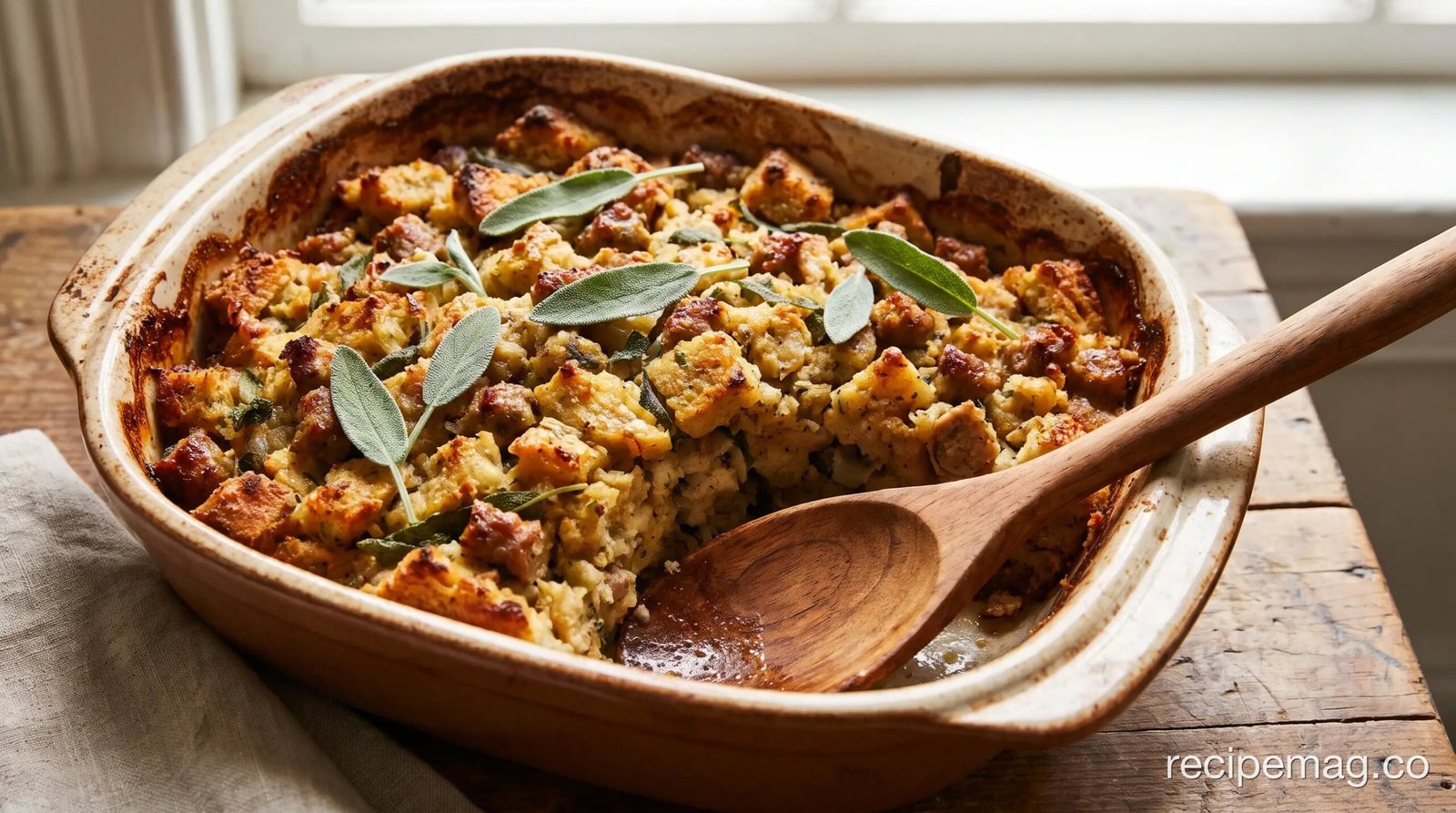
This sausage and sage stuffing is the classic: browned pork sausage, onion and celery softened in butter, fresh sage and sturdy dried bread, baked in a 9-by-13-inch dish until the top crackles and the center stays moist. It serves 10 to 12, and almost every step can be done days ahead. Cook the sausage all the way through, since ground pork’s safe minimum is 160°F (FoodSafety.gov, 2025), then bake the dish until its center reads 165°F.
Key Takeaways
- One 9-by-13-inch dish serves 10 to 12.
- Dry the bread cubes at 275°F, up to a week ahead.
- Cooked sausage and vegetables keep 3 to 4 days in the fridge (USDA FSIS, 2025), so cook them early.
- Bake covered, then uncovered, until the center reads 165°F.
- Baked stuffing freezes well. Reheat it with a splash of stock.
Why Does Sausage Make Stuffing Taste Better?
Sausage does three jobs at once. It seasons the bread, adds fat and leaves savory, meaty bites throughout. Because it’s already salted and spiced, you need less butter and less seasoning than a plain bread stuffing, and the onions and celery cook in its rendered fat.
Which sausage? In our experience, bulk sage breakfast sausage tastes most like the stuffing people remember. Mild Italian adds fennel and garlic, which is lovely but less traditional.
What Bread Is Best for Sausage Stuffing?
Use a sturdy, plain loaf, such as a country loaf, Italian bread, sourdough or firm sandwich bread, and dry it thoroughly. Dry cubes soak up the stock and eggs evenly and keep their shape, while soft bread collapses into paste. Our stuffing vs. dressing guide explains why stale bread isn’t the same as dry bread.
You need 1 1/2 pounds, cut into 3/4-inch cubes with the crust left on for chew. Dry the cubes in a 275°F oven until crisp but pale, or do it up to a week ahead and store them airtight at room temperature.
Sausage and Sage Stuffing Recipe
Prep Time: 30 minutes | Cook Time: 1 hour 55 minutes | Total Time: 2 hours 35 minutes (including resting) | Serves: 10 to 12
With the bread dried ahead, the total drops to about 1 hour 50 minutes.
Ingredients
- 1 1/2 pounds sturdy white bread (country loaf, Italian or firm sandwich bread), cut into 3/4-inch cubes
- 1 pound bulk pork sausage (sage breakfast or mild Italian), casings removed
- 8 tablespoons (1 stick) unsalted butter, divided
- 2 medium yellow onions, diced (about 2 1/2 cups)
- 4 celery ribs, diced (about 2 cups)
- 4 garlic cloves, minced
- 3 tablespoons chopped fresh sage, plus 8 whole leaves for the top (optional)
- 1 tablespoon chopped fresh thyme leaves
- 1/3 cup chopped fresh flat-leaf parsley
- 1 teaspoon kosher salt, plus more to taste
- 1/2 teaspoon freshly ground black pepper
- 2 large eggs
- 3 to 3 1/2 cups low-sodium chicken or turkey stock
Instructions
- Dry the bread. Heat the oven to 275°F. Spread the bread cubes over 2 rimmed baking sheets and bake for 40 to 50 minutes, stirring once, until dry and crisp but barely colored. Let cool.
- Prepare the dish. Raise the oven to 350°F. Grease a 9-by-13-inch baking dish with 1 tablespoon of the butter. Put the bread in a very large bowl.
- Brown the sausage. In a large skillet over medium-high heat, cook the sausage, breaking it into small pieces, until browned and cooked through, 8 to 10 minutes. Use a slotted spoon to add it to the bread, leaving the fat in the skillet.
- Cook the vegetables. Reduce the heat to medium and add 5 tablespoons of the butter. Add the onions, celery and a pinch of the salt and cook, stirring often, until soft, 8 to 10 minutes. Stir in the garlic, chopped sage and thyme and cook for 1 minute. Scrape everything, fat included, over the bread.
- Season. Add the parsley, the remaining salt and the pepper, and toss well. Taste a cube: it should taste well seasoned, even slightly salty.
- Add the liquid. Whisk the eggs with 3 cups of the stock, pour it over the bread and fold gently until evenly moistened. Let stand 10 minutes, then squeeze a handful. If it crumbles, fold in up to 1/2 cup more stock.
- Fill the dish. Spoon the stuffing into the dish without packing it down and press the sage leaves on top, if using. Melt the remaining 2 tablespoons of butter and drizzle it over everything.
- Bake. Cover with foil and bake for 25 minutes. Uncover and bake 20 to 25 minutes more, until the top is golden and crisp and the center reads 165°F on an instant-read thermometer.
- Rest and serve. Let stand for 10 minutes before serving.
How Do You Make Sausage Stuffing Ahead of Time?
Cook the components early and add the eggs and stock on the day. USDA FSIS says cooked foods should be refrigerated within 2 hours and eaten within 3 to 4 days, so a Tuesday start works for Thursday (USDA FSIS, 2025).
- Up to 1 week ahead: Dry the bread and store it airtight at room temperature.
- Up to 2 days ahead: Brown the sausage and cook the vegetables (steps 3 and 4), but cool them in a shallow container and refrigerate instead of adding them to the bread.
- The night before: Toss the bread with the cold sausage mixture, parsley and seasonings, transfer it to the buttered dish, cover and refrigerate. On Thursday, fold in the eggs and stock and bake, allowing about 10 extra minutes.
- Fully baked: Bake up to 2 days early, cool and refrigerate. Reheat covered at 350°F with about 1/2 cup of stock drizzled over until the center reaches 165°F, then uncover for 10 minutes.
- Frozen: Wrap the baked, cooled stuffing tightly and use it within about 2 months for the best texture. Thaw overnight in the fridge.
Can You Cook This Stuffing Inside the Turkey?
Yes, with care. USDA FSIS says to stuff the turkey loosely, about 3/4 cup per pound, immediately before roasting, and to make sure the center of the stuffing reaches 165°F (USDA FSIS, 2025). The agency’s own preference is a separate dish, which cooks more evenly.
If you do stuff the bird, add the eggs and stock only when the turkey is ready to go in, and never stuff it the night before. Bake any extra in a small buttered dish. Let the turkey rest 20 minutes before scooping out the stuffing, and check it with a thermometer, not by eye; our meat thermometer guide covers how. Either way, it’s a natural match for our classic herb-butter roast turkey.
Tips for the Best Sausage Stuffing
- Don’t drain the fat. Rendered sausage fat flavors the vegetables and, through them, every cube of bread.
- Season before the eggs go in. Bread mutes salt, so the mixture should taste slightly too salty before baking.
- Using turkey sausage? It’s leaner, so add 2 extra tablespoons of butter with the vegetables.
- Want add-ins? Fold in 1 diced tart apple, 1/2 cup dried cranberries or 1 cup toasted chopped pecans with the parsley.
Frequently Asked Questions About Sausage and Sage Stuffing
Can I use dried sage instead of fresh?
Yes. Use about 1 tablespoon of dried rubbed sage in place of the 3 tablespoons of fresh, and add it with the garlic so it blooms in the fat. Rubbed sage varies in strength, so taste the mixture before the eggs go in and add more if needed.
Can I use turkey or chicken sausage?
Yes. Poultry sausage is leaner, so add 2 extra tablespoons of butter with the vegetables. Cook it through: FoodSafety.gov lists 165°F as the safe minimum for ground turkey and chicken, versus 160°F for ground pork (FoodSafety.gov, 2025). It’s often milder, so season a little more boldly.
Can I make this stuffing without eggs?
Yes. Leave out the eggs and use the full 3 1/2 cups of stock, letting the squeeze test guide you. Without eggs, the stuffing bakes up looser and more crumbly instead of setting into neat squares, which some families prefer. The baking time and the 165°F target stay the same.
How long does leftover stuffing last?
Refrigerate leftovers within 2 hours and eat them within 3 to 4 days, per USDA FSIS. Reheat them in a covered dish at 350°F or in the microwave until they reach 165°F, adding a splash of stock if they look dry.
Get the Stuffing Done Before the Turkey
This is the Thanksgiving dish that rewards an early start. Dry the bread the week before, cook the sausage and vegetables on Tuesday, and on Thursday it takes about 10 minutes to finish before the dish goes into the oven.
Spoon our make-ahead turkey gravy over each serving, and use our Thanksgiving dinner planning guide to see where the stuffing fits into the full week.
