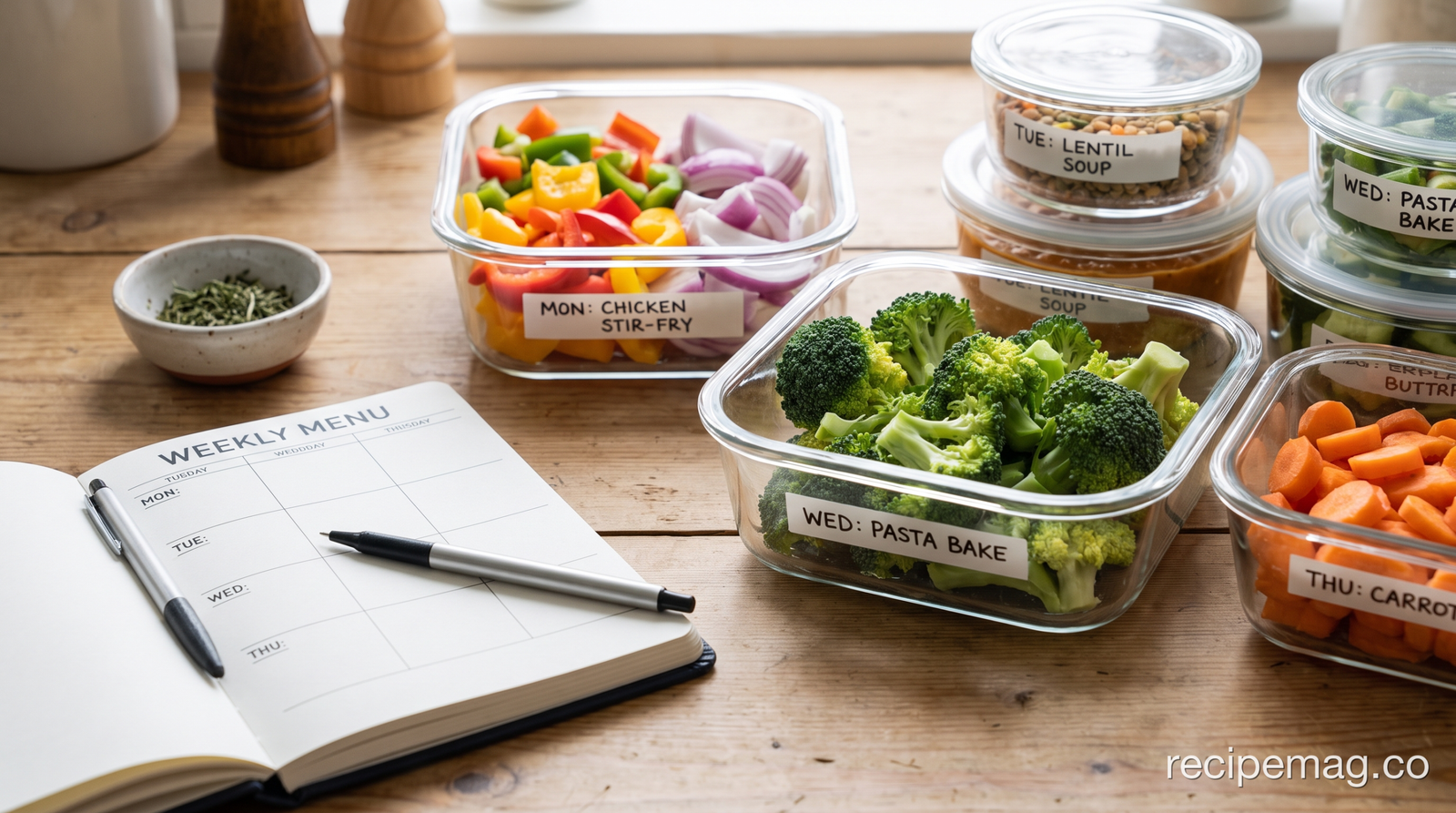
The hardest part of a school-night dinner is not the cooking. It is deciding at 5pm, with everyone hungry, what dinner is going to be. Removing that decision is worth more than any thirty-minute recipe, and it takes about an hour on a weekend. This is a system, not a meal plan: a repeatable structure you fill with whatever is cheap and in season that week.
Key Takeaways
- Plan five dinners, not seven; leave two nights deliberately unplanned.
- Assign each weeknight a fixed format rather than a fixed recipe.
- Prep components, not finished meals, so the week stays flexible.
- One hour on Sunday covers shopping list, two components, and one full make-ahead dinner.
- Cooked dishes hold safely three to four days at 40°F or below (USDA FSIS, 2023).
Plan Five Dinners, Not Seven
Almost every abandoned meal plan fails the same way: it plans seven nights, reality eats three of them, and the leftover ingredients rot as a visible reminder of failure. Plan five and you leave room for the school event you forgot, the night nobody is hungry, and the night takeaway is genuinely the right call.
Two unplanned nights are not a gap in the system. They are the shock absorber that keeps the other five working. In practice one becomes leftovers and one becomes something improvised from what is left, which is usually eggs, pasta, or a sandwich, and that is fine.
Write the five on paper or a whiteboard where everyone can see them. Half the value of a plan is that nobody has to ask.
Assign Formats, Not Recipes
This is the part that makes the system durable. Instead of writing “Tuesday: chicken piccata,” you write “Tuesday: cutlet night.” The format stays fixed week after week; the specific dish changes with what is cheap.
A workable set of five:
- Bowl night. Grain, protein, vegetable, sauce. Endlessly variable and uses up odds and ends. Our sesame ground beef bowls are the twenty-minute version.
- Pasta night. The most reliable win with children. See easy weeknight pasta dinners.
- Sheet-pan night. Protein plus vegetables on one tray at 425°F. Almost no active time and one pan to wash.
- Cutlet night. Something thin, breaded, and fast, like our crispy chicken cutlets with lemon and arugula.
- Soup or braise night. Made ahead on the weekend and reheated. This slot gets more useful every week from now until spring.
Rotate the formats to whatever suits your household. The only rule is that the slot is fixed and the contents are not.
The One-Hour Sunday Block
Set a timer. The hour is not for cooking five dinners; it is for removing friction from all five.
Minutes 0 to 10: decide and list. Fill the five format slots with actual dishes based on what is in the fridge and what is in season. Write the shopping list off the back of those five, not the other way around.
Minutes 10 to 30: prep two components. Not meals, components. A big batch of grain. A tray of roasted vegetables. Washed and dried greens. A jar of vinaigrette. A marinade sitting on chicken in the fridge. Each one collapses ten minutes off a weeknight.
Minutes 30 to 55: cook one full dinner. Make the soup or braise now. It reheats better than it cooked, and it covers the night the week goes sideways. Our end-of-summer minestrone is a good candidate right now.
Minutes 55 to 60: stage it. Put the plan somewhere visible. Move Monday’s protein from freezer to fridge. Done.
Cooked components hold three to four days refrigerated at 40°F or below (USDA FSIS, 2023), which is exactly the working window for a five-night plan.
A Sample Late-August Week
Built on what is cheap right now: peppers, eggplant, tomatoes, corn.
- Monday, bowl night. Sesame ground beef over the batch of rice from Sunday, cucumber, and quick-pickled onion.
- Tuesday, cutlet night. Chicken cutlets with lemon and arugula. Twenty minutes start to finish.
- Wednesday, sheet-pan night. Sausage with peppers and the last of the eggplant, roasted hard at 425°F.
- Thursday, pasta night. Pasta with the roasted vegetables from Wednesday, blitzed into a sauce with a splash of cream.
- Friday, soup night. The minestrone made on Sunday, with bread.
Note what Thursday is doing. It is not a new recipe; it is Wednesday’s leftovers wearing a different shape. Building one deliberate reuse into every week is what separates a plan that saves time from one that just relocates the work.
Where These Systems Break
Over-prepping. Fully assembled meals on Sunday are appealing and almost always end badly. By Thursday the salad is wet and the rice is dry, and nobody wants Sunday’s idea of Thursday’s dinner. Prep components; assemble on the night.
Too many new recipes. A week with five unfamiliar dishes is five chances to misjudge timing. Keep four known quantities and one new thing, and put the new thing on a night with slack.
Ignoring the shopping reality. A plan built from recipes generates a list of thirty items, half of which are used once. A plan built from formats generates a shorter list with more overlap, which is cheaper and produces less waste.
Treating it as permanent. The format set should change with the season. The grill slot that made sense in July becomes the braise slot in October. Our late-August kitchen reset covers that changeover.
Stocking for the System
A format-based plan only works if the pantry can absorb it. The short list worth keeping permanently: a long-cooking grain, a short pasta, tinned tomatoes, tinned beans, stock, soy sauce, vinegar, a hard cheese, and frozen vegetables. With those on hand, four of the five formats can be improvised without a shop.
Freezer discipline matters more than pantry depth. Protein portioned flat in labelled bags thaws in twenty minutes under cool water, which is the difference between the plan working on a Tuesday and not. Batches of sauce and soup frozen flat do the same job, and our roasted tomato sauce for the freezer is the most useful single thing to bank right now.
For the broader restock, our pantry guide covers what earns its shelf space.
Getting the Household on Board
A dinner system imposed on people fails. A dinner system people have a stake in survives, and the difference is usually one conversation.
The most effective move is to let each person claim one slot. A child who chooses pasta night is far more invested in pasta night than one who is served it. It also surfaces information you would not otherwise get, like the fact that nobody actually likes the dish you have been making for a year.
Post the week where everyone can see it. Half the friction in a household kitchen is people asking what’s for dinner and the cook having to answer five times. A whiteboard removes that entirely and it also stops the 4pm negotiation, because the answer is already on the wall.
Delegate the parts that are genuinely delegable. Setting the table, washing salad leaves, and putting leftovers away are all tasks a seven-year-old can own. The point is not the labour saved, which is minimal, but that a shared system is harder to abandon than a personal one.
Finally, allow the plan to be overridden without guilt. A system that treats one takeaway night as a failure will be abandoned within a month. The two unplanned nights exist precisely so the other five hold.
Frequently Asked Questions
How long does this actually take each week?
About an hour on the weekend once the system is established, plus fifteen to thirty minutes on each cooking night. The first two weeks take longer while the formats settle.
What if my family will not eat the same formats every week?
The formats repeat; the food does not. Bowl night can be Korean one week and Mediterranean the next. Most people never notice the underlying structure.
Should I plan breakfasts and lunches too?
Only if dinner is already solved. Adding all three meals at once is the usual reason people abandon meal planning in the first month. Get dinner stable, then extend.
How far ahead can I prep components?
Cooked grains, roasted vegetables, and dressings hold three to four days refrigerated. Washed greens last about five days if dried thoroughly. Marinating protein is best kept to 24 hours.
Is it cheaper to plan this way?
Generally yes, because the shopping list is built from overlapping formats rather than unrelated recipes, so fewer single-use ingredients get bought and fewer get thrown away.
What is the single highest-value thing to prep on Sunday?
A pot of soup or a braise. It is the only prep that turns into a complete dinner with no further work, and it covers the night the plan fails.
