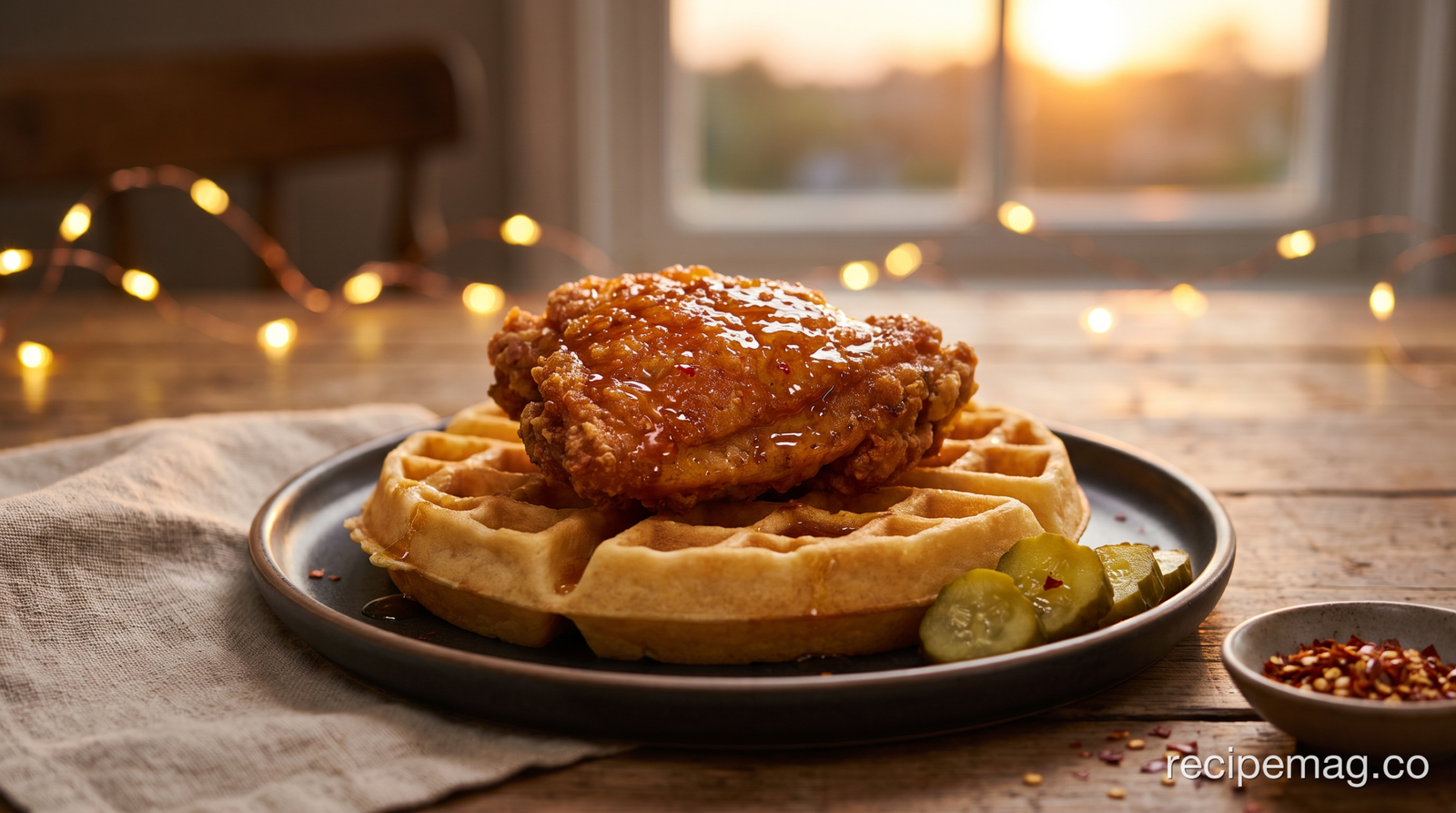
Chicken and waffles works because of contrast, not novelty. Salt against sweet, crunch against soft, heat against cool. The version most people picture comes from the American South by way of Harlem supper clubs in the 1930s, where late-night musicians were served a plate that straddled dinner and breakfast. The hot honey is a modern addition and, honestly, an improvement.
Key Takeaways
- A buttermilk brine seasons the chicken through and tenderises it; two hours is enough.
- Pressing the dredge onto wet chicken is what creates the craggy crust.
- Fry at 325 to 350°F; hotter burns the crust before the meat is done.
- Chicken is safe at 165°F, though thighs eat better closer to 175°F (USDA FSIS, 2023).
- Hot honey takes five minutes and keeps for a month.
Ingredients
Serves 4. Active time 40 minutes. Total time 3 hours including the brine.
For the chicken:
- 8 boneless chicken thighs, about 2 lbs
- 2 cups buttermilk
- 1 tbsp kosher salt
- 1 tsp black pepper
- 1 tsp smoked paprika
- 1/2 tsp cayenne
For the dredge:
- 2 cups all-purpose flour
- 1/4 cup cornstarch
- 2 tsp kosher salt
- 2 tsp smoked paprika
- 1 tsp garlic powder
- 1 tsp onion powder
- 1 tsp black pepper
- Neutral oil for frying, about 6 cups
For the hot honey:
- 1/2 cup honey
- 1 to 2 tsp red pepper flakes
- 1 tsp apple cider vinegar
- Pinch of salt
Plus one batch of buttermilk waffles, made savoury by dropping the sugar to a teaspoon.
How to Make It
1. Brine the chicken. Whisk the buttermilk with the salt, pepper, smoked paprika, and cayenne. Add the thighs, cover, and refrigerate at least 2 hours and up to overnight. The salt seasons the meat throughout and the mild acidity tenderises the surface without turning it chalky.
2. Make the hot honey. Warm the honey with the pepper flakes over low heat for 5 minutes, without boiling. Take it off the heat, stir in the vinegar and salt, and let it steep. It thickens as it cools and keeps a month in a jar.
3. Set up the dredge. Whisk the flour, cornstarch, and seasonings in a wide bowl. Spoon in about three tablespoons of the buttermilk brine and rub it through with your fingers until the mixture is shaggy with small clumps. Those clumps become the crags on the finished crust.
4. Coat. Lift each thigh from the brine, let the excess run off for a second, then press it firmly into the dredge on both sides. Press, do not toss. Set the coated pieces on a rack and let them sit 10 minutes so the coating hydrates and adheres.
5. Fry. Heat 2 inches of oil to 350°F in a heavy pot. Fry in batches of three or four, keeping the oil between 325 and 350°F, for 6 to 8 minutes, turning once. Crowding the pot drops the temperature and gives you greasy chicken.
6. Check and rest. Pull the chicken at 165°F minimum; thighs are better around 175°F, where the connective tissue has softened (USDA FSIS, 2023). Rest on a rack, never on paper towels, which steam the underside soft.
7. Assemble. Hot waffle, hot chicken, a generous drizzle of hot honey, and a few pickle slices. Serve immediately.
Getting the Crust Right
Three things separate a crust that shatters from one that sloughs off in the pan.
Moisture in the dredge. Rubbing a few spoonfuls of the wet brine into the dry flour is the whole trick. Those small hydrated clumps fry into irregular, crunchy ridges. A perfectly smooth dredge gives a smooth, dull crust.
Pressure, then rest. Press the coating on firmly, then let the coated chicken sit ten minutes before it hits the oil. During that rest the flour absorbs surface moisture and glues itself to the meat. Skipping it is the main reason coatings fall away.
Oil temperature discipline. Below 325°F the coating absorbs oil and turns greasy. Above 375°F it browns before the interior is cooked. Use a thermometer and let the oil recover between batches. This is the same temperature discipline that governs our Nashville hot chicken sandwiches.
Oven and Air Fryer Versions
Oven. Coat as directed, then spray the pieces generously with oil and bake on a rack at 425°F for 25 to 30 minutes, flipping once. The crust is less craggy but genuinely good, and the cleanup is a different world.
Air fryer. Spray well and cook at 380°F for 20 to 22 minutes, turning halfway. Do not crowd the basket; two thighs at a time is the realistic capacity for most machines.
Both versions need more oil spray than feels reasonable. Dry patches of flour stay dry and taste raw, and spraying is what stands in for the fryer.
What to Serve With It
The plate is already rich, so everything alongside should cut. Quick pickles are the traditional answer and take fifteen minutes; our refrigerator pickles are ready in a day and get better through the week.
A sharp vinegary slaw does the same job. So does a simple green salad with a lemon dressing. Collard greens are the deeply traditional pairing, and our Southern collard greens with smoked ham hock covers that route.
For more ways to put the waffle iron to work once you own the batter, see our National Waffle Day roundup.
A Short History of the Dish
Chicken and waffles has two distinct lineages that are often confused. The Pennsylvania Dutch version, which dates to the 1800s, is pulled stewed chicken and gravy served over a waffle — no frying involved at all, and closer to chicken and dumplings in spirit.
The version most people mean today comes from African American cooking, and became famous through Harlem supper clubs in the 1930s. Wells Supper Club is the name most often cited: it served jazz musicians arriving too late for dinner and too early for breakfast, and the plate straddled both. Roscoe’s House of Chicken and Waffles took the same idea to Los Angeles in 1975 and made it national.
The hot honey is recent, and it is a genuine improvement rather than a novelty. It resolves the plate’s central tension, since fried chicken wants salt and heat while a waffle wants sweetness, and a chilli-infused honey delivers both at once instead of forcing you to choose between syrup and hot sauce.
Knowing the lineage is useful practically as well: if you want the older, gentler version, skip the frying entirely and ladle a creamy braised chicken over the waffle instead. It is a completely different and equally legitimate dish.
Frequently Asked Questions
Should I use chicken thighs or breasts?
Thighs. They stay juicy through frying and tolerate the higher finish temperature that makes fried chicken taste right. Breasts dry out in the window between safe and crisp.
How long can I brine the chicken?
Two hours minimum, 24 hours maximum. Beyond a day the acidity starts to break the surface down and the texture turns soft.
What oil is best for frying?
Any neutral oil with a high smoke point: peanut, canola, or vegetable. Avoid olive oil, which smokes well below frying temperature.
Can I make the hot honey ahead?
Yes, and you should. It keeps a month at room temperature in a sealed jar and the heat deepens over the first few days.
Why did my coating fall off in the oil?
Either the chicken went in straight from the dredge with no rest, or the coating was not pressed on firmly. Both are fixed by pressing hard and waiting ten minutes.
Are the waffles sweet or savoury?
Either works, but savoury is the better plate. Cut the sugar in the batter to a teaspoon and skip the vanilla, and let the hot honey supply all the sweetness.
