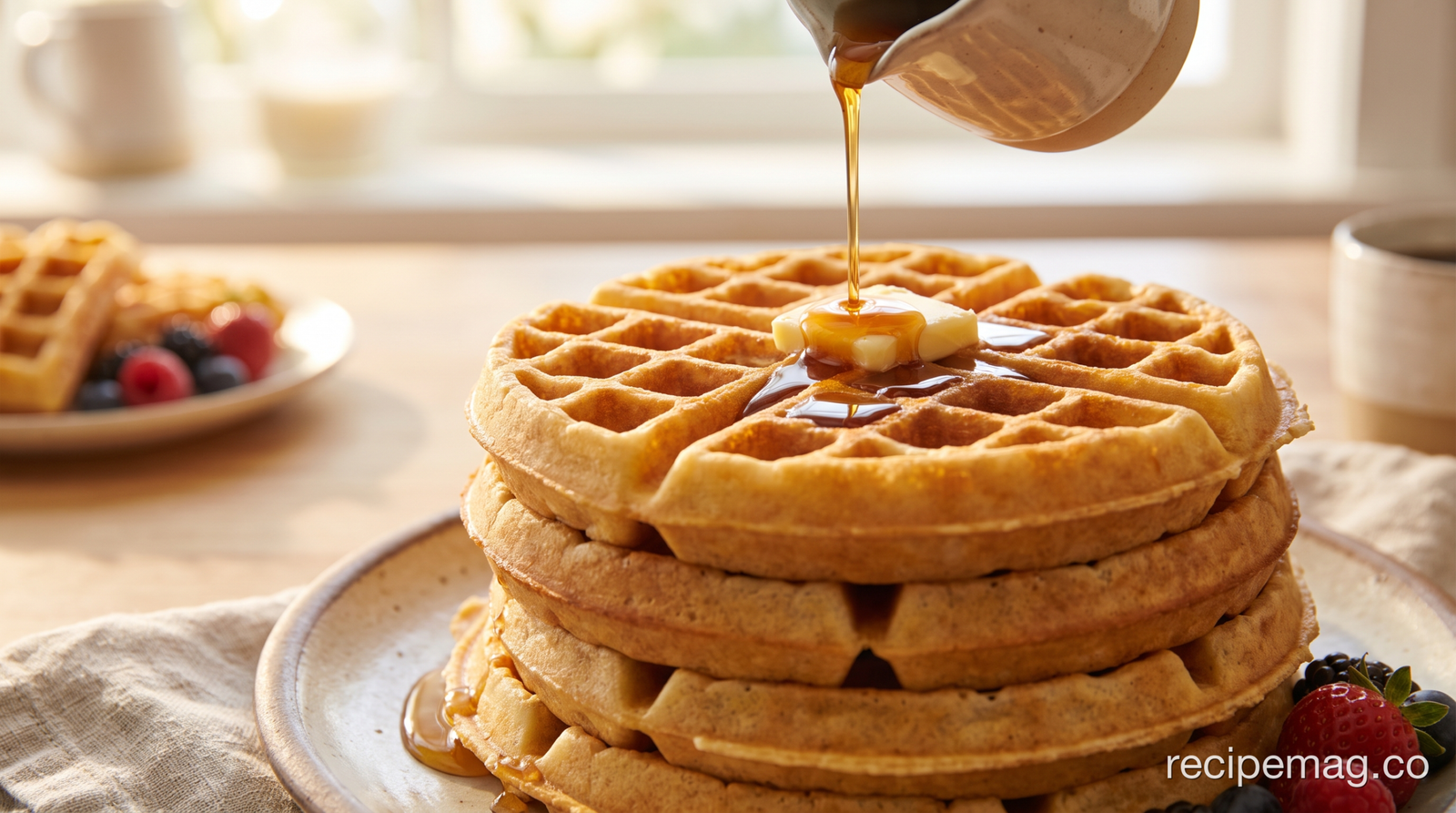
The difference between a good waffle and a great one is almost entirely about moisture management. A crisp waffle needs enough fat to fry its own surface, enough sugar to brown, and a batter that has rested long enough for the flour to hydrate. Get those three right and you do not need a special iron or a secret ingredient. Get them wrong and no topping will rescue the result.
Key Takeaways
- Buttermilk plus baking soda gives both lift and tenderness; the acid is doing real work.
- Resting the batter 15 to 30 minutes measurably improves crispness.
- Separating the eggs and folding in whipped whites is the single biggest upgrade.
- Cornstarch in the flour blend lowers the protein and crisps the shell.
- Hold finished waffles on a rack in a 200°F oven, never stacked on a plate.
Ingredients
Makes 6 to 8 waffles. Active time 15 minutes. Total time 45 minutes including the rest.
- 1 3/4 cups all-purpose flour
- 1/4 cup cornstarch
- 2 tbsp granulated sugar
- 2 tsp baking powder
- 1/2 tsp baking soda
- 3/4 tsp kosher salt
- 2 cups buttermilk, well shaken
- 2 large eggs, separated
- 6 tbsp unsalted butter, melted and slightly cooled
- 1 tsp vanilla extract
- Neutral oil, for the iron
Real buttermilk is worth buying. The common substitute of milk plus lemon juice curdles the milk but does not reproduce buttermilk’s thickness or its full acidity, and both matter here.
How to Make Them
1. Whisk the dry ingredients. Combine the flour, cornstarch, sugar, baking powder, baking soda, and salt in a large bowl. The cornstarch is not filler: it dilutes the wheat protein, which means less gluten and a crisper shell.
2. Mix the wet. In a second bowl, whisk the buttermilk, egg yolks, melted butter, and vanilla until smooth. Add the melted butter last and make sure it has cooled slightly, or it will start cooking the yolks.
3. Combine, barely. Pour the wet into the dry and stir just until no dry flour remains. Lumps are correct. Overmixing develops gluten and gives you a chewy, bready waffle.
4. Whip and fold the whites. Beat the egg whites to soft peaks, then fold them into the batter in two additions with a spatula. This is the step most people skip and it is the one that matters most: the whipped whites give an airy interior that no amount of baking powder replicates.
5. Rest. Let the batter sit 15 to 30 minutes at room temperature. The flour hydrates fully and the leavening gets a head start. Do not stir it again afterwards.
6. Cook. Heat the waffle iron thoroughly, then brush lightly with oil. Ladle in enough batter to cover about two-thirds of the surface; it spreads. Close and cook without opening for 4 to 6 minutes, until the steam slows noticeably and the waffle is deep golden.
7. Hold properly. Move each waffle to a wire rack in a 200°F oven. Stacking them on a plate traps steam and undoes the crispness within a minute.
What Each Ingredient Is Doing
Buttermilk. Its acidity reacts with baking soda to produce carbon dioxide, and it also tenderises by slowing gluten development. A waffle made with plain milk is flatter and tougher.
Two leaveners. Baking soda handles the reaction with the buttermilk and drives browning. Baking powder provides a second lift that is triggered by heat in the iron. Using only one gives you either a pale waffle or a flat one.
Butter, and plenty of it. Six tablespoons sounds generous for two cups of liquid, and that is deliberate. The fat effectively fries the waffle’s surface from the inside. A low-fat batter steams instead.
Sugar. Two tablespoons will not make the waffle sweet. It is there for browning, since sugars caramelise and participate in the Maillard reaction that gives the shell its colour and flavour.
Separated eggs. Yolks contribute fat and emulsification; whipped whites contribute air. Folding them in separately is worth the extra bowl.
Variations and Storage
Yeasted overnight waffles. Replace the baking powder with a teaspoon of instant yeast, mix the night before, and refrigerate. The overnight ferment builds a tangy, complex flavour and an even crisper shell. It is the same logic as our no-knead bread guide: time does the work.
Savoury. Drop the sugar to one teaspoon, skip the vanilla, and fold in sharp cheddar, scallions, and black pepper. These are the waffles you want under fried chicken.
Whole grain. Replace up to half the flour with whole wheat or buckwheat. Expect a denser waffle with a nuttier flavour; add an extra tablespoon of buttermilk to compensate for the extra absorption.
Freezing. Cool completely on a rack, freeze in a single layer on a sheet pan, then bag. They toast straight from frozen in about three minutes. A double batch on a Sunday covers school breakfasts for a week, which is the same thinking behind our make-ahead back-to-school lunches.
For ten more things to do with the iron once you have the batter down, see our National Waffle Day roundup, and for the full dinner version, chicken and waffles with hot honey.
Scaling Up for a Crowd
Waffles are a bad à la minute breakfast for more than four people, because a single iron produces one waffle every five minutes and everyone eats at a different time. The fix is to stop trying to serve them straight from the iron.
Cook the entire batch first, holding each waffle in a single layer on a wire rack in a 200°F oven. They keep their crispness for up to forty minutes there, which is far longer than most people expect, and it means everyone eats together. The rack is essential; a baking sheet traps steam underneath and undoes the crust.
The batter itself doubles cleanly, with one caveat: whip the egg whites in a single batch but fold them into the base in two halves, because a very large volume of batter deflates the whites as you work. If you are doubling, it is also worth splitting the dry mix into two bowls so nothing has to be stirred in an oversized container.
For a genuinely large gathering, make the yeasted overnight variation instead. It holds better, tastes more interesting, and removes all the whisking from the morning, which is where the pressure actually is.
Frequently Asked Questions
Why are my waffles not crispy?
The three usual causes are an under-heated iron, a batter too low in fat, and stacking the waffles after cooking. Fix all three before changing the recipe.
Can I make the batter the night before?
Not this version; the chemical leaveners will be largely spent by morning. For an overnight batter, use the yeasted variation instead, which is designed for a long cold rest.
What can I substitute for buttermilk?
Plain yogurt thinned with milk to a pourable consistency is the closest substitute. Milk soured with lemon juice works in a pinch but produces a slightly flatter, less tender waffle.
How do I know when a waffle is done?
Watch the steam rather than the clock. A waffle releases a heavy plume early on; when that slows to a wisp, the interior moisture has cooked off and the shell is set.
Do I really need to whip the egg whites?
No, but it is the single largest improvement available. Without it you get a perfectly good waffle; with it you get a noticeably lighter one.
How long do leftover waffles keep?
Three days refrigerated or three months frozen. Reheat in a toaster or a 375°F oven, never a microwave, which turns them to rubber.
