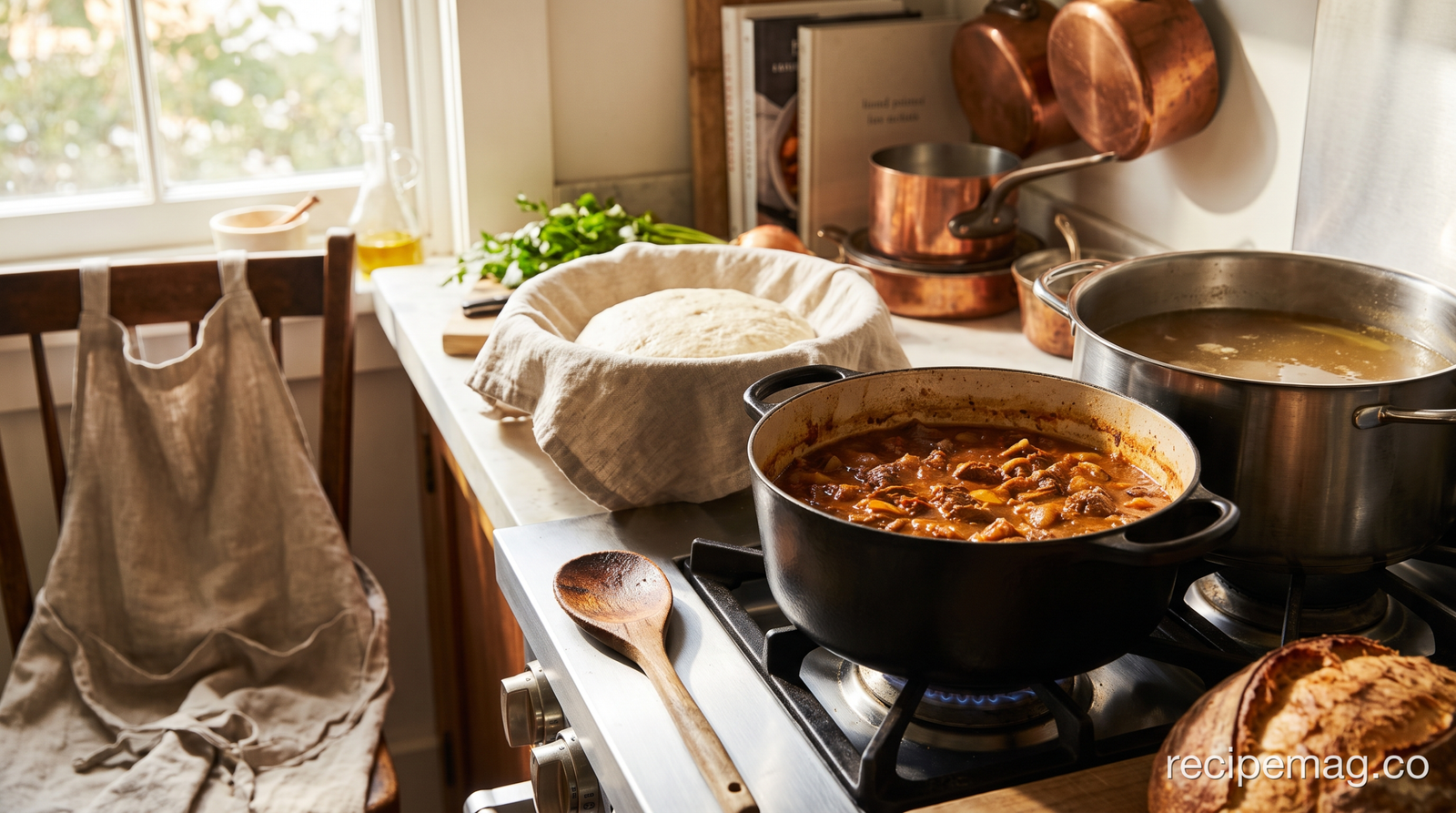
There is a category of cooking that does not fit a weeknight: things that need four hours of mostly unattended time, or that only make sense in a quantity large enough to last. Late August is when that category becomes appealing again, because the kitchen is no longer unbearable and the week ahead has structure to it. Every recipe below produces something that makes the following week easier, which is the actual argument for spending a Sunday afternoon this way.
Key Takeaways
- Pick projects with long unattended stretches, not long active ones.
- Stack them: bread proofs while stock simmers while a braise cooks.
- Anything that freezes flat is worth doubling.
- Cooked dishes hold three to four days refrigerated at 40°F or below (USDA FSIS, 2023).
- One afternoon should yield at least three weeknight dinners.
How to Stack an Afternoon
The trick is not speed, it is overlap. Almost everything worth cooking on a Sunday has a long stretch where nothing is required of you, and those stretches can run concurrently.
A workable sequence: mix bread dough first, because it needs the longest and least attention. Get stock on the back burner second. Start a braise third. Then, while all three run, make the sauces and dressings that need ten minutes each. By the time the braise is done the bread has proofed, and the total active time across all of it is perhaps ninety minutes.
Order things by unattended duration, longest first. Doing it the other way around — starting with the ten-minute jobs — is how a Sunday afternoon becomes a Sunday evening.
Eight Projects Worth the Time
1. A Pot of Stock
The highest-value thing on this list. Roast chicken bones, an onion, a carrot, celery, and peppercorns, covered with water and simmered three hours at a bare tremble. Never boil it; a rolling boil emulsifies fat into the liquid and turns it cloudy. Freeze flat in bags.
2. No-Knead Bread
Fifteen minutes of work spread across a day, and the rest is waiting. Start it Saturday night and bake Sunday afternoon. Our no-knead Dutch oven bread is the version to start with, and the method guide explains why it works.
3. A Braise
The definitive Sunday dish, because three hours in a low oven asks nothing of you. Our braised short ribs with late-summer tomatoes is the seasonal one, and it is better made a day ahead anyway.
4. Roasted Tomato Sauce
Two sheet pans of tomatoes, ninety minutes in the oven, and a winter’s worth of sauce in the freezer. Given end-of-season tomato prices this is the best return available on an afternoon. See our roasted tomato sauce for the freezer.
5. Pesto, in Bulk
Twenty minutes of work that preserves an entire basil crop. Blanch first if it is going in the freezer. Our basil pesto and how to freeze it covers the method.
6. A Big Soup
Made Sunday, it covers the night the week falls apart. Our end-of-summer minestrone uses whatever the market cleared out.
7. Quick Pickles and Condiments
Fifteen minutes, and they improve every plate for the next month. Our refrigerator pickles peak at 72 hours, which lines up with Wednesday.
8. Breaded Cutlets for the Freezer
Bread a dozen, freeze them flat, and fry from frozen on a weeknight. It is the single most useful thing in our school-night dinner system. The recipe is our crispy chicken cutlets.
What Not to Do
Do not assemble finished meals. Complete plated dinners degrade badly by Thursday. Make components and sauces; assemble on the night.
Do not attempt everything. Three projects is a good afternoon. Eight is a resentful one, and the point is that this should be pleasant enough to repeat next week.
Do not skip labelling. Everything in a freezer looks the same in January. Contents and date, on every bag.
Do not cook things nobody wants. Batch cooking only saves time if the food gets eaten. A gallon of a soup your household is lukewarm about is not an asset.
A Worked Example of an Afternoon
Concrete timings make the stacking idea easier to picture. This is a four-hour Sunday producing stock, bread, a braise, and pickles.
12:00. Mix the bread dough if you did not do it last night, or shape it if you did. Get the stock pot on with bones, aromatics, and cold water, and bring it to a bare simmer.
12:20. Sear the braise meat, build the base, and get it into a 300°F oven. It needs nothing further for three hours.
12:45. Make the pickle brine and pack the jars. Fifteen minutes, start to finish.
1:00 to 3:00. Nothing required. Skim the stock once if you think of it. This is the stretch that makes the whole approach worthwhile.
3:00. Preheat the Dutch oven for the bread. Strain the stock and set it to cool.
3:45. Bread into the oven once the braise comes out and rests.
4:30. Bread out. Portion and label everything: stock flat in bags, braise into containers, pickles into the fridge.
Total hands-on time is under ninety minutes, and the output covers three dinners plus a month of pickles and a freezer of stock.
Freezing and Labelling Properly
The output of a Sunday afternoon is only worth having if you can find it and use it in February. Two habits make the difference.
Freeze flat. Liquids and semi-liquids — stock, sauce, soup, braise — go into zip bags laid flat on a sheet pan until solid. Flat slabs stack upright like files, take a fraction of the space of tubs, and thaw in twenty minutes under cool water rather than overnight. This one change roughly doubles usable freezer capacity.
Label everything, always. Contents, date, and quantity, written before the bag is filled rather than after, when it is wet. Every frozen red thing looks identical by January, and unlabelled bags are how good food becomes a mystery and then rubbish.
Portion to how you will actually use it. Stock in two-cup bags matches most recipes; a single enormous bag means thawing far more than you need. Sauce in one-cup portions serves two. Braises in meal-sized containers, not family-sized, unless you always eat as a family.
Keep a running list on the freezer door. It sounds fussy and it takes ten seconds per item, and it is the only reliable way to stop the third batch of stock going in behind two forgotten ones.
Frequently Asked Questions
How long does a Sunday session actually take?
Three to four hours of elapsed time, of which perhaps ninety minutes is active if the projects are stacked properly.
What freezes best?
Stock, tomato sauce, soups without pasta, braises, pesto, and breaded raw cutlets. All of them freeze flat and thaw quickly.
What does not freeze well?
Cooked pasta, potatoes in soup, cream sauces, salad vegetables, and anything crumbed and already fried. Add those fresh.
How long do refrigerated leftovers last?
Three to four days at 40°F or below. Anything beyond that should have gone into the freezer on day one.
Is batch cooking actually cheaper?
Generally yes, because it lets you buy end-of-season produce in bulk and use cheaper cuts that need long cooking. Both are the point of a Sunday.
Which single project should I start with?
Stock. It costs almost nothing, it is nearly impossible to ruin, and it improves everything you cook for the next two months.
