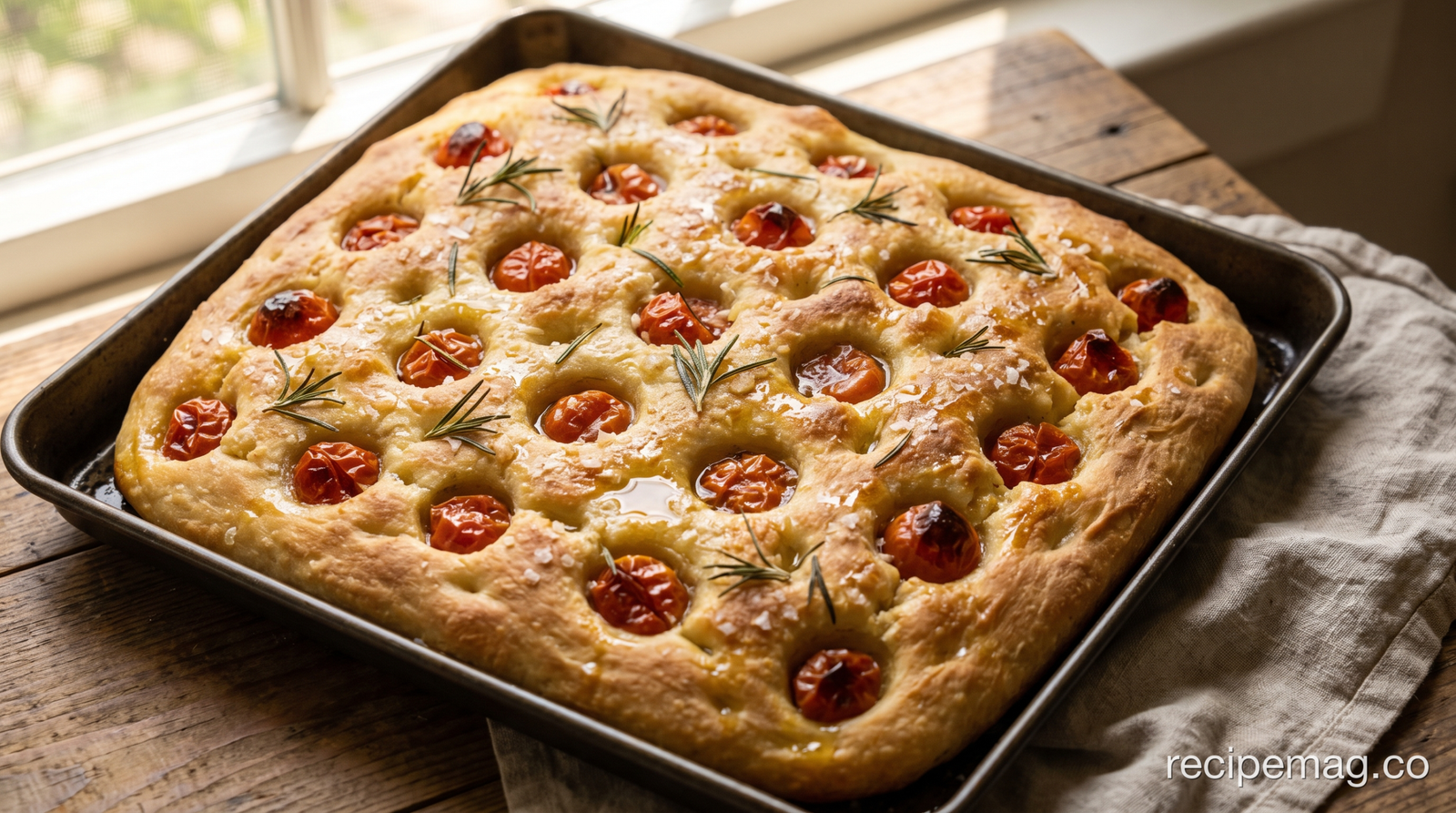
Focaccia is the most forgiving bread there is, and the most rewarding way to use the last of the cherry tomatoes. There is no shaping, no scoring, and no Dutch oven. What it does need is more olive oil than feels reasonable, because the oil pooled under the dough effectively fries the base while the top bakes, and that contrast is the entire appeal.
Key Takeaways
- High hydration plus an overnight cold rise gives the open, airy interior.
- Use far more olive oil in the pan than seems sensible; it fries the base crisp.
- Dimple with oiled fingers right down to the pan, firmly.
- Halve the tomatoes and press them in cut side up so they roast rather than steam.
- Flaky salt goes on immediately before baking, not into the dough.
Ingredients
Makes one 9×13 pan, serves 8. Active time 20 minutes. Total time 18 to 24 hours.
- 500g (about 4 cups) bread flour
- 400g (about 1 2/3 cups) room-temperature water
- 1/2 tsp instant yeast
- 10g (2 tsp) fine sea salt
- 1/2 cup extra-virgin olive oil, divided
- 12 oz cherry tomatoes, halved
- 3 sprigs rosemary, leaves picked
- 2 garlic cloves, thinly sliced
- Flaky sea salt
Eighty percent hydration is what produces the big irregular holes. The dough will be unmanageably wet by normal standards, and that is the point; you never handle it directly with dry hands.
How to Make It
1. Mix (evening). Whisk the flour, yeast, and salt in a large bowl. Add the water and 2 tablespoons of the olive oil, then stir with a wet hand until no dry flour remains. It will be a sticky, shaggy mess. Cover the bowl.
2. Fold, then chill. After 30 minutes, wet your hand, reach under one side of the dough, stretch it up and fold it over the centre. Rotate the bowl and repeat three more times. Do this set of folds twice more at 30-minute intervals, then cover and refrigerate 12 to 24 hours. The folds build structure that kneading would otherwise provide.
3. Pan it. Pour 3 tablespoons of olive oil into a 9×13 metal pan and spread it up the sides. Scrape the cold dough in, turn it once to coat both sides in oil, and gently stretch it toward the corners. It will resist and spring back. Leave it, cover, and let it relax 20 minutes, then stretch again. Repeat until it reaches the corners.
4. Final rise. Cover and leave at room temperature 2 to 4 hours, until visibly puffed and jiggly. Cold dough from the fridge takes the longer end of that range.
5. Dimple and top. Heat the oven to 450°F. Drizzle the remaining oil over the surface. Press your oiled fingertips straight down through the dough to the pan bottom, all over, at roughly one-inch intervals. Be firm; timid dimpling disappears in the oven. Press the halved tomatoes in cut side up, scatter the rosemary and garlic, and finish with flaky salt.
6. Bake. 22 to 27 minutes, until the top is golden and the edges are deep brown and pulling from the pan. Lift a corner with a spatula to check the base is crisp and golden.
7. Rest briefly. Slide it out of the pan onto a rack after 5 minutes so the base does not steam. Serve warm or at room temperature.
The Three Things That Decide Focaccia
Oil quantity. Half a cup for one pan sounds excessive until you understand the mechanism. The oil beneath the dough reaches frying temperature and crisps the base, while the oil on top conducts heat and browns the surface. Cut it back and you get a pale, bready result that is technically focaccia and not worth making.
Dimple depth. The dimples are structural, not decorative. Pressing all the way to the pan creates the characteristic uneven surface of thin crisp ridges and thick soft valleys. Shallow dimples puff closed and you get flatbread.
The cold ferment. Twelve to twenty-four hours in the fridge slows the yeast while flour enzymes keep converting starch to sugar. That means more flavour and better browning. A same-day warm rise produces bread that is fine and forgettable.
The underlying method is the same as our no-knead bread guide: time and water replace kneading.
Toppings and Serving
Late August is generous here. Cherry tomatoes are the obvious choice and the best; halve them and press them cut side up so they concentrate rather than weep. Thin slices of courgette, red onion, or the last peppers all work, as does a scattering of olives.
Keep the topping sparse. Focaccia loaded edge to edge steams itself and never crisps. Leave visible dough between the pieces.
It is at its best warm on the day it is baked. Beyond that, refresh slices in a 350°F oven for five minutes rather than a microwave. Split horizontally it makes an outstanding sandwich, and cut into squares it belongs on a summer charcuterie board or beside our end-of-summer minestrone.
If tomatoes are still arriving faster than you can cook them, our tomato glut roundup covers the rest.
Focaccia as a Base for the Week
A single pan produces far more than one meal, and treating it as a component rather than a side extends its usefulness considerably.
Split horizontally it becomes sandwich bread with a structure no sliced loaf matches — crisp top, soft middle, oiled base. Filled with mozzarella, tomato, and basil it is essentially a caprese sandwich that holds together for a packed lunch.
Cut into small squares it becomes the carbohydrate on a grazing board, and it is sturdy enough to hold a spoonful of dip without collapsing. Cubed and re-toasted it makes croutons with far more character than sliced bread produces, which is exactly what a panzanella wants while tomatoes are still good.
Stale focaccia has one more use worth knowing. Blitzed in a processor it makes seasoned breadcrumbs already carrying olive oil, rosemary, and salt, which are excellent on pasta or over roasted vegetables. Frozen, those breadcrumbs keep three months.
The one thing focaccia does not do well is sit around soft. Anything not eaten within a day should be refreshed in a hot oven or repurposed, because reheating restores it and time does not.
Frequently Asked Questions
Can I make focaccia the same day?
Yes. Use a full teaspoon of yeast, do the folds, and let it rise at room temperature 3 to 4 hours before panning. The flavour will be noticeably plainer than the overnight version.
Why is my focaccia dense?
Usually under-proofing at the final rise, or knocking the air out while stretching. The dough should look visibly puffed and wobble when the pan is shaken before it goes in the oven.
Does the pan material matter?
Yes. Metal conducts heat far better than glass or ceramic and gives a crisper base. A dark metal pan is best of all.
Can I use dried herbs instead of fresh?
Fresh rosemary is much better here, since dried herbs scorch at 450°F. If using dried, mix them into the oil rather than scattering them on top.
How do I stop the tomatoes making it soggy?
Halve them and place them cut side up so moisture evaporates upward rather than into the dough, and do not overload the surface.
Can I freeze focaccia?
Yes. Cool completely, cut into portions, and freeze in bags for up to three months. Reheat from frozen at 350°F for about ten minutes.
