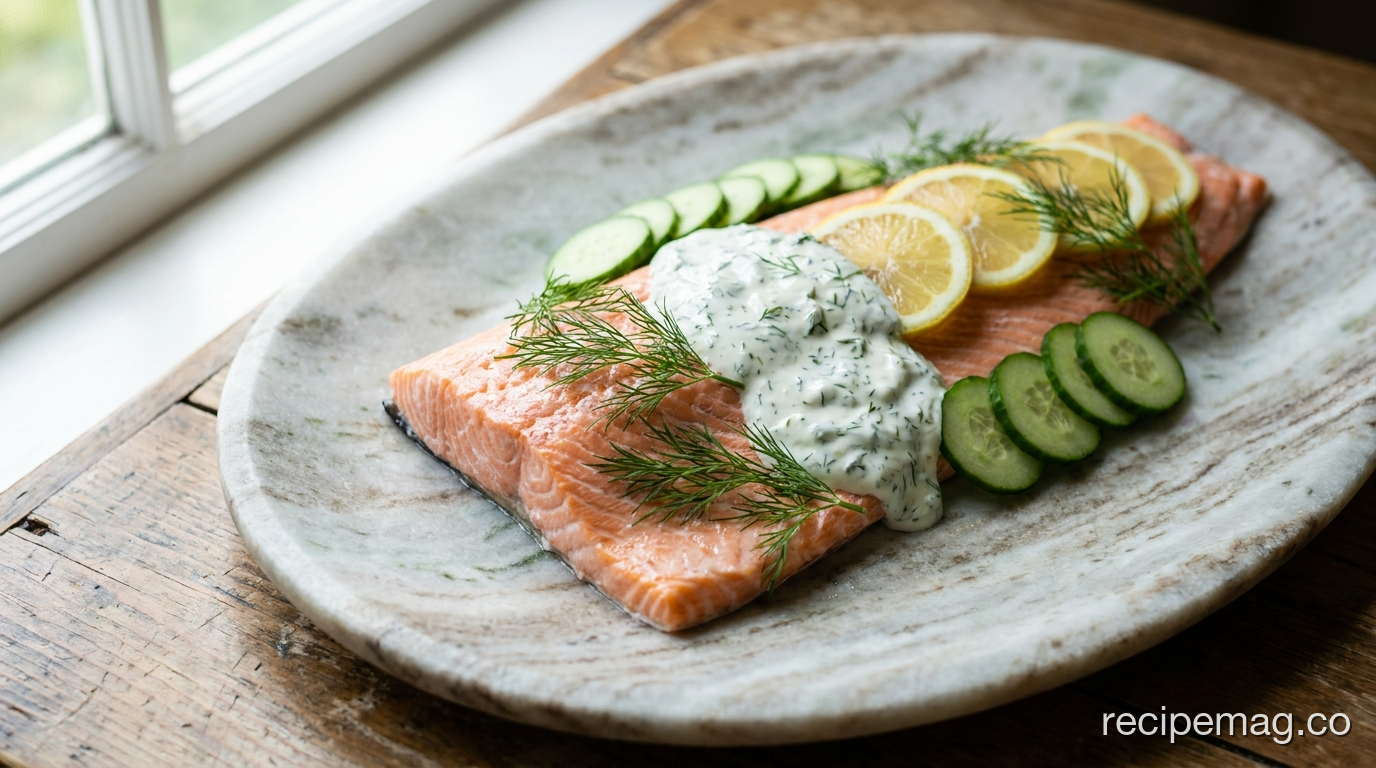
Cold poached salmon is salmon gently cooked in barely-simmering liquid, then chilled and served cold with a bright sauce. It’s an elegant make-ahead summer dinner that stays moist because poaching happens well below a boil. Salmon is one of the best sources of omega-3 fats, delivering over 1,500 mg of EPA and DHA per serving (FDA, 2023). Cook it once, serve it cold all week.
Key Takeaways
- Poach at 160-180°F, never a rolling boil, to keep salmon tender and moist.
- Salmon delivers over 1,500 mg of omega-3s (EPA and DHA) per serving. ([FDA](https://www.fda.gov), 2023)
- Cold poached salmon is fully make-ahead: it’s meant to be chilled and served cold.
- The dill yogurt sauce takes 5 minutes and needs no cooking.
- Cook salmon to an internal temperature of 145°F for food safety (USDA).
What Is Cold Poached Salmon?
Cold poached salmon is salmon cooked slowly in gently simmering liquid, then chilled and served cold. Poaching holds the liquid between 160°F and 180°F, well under a boil, which stops the fish proteins from seizing and pushing out moisture (America’s Test Kitchen, 2022). The result is silky, tender fish that never dries out.
Because it’s served cold, the whole dish is designed to be made ahead. You poach in the morning or the day before, chill it, and dinner is essentially done. On a hot night, that’s exactly what you want.
It’s also a naturally elegant plate. A cold poached fillet with a spoon of herbed sauce and a wedge of lemon looks like something from a summer luncheon menu, yet it takes very little active work.
Why Cold Poached Salmon Is the Perfect Summer Dinner
This dish checks every summer box: no oven heat, make-ahead friendly, light, and packed with nutrition. Health authorities recommend eating fatty fish like salmon at least twice a week for its omega-3 content and heart benefits (American Heart Association, 2023). Cold poached salmon makes hitting that target genuinely pleasant.
The make-ahead angle is the real draw. There’s no last-minute cooking, no hot pan, no timing stress at dinner. You pull a chilled platter from the fridge and serve. Guests get a restaurant-looking plate, and you get to actually sit down.
[PERSONAL EXPERIENCE] We started making this for weekend lunches and quickly moved it into the weeknight rotation. Poaching a batch on Sunday means cold salmon over salad on Monday and flaked into a grain bowl on Tuesday, all without touching the stove again.
Ingredients for Cold Poached Salmon and Dill Yogurt Sauce
The salmon needs a flavorful poaching liquid, and the sauce comes together from fridge staples. Choose a thick, even fillet for the best result: center-cut salmon poaches more evenly than thin tail pieces. A single serving delivers well over 1,000 mg of EPA and DHA omega-3s (FDA, 2023).
For the Poached Salmon
- 4 salmon fillets (about 6 oz each), skin on or off
- 4 cups water
- 1 cup dry white wine (or 2 more cups water plus a splash of vinegar)
- 1 lemon, sliced
- 1 shallot, sliced
- A few sprigs fresh dill and parsley
- 1 teaspoon whole peppercorns
- 1 bay leaf
- 1 teaspoon salt
For the Dill Yogurt Sauce
- 1 cup plain Greek yogurt
- 2 tablespoons chopped fresh dill
- 1 tablespoon fresh lemon juice
- 1 small garlic clove, grated
- 2 teaspoons olive oil
- Salt and black pepper to taste
Greek yogurt does the heavy lifting in the sauce, adding tang and protein without the heaviness of a mayonnaise base. A grated garlic clove spreads through more evenly than minced and won’t leave sharp bites.
How to Poach Salmon So It Stays Moist
The single rule of good poached salmon: never let the liquid boil. Keep it at a bare simmer, around 170°F, where you see only tiny bubbles and gentle steam (Serious Eats, 2022). A boil toughens the fish and drives out the moisture you’re trying to protect. Low and slow is the whole technique.
Step-by-Step Poaching Instructions
- Build the poaching liquid. Combine water, wine, lemon, shallot, herbs, peppercorns, bay leaf, and salt in a wide pan. This is a quick court bouillon.
- Simmer the liquid for 10 minutes. Bring it to a gentle simmer and let it steep so the flavors bloom, then reduce to low.
- Lower the salmon in gently. Slide the fillets into the liquid. They should be just covered. Add a splash of water if not.
- Hold at a bare simmer. Keep the liquid at 160-180°F, never bubbling hard. You want the surface barely trembling.
- Poach 8 to 12 minutes. Timing depends on thickness. The fish is done at an internal temperature of 145°F (USDA FSIS, 2023).
- Cool in the liquid, then chill. Turn off the heat and let the salmon cool in the poaching liquid for 10 minutes, then transfer to the fridge to chill fully.
[UNIQUE INSIGHT] Cooling the salmon in its own poaching liquid is the step most recipes skip, and it’s the one that guarantees moist fish. As the liquid cools, the fillets keep absorbing seasoned moisture instead of drying out on a plate. Pull them straight from a hot pan and you lose that cushion.
How to Make the Dill Yogurt Sauce
This 5-minute no-cook sauce is what makes the dish sing. Yogurt-based sauces are lighter than mayonnaise or cream versions while still adding richness and a protein boost (Harvard T.H. Chan School of Public Health, 2023). Dill and salmon are a classic pairing for good reason: the herb’s grassy brightness cuts the fish’s richness cleanly.
Steps
- Combine Greek yogurt, chopped dill, lemon juice, grated garlic, and olive oil in a bowl.
- Stir until smooth and evenly green-flecked.
- Season with salt and black pepper. Taste and add more lemon if you want it brighter.
- Chill for 15 minutes so the garlic and dill infuse the yogurt.
The sauce keeps in the fridge for up to three days and works far beyond this dish. Spoon it over roasted vegetables, use it as a dip, or thin it with water into a salad dressing. Make a double batch.
Serving and Make-Ahead Tips
Cold poached salmon is built for entertaining because nearly all the work happens in advance. Chilled cooked fish keeps safely for up to three to four days when refrigerated at or below 40°F (USDA FSIS, 2023). Poach it a day ahead and serving becomes a two-minute job.
- Serve it on a platter with lemon wedges, extra dill, and the sauce in a bowl alongside.
- Pair with cold sides: a cucumber salad, boiled new potatoes chilled, or a simple green salad.
- Flake leftovers into grain bowls, salads, or lettuce wraps through the week.
- Bring it to room temperature for 10 minutes before serving so the flavor opens up.
- Keep the sauce separate until serving so the salmon doesn’t go soft.
Cold Poached Salmon with Dill Yogurt Sauce
Prep Time: 15 minutes | Cook Time: 12 minutes | Chill Time: 2 hours | Serves: 4
Ingredients
Poached Salmon
- 4 salmon fillets (about 6 oz each)
- 4 cups water
- 1 cup dry white wine
- 1 lemon, sliced
- 1 shallot, sliced
- Fresh dill and parsley sprigs
- 1 teaspoon peppercorns
- 1 bay leaf
- 1 teaspoon salt
Dill Yogurt Sauce
- 1 cup plain Greek yogurt
- 2 tablespoons chopped fresh dill
- 1 tablespoon lemon juice
- 1 small garlic clove, grated
- 2 teaspoons olive oil
- Salt and black pepper to taste
Instructions
- Combine all poaching liquid ingredients in a wide pan. Simmer gently 10 minutes.
- Reduce heat to low. Slide in the salmon fillets so they’re just covered.
- Poach at a bare simmer (160-180°F) for 8 to 12 minutes, until the fish reaches 145°F internally.
- Turn off heat. Let salmon cool in the liquid 10 minutes, then chill fully in the fridge, at least 2 hours.
- Make the sauce: stir together yogurt, dill, lemon juice, garlic, and olive oil. Season and chill.
- Serve the cold salmon with the dill yogurt sauce and lemon wedges.
Notes
- Keeps refrigerated for 3 to 4 days. Store sauce separately.
- No wine? Use extra water plus a splash of white vinegar or lemon juice.
- Let the salmon sit 10 minutes at room temperature before serving for the best flavor.
Frequently Asked Questions About Cold Poached Salmon
What temperature should I poach salmon at?
Keep the poaching liquid between 160°F and 180°F, a bare simmer with only tiny bubbles. Boiling toughens the fish and squeezes out moisture. Cook until the salmon reaches an internal temperature of 145°F, which the USDA considers the safe minimum for fish (USDA FSIS, 2023). Gentle heat is the entire secret to tender, moist poached salmon.
Can I make poached salmon ahead of time?
Yes, that’s the whole point of serving it cold. Poach the salmon, chill it, and store it covered in the fridge for up to three to four days at or below 40°F (USDA FSIS, 2023). Make the dill yogurt sauce up to three days ahead too. Keep the two separate until serving so the fish stays firm.
What liquid is best for poaching salmon?
A court bouillon, which is water with wine, lemon, shallot, herbs, and peppercorns, gives the most flavor. The wine and aromatics gently season the fish as it cooks. You can use plain salted water with lemon in a pinch, but the extra ingredients make a real difference. Simmer the liquid for ten minutes first so the flavors develop before the salmon goes in.
Is cold salmon safe to eat?
Yes, as long as it was cooked to 145°F and chilled promptly. Cooked salmon served cold is perfectly safe when it’s refrigerated within two hours and kept at or below 40°F (USDA FSIS, 2023). This is different from raw preparations like sushi. Here the fish is fully cooked, then simply chilled and served at a cold temperature.
What can I substitute for the yogurt in the sauce?
Sour cream works as a direct swap and gives a slightly richer result. For a dairy-free version, use a thick plant-based yogurt or a cashew cream base. You can also fold the dill, lemon, and garlic into mayonnaise for a more classic tartar-style sauce. Greek yogurt stays the lightest option and adds the most protein.
Make It Once, Eat It All Week
Cold poached salmon is the rare summer dinner that’s elegant, healthy, and almost entirely make-ahead. Master the gentle poach, keep the liquid below a boil, and you’ll get tender fish every time. The dill yogurt sauce takes five minutes and pulls the whole plate together.
Poach a batch this weekend and you’ve set yourself up for cool, effortless meals across several days. Salad on one night, a grain bowl the next, a full platter for guests when they come by.
Next time the heat makes the oven unthinkable, let a pot of barely-simmering water do the cooking. Chill, sauce, and serve.
