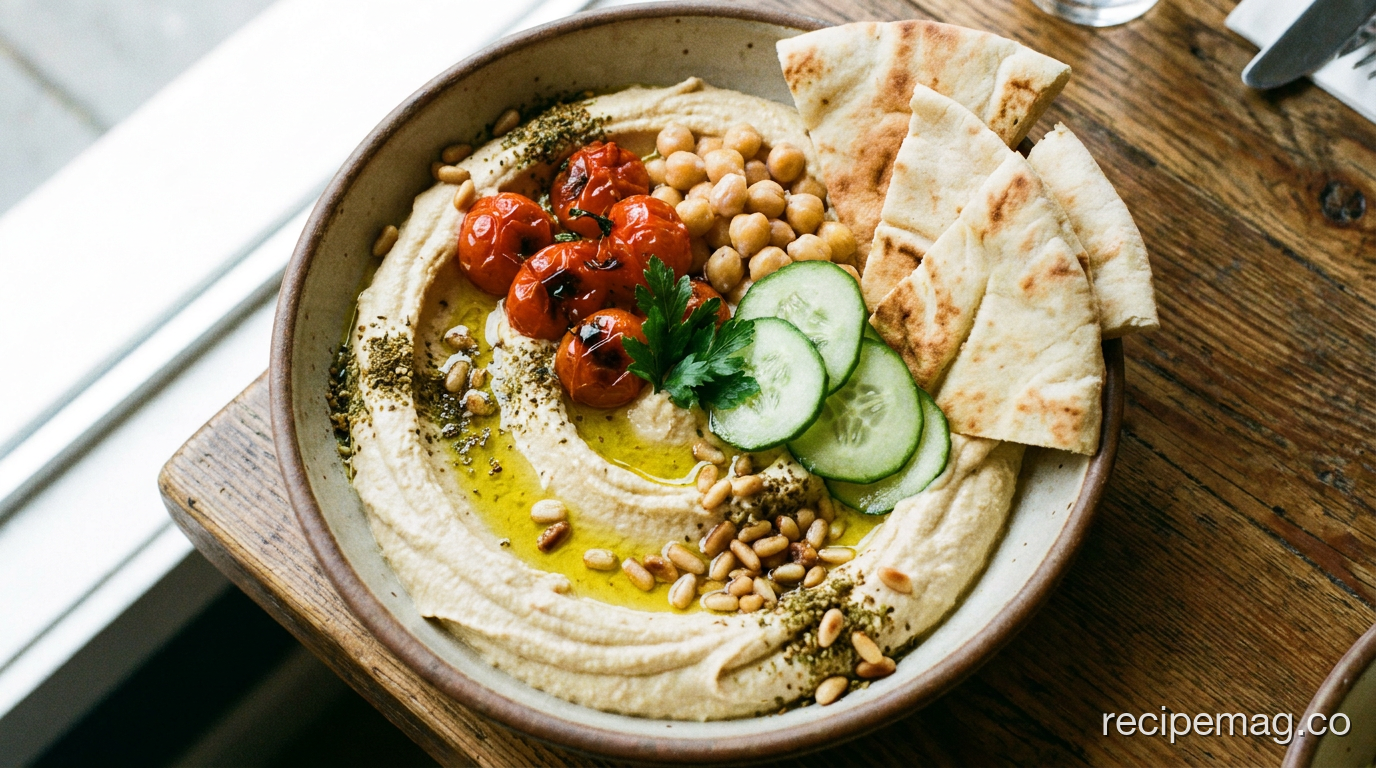
A loaded hummus bowl turns a tub of hummus into a full mezze-style lunch in about 30 minutes. You swirl a thick layer of hummus across a shallow bowl, then pile it with roasted cherry tomatoes, crispy chickpeas, cool cucumber, briny olives, and herbs. Warm pita does the scooping. It’s mostly assembly, almost no real cooking, and it holds beautifully for summer meal prep. Hummus is more popular than ever: roughly 25% of U.S. households now keep it in the fridge, according to industry tracking data. (Statista, 2023) This is the best way to use it.
Key Takeaways
- Comes together in about 30 minutes and is largely no-cook beyond roasting the tomatoes and chickpeas.
- Roasting cherry tomatoes at 425°F blisters and concentrates them, deepening flavor through the Maillard reaction. (Serious Eats, 2022)
- Chickpeas are a complete-meal anchor: a half cup delivers about 7 grams of plant protein and 6 grams of fiber. (USDA FoodData Central, 2023)
- Swirling the hummus into a wide, shallow bowl creates valleys that catch every topping and the warm tomato juices.
- Built for meal prep: store components separately and assemble fresh in two minutes.
What Makes a Hummus Bowl “Loaded”?
A loaded hummus bowl treats hummus as the plate, not the dip. Instead of a small ramekin beside crudités, you spread a generous, swirled base across a wide bowl and load it with warm and cold toppings until it reads as a full meal. The popularity is real: roughly a quarter of U.S. households now buy hummus regularly. (Statista, 2023) This recipe gives that habit a proper destination.
The “loaded” part is about contrast. You want warm against cool, soft against crunchy, rich against bright. Roasted cherry tomatoes bring jammy warmth and acid. Crispy chickpeas add crunch and a second hit of protein. Cucumber and herbs keep it fresh. Olives and a swirl of good olive oil tie it to its mezze roots.
Hummus itself earns the starring role nutritionally. It’s built from chickpeas and tahini, so it carries plant protein, fiber, and healthy fats in the base layer before you add a single topping. That’s why this bowl satisfies in a way a salad alone often doesn’t.
[PERSONAL EXPERIENCE] We’ve made this dozens of times across a hot summer of recipe testing, and the single biggest upgrade was treating the hummus like a canvas. Spreading it thick with the back of a spoon and dragging a swirl into it creates little valleys that catch the warm tomato juices. A flat smear just doesn’t do the same job.
Ingredients for Your Loaded Hummus Bowl
This bowl is forgiving, and most of it comes straight from the fridge. The one component worth real attention is the chickpeas. A half cup of cooked chickpeas provides roughly 7 grams of protein and 6 grams of fiber, making them the nutritional backbone of both the hummus and the crispy topping. (USDA FoodData Central, 2023) You’ll use one can across the whole recipe.
For the Base and Toppings
- 1½ cups hummus (store-bought or homemade), at room temperature
- 2 cups cherry tomatoes
- 1 can (15 oz) chickpeas, drained and patted very dry
- 3 tablespoons olive oil, divided, plus more for drizzling
- ½ teaspoon smoked paprika
- ½ teaspoon cumin
- 1 Persian or mini cucumber, sliced into half-moons
- ⅓ cup Kalamata or Castelvetrano olives, halved
- ¼ cup crumbled feta (optional)
- 2 tablespoons fresh parsley or dill, roughly chopped
- Squeeze of lemon
- Flaky salt and black pepper to taste
- 2 to 3 pita breads, warmed, for serving
Pat the chickpeas as dry as you can. Moisture is what stands between you and crisp chickpeas. Roll them in a clean towel, rub off any loose skins, and let them air-dry for a few minutes while the oven heats. Dry chickpeas crisp; wet ones steam and stay soft.
How Do You Roast Cherry Tomatoes Until Blistered?
High heat is the whole trick. Roasting cherry tomatoes at 425°F blisters their skins and concentrates their juices into something jammy and intensely sweet-tart. The browning comes from caramelization and the Maillard reaction, the same chemistry that gives roasted vegetables their savory edge. (Serious Eats, 2022) Twenty minutes turns plain tomatoes into the best part of the bowl.
Step-by-Step Roasting
- Preheat the oven to 425°F (220°C). Let it come fully to temperature. A cool oven steams instead of roasting, and you’ll lose the blister.
- Use two pans, or two zones of one large pan. Put the cherry tomatoes on one side and the dried chickpeas on the other, keeping them separate so each crisps and blisters properly.
- Season. Toss the tomatoes with 1 tablespoon olive oil and a pinch of salt. Toss the chickpeas with 2 tablespoons olive oil, the smoked paprika, cumin, salt, and pepper.
- Give everything room. Crowded tomatoes steam in their own juice. Spread them in a single layer so the skins can split and char.
- Roast the tomatoes for 18 to 22 minutes, until the skins blister, split, and several have collapsed into jammy pockets. Don’t stir; let them sit and brown.
- Roast the chickpeas for 25 to 30 minutes, shaking the pan once at 15 minutes, until firm, dry, and golden. They crisp further as they cool.
[UNIQUE INSIGHT] Most people pull the tomatoes too early, the moment they look soft. Don’t. The flavor payoff happens in the last five minutes, when the skins actually char and the juices reduce to a syrup. Those concentrated juices are your dressing. Scrape every bit off the pan and spoon it over the hummus.
How to Assemble a Swirled Hummus Base
Assembly is where this bowl earns its name, and the swirl is the key move. Spreading hummus into a wide, shallow bowl and dragging a swirl through it creates ridges and valleys that hold the toppings and the warm juices. Plating matters more than people think: research has linked attractive arrangement to higher taste ratings for the same food. (Appetite, Elsevier, 2020) Two minutes of careful assembly genuinely changes how good it tastes.
Assembly Steps
- Swirl the hummus. Spoon room-temperature hummus into a wide, shallow bowl. Use the back of a spoon to spread it to the edges, then drag a curved swirl to build ridges that catch toppings.
- Add the warm components. Spoon the roasted cherry tomatoes into the center, pouring their pan juices over the hummus. Scatter the crispy chickpeas around them.
- Add the cool components. Tuck in the cucumber half-moons and halved olives around the edges. Add feta if using.
- Finish. Drizzle with olive oil, squeeze over fresh lemon, and shower with parsley or dill. Add flaky salt and cracked pepper.
- Serve with warm pita. Warm the pita in a dry skillet or oven for a minute, cut into wedges, and serve alongside for scooping.
For a single large sharing bowl, build everything on one platter and set it in the middle of the table. For individual servings, divide across two or three smaller bowls and adjust the toppings to taste. Either way, the warm-on-cool contrast is best within a few minutes of assembling.
Make-Ahead and Meal Prep Tips
This bowl is a strong meal-prep candidate because the components store well on their own. The USDA recommends keeping cooked legumes and prepared dips in sealed airtight containers at 40°F or below, where they stay safe and high quality for three to four days. (USDA Food Safety and Inspection Service, 2023) Prep on Sunday and you’ve got fast lunches through midweek.
- Store components separately. Hummus, roasted tomatoes, crispy chickpeas, and chopped vegetables each go in their own container. This keeps the chickpeas crunchy and the cucumber crisp.
- Refrigerator life: Hummus and roasted tomatoes keep for 4 days. Cut cucumber is best within 2 to 3 days. Crispy chickpeas are best within 2 days before they soften.
- Reheat the tomatoes gently, or bring them to room temperature. Cold hummus straight from the fridge tastes flat, so let it sit out for 15 minutes before serving.
- Keep chickpeas at room temperature, loosely covered, rather than sealed warm. Trapped steam softens them fast.
- Double the roasted tomatoes. They’re just as good on eggs, pasta, toast, or folded into a grain bowl later in the week.
Variations and Add-Ins
The bowl is a framework. Once you’ve made the base version, it bends easily toward whatever you have on hand or want more of. Plant-forward eating keeps expanding the options: U.S. retail sales of plant-based foods reached roughly $8 billion in 2022, reflecting how many cooks now build flexible, vegetable-centered meals. (Good Food Institute, 2023) This bowl fits that habit perfectly.
Swap the Hummus Base
- Roasted red pepper hummus adds sweetness and color that plays well with the charred tomatoes.
- Beet hummus turns the base a dramatic pink and brings earthy depth.
- Whipped feta or labneh works as an alternative tangy base if you want a change from hummus.
Add More Substance
- Falafel. Two or three baked falafel on top push this from light lunch to full dinner.
- A jammy egg. A 6-minute soft-boiled egg, halved, melts into the hummus beautifully.
- Grilled halloumi. Salty, seared slices against creamy hummus are hard to beat.
- Warm grains. A scoop of couscous, farro, or rice tucked under the toppings makes it heartier.
- Pickled onions. A handful of quick-pickled red onion adds brightness and crunch.
—
Loaded Hummus Bowl with Roasted Cherry Tomatoes
Prep Time: 10 minutes | Cook Time: 25 minutes | Serves: 2 to 3
Ingredients
- 1½ cups hummus, at room temperature
- 2 cups cherry tomatoes
- 1 can (15 oz) chickpeas, drained and patted very dry
- 3 tablespoons olive oil, divided, plus more to drizzle
- ½ teaspoon smoked paprika
- ½ teaspoon cumin
- 1 Persian or mini cucumber, sliced into half-moons
- ⅓ cup Kalamata or Castelvetrano olives, halved
- ¼ cup crumbled feta (optional)
- 2 tablespoons fresh parsley or dill, chopped
- Squeeze of lemon
- Flaky salt and black pepper to taste
- 2 to 3 pita breads, warmed
Instructions
- Preheat oven to 425°F (220°C).
- Pat chickpeas very dry, rubbing off loose skins. Spread on one side of a sheet pan. Place cherry tomatoes on the other side, or use a second pan.
- Toss tomatoes with 1 tablespoon olive oil and a pinch of salt. Toss chickpeas with 2 tablespoons olive oil, smoked paprika, cumin, salt, and pepper. Spread both in a single layer.
- Roast tomatoes 18 to 22 minutes, until blistered and jammy. Roast chickpeas 25 to 30 minutes, shaking once at 15 minutes, until dry and golden.
- Spread hummus into a wide, shallow bowl. Swirl the back of a spoon through it to create ridges.
- Spoon roasted tomatoes and their pan juices into the center. Scatter crispy chickpeas, cucumber, olives, and feta around them.
- Drizzle with olive oil, squeeze over lemon, and finish with herbs, flaky salt, and pepper. Serve with warm pita.
Notes
- For meal prep: store components separately. Hummus and tomatoes keep 4 days; chickpeas are best within 2.
- Let cold hummus sit at room temperature for 15 minutes before serving for the best flavor and texture.
- Make it a full dinner with falafel, a jammy egg, grilled halloumi, or a scoop of warm grains.
- Save the tomato pan juices. They’re the built-in dressing for the bowl.
—
Frequently Asked Questions About the Loaded Hummus Bowl
Can I make a loaded hummus bowl without turning on the oven?
Yes. For a fully no-cook version, skip roasting and use fresh halved cherry tomatoes and canned chickpeas straight from the can, rinsed and dried. You lose the blistered, jammy flavor but gain a five-minute summer lunch. A quick char in a hot dry skillet for three minutes is a good middle ground if you want some color without heating the whole oven.
Is store-bought hummus fine, or should I make my own?
Store-bought hummus is completely fine here, and it’s what makes this such a fast lunch. The toppings carry the flavor. That said, homemade hummus has a lighter, fresher texture that’s noticeably creamier. If you have 10 minutes and a food processor, it’s worth it. Whichever you use, bring it to room temperature first; cold hummus tastes flat and dense.
How do I keep the chickpeas crispy?
Dry them thoroughly before roasting and let them cool fully on the pan after. Storing warm chickpeas in a sealed container traps steam and softens them within minutes. Keep them loosely covered at room temperature for up to two days, and add them to the bowl last, right before serving. They’ll never be as shatteringly crisp as the moment they leave the oven, but they hold their crunch well when stored dry.
What can I serve instead of pita?
Plenty works. Warm flatbread, naan, or pita chips all scoop well. For a lower-carb route, serve with cucumber spears, endive leaves, or sliced bell pepper. Toasted sourdough rubbed with garlic is excellent too. The bowl just needs something sturdy enough to carry a swipe of hummus and a roasted tomato, so choose whatever you have and warm it briefly first.
Is this bowl vegan?
The base recipe is vegan if you skip the feta, which is optional. Hummus, roasted tomatoes, chickpeas, cucumber, olives, herbs, and olive oil are all plant-based. Check your pita label, since some breads contain dairy or honey. For a vegan upgrade, add falafel or a scoop of grains instead of cheese. The bowl works equally well for vegan, vegetarian, and omnivore eaters.
A loaded hummus bowl is proof that a great summer lunch doesn’t need a recipe so much as a good assembly. The roasted cherry tomatoes do the heavy lifting, the crispy chickpeas add protein and crunch, and the swirled hummus base ties it all together in one bright, mezze-style bowl.
Make it once as written, then start improvising. Swap the hummus, change the herbs, add falafel or a jammy egg when you want more. Double the roasted tomatoes while the oven’s on; you’ll want them on everything else this week too.
Spread the hummus thick, swirl it deep, and pile it high. Lunch is ready in thirty minutes, and most of that is just the oven doing its job.
