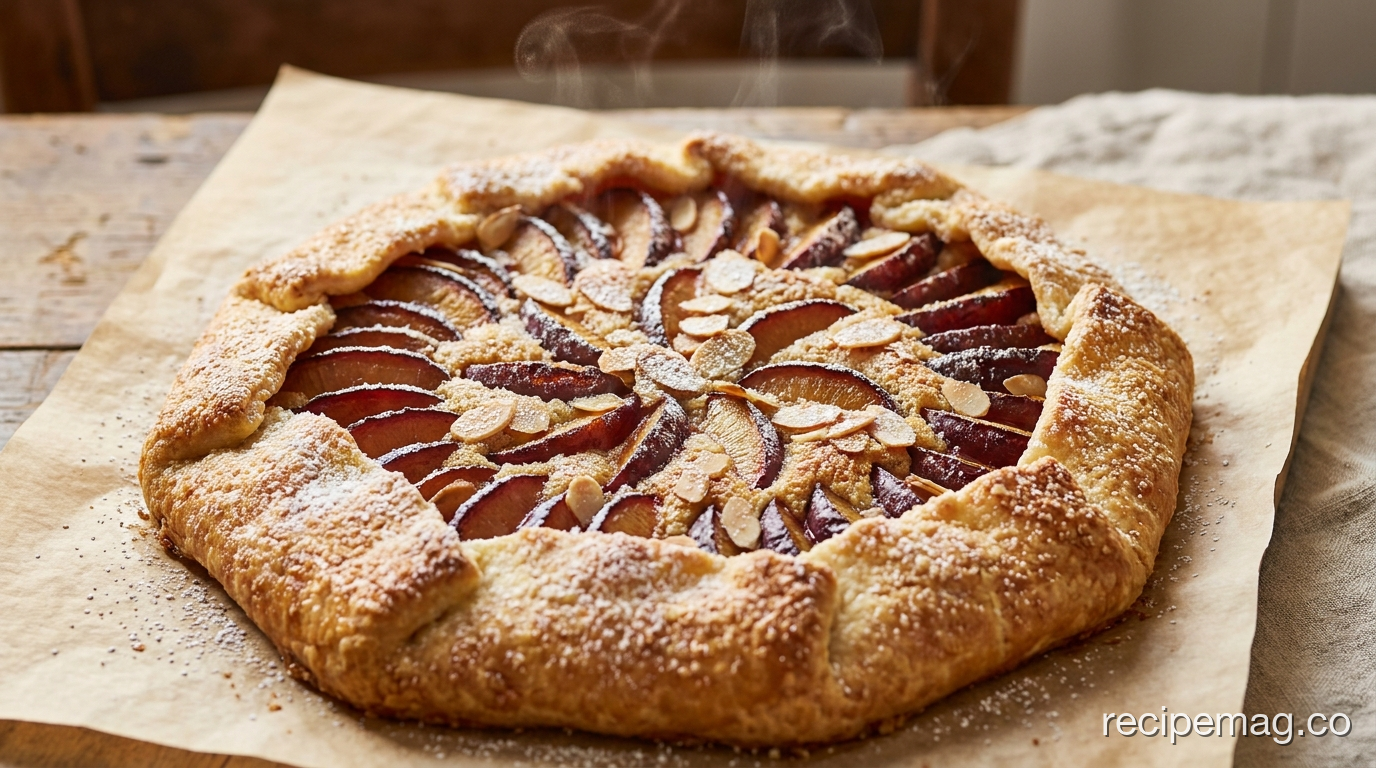
A plum galette is a free-form tart you fold by hand, no pan and no fussy edges required. Ripe plums sit on a layer of almond frangipane, which soaks up their juice and keeps the crust crisp. It bakes in about 40 minutes and forgives every crooked fold. Plums and almonds are botanical cousins, both members of the Prunus family, which is why they taste so at home together (USDA PLANTS Database, 2023).
Key Takeaways
- A galette is a free-form tart, so you need no tart pan and no perfect edges.
- Almond frangipane under the fruit absorbs juice and stops a soggy bottom.
- Just 1 ounce of almonds delivers roughly 6 grams of protein and 37% of daily vitamin E. (USDA FoodData Central, 2023)
- Cold butter and a cold dough are the whole secret to a flaky crust.
- Ready in about an hour, start to finish, and it serves 8 slices.
Why a Galette Is the Easiest Summer Dessert
A galette skips everything intimidating about pie. There is no pan to grease, no lattice to weave, and no crimped edge to get right. You roll one round of dough, pile fruit in the middle, fold the border over, and bake. Home bakers overwhelmingly rank pie crust as the most stressful baking task, which is exactly the fear a galette removes (King Arthur Baking, 2022). The free-form shape does real work, too: it lets the plums caramelize on top while their juice bubbles and reduces right in the pan.
[PERSONAL EXPERIENCE] We’ve made this galette with everything from firm red plums to soft Italian prune plums, and the recipe barely cares. Firmer fruit holds its shape and looks tidy; softer fruit slumps into something more like jam. Both taste excellent, so use whatever is ripe on your counter.
What Ingredients Do You Need?
The ingredient list is short and mostly pantry staples. The two components that matter most are cold butter for the crust and ground almonds for the frangipane. Almonds are not just flavor here; they are a nutrition boost, since 1 ounce provides about 6 grams of protein and 37% of the daily value for vitamin E, a key antioxidant (USDA FoodData Central, 2023). Choose plums that are ripe but still slightly firm so they hold a slice.
For the Crust
- 1¼ cups (150g) all-purpose flour
- 1 tablespoon granulated sugar
- ¼ teaspoon salt
- 8 tablespoons (113g) cold unsalted butter, cubed
- 3 to 5 tablespoons ice water
For the Almond Frangipane
- ½ cup (48g) almond flour or finely ground almonds
- 3 tablespoons (38g) granulated sugar
- 3 tablespoons (43g) softened butter
- 1 egg yolk
- ¼ teaspoon almond or vanilla extract
For the Filling and Finish
- 5 to 6 ripe plums, pitted and sliced into wedges
- 1 tablespoon sugar, plus more for the crust
- 1 teaspoon lemon juice
- 1 egg, beaten, for the egg wash
- 2 tablespoons sliced almonds (optional)
- 1 tablespoon apricot jam, warmed, for glaze (optional)
How Do You Make the Crust Flaky?
Flaky crust comes down to one rule: keep the butter cold and in flat, visible pieces. Those cold shards melt in the oven and release steam, which puffs the dough into layers. America’s Test Kitchen stresses chilling the dough thoroughly before it bakes so the butter stays intact (America’s Test Kitchen, 2021). Warm, overworked dough is the number one reason a crust turns out dense.
Mixing and Chilling
- Whisk the flour, sugar, and salt in a bowl. Add the cold cubed butter.
- Cut the butter in with your fingers or a pastry cutter until the pieces range from pea-sized to flat flakes. Do not overwork it.
- Drizzle in ice water one tablespoon at a time, tossing until the dough just holds together when squeezed. It should look shaggy, not smooth.
- Shape it into a disk, wrap it, and chill for at least 30 minutes. This relaxes the gluten and re-firms the butter.
How to Assemble and Bake the Galette
Assembly is where the galette earns its rustic name. You make a quick frangipane, spread it in the center, fan the plums on top, and fold the border over the edge of the fruit. A layer of almond frangipane is the classic fix for a soggy base, since it absorbs excess juice as the fruit bakes (Serious Eats, 2020). Work on parchment so you can slide the whole thing onto a sheet pan.
Step-by-Step
- Heat the oven to 400°F (200°C) and line a sheet pan with parchment.
- Make the frangipane. Beat the softened butter and sugar, then mix in the almond flour, egg yolk, and extract until smooth.
- Toss the plums with 1 tablespoon sugar and the lemon juice. Let them sit while you roll the dough.
- Roll the chilled dough into a rough 12-inch circle on the parchment. Uneven edges are fine.
- Spread the frangipane over the center, leaving a 2-inch border bare.
- Arrange the plums over the frangipane, slightly overlapping. Leave any pooled juice behind.
- Fold the border up and over the outer ring of fruit, pleating as you go. The center stays open.
- Brush the crust with egg wash and sprinkle with sugar and sliced almonds.
- Bake 38 to 45 minutes, until the crust is deep golden and the fruit bubbles. Cool at least 20 minutes before slicing.
[UNIQUE INSIGHT] The most common galette failure is not a bad crust; it is too much fruit juice. Draining the plums after they macerate, and leaving that syrupy liquid in the bowl, keeps the frangipane from flooding. You can reduce that reserved juice in a small pan and brush it on as a glaze, so nothing goes to waste and the crust stays crisp.
Tips for the Best Plum Galette
Small habits separate a good galette from a great one. The dough rewards patience and a cool kitchen, while the fruit rewards restraint. Ripe summer plums carry plenty of their own sugar, so heavy sweetening only masks their flavor (UC Davis Postharvest Technology Center, 2022). Taste a plum first, then adjust.
- Keep everything cold. If the kitchen is warm, chill the assembled galette for 15 minutes before it goes in the oven.
- Do not skip the frangipane. If you are out of almond flour, a spoon of ground almonds or fine breadcrumbs under the fruit still soaks up juice.
- Cut plums evenly so they bake at the same rate and fan neatly.
- Cool before slicing. Warm frangipane is soft; it sets as the galette cools, giving cleaner slices.
- Serve it slightly warm with vanilla ice cream or a spoon of crème fraîche.
Rustic Plum and Almond Galette
Prep Time: 20 minutes | Chill Time: 30 minutes | Cook Time: 40 minutes | Serves: 8
Ingredients
Crust
- 1¼ cups (150g) all-purpose flour
- 1 tablespoon sugar
- ¼ teaspoon salt
- 8 tablespoons (113g) cold unsalted butter, cubed
- 3 to 5 tablespoons ice water
Almond Frangipane
- ½ cup (48g) almond flour
- 3 tablespoons sugar
- 3 tablespoons softened butter
- 1 egg yolk
- ¼ teaspoon almond or vanilla extract
Filling and Finish
- 5 to 6 ripe plums, pitted and sliced
- 1 tablespoon sugar, plus extra for the crust
- 1 teaspoon lemon juice
- 1 egg, beaten (egg wash)
- 2 tablespoons sliced almonds (optional)
- 1 tablespoon warmed apricot jam (optional glaze)
Instructions
- Make the dough: whisk flour, sugar, and salt. Cut in cold butter until pea-sized. Add ice water a tablespoon at a time until it just holds. Shape into a disk, wrap, and chill 30 minutes.
- Heat oven to 400°F (200°C). Line a sheet pan with parchment.
- Beat frangipane: cream butter and sugar, then mix in almond flour, egg yolk, and extract.
- Toss sliced plums with 1 tablespoon sugar and lemon juice. Let sit 10 minutes, then drain.
- Roll dough into a 12-inch circle on the parchment. Spread frangipane in the center, leaving a 2-inch border.
- Arrange plums over the frangipane. Fold the border up over the edge of the fruit, pleating as you go.
- Brush crust with egg wash. Sprinkle with sugar and sliced almonds.
- Bake 38 to 45 minutes until deep golden and bubbling. Cool 20 minutes. Brush with warm jam if using.
Notes
- No almond flour? Grind whole almonds fine, or use fine breadcrumbs to soak up juice.
- Dough can be made 2 days ahead and refrigerated, or frozen up to 1 month.
- Swap in nectarines, apricots, or a mix of stone fruit using the same amounts.
- Store leftovers loosely covered at room temperature for 1 day, or refrigerate up to 3 days.
Frequently Asked Questions About Plum Galette
What are the best plums for a galette?
Ripe but slightly firm plums work best because they hold their shape when sliced. Italian prune plums are a baker’s favorite for their dense, low-moisture flesh and rich flavor. Black and red plums also shine, though they release more juice, so drain them well after tossing with sugar. Taste one first; peak-season plums need very little added sugar to sing.
Why did my galette leak or turn soggy?
Excess fruit juice is almost always the cause. Toss the plums with sugar, let them sit, then drain off the liquid before assembling. The almond frangipane layer is your insurance, since it absorbs juice as it bakes (Serious Eats, 2020). Also make sure the oven is fully preheated to 400°F so the crust sets quickly before liquid can soak in.
Can I make the galette dough ahead of time?
Yes, and it helps. The dough can be wrapped and refrigerated for up to two days or frozen for a month, which gives the butter time to firm and the gluten time to relax. Both improve flakiness. Let frozen dough thaw in the fridge overnight before rolling. You can even assemble the full galette and chill it 15 minutes before baking.
What can I use instead of almond frangipane?
If you cannot use nuts, sprinkle a thin layer of fine breadcrumbs, crushed cookies, or a spoon of cornstarch mixed with sugar over the dough before adding fruit. Each one absorbs juice and protects the crust. The frangipane adds flavor and richness, but the real job of that layer is moisture control, and several pantry swaps do it well.
How do I store and reheat leftover galette?
Keep leftovers loosely covered at room temperature for a day, or refrigerate for up to three days. The crust softens over time, so a quick reheat helps. Warm slices in a 325°F oven for about 10 minutes to crisp the pastry again; the microwave will make it soft. A galette is also excellent cold with morning coffee.
Bake One This Weekend
The beauty of a galette is that it looks impressive while asking almost nothing of you. Rough edges read as charm, ripe fruit does the heavy lifting, and the almond layer quietly keeps everything crisp. Once you make one, the format sticks with you all summer.
Treat this recipe as a template. Swap plums for nectarines in August, apricots in July, or a mix of whatever is ripe and cannot wait another day. The crust and frangipane stay the same. Only the fruit on top changes.
Make the dough first, pour a coffee while it chills, and you will have a warm, golden galette on the table within the hour. That is a very good trade.
