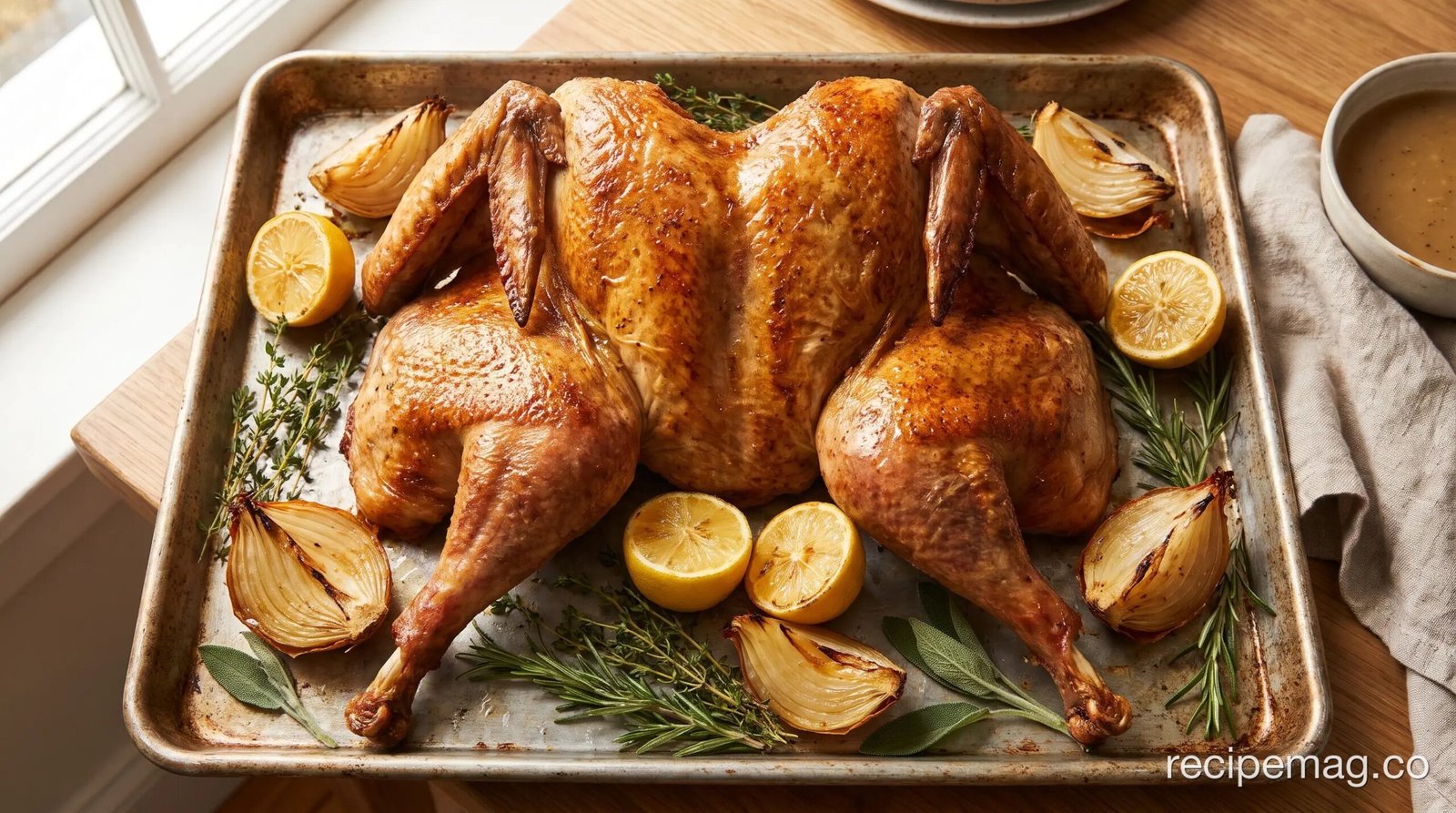
Spatchcocking a turkey means cutting out the backbone and pressing the bird flat, and it’s the fastest way to roast a whole one. A flattened 12- to 14-pound turkey roasts at 450°F in about 75 to 95 minutes, while USDA’s timetable puts the same bird, whole and unstuffed, at 3 to 3¾ hours at 325°F (USDA FSIS, 2024). The skin browns evenly, the thighs and breast finish at about the same time, and the backbone you remove is a head start on gravy.
Key Takeaways
- Spatchcocking means removing the backbone and pressing the bird flat.
- A 12- to 14-pound bird roasts at 450°F in about 75 to 95 minutes.
- It’s done at 165°F in the breast and the innermost thigh and wing (USDA FSIS, 2024).
- A turkey this size usually fits an 18-by-13-inch rimmed sheet pan.
- Cut and salt it up to 2 days ahead, and save the backbone for gravy.
Why Does a Spatchcocked Turkey Cook So Much Faster?
Because it’s no longer a thick, round shape. A whole turkey has a deep breast on top and thighs tucked against its sides, shaded from the heat. That shape is why USDA FSIS times a whole 12- to 14-pound bird at 3 to 3¾ hours at 325°F (USDA FSIS, 2024). Flattened, it’s only a few inches thick.
Flattening also moves the thighs to the hot outer edges of the pan and the breast to the cooler center. That suits both: dark meat tastes best cooked past 165°F, while the breast dries out if it climbs much higher.
The bigger Thanksgiving win is oven time. A whole bird ties up the oven from late morning to mid-afternoon. A spatchcocked one is in and out in about 90 minutes, so casseroles and rolls can bake before it goes in or while it rests.
Ingredients and Equipment
This recipe uses a 12- to 14-pound turkey, which feeds 12 to 14 people at 1 pound per person (USDA FSIS, 2024), or 10 to 12 with leftovers.
Serves 10 to 12. Prep time 25 minutes, plus an optional 24- to 48-hour dry brine. Cook time 75 to 95 minutes, plus 20 minutes resting. Total time 2 hours to 2 hours 20 minutes.
- 1 whole turkey, 12 to 14 pounds, fully thawed, neck and giblets removed
- 3 tablespoons Diamond Crystal kosher salt (or 1¾ tablespoons Morton kosher salt)
- 2 teaspoons freshly ground black pepper
- 2 large yellow onions, sliced into ½-inch rounds
- 1 lemon, halved
- 6 sprigs fresh thyme
- 2 sprigs fresh rosemary
- 3 tablespoons unsalted butter, melted
- 1½ cups low-sodium chicken stock, divided
Equipment: heavy-duty poultry shears, an 18-by-13-inch rimmed sheet pan with a wire rack that fits inside, and an instant-read thermometer.
How to Spatchcock a Turkey
It takes about 10 minutes and a good pair of shears. Turkey bones are tougher than chicken bones, so use short, firm snips. Skip the rinse: USDA FSIS advises against washing raw poultry, because it spreads bacteria around the sink (USDA FSIS, 2024).
- Cut out the backbone. Pat the turkey dry and set it breast side down, tail toward you. Cut along one side of the backbone from tail to neck, staying close to the bone, then along the other side. Lift it out and refrigerate it with the neck for gravy.
- Flatten it. Flip the turkey breast side up and spread the legs so the thighs face outward. Press down hard on the breastbone with both hands until it cracks and the bird lies flat. Tuck the wing tips behind the breast.
- Season it. Mix the salt and pepper and sprinkle it over both sides, heavier on the breast and thighs. For the crispest skin, refrigerate the bird uncovered, skin side up, on the wire rack in the sheet pan for 24 to 48 hours, as in our dry-brined turkey. Short on time? Roast it now.
In our experience, the toughest snip is where the backbone meets the thigh joint. If the shears stall there, press through with the heel of a heavy chef’s knife, then switch back. Don’t saw.
How to Roast a Spatchcock Turkey
Roast it at 450°F until the thickest part of the breast and the innermost thigh and wing read 165°F (USDA FSIS, 2024). For a 12- to 14-pound bird, that usually takes 75 to 95 minutes. Onions and stock under the rack keep the drippings from burning.
- Heat the oven. Set a rack in the middle position and heat the oven to 450°F.
- Build the pan. If the turkey brined on the sheet pan, move it to a cutting board. Spread the onions, lemon halves, thyme and rosemary over the pan and set the wire rack on top.
- Arrange the bird. Set the turkey skin side up on the rack, thighs toward the edges and breast in the center. Brush it with the melted butter and pour 1 cup of the stock into the pan.
- Roast. Roast until the breast and thighs reach 165°F, 75 to 95 minutes, rotating the pan after 45 minutes. If the pan dries out, add the remaining ½ cup of stock. Cover any spot that darkens too fast with foil.
- Rest. Move the turkey to a cutting board and rest it, uncovered, for 20 minutes.
- Carve. Remove the legs at the hip and separate the thighs from the drumsticks. Cut off the wings. Lift each breast half off the bone in one piece, then slice it crosswise.
- Save the juices. Strain the pan juices into a fat separator, pressing on the onions, for gravy or for spooning over the meat.
Tips for a Better Spatchcock Turkey
- Measure first. A 12- to 14-pound bird usually fits an 18-by-13-inch sheet pan. Bigger birds need a large roasting pan, or buy two smaller turkeys.
- Check the label. If it says kosher, self-basting or “enhanced,” the bird is already salted, so skip the salt.
- Ask the butcher. Many meat counters will spatchcock a thawed turkey if you ask ahead.
- Expect a little smoke. At 450°F, old oven spills will smoke, so wipe them up beforehand and run the vent fan.
- Bake the stuffing in a dish. There’s no cavity anyway, and FSIS recommends cooking stuffing separately, to 165°F in the center.
Can You Spatchcock a Turkey Ahead of Time?
Yes, up to 2 days ahead. USDA FSIS says a fridge-thawed turkey keeps 1 to 2 days before cooking (USDA FSIS, 2024), so you can cut, salt and refrigerate the flat bird as soon as it’s thawed. For Thursday, November 26:
- Saturday, November 21: Move a frozen 12- to 14-pound turkey to the fridge. Our guide on how to thaw a turkey safely covers other sizes.
- Tuesday, November 24: Spatchcock and salt the bird, then refrigerate it uncovered. Simmer the backbone and neck into stock for our make-ahead turkey gravy.
- Thursday, November 26: For a 4 p.m. dinner, get the turkey in the oven by 2 p.m. The rolls can bake while it rests.
Refrigerate leftovers within 2 hours and eat them within 3 to 4 days, according to FSIS. Sliced turkey freezes well with a splash of stock.
Frequently Asked Questions About Spatchcock Turkey
Can you spatchcock a turkey bigger than 14 pounds?
Yes, but it may not fit a standard sheet pan, so use a large roasting pan with a rack and expect a longer roast. For a crowd, two 12-pound birds on two pans often cook more evenly than one 20-pounder, as long as your oven holds both.
Is spatchcock turkey as juicy as a whole roast turkey?
Usually juicier, because the breast spends far less time in the oven. A flat bird roasts in about 90 minutes instead of 3 hours or more, so the breast doesn’t dry out while the thighs catch up. Pull it at 165°F, rest it and slice the breast crosswise.
Can you spatchcock a turkey on the grill?
Yes. Set up a two-zone fire, lay the turkey skin side up on the cooler side and close the lid, aiming for about 400°F. Expect it to take a little longer than the oven. It’s the same method as our grilled spatchcock chicken, just with a bigger bird.
What should I do with the backbone?
Make stock. Roast the backbone and neck until browned, then simmer them with an onion, a carrot and enough water to cover for about 2 hours. Strain and chill it for gravy or stuffing. It keeps 3 to 4 days in the fridge, or freeze it for later.
Make This the Year You Flatten the Bird
Spatchcocking takes 10 minutes with good shears and gives back hours of oven time. The skin browns evenly, the breast stays juicy and dinner doesn’t hinge on a 4-hour roast.
Pick your thaw date, salt the bird on Tuesday and plan the rest of the meal with our Thanksgiving dinner planning guide.
