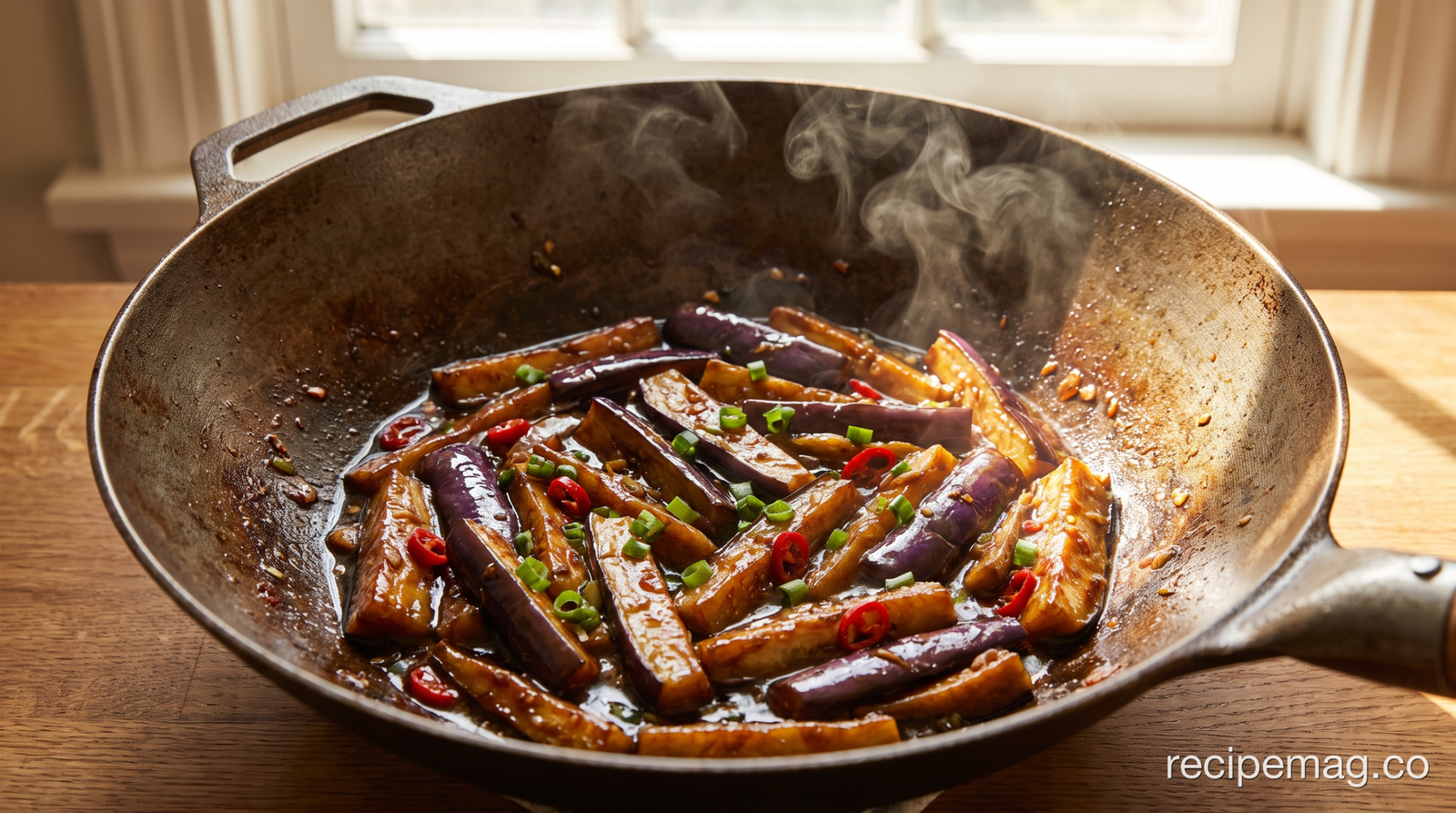
Yu xiang qie zi, usually translated as fish-fragrant eggplant, contains no fish. The name refers to a Sichuan seasoning profile originally developed for cooking fish: pickled chilli, garlic, ginger, vinegar, and sugar in balance. Applied to eggplant, it produces one of the best vegetable dishes in any cuisine, and it takes about twenty-five minutes.
Key Takeaways
- The “fish-fragrant” name comes from a seasoning profile, not from any fish in the dish.
- Doubanjiang, fermented broad bean chilli paste, is the one ingredient worth sourcing.
- Cut eggplant into batons, not cubes, so it holds shape while turning silky.
- Steaming or microwaving the eggplant first cuts the oil dramatically.
- Balance is the point: sweet, sour, salty, and spicy should all be detectable.
Ingredients
Serves 4 with rice. Active time 25 minutes. Total time 25 minutes.
- 1.5 lbs Chinese or Japanese eggplant, about 3 medium
- 3 tbsp neutral oil
- 4 oz ground pork, optional
- 2 tbsp doubanjiang (fermented broad bean chilli paste)
- 6 garlic cloves, minced
- 1 tbsp fresh ginger, minced
- 3 scallions, whites and greens separated
For the sauce:
- 1/2 cup chicken or vegetable stock
- 1 tbsp light soy sauce
- 1 tbsp Chinkiang black vinegar
- 2 tsp sugar
- 1 tsp cornstarch
- 1 tsp toasted sesame oil
Chinese or Japanese eggplant is worth seeking out. They are thin-skinned with few seeds and turn silky quickly. Globe eggplant works but needs peeling and a couple of extra minutes.
How to Make It
1. Cut the eggplant. Trim and cut into batons roughly 3 inches long and 3/4 inch thick. Batons hold their shape as they soften; cubes disintegrate into paste.
2. Pre-cook it. This is the step that separates a good home version from a greasy one. Steam the batons for 6 to 8 minutes, or microwave them covered for 5 minutes, until just tender. Pre-cooking collapses the sponge structure so the eggplant absorbs a fraction of the oil it otherwise would. Pat dry.
3. Mix the sauce. Whisk the stock, soy sauce, black vinegar, sugar, cornstarch, and sesame oil together. Have it beside the stove; once cooking starts there is no time to measure.
4. Sear the eggplant. Heat 2 tablespoons of oil in a wok or large skillet over high heat. Add the eggplant in a single layer and sear 3 to 4 minutes, turning once, until browned at the edges. Remove and set aside.
5. Build the base. Add the remaining oil and the pork if using, breaking it up until browned. Add the doubanjiang and fry 30 seconds until the oil turns red; this blooming step is where the flavour is unlocked. Add the garlic, ginger, and scallion whites and cook one more minute.
6. Combine and glaze. Return the eggplant, pour in the sauce, and toss for 1 to 2 minutes until it thickens and coats everything glossily. Finish with scallion greens and serve immediately over rice.
Balancing the Sauce
Fish-fragrant seasoning is a balance, and the dish fails when one element runs away. Sugar and vinegar should be roughly matched, with the doubanjiang supplying salt and heat and the aromatics supplying the perfume.
Taste before it goes over the eggplant. If it is flat, it usually needs vinegar rather than salt. If it is sharp, a little more sugar rounds it. If it tastes thin, it wants another teaspoon of doubanjiang, not more soy sauce, which only makes it saltier.
Chinkiang vinegar is the correct one. It is a dark, malty rice vinegar with a rounded acidity quite unlike white rice vinegar, which is sharper and thinner. Balsamic is the closest emergency substitute, used at about two-thirds the quantity.
For a broader look at building this kind of savoury depth from pantry ingredients, our pantry guide covers what to keep on hand.
Variations and Serving
Vegetarian and vegan. Skip the pork, use vegetable stock, and add finely chopped shiitake mushrooms with the aromatics for the same savoury weight. Check the doubanjiang label, as most are vegan.
Milder. Halve the doubanjiang and add a teaspoon of miso to keep the savoury depth without the heat.
With tofu. Add cubes of pressed firm tofu, seared separately, alongside the eggplant. It makes the dish substantial enough to stand alone.
Numbing. A quarter teaspoon of ground Sichuan peppercorn added with the garlic brings the tingling ma la character that pairs with the chilli heat.
Serve with plain steamed rice and something cool alongside. Our refrigerator pickles or a simple smashed cucumber salad both work. For nine more ways to use the season’s eggplant, see our late-summer eggplant roundup.
Wok Technique Without a Wok Burner
Home hobs deliver a fraction of the heat a restaurant wok burner does, which is why home stir-fries so often steam. Three adjustments close most of that gap.
Cook in batches. A domestic burner cannot recover heat fast enough for a full pan of cold ingredients. Searing the eggplant separately and returning it at the end, as this recipe does, is exactly that principle.
Preheat properly. Get the pan hot before the oil goes in, then heat the oil until it shimmers and moves freely. A pan that looks hot and is not is the single most common cause of grey, limp stir-fries.
Have everything ready. Once cooking starts there is no time to mince garlic. Chinese cooking calls this preparation stage the reason stir-fries look effortless, and it is not optional at high heat where thirty seconds of inattention burns the aromatics.
A carbon steel wok is worth owning if you cook this way often, but a wide heavy skillet outperforms a thin wok on a domestic hob. Surface contact matters more than shape when the flame cannot wrap up the sides.
Building a Sichuan Pantry
Four ingredients unlock most of the repertoire, and all four keep for a year or more, which makes them a genuinely low-risk purchase.
Doubanjiang. Fermented broad bean and chilli paste, and the backbone of Sichuan cooking. Pixian doubanjiang is the benchmark; look for a deep red-brown paste rather than a bright red one, which usually indicates added colour and less ageing. Keep it refrigerated after opening.
Chinkiang vinegar. Dark, malty black rice vinegar with a rounded acidity. It is what gives this dish its sour edge and it is not interchangeable with white rice vinegar.
Sichuan peppercorns. Not related to black pepper or chilli. They produce a tingling numbness called ma that pairs with chilli heat. Buy them whole, toast briefly before grinding, and replace them annually, since they lose potency fast.
Light soy sauce. Thinner and saltier than dark soy, which is used for colour rather than seasoning. Most recipes calling simply for soy sauce mean light.
With those four plus garlic, ginger, and scallions, a large portion of Sichuan home cooking becomes accessible. None of them are expensive, and the paste in particular will improve any braise, stew, or stir-fry you add a spoonful to, well outside its own cuisine.
Frequently Asked Questions
Is there fish in fish-fragrant eggplant?
No. The name refers to a Sichuan seasoning combination originally used for fish. The dish itself is eggplant, optionally with pork.
What can I use instead of doubanjiang?
There is no exact substitute, and it is the ingredient that defines the dish. A workable approximation is gochujang plus a teaspoon of white miso, though the flavour leans Korean rather than Sichuan.
How do I stop the eggplant absorbing so much oil?
Steam or microwave it before it hits the pan. Pre-cooking collapses the air pockets that soak up oil, and it is the single most effective fix.
Can I make this ahead?
It is best fresh, but it reheats acceptably for two days. The eggplant softens further, so expect a looser texture on day two.
Do I need a wok?
No. A large heavy skillet works, though you will want to sear the eggplant in two batches to avoid crowding.
What kind of eggplant is best here?
Chinese or Japanese varieties, which are long, thin-skinned, and low in seeds. Globe eggplant works if you peel it and cook it a little longer.
