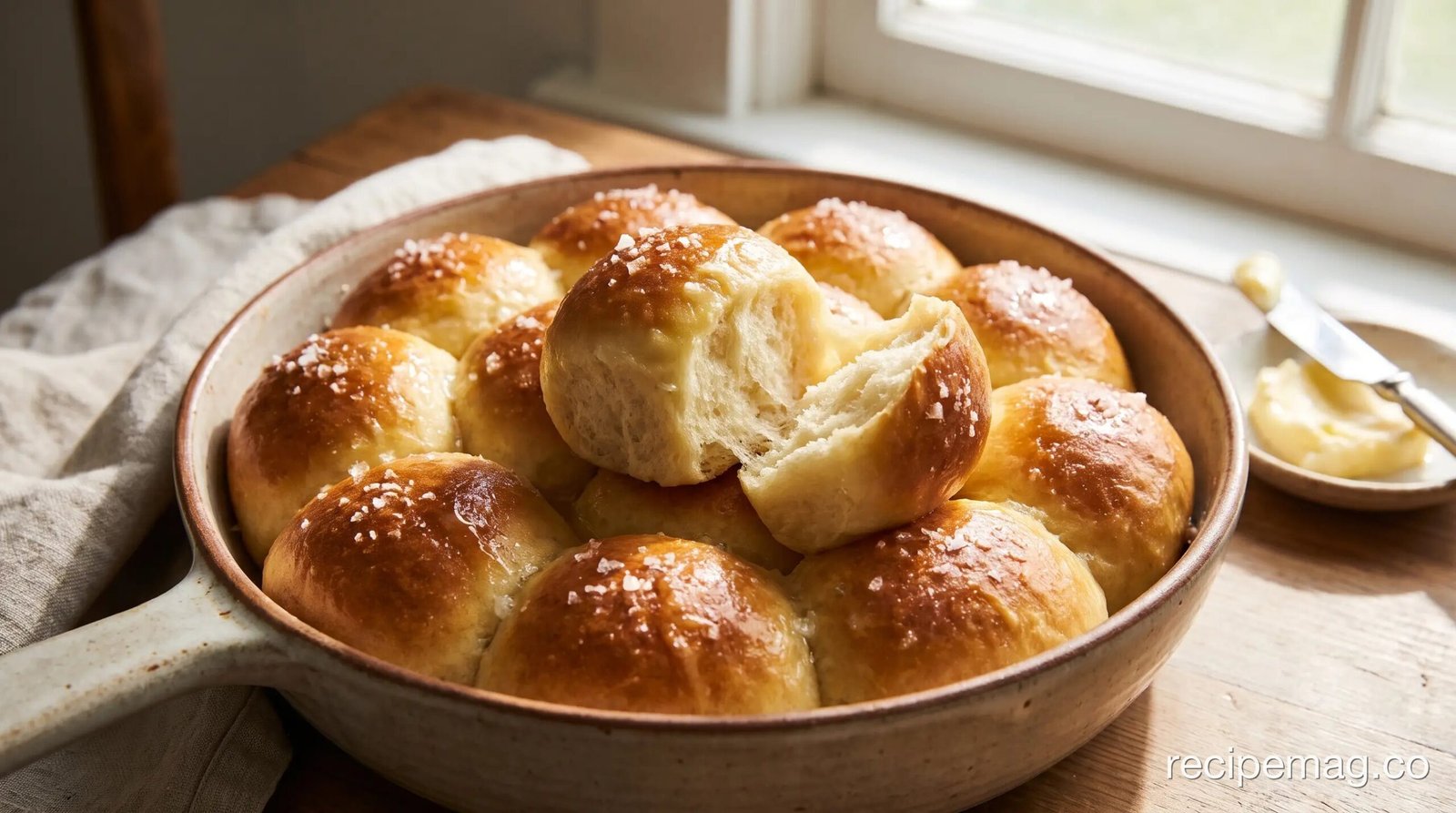
Parker House rolls are soft, buttery yeast rolls that are flattened, brushed with butter and folded in half before baking, so they pull apart in tender layers. This recipe makes 16 with about 30 minutes of hands-on work, and they bake in 18 to 22 minutes. That’s close to the 20 minutes USDA FSIS recommends letting a roast turkey stand before carving (2026), so the rolls can bake while the bird rests.
Key Takeaways
- Makes 16 rolls: about 30 minutes hands-on and 3 hours start to finish.
- The signature fold, a butter-brushed oval folded slightly off-center, creates the pull-apart layers.
- Bake at 375°F until the center roll reads 190°F, the doneness point King Arthur Baking gives for soft, enriched breads.
- Make ahead three ways: an overnight rise in the fridge, par-bake and freeze, or bake fully and freeze.
What Makes Parker House Rolls Different?
The fold. Each piece of dough is rolled into an oval, brushed with melted butter and folded nearly in half, so the roll bakes with a buttery seam that opens into two soft layers. The rolls are named for Boston’s Parker House hotel, open since 1855 and now the Omni Parker House, which credits its 19th-century kitchen with creating them.
The dough is a classic enriched dough: milk, an egg, butter and a little sugar. The fat keeps the crumb tender, and the milk and sugar help the crust brown. It’s far softer than a lean loaf like the one in our beginner’s guide to no-knead bread.
Ingredients
Makes 16 rolls. Prep time 30 minutes. Rise time 1 hour 45 minutes to 2 hours 30 minutes. Cook time 20 minutes. Total time about 3 hours.
For the Dough
- 1 cup (240 ml) whole milk
- 3 tablespoons (38 g) granulated sugar
- 2 1/4 teaspoons (one 1/4-ounce packet) instant yeast or active dry yeast
- 3 1/2 cups (about 440 g) all-purpose flour, plus up to 1/4 cup more as needed
- 1 1/4 teaspoons fine sea salt or table salt
- 1 large egg, at room temperature
- 6 tablespoons (85 g) unsalted butter, softened and cut into 6 pieces
For Shaping and Finishing
- 1 tablespoon softened butter or neutral oil, for greasing the bowl and pan
- Extra all-purpose flour, for the counter
- 6 tablespoons (85 g) salted butter, melted and divided
- 1 to 2 teaspoons flaky sea salt
How to Make Parker House Rolls
- Warm the milk. Heat the milk in a small saucepan or the microwave to 105°F to 110°F. If you’re using active dry yeast, stir it in with a pinch of the sugar and let it stand 5 to 10 minutes, until foamy.
- Mix. In the bowl of a stand mixer, whisk the flour, the remaining sugar, the salt and the instant yeast, if using. Add the warm milk (with the proofed yeast, if using active dry) and the egg. Mix on low with the dough hook until shaggy, about 2 minutes.
- Knead in the butter. Raise the speed to medium-low and add the softened unsalted butter one piece at a time. Knead 6 to 8 minutes, until smooth, elastic and slightly tacky. If it still sticks to the bowl after 5 minutes, add flour 1 tablespoon at a time.
- First rise. Grease a large bowl and a 9-by-13-inch metal baking pan with the softened butter or oil. Put the dough in the bowl, turn it to coat, cover, and let it rise in a warm spot until doubled, 1 to 1 1/2 hours.
- Divide. Turn the dough onto a lightly floured counter and cut it into 16 equal pieces, about 55 grams each. Roll each into a tight ball, cover, and rest 10 minutes.
- Shape. Roll a ball into an oval about 4 inches long and 3 inches wide. Brush the top lightly with melted butter, then fold it in half crosswise so the top edge sits about 1/4 inch short of the bottom edge. Use about 2 tablespoons of the melted butter for all 16.
- Arrange. Set the rolls in the pan in 4 rows of 4, folded edges facing the same way, just touching.
- Second rise. Cover and let rise until puffy and pressed together, 45 to 60 minutes. Meanwhile, heat the oven to 375°F with a rack in the center.
- Bake. Brush the tops with 1 tablespoon of the melted butter. Bake 18 to 22 minutes, rotating the pan halfway, until deep golden and the center roll reads 190°F.
- Finish. Brush the hot rolls with the remaining 3 tablespoons melted butter and sprinkle with flaky salt. Cool 10 minutes in the pan and serve warm.
How Do You Make Parker House Rolls Ahead for Thanksgiving?
Three ways: an overnight rise in the fridge, par-baking, or baking fully and freezing. USDA FSIS recommends letting a roast turkey stand 20 minutes before carving, and a big bird tented with foil stays hot well past that. Turn the oven up to 375°F as soon as the turkey comes out.
Overnight Rise in the Fridge
Shape the rolls through step 7, cover the pan tightly and refrigerate overnight, up to 18 hours. On the day, let them sit at room temperature until puffy, 1 to 1 1/2 hours, then bake as directed.
Par-Bake and Freeze
Bake the rolls for 10 to 12 minutes, until set but only lightly colored, and skip the final butter and salt. Cool completely, wrap the pan in plastic and foil, and freeze. On the day, brush with butter and bake at 375°F straight from frozen for 12 to 15 minutes, until deep golden. Then finish with butter and salt.
Bake Fully and Freeze
Bake as directed, cool, wrap airtight and freeze. Thaw in the wrapping at room temperature, then warm, loosely covered with foil, at 350°F for 8 to 10 minutes. USDA FSIS notes that food held at 0°F stays safe indefinitely, but bread slowly dries out, so use frozen rolls within about 2 months.
For Thanksgiving, we’d choose par-baking. The overnight method still needs an hour on the counter plus 20 minutes in the oven on the busiest afternoon of the year. Par-baked rolls need about 15 minutes. Our Thanksgiving make-ahead guide shows where they fit in the week.
Tips for Soft, Fluffy Parker House Rolls
- Check the milk temperature. Milk that’s too hot can kill the yeast. Aim for 105°F to 110°F.
- Don’t pack the flour. Spoon it into the cup and level it, or weigh it. Scooping straight from the bag adds extra flour and makes dense rolls.
- Watch the dough, not the clock. A cool November kitchen slows yeast down, so go by how the dough looks.
- Crease before you fold. Press the handle of a wooden spoon across each oval just off center, then fold along the line.
In our experience, the most common shaping problem is rolls that spring open in the oven. Too much butter on the fold lets the halves slide apart. Brush a thin coat and press the fold firmly.
How Should You Store Leftover Rolls?
Keep them wrapped at room temperature for up to 2 days, or freeze them. Don’t refrigerate bread: it goes stale faster in the fridge than on the counter. Leftover rolls make excellent next-day sliders. Split them, fill with turkey and a spoonful of our homemade cranberry sauce, or ladle over some make-ahead turkey gravy. Use the turkey within 3 to 4 days, per USDA FSIS leftover guidance.
Frequently Asked Questions About Parker House Rolls
Why are my Parker House rolls dense?
Usually too much flour, a rise cut short, or yeast damaged by milk that was too hot. Spoon and level the flour or weigh it, and keep the milk at 105°F to 110°F. In a cool kitchen, let the dough rise in a turned-off oven with the light on.
Can I use bread flour instead of all-purpose?
Yes. Bread flour’s extra protein makes the rolls a little taller and chewier, while all-purpose gives the softer crumb most people expect. The dough may feel stiffer with bread flour, so add a tablespoon of milk if it won’t come together smoothly.
How far ahead can I make Parker House rolls for Thanksgiving?
Shaped rolls can rise overnight in the fridge for up to 18 hours. Par-baked or fully baked rolls keep about 2 months in the freezer. Par-baking is the easiest option on the day, since the rolls finish in about 15 minutes.
Can I make Parker House rolls without a stand mixer?
Yes. Stir the dough together with a wooden spoon, then knead it on the counter for 10 to 12 minutes, working in the softened butter a piece at a time. It feels greasy and messy at first, then turns smooth. Resist adding much extra flour, or the rolls will bake up dense.
Bake a Test Batch This Weekend
Don’t make Parker House rolls for the first time on Thanksgiving morning. Bake a pan this weekend, eat a few warm, and par-bake and freeze the rest. You’ll learn how your kitchen affects the rise and get a head start on the big day.
On Thursday, the rolls become the easy part: 15 minutes in the oven while our classic herb-butter roast turkey rests, a last brush of butter and a pinch of flaky salt. Nobody needs to know they came from the freezer.
