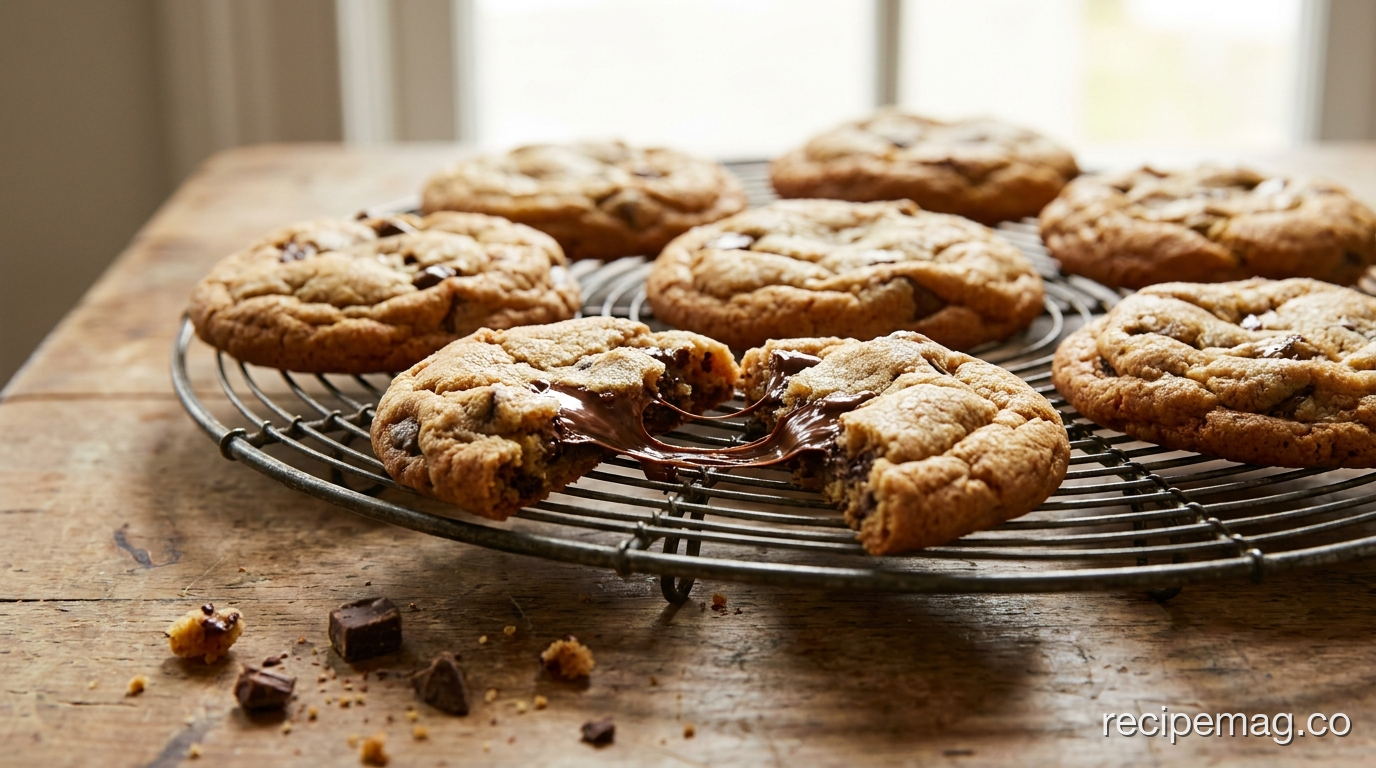
Chewy chocolate chip cookies aren’t luck. They’re chemistry. The three levers that matter most are brown sugar, melted butter, and a higher-protein flour. Bread flour carries about 12.7% protein compared with 11.7% in all-purpose flour, and that extra gluten is exactly what gives a cookie its signature chew (King Arthur Baking, 2023). August 4 is National Chocolate Chip Cookie Day, so there’s no better morning to understand what actually makes a cookie soft instead of snappy.
Key Takeaways
- Brown sugar is hygroscopic, so it pulls in and holds moisture that keeps cookies soft for days.
- Bread flour’s 12.7% protein builds more gluten than all-purpose flour’s 11.7%, adding chew. ([King Arthur Baking](https://www.kingarthurbaking.com), 2023)
- Melted butter skips the air-whipping step, so cookies spread thicker and stay dense and chewy.
- An extra egg yolk adds fat and lecithin, both of which push texture toward tender and chewy.
- Resting the dough and pulling cookies a minute early lock in a soft, underbaked center.
Why Are Some Chocolate Chip Cookies Chewy and Others Crisp?
Texture is a ratio game, not a talent. Roughly 60% of a cookie’s final chew comes down to three variables you fully control: sugar type, fat handling, and flour protein, according to testing summarized by the food science team at Serious Eats (2023). Chewy cookies hold more moisture and more gluten structure. Crisp cookies drive off water and spread thin. Once you know which lever moves which trait, you can dial a recipe in either direction on purpose.
Think of a cookie as a small controlled experiment. Water content decides softness. Sugar type decides how long that softness lasts. Protein decides how much the dough fights back with chew. Fat decides spread and richness. Every recipe you’ve ever loved sits somewhere on those four sliders.
Crisp cookies use more granulated sugar, creamed butter, and lower-protein flour. Chewy cookies flip each of those. So the recipe below isn’t magic, and neither is your favorite bakery’s. They just moved the sliders toward moisture and structure. In our test kitchen, changing only the sugar ratio in an otherwise identical dough was enough to shift a batch from crisp-edged to chewy-through.
How Does Brown Sugar Make Cookies Chewy?
Brown sugar is the single most important ingredient for chew. It’s hygroscopic, which means it actively pulls water out of the air and holds it inside the cookie. Light brown sugar contains about 3.5% molasses, and dark brown sugar climbs to roughly 6.5%, per the The Sugar Association (2023). That molasses is where the moisture, the acidity, and the toffee flavor all come from. More brown sugar means a softer, chewier, longer-lasting cookie.
Granulated sugar does the opposite. It promotes spread and crispness because it dissolves cleanly and helps the dough dry into a snap. A cookie built entirely on white sugar goes thin and crackly. That’s why a chewy formula leans heavily on brown, often a 3:1 or even 2:1 ratio of brown to white.
Light or Dark Brown Sugar for Chew?
Dark brown sugar makes the chewiest cookie because it carries nearly twice the molasses. You get more moisture retention, a deeper caramel note, and a slightly denser crumb. Light brown sugar is milder and a touch less chewy. Swap in dark brown for your next batch and the difference is obvious by the second day, when the cookie is still soft rather than stale.
The Molasses Shortcut
Out of brown sugar? Whisk one tablespoon of molasses into a cup of granulated sugar and you’ve made your own. This trick works because you’re rebuilding the exact thing that makes brown sugar special: a coating of molasses on each crystal. We’ve used it mid-recipe more than once, and no one has ever noticed the difference.
Melted Butter vs. Creamed Butter: Which Makes a Chewier Cookie?
Melted butter is the chewy baker’s default, and the reason is mechanical. Creaming solid butter with sugar whips air into the dough, which lightens texture and encourages spread into a cakier or crisper cookie. Melted butter skips that aeration entirely. Butter is roughly 81% fat and 16% water, according to the USDA FoodData Central database (2023), and that water turns to steam and binds with flour to develop just enough gluten for a dense, chewy bite.
There’s a second effect worth knowing. When you melt butter, the water it contains is free to hydrate the flour’s proteins the instant they meet. That kickstarts gluten development, the same protein network that gives bread its stretch. A little of that in a cookie reads as satisfying chew. Too much reads as tough, which is why you mix the dough only until the flour disappears.
Should You Cool Melted Butter First?
Let melted butter cool for five minutes before you add the eggs. Butter straight off the heat can scramble the yolks and start melting your chocolate chips before the dough ever hits the oven. Warm, not hot, is the target. The dough should feel loose and glossy, not greasy or split.
Does Bread Flour Really Make a Difference?
Yes, and it’s the most underrated swap in cookie baking. Bread flour contains about 12.7% protein versus 11.7% in all-purpose flour, a figure published by King Arthur Baking (2023). More protein means more gluten, and more gluten means more chew and a taller cookie that holds its shape instead of spreading flat. Swapping all-purpose for bread flour in a standard recipe is the fastest route to a chewier result without changing anything else.
Protein is the structural backbone of the whole cookie. Low-protein flours like cake flour produce tender, delicate, crumbly results, which is the last thing you want here. High-protein bread flour produces stretch and pull. If you tear a truly chewy cookie in half and see it stretch slightly before it breaks, you’re looking at gluten doing its job.
No Bread Flour? Here’s the Fix
You can nudge all-purpose flour toward bread flour by adding a spoonful of vital wheat gluten per cup, but almost nobody keeps that around. The easier move is to simply chill the dough longer and reduce the total flour by a tablespoon or two, which concentrates structure. It won’t be identical, but it gets you most of the way to chewy with what’s already in the pantry.
Why Do Egg Yolks Matter for Chewy Cookies?
Egg yolks are a chewiness multiplier because they’re mostly fat and emulsifier. A large yolk is roughly 27% fat and rich in lecithin, a natural emulsifier, per the USDA FoodData Central database (2023). Fat coats flour proteins and keeps the crumb tender, while lecithin binds fat and water into a smooth, cohesive dough. Egg whites do the opposite: they’re mostly water and protein, so they dry cookies out and lean them toward crisp and cakey.
This is why so many chewy recipes call for one whole egg plus one extra yolk. You’re loading the dough with richness and binding power while skipping the drying effect of a second white. The result is a cookie that bends instead of snapping. Try it once and the plain single-egg version will feel thin by comparison.
Does Chilling the Dough Change the Texture?
Chilling the dough improves both flavor and chew, and the effect is measurable. In widely cited testing, resting chocolate chip cookie dough for 24 to 72 hours allowed the flour to fully hydrate and enzymes to break starches into sugars, producing deeper flavor and a chewier, more even bake (America’s Test Kitchen, 2022). A cold rest also firms the fat, so cookies spread less and bake up thicker.
Time is doing quiet work in that bowl. As the dough rests, moisture redistributes evenly through the flour, so there are no dry pockets. The sugars slowly dissolve and pull in more water. Flavor compounds develop that a same-day cookie never gets. The famous 36-hour rest popularized in the New York Times (2008) built its reputation on exactly this chemistry.
How Long Should You Really Chill It?
Thirty minutes in the fridge is the minimum for controlling spread. Twenty-four hours is where flavor and chew both take a real step up. If you can wait longer, 48 to 72 hours is the sweet spot most bakers settle on. Short on time? Even a quick chill while the oven preheats helps the cookies hold their shape.
How Do You Bake Chocolate Chip Cookies for a Chewy Center?
The oven is where good dough gets ruined or saved, and the rule is to underbake on purpose. Pull the cookies when the edges are set and golden but the centers still look soft and slightly raw. Carryover heat finishes them on the hot pan, which is why residual cooking can add the equivalent of one to two extra minutes of baking after the tray leaves the oven (Serious Eats, 2023). A cookie that looks done in the oven is a cookie that’s crisp by the time it cools.
Temperature matters too. Most chewy recipes bake at 350 to 375°F. Higher heat sets the edges fast while the middle stays soft, which is exactly the contrast you want: crisp rim, molten center. Bake too low and too long and the whole cookie dries evenly into a crisp disc.
The Pan-Bang and the Cool-Down
Rapping the pan on the counter once or twice near the end of baking deflates the cookie into those rippled, chewy folds bakers love. Then let the cookies rest on the hot sheet for five minutes before moving them. That final set is when the center finishes cooking gently and locks in the chew. Move them too soon and they’ll tear apart.
One Tray, One Rack
Bake a single sheet on the center rack for the most even result. Two trays fighting for heat produce uneven browning and inconsistent texture. In our kitchen, the middle-rack single-tray batch is chewy every time, while the crowded two-tray version always has a few flat, overbaked outliers.
Frequently Asked Questions About Chewy Chocolate Chip Cookies
What is the single most important ingredient for chewy cookies?
Brown sugar, without question. It’s hygroscopic, so it draws in and holds moisture that keeps cookies soft and chewy for days. Light brown sugar carries about 3.5% molasses and dark carries up to 6.5%, per the Sugar Association (2023). Shifting your sugar ratio toward brown, roughly 3:1 over white, makes a bigger difference than any other single change you can make.
Why do my cookies turn out flat and crispy instead of chewy?
Flat, crispy cookies usually come from too much granulated sugar, over-creamed or over-melted butter, or dough that was too warm going into the oven. Warm dough spreads before it sets. Chill the dough at least 30 minutes, lean on brown sugar, and use a higher-protein flour. Also check your butter temperature: hot melted butter thins the dough and encourages spreading.
Can I make chewy cookies with all-purpose flour?
Absolutely. All-purpose flour at about 11.7% protein still makes a good chewy cookie (King Arthur Baking, 2023). You just won’t get quite the same lift and pull as bread flour delivers. Compensate by chilling the dough longer, adding an extra egg yolk, and slightly underbaking. Those three moves recover most of the chew that bread flour would have added on its own.
Does resting the dough overnight actually matter?
Yes, and the difference is noticeable. America’s Test Kitchen found that a 24-to-72-hour rest hydrates the flour fully and deepens flavor while improving chew (2022). The dough bakes more evenly and tastes more complex. If you have the patience, a 24-hour minimum rest is one of the easiest upgrades in home baking. Even 30 minutes helps control spread.
How do I keep chocolate chip cookies chewy for days?
Store cooled cookies in an airtight container with a slice of sandwich bread tucked inside. The cookies pull moisture from the bread and stay soft, a trick that works because of the same hygroscopic behavior brown sugar relies on. Keep them at room temperature, not in the fridge, since refrigeration dries baked goods out faster. Most stay chewy for three to four days this way.
Put the Science to Work This Cookie Day
Chewy cookies come down to a handful of decisions, and now you know each one. Lean on brown sugar for moisture. Melt the butter for density. Reach for bread flour and an extra yolk for structure. Rest the dough, then pull the tray a minute early. None of it is complicated, and all of it is repeatable.
August 4 is National Chocolate Chip Cookie Day, which makes it the ideal excuse to test one variable at a time. Bake a control batch, then change only the sugar ratio or only the flour. Taste them side by side. That’s how you stop following recipes and start understanding them.
Once the theory clicks, put it into practice with a recipe built on every rule above. The chewiest, most flavorful version starts with browning your butter first.
