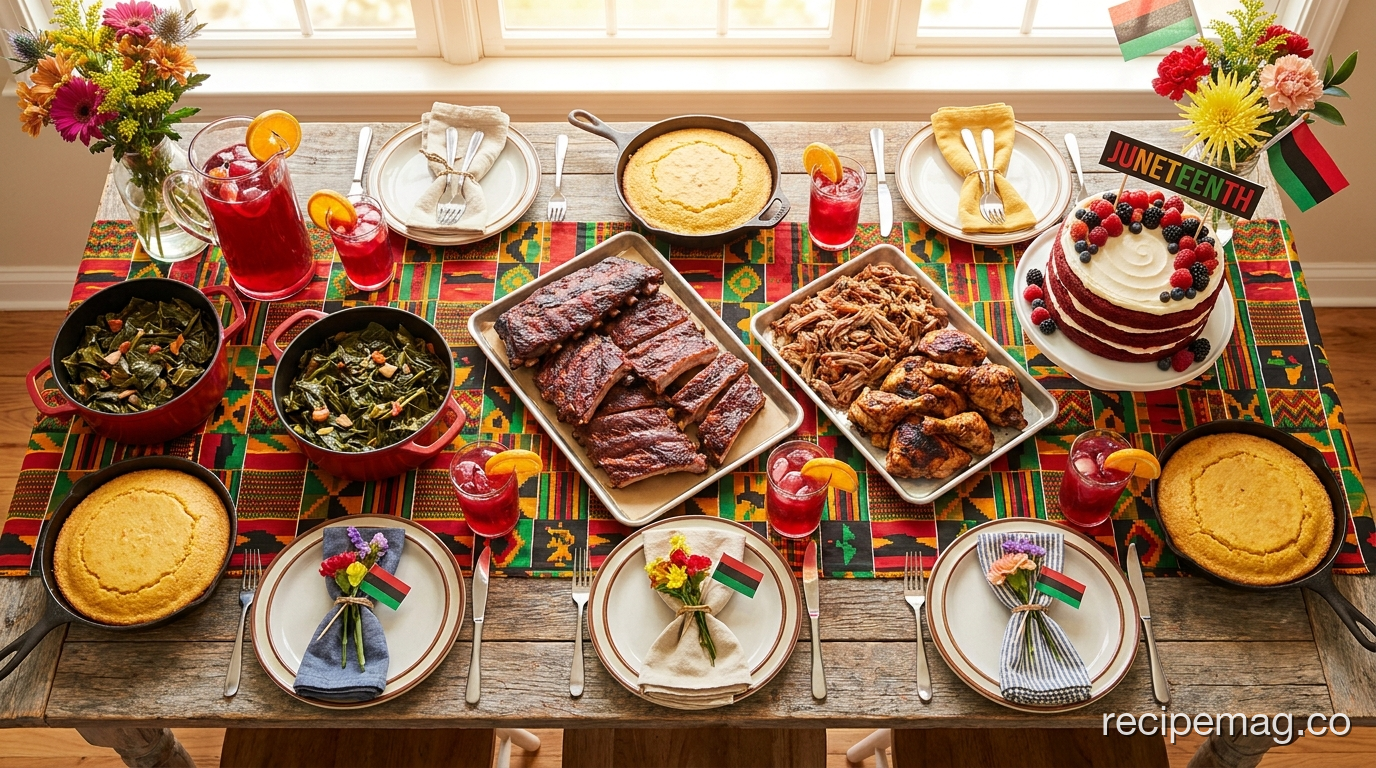
Juneteenth marks June 19, 1865, the day Union troops reached Galveston, Texas, and announced that enslaved people there were free, more than two years after the Emancipation Proclamation. Food sits at the heart of how the holiday is observed. Red foods and drinks, slow-smoked barbecue, collard greens, and cornbread carry meaning passed down through generations. Juneteenth became a federal holiday in 2021, the first new one established since 1983 ([Library of Congress](https://www.loc.gov), 2021). This guide walks through the dishes and the stories behind them.
Key Takeaways
- Juneteenth commemorates June 19, 1865, when freedom finally reached enslaved people in Galveston, Texas.
- Red foods and drinks symbolize resilience, sacrifice, and the West African heritage carried through slavery.
- Congress made Juneteenth a federal holiday in 2021 with a near-unanimous vote ([U.S. Senate](https://www.senate.gov), 2021).
- The classic table centers on barbecue, collard greens, cornbread, red velvet cake, and red drinks like hibiscus and strawberry soda.
- Each dish carries cultural memory, not just flavor, making the meal an act of remembrance and joy.
Why Is Red Food Central to Juneteenth?
Red is the signature color of the Juneteenth table, and the reason runs deep. Food historians connect it to West African traditions where red represents resilience, sacrifice, and spiritual power. Hibiscus and kola nut, both deep red and both carried across the Atlantic during the transatlantic slave trade, became foundational to the holiday’s drinks and dishes ([Smithsonian NMAAHC](https://nmaahc.si.edu), 2021).
The color also stands as a remembrance of bloodshed and survival. Celebrants honor the lives lost in slavery while marking the joy of freedom. That dual meaning is why a Juneteenth plate so often glows red, from the drink in the glass to the dessert on the table.
You’ll see this play out in red velvet cake, watermelon, strawberry soda, hibiscus tea, red beans, and barbecue glazed in tomato-red sauce. None of it is accidental. The color ties the meal to memory.
Recipe note
Start your menu by choosing two or three red anchors: a drink, a main, and a dessert. That single decision shapes the whole table and keeps the symbolism clear without forcing every dish to be red.
1. Red Drinks: Hibiscus Tea and Strawberry Soda
No Juneteenth gathering feels complete without a red drink. The tradition draws directly from hibiscus (often called bissap or sorrel) and kola, two red West African ingredients brought to the Americas through slavery ([Smithsonian NMAAHC](https://nmaahc.si.edu), 2021). Today the red drink ranges from steeped hibiscus tea to homemade strawberry soda to the beloved red Big Red soda popular across Texas, the holiday’s birthplace.
Recipe note
For hibiscus tea, simmer 1 cup dried hibiscus flowers in 4 cups water for 10 minutes, sweeten with sugar or honey while warm, then chill and serve over ice with a squeeze of lime. For a quick strawberry soda, muddle fresh strawberries with sugar, strain, and top with sparkling water.
2. Barbecue: Slow-Smoked Brisket and Ribs
Barbecue is the backbone of most Juneteenth cookouts, and its history is inseparable from Black cooks. Enslaved and freed Black pitmasters developed much of the low-and-slow smoking technique that defines Southern barbecue today ([Smithsonian Magazine](https://www.smithsonianmag.com), 2021). Brisket carries special weight in Texas, where the holiday began, while ribs, pulled pork, and smoked sausage round out the spread.
Smoke is the whole point, and it takes patience. The USDA notes that whole cuts of beef and pork are safe once they reach an internal temperature of 145°F with a three-minute rest, while tougher cuts like brisket taste best pushed well past that to break down connective tissue ([USDA FSIS](https://www.fsis.usda.gov), 2023).
Recipe note
For brisket, rub with salt, black pepper, and paprika, then smoke at 225°F until the internal temperature hits about 203°F, roughly 1 to 1.5 hours per pound. Rest it wrapped for at least 30 minutes before slicing against the grain.
3. Collard Greens with Smoked Meat
Collard greens are a Juneteenth staple and a direct link to West African cooking. Leafy greens simmered low and slow with smoked meat trace back to traditional African stews, and they carry symbolic weight too: their green color is often associated with prosperity and growth. Cooked greens are also genuinely nutritious, with one cooked cup providing over 200% of the daily value for vitamin K ([USDA FoodData Central](https://fdc.nal.usda.gov), 2023).
Recipe note
Simmer washed, stemmed collards with a smoked turkey leg or ham hock, onion, garlic, and a splash of vinegar for 60 to 90 minutes until tender. Don’t toss the cooking liquid, the “pot likker.” Spoon it over the greens with cornbread for dipping.
4. Cornbread: Skillet-Style and Sweet
Cornbread anchors the Southern table and serves as the perfect partner to greens and barbecue. Corn was a foundational crop for enslaved communities, who turned a modest ration into hoecakes, spoonbread, and skillet cornbread. Cornmeal remains a Southern pantry essential, and a cast-iron skillet delivers the crisp, golden crust that defines the classic version ([America’s Test Kitchen](https://www.americastestkitchen.com), 2022).
Recipe note
Heat a greased cast-iron skillet in a 425°F oven while you mix the batter. Pour the batter into the screaming-hot pan for an instant crust, then bake 20 to 25 minutes until golden. Sweeten to taste; the South is divided, and both camps are right.
5. Red Velvet Cake
Red velvet cake is the dessert that ties the Juneteenth table back to its symbolic red. The deep crimson crumb echoes the holiday’s themes of sacrifice and resilience, and its cream cheese frosting makes it a celebration centerpiece. The cake’s signature color and tang come from the reaction between cocoa, buttermilk, and a touch of vinegar, a chemistry that originally gave the “velvet” texture its name ([Serious Eats](https://www.seriouseats.com), 2021).
Recipe note
Cream butter and sugar, add buttermilk, cocoa, vinegar, and red food coloring, then bake in two rounds at 350°F for about 25 minutes. Cool completely before frosting with tangy cream cheese frosting to keep it from sliding.
6. Watermelon and Fresh Red Fruit
Watermelon shows up at nearly every Juneteenth celebration, both for its color and its history. The fruit was widely grown by free Black farmers after emancipation, and reclaiming it as a symbol of freedom and joy is part of the holiday’s spirit. It’s also peak season: U.S. watermelon hits its harvest stride from June through August, making mid-June fruit reliably sweet ([USDA AMS](https://www.ams.usda.gov), 2023).
Recipe note
Serve watermelon simply chilled and cubed, or dress it up: toss cubes with feta, mint, and a squeeze of lime for a savory-sweet salad. A sprinkle of Tajín adds a bright, salty kick that plays beautifully against the sugar.
7. Red Beans and Rice
Red beans and rice brings both color and deep Louisiana roots to the Juneteenth table. The dish grew from Creole and West African traditions of cooking beans low and slow with smoked pork and the aromatic “holy trinity” of onion, celery, and bell pepper. Beans are a nutritional powerhouse too, delivering roughly 15 grams of protein and 13 grams of fiber per cooked cup ([USDA FoodData Central](https://fdc.nal.usda.gov), 2023).
Recipe note
Soak dried red beans overnight, then simmer with andouille sausage, the holy trinity, garlic, thyme, and bay leaves for 2 to 3 hours until creamy. Mash a few beans against the pot to thicken the sauce. Serve over white rice.
8. Fried Chicken and Catfish
Fried chicken and cornmeal-crusted catfish are celebration foods with deep roots in Black Southern cooking. Both turn humble ingredients into something worthy of a gathering, and both reflect the resourcefulness that defined cooking under slavery and after emancipation. Frying safely matters: the USDA recommends cooking poultry to an internal temperature of 165°F to ensure it’s fully done ([USDA FSIS](https://www.fsis.usda.gov), 2023).
Recipe note
Brine chicken in buttermilk for a few hours, dredge in seasoned flour, and fry at 350°F until golden and cooked through. For catfish, coat fillets in seasoned cornmeal and fry just 3 to 4 minutes per side. Drain both on a wire rack, not paper towels, to keep the crust crisp.
9. Potato Salad and Macaroni and Cheese
No Southern celebration plate is complete without the sides, and potato salad and baked macaroni and cheese are non-negotiable at most Juneteenth gatherings. These dishes are about community as much as flavor, often made in large batches and shared family-style. Baked mac and cheese in particular has a storied place in Black Southern cooking, with recipes guarded and passed down through generations.
Recipe note
For mac and cheese, build a sharp cheddar base and bake until the top browns. For potato salad, fold boiled potatoes with mayonnaise, mustard, celery, egg, and a little sweet pickle relish. Chill both for at least an hour so the flavors settle before serving.
10. Peach Cobbler and Sweet Tea
The Juneteenth meal usually closes with peach cobbler and a tall glass of sweet tea. Peaches reach their Southern peak in summer, and a warm cobbler with a buttery crust is pure celebration. Peaches hit their harvest stride from July into August across leading states like Georgia and South Carolina, with early varieties arriving in June ([USDA NASS](https://www.nass.usda.gov), 2023).
Recipe note
Toss sliced peaches with sugar, cinnamon, and a squeeze of lemon, pour over a simple batter or under a biscuit topping, and bake at 375°F until bubbling and golden. Serve warm with vanilla ice cream and ice-cold sweet tea.
Frequently Asked Questions About Juneteenth Food Traditions
What is the significance of red foods on Juneteenth?
Red foods and drinks symbolize resilience, sacrifice, and the bloodshed endured during slavery, while also celebrating the joy of freedom. The tradition traces to West African ingredients like hibiscus and kola nut, both deep red, that traveled with enslaved Africans ([Smithsonian NMAAHC](https://nmaahc.si.edu), 2021). Red velvet cake, hibiscus tea, watermelon, and strawberry soda all carry this meaning.
When and where did Juneteenth originate?
Juneteenth originated on June 19, 1865, in Galveston, Texas, when Union General Gordon Granger arrived and announced that enslaved people were free. This came more than two years after the Emancipation Proclamation, because enforcement had not reached Texas. The holiday became federal in 2021 ([Library of Congress](https://www.loc.gov), 2021), and celebrations spread nationwide from their Texas roots.
What are the most traditional Juneteenth dishes?
The classic Juneteenth menu centers on barbecue (especially brisket in Texas), collard greens, cornbread, red velvet cake, watermelon, and red drinks like hibiscus tea. Sides like potato salad, baked macaroni and cheese, and red beans and rice are common too. Many menus deliberately feature red foods to honor the holiday’s symbolism of sacrifice and resilience.
Do I need to make everything red for Juneteenth?
No. The red theme is symbolic, not a strict rule. Most cooks choose two or three red anchors, often a drink, a main, and a dessert, and let the rest of the menu follow Southern tradition. A red drink and red velvet cake alongside barbecue, greens, and cornbread captures the spirit fully without forcing every dish to match.
Can I make Juneteenth dishes ahead of time?
Yes, and many improve with time. Collard greens, red beans and rice, potato salad, and baked macaroni and cheese all taste better after the flavors settle overnight. Cobbler and cornbread are best fresh but reheat well. Smoked meats can be prepped a day ahead and gently rewarmed, freeing you to enjoy the gathering rather than working the whole day.
Celebrate Juneteenth Around the Table
Juneteenth food is about memory and joy in equal measure. Every red drink, every plate of greens, every slice of red velvet cake carries a story of resilience that stretches back through generations. Cooking these dishes is a way of honoring that history while gathering the people you love.
You don’t need to make all ten dishes to celebrate well. Pick a red drink, fire up the grill, simmer a pot of greens, and bake something sweet to finish. The meal matters most when it’s shared, so set a generous table and make room for everyone.
This Juneteenth, let the food tell the story. Freedom, after all, is worth celebrating with the very best of what the Southern kitchen has given us.
