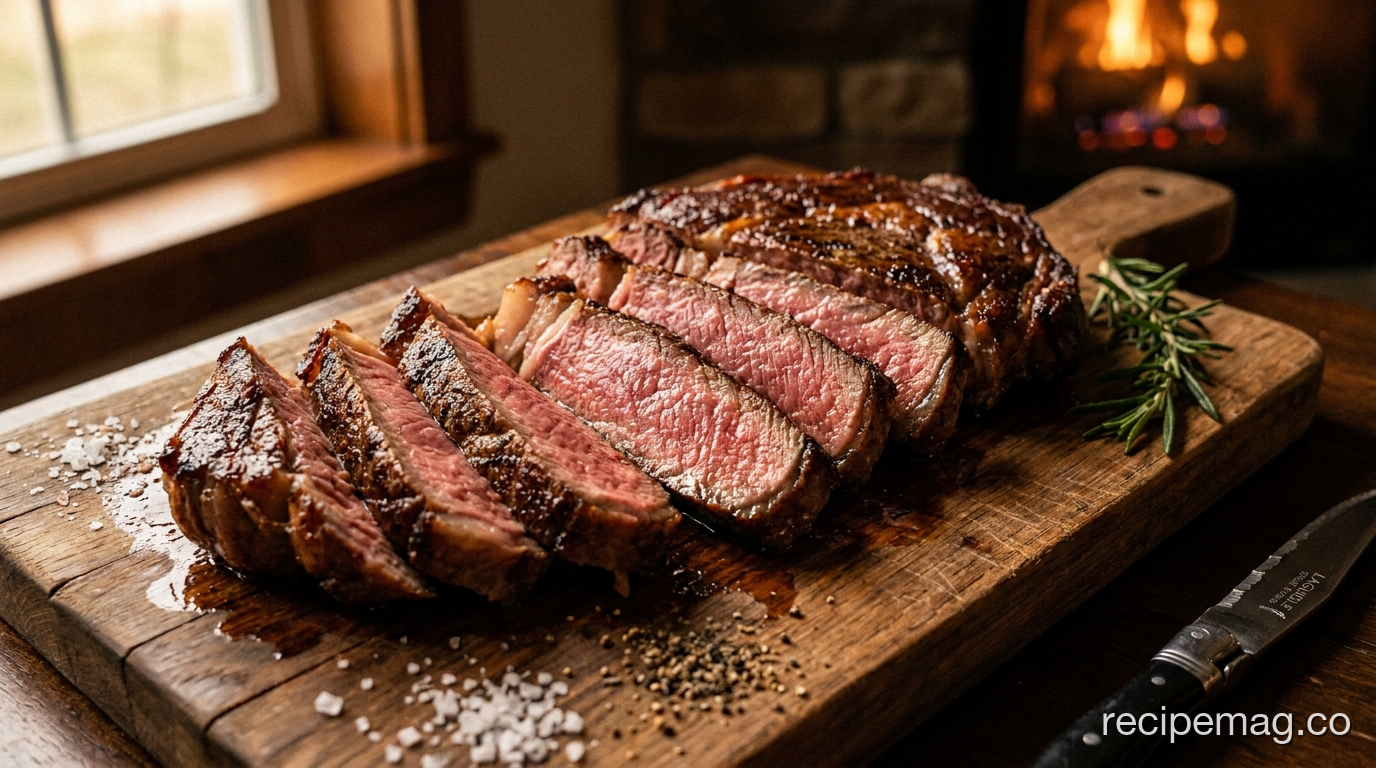
The reverse sear flips the classic steak order on its head. Instead of searing first, you cook the ribeye slowly in a low oven or over indirect heat until it reaches about 115°F, then finish it with a blazing-hot sear. The payoff is a steak that’s evenly rosy from edge to edge, with no gray band of overcooked meat under the crust. According to America’s Test Kitchen, this method gives you a wider margin for error and a more uniform doneness than traditional high-heat searing. ([America’s Test Kitchen](https://www.americastestkitchen.com), 2022) It works best on thick cuts, 1.5 inches or more.
Key Takeaways
- Reverse searing means slow first, sear last: low heat to an internal temp of ~115°F, then a hard sear.
- Best for thick steaks 1.5 inches or thicker; thin steaks overcook before they sear.
- Pull the steak from low heat 10–15°F below your target, since carryover cooking raises the temp during the sear and rest.
- The USDA lists 145°F as the safe minimum for whole beef, with a 3-minute rest. ([USDA FSIS](https://www.fsis.usda.gov), 2023)
- An instant-read thermometer is the single most important tool for getting this right.
What Is Reverse Searing, Exactly?
Reverse searing reverses the steakhouse sequence. You start low and slow, then finish hot. A 2016 explainer from Serious Eats describes the technique as cooking the steak in a 200–275°F oven until it’s nearly done, then searing it in a screaming-hot pan or over direct flame for a minute or two per side. ([Serious Eats](https://www.seriouseats.com), 2016) The gentle first stage warms the meat evenly all the way through. The fast sear then handles only the crust.
Compare that to the standard method, where you slam a cold steak into a hot pan. The outside cooks far faster than the inside. By the time the center hits medium-rare, you’ve got a thick gray ring of overdone meat just under the surface. Reverse searing solves that problem by separating the two jobs the heat has to do.
Think of it as two tasks: cook the inside, then brown the outside. Most methods try to do both at once with one blast of heat. The reverse sear gives each task its own stage, and each one gets done properly.
Why Does the Reverse Sear Work So Well?
The reverse sear works because of two pieces of food science: even heating and the Maillard reaction. The slow low-heat stage raises the steak’s internal temperature gradually, so the center and the edges arrive at the same doneness together. As food scientist Harold McGee explains, the deep, savory crust comes from the Maillard reaction, the browning chemistry that kicks in above about 300°F. ([Harold McGee, On Food and Cooking](https://www.haroldmcgee.com), 2004) Slow cooking also dries the surface, and a dry surface browns faster.
That dried surface is the hidden advantage. During the low oven stage, moisture evaporates off the outside of the steak. When you hit it with high heat, there’s no surface water to boil off first, so the crust forms in seconds instead of minutes. Less time searing means less chance of overcooking the layer just beneath.
There’s also the matter of control. Because the steak heats slowly, you have minutes, not seconds, to catch it at the exact temperature you want. With a thermometer in hand, the window for a perfect medium-rare is generous and forgiving.
[UNIQUE INSIGHT] Most home cooks blame their thin gray band on “not enough heat.” It’s usually the opposite problem. The traditional sear-first method dumps too much heat into the surface too fast, cooking the outer layers well past your target before the center catches up. The reverse sear isn’t about more heat. It’s about putting the heat where it belongs, when it belongs there.
Why Is the Reverse Sear Best for Thick Ribeyes?
This method shines specifically on thick steaks, and there’s a clear reason. A steak needs enough mass for the gentle first stage to matter. Serious Eats recommends the reverse sear for steaks at least 1.5 inches thick, noting that thinner cuts overcook before you can build a proper crust. ([Serious Eats](https://www.seriouseats.com), 2016) A ribeye is ideal here: it’s well-marbled, generously sized, and forgiving.
A thin steak, say three-quarters of an inch, has almost no interior to protect. By the time the surface browns, the whole thing is cooked through. The slow stage gives you nothing because there’s no thermal buffer between the crust and the center. For thin cuts, a fast hot sear is genuinely the better tool.
A 1.5-inch ribeye, on the other hand, has real depth. The slow stage warms that depth evenly, and the fast sear browns the outside without driving heat too far inward. The thicker the steak, the bigger the advantage. A two-inch ribeye is where the reverse sear truly outclasses every other method.
What About Marbling?
Ribeye is the cut of choice partly because of its fat. The intramuscular marbling melts as the steak warms slowly, basting the meat from the inside and adding richness. Look for a ribeye with fine, even threads of white fat running through the red. That marbling renders gently during the low stage rather than scorching, which is exactly what you want.
What Temperatures Should You Cook a Reverse-Seared Ribeye To?
Temperature is where the reverse sear lives or dies, so use a thermometer. The USDA Food Safety and Inspection Service sets 145°F as the safe minimum internal temperature for whole beef cuts, with a 3-minute rest afterward. ([USDA FSIS](https://www.fsis.usda.gov), 2023) Most steak lovers target medium-rare, which sits lower, around 130–135°F. Whatever you choose, the key number to remember is your pull temperature, not your final temperature.
Here’s the critical move: pull the steak from the low oven about 10–15°F below your target. Carryover cooking does the rest. The residual heat keeps cooking the meat during the sear and the rest, climbing those last degrees on its own. For a medium-rare final temp of 130°F, pull the steak at around 115°F.
Reverse Sear Temperature Guide
- Rare (final ~120°F): Pull from low heat at ~105°F.
- Medium-rare (final ~130°F): Pull from low heat at ~115°F. This is the sweet spot for ribeye.
- Medium (final ~140°F): Pull from low heat at ~125°F.
- Medium-well (final ~150°F): Pull from low heat at ~135°F.
These pull numbers assume a hot, fast sear that adds roughly 10–15°F. A longer or gentler sear adds more, so check the temp again right before you sear and adjust. The thermometer is not optional. Guessing is how perfectly good ribeyes get ruined.
How Do You Reverse-Sear a Ribeye Step by Step?
The process is simple once you’ve done it once, and it forgives small mistakes. According to America’s Test Kitchen, the wider time window of low-temperature cooking is the main reason reverse-seared steaks come out more consistently than pan-seared ones. ([America’s Test Kitchen](https://www.americastestkitchen.com), 2022) You’ll need a thick ribeye, a wire rack, a sheet pan, a thermometer, and a heavy skillet or a hot grill for the final sear.
Step-by-Step Instructions
- Salt and rest the steak. Season the ribeye generously with kosher salt on all sides. If you have time, leave it uncovered on a rack in the fridge for 1 to 24 hours. This dries the surface and seasons the interior, both of which improve the sear.
- Set up low heat. Preheat your oven to 250°F (or set up a grill for indirect heat at 250°F). Place the steak on a wire rack set over a sheet pan so air circulates underneath.
- Cook low and slow. Cook until the internal temperature reaches your pull point, about 115°F for medium-rare. For a 1.5-inch ribeye, this takes roughly 35 to 50 minutes. Start checking early; thickness and oven accuracy vary.
- Rest briefly and dry the surface. Pull the steak and pat it completely dry with paper towels. A dry surface is essential for a fast, deep crust.
- Get the pan screaming hot. Heat a cast-iron or heavy stainless skillet over high heat with a high-smoke-point oil until it just begins to smoke. On a grill, build the hottest direct fire you can.
- Sear hard and fast. Sear the ribeye for 45 to 90 seconds per side, until a deep brown crust forms. Add a knob of butter, a smashed garlic clove, and a thyme sprig in the last 30 seconds, basting the spoon-fuls over the top.
- Sear the edges. Use tongs to stand the steak on its fat cap and edges for 20 to 30 seconds each. Rendered fat cap is one of the best parts of a ribeye.
- Rest and slice. Let the steak rest 5 to 10 minutes. Slice against the grain and finish with flaky salt.
[PERSONAL EXPERIENCE] We’ve found that the dry-brine step in stage one makes the biggest difference of anything in this recipe. Salting the ribeye and leaving it uncovered in the fridge overnight pulls surface moisture out, so the sear takes hold almost instantly. The difference between an overnight dry-brine and a steak salted right before cooking is the difference between a crackling crust and a pale, slow-forming one.
What Are the Most Common Reverse-Sear Mistakes?
Most reverse-sear failures trace back to a handful of avoidable errors, and nearly all of them involve temperature or moisture. The most common one, according to Serious Eats, is skipping the thermometer and cooking by time alone, which ignores how much steak thickness affects cooking duration. ([Serious Eats](https://www.seriouseats.com), 2016) Below are the mistakes worth steering around.
Mistakes to Avoid
- Cooking by time, not temperature. Steak thickness, oven calibration, and starting temp all vary. The thermometer is the only honest answer to “is it done yet?”
- A wet steak surface. Moisture is the enemy of crust. Pat the steak bone-dry before searing, every time.
- A pan that isn’t hot enough. A lukewarm pan gives you a slow, gray sear. Wait for the oil to shimmer and just smoke.
- Searing too long. The steak is already cooked through. The sear is only for crust. Forty-five to ninety seconds per side is plenty.
- Using a thin steak. Reverse searing a thin cut overcooks it. Save this method for ribeyes 1.5 inches and up.
- Skipping the rest. A short rest lets the juices redistribute. Slice too soon and they run out onto the board.
—
Reverse-Seared Ribeye
Prep Time: 10 minutes (plus optional overnight dry-brine) | Cook Time: 45 minutes | Serves: 2
Ingredients
- 1 bone-in or boneless ribeye, at least 1.5 inches thick (about 1 to 1.25 lb)
- Kosher salt, generously
- Freshly ground black pepper
- 1 tablespoon high-smoke-point oil (avocado, grapeseed, or refined canola)
- 2 tablespoons butter
- 1 garlic clove, smashed
- 1 sprig fresh thyme or rosemary
- Flaky sea salt, to finish
Instructions
- Season the ribeye generously with kosher salt on all sides. For the best crust, leave it uncovered on a wire rack in the fridge for 1 to 24 hours. Otherwise, proceed right away.
- Preheat the oven to 250°F (120°C). Set the steak on a wire rack over a sheet pan.
- Cook until the internal temperature reaches about 115°F for medium-rare, roughly 35 to 50 minutes for a 1.5-inch steak. Check early and often with an instant-read thermometer.
- Remove the steak and pat it completely dry with paper towels. Season with black pepper.
- Heat the oil in a cast-iron skillet over high heat until it just begins to smoke.
- Sear the ribeye 45 to 90 seconds per side, until deeply browned. Stand it on its edges and fat cap for 20 to 30 seconds each.
- Add butter, smashed garlic, and thyme in the final 30 seconds. Tilt the pan and spoon the foaming butter over the steak.
- Rest 5 to 10 minutes. Slice against the grain, finish with flaky salt, and serve.
Notes
- Pull temp matters more than time: pull 10–15°F below your target, since carryover cooking adds the rest.
- USDA recommends a safe minimum of 145°F with a 3-minute rest. Lower medium-rare targets are a personal preference.
- No oven? Use a grill set up for indirect heat at 250°F, then finish over the hottest direct fire.
- Double the recipe for a larger crowd; sear steaks one or two at a time so the pan stays blazing hot.
—
Frequently Asked Questions About Reverse-Seared Ribeye
What temperature do I pull the ribeye at for medium-rare?
Pull the ribeye from the low oven at about 115°F for a medium-rare final temperature of roughly 130°F. The 15°F gap accounts for carryover cooking during the sear and rest. Always use an instant-read thermometer rather than guessing by time. Steak thickness and oven calibration vary too much to rely on the clock alone.
How thick should my steak be for reverse searing?
Aim for at least 1.5 inches thick, and 2 inches is even better. Serious Eats recommends this method specifically for thick cuts, because thinner steaks overcook before a crust can form. ([Serious Eats](https://www.seriouseats.com), 2016) A thin steak has no thermal buffer between the surface and the center, so a fast traditional sear suits it better.
Can I reverse sear on a grill instead of in the oven?
Yes, and it’s a classic outdoor method. Set up your grill for two-zone cooking: bank the coals or light only some burners to create an indirect-heat side around 250°F. Cook the steak on the cool side until it hits your pull temperature, then move it to the hot direct side for a fast, hard sear on both faces.
Do I need to rest the steak after reverse searing?
A short rest of 5 to 10 minutes helps. Because the steak cooked gently, its juices are already fairly evenly distributed, so it needs less rest than a traditionally seared steak. The USDA also recommends a 3-minute rest for food safety on whole beef cuts. ([USDA FSIS](https://www.fsis.usda.gov), 2023) Slicing immediately lets juices escape onto the board.
Why is my crust pale and not browning?
A pale crust almost always means a wet steak surface or a pan that isn’t hot enough. Pat the steak bone-dry before searing, and heat your oil until it just begins to smoke. A dry surface browns far faster because there’s no moisture to boil off first. The overnight dry-brine in the recipe helps dramatically here.
The reverse sear isn’t a chef’s trick reserved for restaurants. It’s the most reliable way to cook a thick ribeye at home, and it asks for only two things: patience during the slow stage and a thermometer to catch the right moment.
Start with a ribeye 1.5 inches or thicker. Cook it low to about 115°F, dry it well, and sear it hard in a smoking-hot pan. Pull at the right temperature, rest it briefly, and slice against the grain. That’s the whole method.
Do it once and the gray band disappears for good. You’ll get edge-to-edge, rosy medium-rare with a crackling crust, the kind of steak that makes you wonder why you ever did it the old way. Fire up the oven this weekend and see for yourself.
