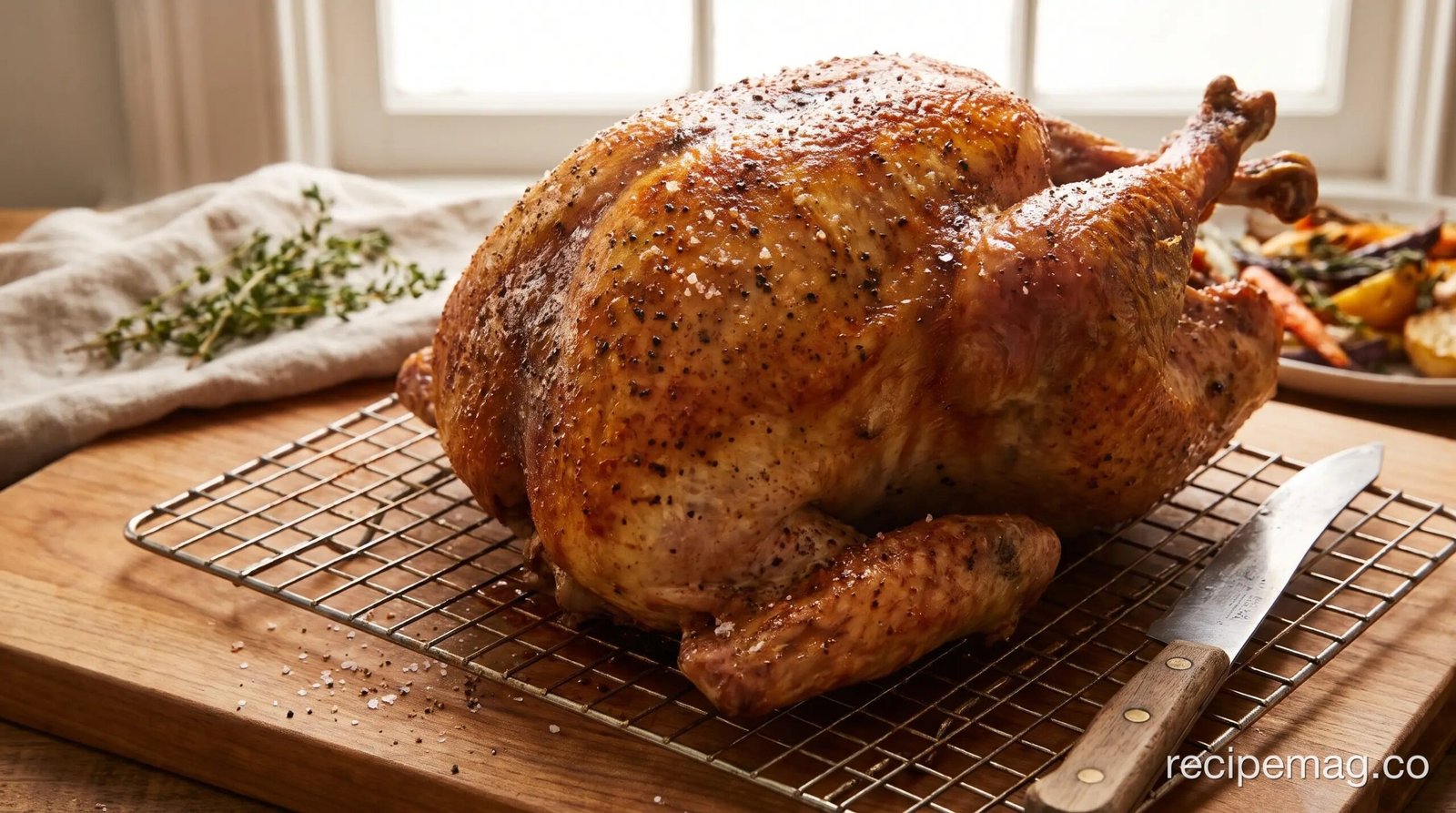
A dry-brined turkey is simply a salted turkey: you rub kosher salt over the bird, leave it uncovered in the fridge for 24 to 48 hours, then roast. The salt seasons the meat all the way through and helps it hold onto its juices, while the cold, dry air of the fridge leaves the skin taut and ready to crackle. Like any turkey, it’s done when the thickest part of the breast and the innermost thigh and wing reach 165°F (USDA FSIS, 2024).
Key Takeaways
- Use about 1 tablespoon of Diamond Crystal kosher salt per 4 to 5 pounds of turkey.
- Salt 24 to 48 hours ahead and leave the bird uncovered in the fridge.
- Skip the salt for kosher, self-basting or “enhanced” turkeys.
- Roast at 425°F for 30 minutes, then 325°F until it reaches 165°F (USDA FSIS, 2024).
- Don’t rinse before roasting; just blot and go.
Why Dry-Brine a Turkey Instead of Wet-Brining It?
Dry brining gives you the seasoning of a wet brine without the bucket. Either way, the bird has to stay at 40°F or below, because bacteria multiply rapidly between 40°F and 140°F (USDA FSIS, 2024). A bucket of salt water rarely fits in a home fridge; a salted turkey on a sheet pan takes one shelf.
Salt first draws moisture to the surface, where it dissolves into a concentrated brine. Over the next day or two, that brine soaks back into the meat and loosens its proteins, so they hold more juice as they cook. A wet brine does the same job but adds water, which can leave the meat tasting diluted and the skin rubbery.
The skin is where dry brining pulls ahead, and salt is only half the reason. The other half is time uncovered in the fridge. Refrigerator air is dry, so a day or two on an open rack leaves the skin taut and almost papery. Dry skin crisps instead of steaming, so don’t cover the bird.
Ingredients
This recipe is built for a 12- to 14-pound turkey, which feeds 12 to 14 people at 1 pound per person (USDA FSIS, 2024), or 10 to 12 with leftovers.
Serves 10 to 12. Prep time 20 minutes. Dry-brine time 24 to 48 hours. Cook time 2¾ to 3½ hours, plus 30 minutes resting. Total time 3½ to 4½ hours, plus brining.
For the dry brine:
- 3 tablespoons Diamond Crystal kosher salt (or 1¾ tablespoons Morton kosher salt)
- 2 teaspoons freshly ground black pepper
- 2 teaspoons dried thyme
- 1 teaspoon dried rubbed sage
- 2 teaspoons baking powder (optional, for extra-crisp skin)
For roasting:
- 1 whole turkey, 12 to 14 pounds, fully thawed and not pre-brined
- 1 large yellow onion, quartered
- 2 medium carrots, cut into 2-inch pieces
- 2 celery ribs, cut into 2-inch pieces
- 1 lemon, halved
- 4 sprigs fresh thyme
- 3 tablespoons unsalted butter, melted
- 1½ cups low-sodium chicken or turkey stock, plus more as needed
Equipment: a rimmed sheet pan with a wire rack, a roasting pan with a rack, and an instant-read thermometer.
Check the label first. If it says kosher, self-basting, “enhanced” or “contains up to X% of a solution,” the bird is already salted, so leave out the salt.
How to Dry-Brine a Turkey
Dry brining takes about 20 minutes of hands-on work. Start with paper towels, not the faucet: USDA FSIS advises against rinsing raw poultry, which spreads bacteria around the sink (USDA FSIS, 2024).
- Prep the bird. Remove the neck and giblets and refrigerate them for stock. Pat the turkey dry inside and out with paper towels.
- Mix the brine. Stir together the salt, pepper, dried thyme, sage and baking powder, if using.
- Salt it. Gently loosen the skin over the breast and thighs with your fingers. Rub about a third of the mixture onto the meat under the skin, then sprinkle the rest evenly over the outside, a little heavier on the breast and thighs.
- Refrigerate uncovered. Set the turkey breast side up on the wire rack in the sheet pan. Refrigerate it on the bottom shelf, away from ready-to-eat food, for 24 to 48 hours.
How to Roast a Dry-Brined Turkey
Start hot to set the skin, then finish at 325°F. USDA FSIS times a 12- to 14-pound unstuffed turkey at 3 to 3¾ hours at 325°F (USDA FSIS, 2024). The hot start trims that a little, so most dry-brined birds this size take 2¾ to 3½ hours.
- Heat the oven. Set a rack in the lowest position and heat the oven to 425°F. Blot any moisture off the skin.
- Set up the pan. Scatter the onion, carrots and celery in the roasting pan, pour in the stock and set the rack on top.
- Load the rack. Tuck the lemon halves and thyme sprigs into the cavity and the wing tips behind the breast. Set the turkey on the rack breast side up and brush it with the melted butter. Don’t add more salt.
- Roast hot. Roast for 30 minutes.
- Finish low. Reduce the heat to 325°F and keep roasting, checking the temperature after about 1½ hours more. If the pan runs dry, add ½ cup more stock. If the breast browns too fast, lay foil loosely over it.
- Check doneness. It’s ready when the thickest part of the breast and the innermost thigh and wing all read 165°F.
- Rest and carve. Rest the turkey uncovered on a cutting board for 30 minutes; foil would soften the skin. Strain the pan juices into a fat separator for gravy, discard the vegetables and carve.
Tips for the Best Dry-Brined Turkey
- Weigh the salt if you can. About 25 grams covers a 12- to 14-pound bird, whatever the brand. Avoid table salt; it’s fine-grained and easy to overdo.
- Use the baking powder for extra crunch. It raises the skin’s pH, which helps it brown and blister in the oven.
- Want herb butter too? Work softened unsalted butter and chopped herbs under the breast skin just before roasting, as in our classic herb-butter roast turkey.
- Bake the stuffing separately. FSIS says stuffing cooked inside the bird must reach 165°F at the center, which usually means an overcooked breast.
We’ve found that a wire rack beats a roasting pan for the fridge stage. Air reaches the underside, so you get crisp skin all the way around instead of a soggy bottom.
How Far Ahead Can You Dry-Brine a Turkey?
Up to two days. USDA FSIS says a fresh or fridge-thawed turkey should be cooked within 1 to 2 days (USDA FSIS, 2024), which matches a 24- to 48-hour dry brine. Here’s the schedule for a Thursday, November 26, dinner:
- Saturday, November 21: Move a frozen 12- to 14-pound turkey to the fridge. Our guide on how to thaw a turkey safely has dates for other sizes.
- Tuesday, November 24: Salt it for a 48-hour brine. Buying fresh? Pick it up today.
- Wednesday, November 25: Last call for a 24-hour brine. Make our make-ahead turkey gravy too, so Thursday’s drippings are a bonus.
- Thursday, November 26: For a 4 p.m. dinner, get the turkey in the oven by noon. If it’s done early, let it rest longer, but carve and serve within 2 hours.
Refrigerate leftovers within 2 hours and eat them within 3 to 4 days, per FSIS. Freeze sliced turkey with a splash of stock to keep it moist.
Frequently Asked Questions About Dry-Brined Turkey
Do you rinse a dry-brined turkey before roasting?
No. By roasting day, most of the salt has been absorbed, so there’s little left to rinse away. USDA FSIS also advises against washing raw poultry, since it spreads bacteria around the sink. Blot any surface moisture with paper towels and roast the bird as it is.
Will a dry-brined turkey taste salty?
Not at these amounts. About 1 tablespoon of Diamond Crystal kosher salt per 4 to 5 pounds seasons the meat without making it taste cured. The bigger risk is the gravy, because the drippings are already seasoned. Use low-sodium stock and taste before adding any salt.
Can you dry-brine a turkey that’s still partly frozen?
Wait until you can loosen the skin and pull out the giblets. Salt can’t work its way into frozen meat, though a few ice crystals deep in the cavity are fine, because the bird keeps thawing in the fridge as it brines. Count the brining time from that point.
Does dry brining work on chicken?
Yes, and a chicken is a good way to practice before Thanksgiving. Use about 1 tablespoon of Diamond Crystal kosher salt for a 4-pound bird and refrigerate it uncovered overnight. Our grilled spatchcock chicken uses the same method on a flattened bird.
Salt It Tuesday, Roast It Thursday
Dry brining asks for 20 minutes of work and one fridge shelf. In return, you get seasoned meat, crackling skin and no bucket of salt water to wrestle.
Put the salting date on your calendar next to the thaw date, then map out the rest of the day with our Thanksgiving dinner planning guide.
