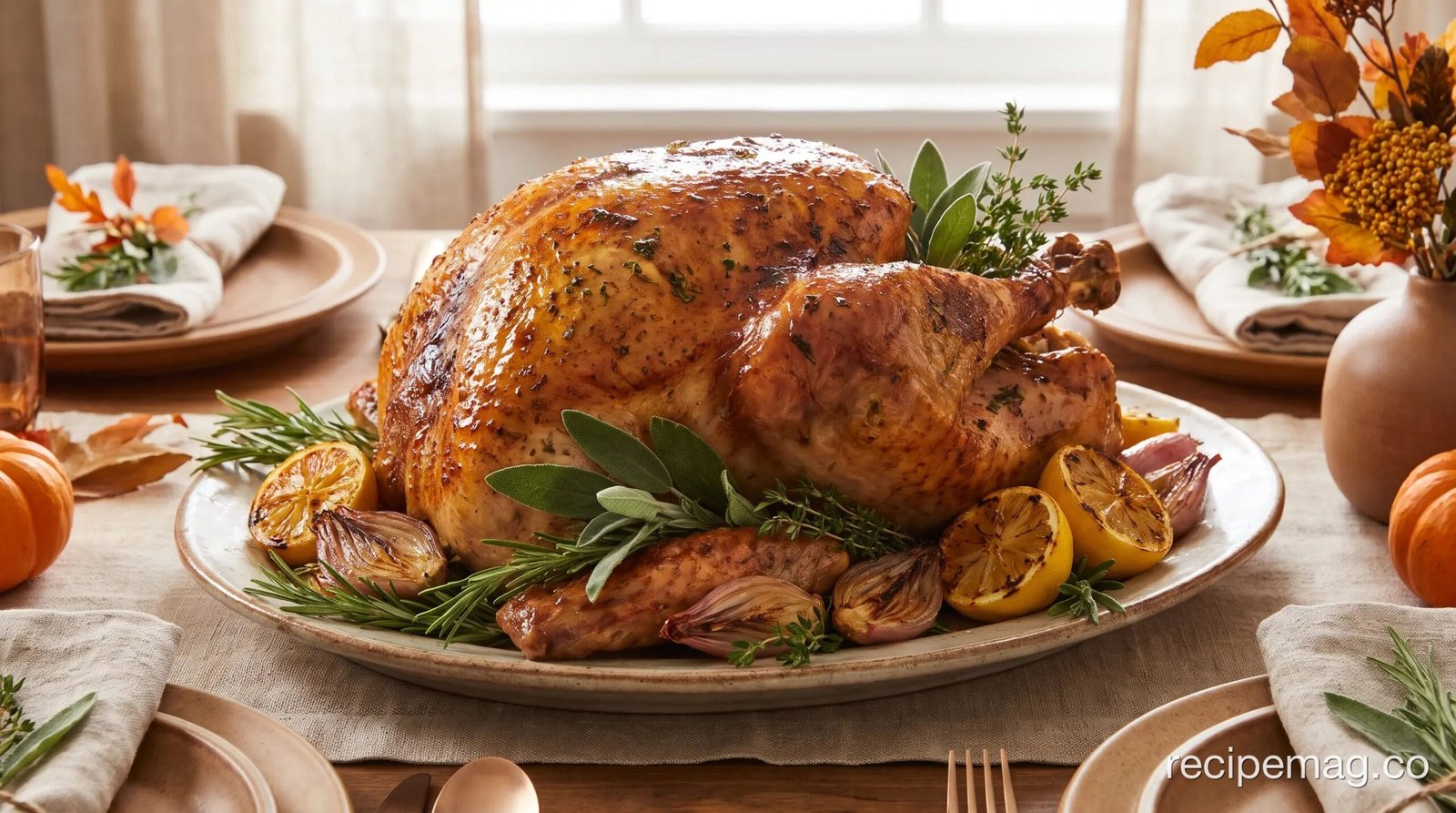
This classic herb-butter roast turkey gets its flavor from a cup of garlic-herb butter pushed under the skin and its color from a hot 425°F start before a steady roast at 325°F. The recipe is written for a 12- to 14-pound bird, which USDA estimates takes about 3 to 3¾ hours unstuffed at 325°F (USDA FSIS, 2025). A thermometer reading of 165°F, not the clock, tells you when it’s done.
Key Takeaways
- Push most of the herb butter under the skin, where it seasons the meat directly.
- Start at 425°F for 30 minutes, then finish at 325°F for even cooking.
- The turkey is done at 165°F in the breast, thigh and wing, per USDA FSIS.
- Rest it 30 to 40 minutes before carving. It stays hot.
- Make the herb butter up to 5 days ahead and butter the bird the night before.
Why Does This Roast Turkey Recipe Work?
This roast turkey recipe works because it solves the two classic problems, bland breast meat and pale skin, separately. Butter under the skin flavors and protects the breast, and a 30-minute blast at 425°F starts the browning early. Then the oven drops to 325°F, the lowest temperature USDA FSIS recommends for roasting turkey (USDA FSIS, 2025).
Here’s what most recipes skip: butter isn’t pure fat. Federal standards only require 80 percent milkfat, and much of the rest is water. Smear it all on top and that water has to steam off before the skin can crisp. Put two-thirds underneath, against the meat, and only a thin coat outside. You get seasoned meat and better skin.
Still mapping out the oven for the rest of the meal? Our Thanksgiving dinner planning guide builds a full schedule around this exact turkey.
Ingredients
Serves 10 to 12. Prep time: 30 minutes. Cook time: 2¾ to 3½ hours, plus 30 to 40 minutes resting. Total time: about 4 to 4½ hours.
For the Herb Butter
- 1 cup (2 sticks) unsalted butter, softened
- 2 tablespoons finely chopped fresh sage
- 2 tablespoons fresh thyme leaves
- 1 tablespoon finely chopped fresh rosemary
- 2 tablespoons finely chopped fresh flat-leaf parsley
- 4 garlic cloves, finely grated
- 1 lemon (zest finely grated for the butter; save the lemon for the cavity)
- 1 teaspoon kosher salt
- 1 teaspoon freshly ground black pepper
For the Turkey and Pan
- 1 whole turkey (12 to 14 pounds), fully thawed, neck and giblets removed
- 2 tablespoons Diamond Crystal kosher salt (or 1 tablespoon Morton kosher salt)
- 1 teaspoon freshly ground black pepper
- 1 head garlic, halved crosswise
- 2 medium yellow onions, quartered
- 1 small bunch fresh herb sprigs (thyme, sage and rosemary)
- 6 shallots, peeled and halved
- 2 medium carrots, cut into 2-inch pieces
- 2 celery ribs, cut into 2-inch pieces
- 2 cups low-sodium chicken or turkey broth, divided
Equipment: a large roasting pan with a rack, kitchen twine, foil and an instant-read thermometer.
How to Roast a Turkey, Step by Step
- Dry the turkey. Remove the neck and giblet bag and save the neck for stock. Don’t rinse the bird, which USDA FSIS warns spreads bacteria. Pat it very dry inside and out with paper towels.
- Make the herb butter. Mash the softened butter with the sage, thyme leaves, rosemary, parsley, grated garlic, lemon zest, 1 teaspoon salt and 1 teaspoon pepper.
- Heat the oven. Take the turkey out of the fridge 1 hour before roasting. Set a rack in the lower third of the oven, remove any rack above it, and preheat to 425°F.
- Butter under the skin. Starting at the cavity end, slide your fingers gently between the skin and the breast meat, then loosen the skin over the thighs. Push about two-thirds of the butter underneath and press from the outside to spread it.
- Season the outside. Rub the remaining butter over the skin. Sprinkle the 2 tablespoons kosher salt and 1 teaspoon pepper over the outside and inside the cavity.
- Add the aromatics. Halve the zested lemon. Loosely fill the cavity with the lemon halves, the halved garlic head, one quartered onion and the herb sprigs. Tuck the wing tips behind the back and tie the drumsticks loosely with twine.
- Set up the pan. Scatter the second onion, the shallots, carrots and celery in the pan and pour in 1 cup of broth. Set the rack over the vegetables and the turkey on it, breast side up.
- Roast hot. Roast at 425°F for 30 minutes, until the skin starts to turn golden.
- Roast low. Reduce the oven to 325°F, rotating the pan once halfway through. Add the remaining 1 cup of broth if the pan looks dry. If the breast browns too fast, tent it loosely with foil.
- Check the temperature. After about 2½ hours total, check the thickest part of the breast, the innermost thigh and the innermost wing, avoiding bone. It’s done when all three read at least 165°F.
- Rest. Move the turkey to a cutting board, tent loosely with foil and rest 30 to 40 minutes. Discard the aromatics and twine.
- Save the drippings. Strain the pan juices into a fat separator for gravy. Keep the roasted shallots for the platter.
- Carve. Remove the legs and separate the thighs from the drumsticks. Cut each breast half off the bone in one piece, then slice it crosswise.
How Long Should You Roast a Turkey?
Roasting time depends mostly on weight. USDA FSIS estimates 3 to 3¾ hours at 325°F for a 12- to 14-pound unstuffed turkey and 4½ to 5 hours for a 20- to 24-pound bird (USDA FSIS, 2025). Our 425°F start often shaves a little off, so begin checking early.
| Turkey Weight | USDA Time at 325°F (Unstuffed) | Herb Butter |
|---|---|---|
| 8 to 12 lb | 2¾ to 3 hours | ¾ cup |
| 12 to 14 lb | 3 to 3¾ hours | 1 cup |
| 14 to 18 lb | 3¾ to 4¼ hours | 1¼ cups |
| 18 to 20 lb | 4¼ to 4½ hours | 1½ cups |
| 20 to 24 lb | 4½ to 5 hours | 1½ cups |
Tips for Crisp Skin and Juicy Meat
- Dry skin browns, wet skin steams. Pat the bird dry, and if you can, refrigerate it uncovered overnight after buttering.
- Trust a fast thermometer. Pop-up timers aren’t reliable. Our meat thermometer guide shows how to find the right spot in the thigh.
- Don’t baste. The butter under the skin does that job, and every door opening costs oven heat.
- Rest longer than feels right. USDA calls for at least 20 minutes, but a 13-pound bird easily handles 40.
- Rehearse small. The same idea drives our grilled spatchcock chicken with herb butter.
In our kitchen, a turkey buttered Wednesday night and left uncovered in the fridge always browns more evenly than one buttered an hour before roasting. The cold butter also stays put under the skin.
Make-Ahead and Storage Notes
Most of this turkey can be prepped before Thursday, and leftovers keep well if you move quickly. USDA FSIS says to refrigerate leftovers within 2 hours and eat them within 3 to 4 days (USDA FSIS, 2025), so carve the meat off the bones right after dinner.
- Herb butter: refrigerate up to 5 days or freeze up to 3 months. Soften before using.
- The night before: butter and season the bird, then refrigerate it uncovered on a rimmed tray.
- Vegetables: cut them up to 2 days ahead and refrigerate in a zip-top bag.
- Leftovers: store sliced meat in shallow containers with a spoonful of broth. Freeze extras up to 3 months for best quality.
- Reheating: warm covered at 325°F with a splash of broth until the meat reaches 165°F.
Frequently Asked Questions About Roast Turkey
Should I roast the turkey covered or uncovered?
Uncovered. Skin needs dry, open heat to brown and crisp, and a lid or tight foil wrap steams it instead. Tent the breast loosely with foil only if it’s browning faster than the thighs are cooking, and remove the foil for the last 30 minutes if the skin still needs color. Covering it loosely while it rests is fine.
How do I know the turkey is done?
Use an instant-read thermometer. USDA FSIS says turkey is safe at 165°F, measured in the thickest part of the breast, the innermost thigh and the innermost wing. Check all three, and keep the probe off the bone, which reads hotter than the meat around it. Clear juices and loose legs are hints, not proof.
Can I stuff this turkey?
You can, but we recommend baking stuffing in a separate dish. A stuffed bird roasts longer, and the stuffing in the center must also reach 165°F, so the breast often overcooks while you wait. The lemon, garlic and herbs here flavor the meat from inside without that problem, and baked stuffing gets crisp edges.
Can I use dried herbs instead of fresh?
Yes, though fresh herbs taste brighter. Use about one-third as much dried herb: 2 teaspoons dried sage, 2 teaspoons dried thyme and 1 teaspoon dried rosemary, crumbled between your fingers. Keep the fresh garlic and lemon zest, since they carry most of the butter’s flavor, and skip the dried parsley.
Make Your Herb Butter This Week
The best part of this turkey is how little of it happens on Thursday. Mix the herb butter this week and freeze it, cut the vegetables on Tuesday, and butter the bird on Wednesday night. Thanksgiving morning, you just turn on the oven.
Then let the thermometer make the call. Pull the turkey at 165°F, give it a long rest, and save every drop of the drippings. They’re the start of a great gravy, and the herb butter means they’re already seasoned.
