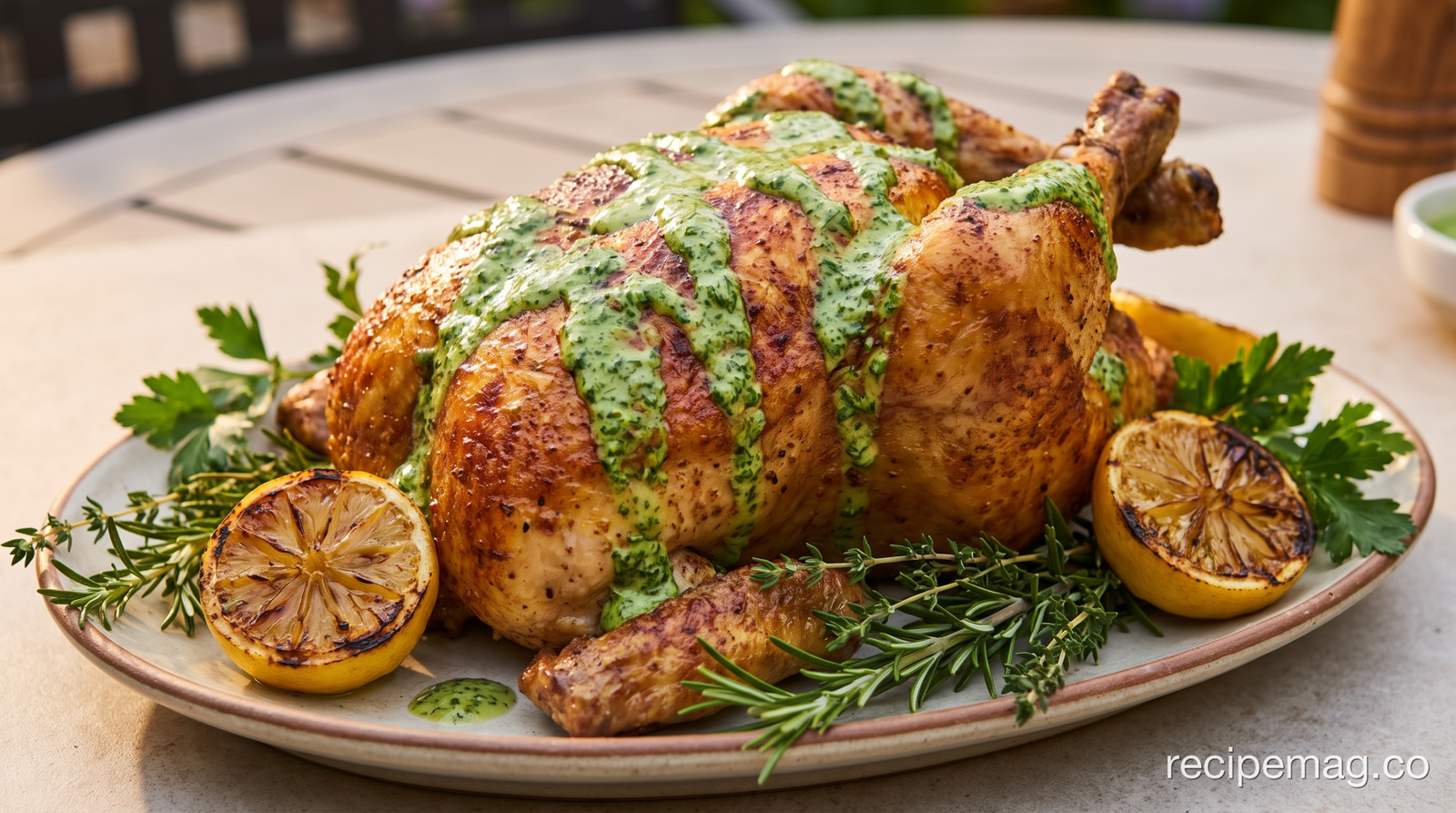
Green goddess dressing was created at San Francisco’s Palace Hotel in the 1920s, named for a play running in the city at the time. The original was anchovy, tarragon, chives, and parsley in a mayonnaise base. It is one of the few dressings substantial enough to work as a sauce for roast meat, and late August, when the herb bed is about to give out, is exactly when to make it.
Key Takeaways
- Dry-brine the bird uncovered overnight for skin that actually crisps.
- Start hot at 450°F, then drop to 375°F; the initial blast sets the skin.
- Anchovy is what makes green goddess taste savoury rather than merely herby.
- Chicken is done at 165°F in the thigh (USDA FSIS, 2023).
- The sauce uses about three cups of soft herbs, which is the point in late August.
Ingredients
Serves 4. Active time 25 minutes. Total time 1 hour 45 minutes, plus overnight brine.
For the chicken:
- 1 whole chicken, 4 to 4.5 lbs
- 1 tbsp kosher salt
- 1 tsp black pepper
- 1 lemon, halved
- 1 head garlic, halved crosswise
- A few sprigs of whatever hard herbs you have
- 2 tbsp olive oil
For the green goddess sauce:
- 1 cup packed parsley leaves
- 1 cup packed basil leaves
- 1/2 cup packed tarragon or dill
- 1/2 cup chives, roughly cut
- 1/2 cup mayonnaise
- 1/2 cup Greek yoghurt or sour cream
- 3 anchovy fillets
- 1 small garlic clove
- 2 tbsp lemon juice
- 2 tbsp olive oil
- Salt and black pepper
How to Make It
1. Dry-brine (the night before). Pat the chicken completely dry. Season all over with the salt and pepper, including inside the cavity. Set it on a rack over a tray and refrigerate uncovered 12 to 24 hours. The salt seasons the meat throughout while the open air dries the skin, and dry skin is the entire secret to crisp skin.
2. Temper and stuff. Take the bird out an hour before roasting. Put the lemon halves, garlic, and herb sprigs in the cavity, tie the legs loosely, and rub the skin with olive oil. Do not salt again.
3. Roast hot, then moderate. Heat the oven to 450°F. Roast the chicken breast side up on a rack for 20 minutes, then reduce to 375°F and continue 45 to 55 minutes more.
4. Check. Pull it when the thickest part of the thigh reads 165°F and the juices run clear (USDA FSIS, 2023). Rest on a board 15 minutes before carving. Skipping the rest costs you the juices.
5. Make the sauce while it rests. Blend all the sauce ingredients until smooth and vividly green. Taste for salt and lemon; it should be assertive, because it is going onto a mild roast. Thin with a spoonful of water if it is thicker than a pourable dressing.
6. Serve. Carve and spoon the sauce over, or serve it in a bowl alongside so the skin stays crisp.
What Makes the Sauce Work
Anchovy. Three fillets will not make the sauce taste of fish. They dissolve completely and supply glutamates, the savoury backbone that separates green goddess from a plain herb dressing. Leave them out and the sauce tastes flat in a way that more salt does not fix. Capers are the nearest vegetarian substitute.
Two dairy elements. Mayonnaise brings richness and body; yoghurt brings acidity and keeps it from being heavy. All mayonnaise is cloying, all yoghurt is thin.
Quantity of herbs. Three cups sounds like a lot because it is. This is a sauce that treats herbs as the main ingredient rather than a seasoning, which is precisely why it is the right thing to make when the herb bed is about to be lost. Our guide to using up every last summer herb covers the rest of that problem.
Tarragon. Traditional and distinctive, with a faint aniseed note. Dill is the best substitute if tarragon is hard to find.
Serving and Leftovers
Roast potatoes under the bird catch the drippings and are the obvious accompaniment. A sharp green salad or charred broccolini with lemon balances the richness.
The sauce outlives the chicken and that is a feature. It keeps five days refrigerated and is excellent on eggs, potatoes, grain bowls, and grilled fish. Thinned with more lemon and oil it becomes a salad dressing.
For the carcass, make stock. A roast chicken frame plus an onion, carrot, and a few peppercorns simmered for three hours gives you the base for soup, and by early September you will want it. Our end-of-summer minestrone is the natural destination.
If you would rather cook the bird faster, the flattened version in our grilled spatchcock chicken takes about 45 minutes and takes this sauce just as well.
Choosing and Carving the Bird
Size is the first decision. A 4 to 4.5 lb chicken is the sweet spot for four people: large enough to feed them, small enough to cook evenly. Above 5 lbs the breast overcooks before the thighs are done, and you are better off spatchcocking.
Air-chilled birds are worth the premium if your market carries them, because water-chilled chicken absorbs moisture during processing and that moisture works directly against crisp skin. If air-chilled is not available, the overnight dry-brine compensates for most of the difference.
Carving is where a good roast is often wasted. Rest the bird fifteen minutes first, then remove the legs by cutting through the skin between thigh and breast and bending the joint back until it pops. Separate thigh from drumstick at the joint.
Then take the breasts off whole rather than carving them on the carcass. Run a knife down either side of the breastbone, following the ribs, and lift each side off in one piece. Slice those pieces crossways on the board. Slicing across the grain in this way gives shorter fibres and a noticeably more tender bite than sawing lengthways at the table.
Keep the wings and the carcass. Both go into stock, and a roast chicken frame makes a far better one than raw bones.
Frequently Asked Questions
Can I skip the overnight dry-brine?
You can, but the skin will be noticeably less crisp and the meat less evenly seasoned. Even four hours uncovered in the fridge helps considerably.
Do I have to use anchovies?
Not strictly, but the sauce loses its savoury depth without them. Two teaspoons of capers or a teaspoon of white miso are the closest substitutes.
What temperature should roast chicken reach?
165°F in the thickest part of the thigh, measured without touching bone. The breast will read slightly lower, which is fine and desirable.
Why is my chicken skin soft?
Moisture. Either the bird went into the oven damp, or it was covered during the fridge rest. Pat it bone dry and leave it uncovered.
How long does the green goddess sauce keep?
Five days refrigerated. It darkens slightly over time but stays perfectly good; a squeeze of lemon revives it.
Can I make the sauce dairy-free?
Yes. Use a vegan mayonnaise and replace the yoghurt with an extra tablespoon of lemon juice and two of olive oil.
