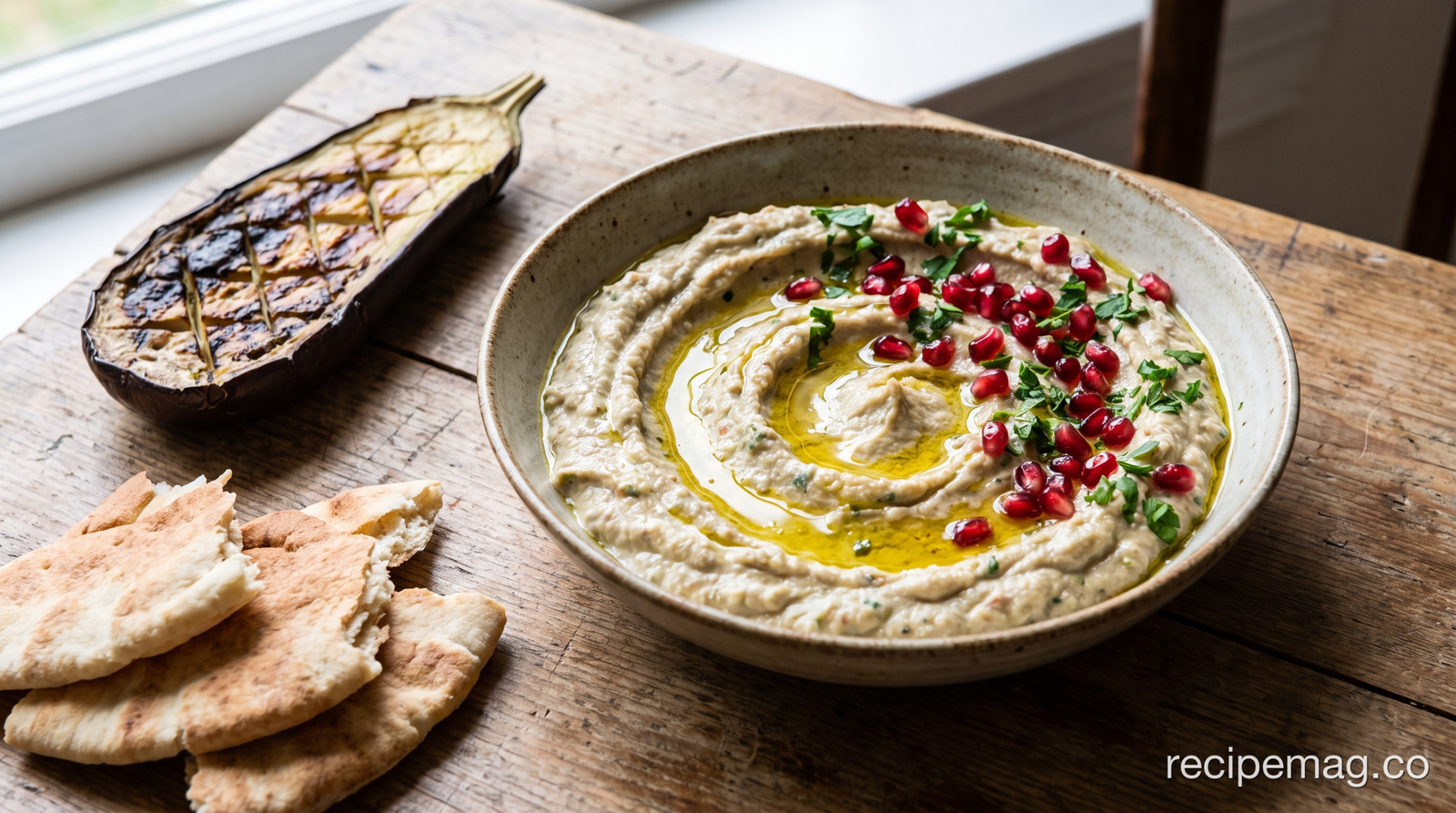
Baba ganoush is a dip defined by smoke, not by tahini. The difference between a memorable version and a bland one is entirely in how far you take the eggplant: the skin has to blacken and split, and the interior has to collapse to the point of looking ruined. Eggplant roasted politely in a moderate oven makes a perfectly pleasant purée that tastes of very little.
Key Takeaways
- Char the eggplant over a flame or under a broiler until the skin is genuinely blackened.
- Drain the flesh in a sieve for 15 minutes or the dip will be watery.
- Tahini should support the smoke, not dominate it; start with less than you think.
- Ice water whisked into tahini makes it pale and creamy instead of seizing.
- Better after a few hours in the fridge, and keeps four days.
Ingredients
Makes about 2 cups. Active time 20 minutes. Total time 50 minutes.
- 2 large eggplants, about 2 lbs total
- 1/4 cup tahini, well stirred
- 2 tbsp lemon juice, plus more to taste
- 1 small garlic clove, finely grated
- 2 tbsp ice water
- 3/4 tsp kosher salt
- 1/4 tsp ground cumin
- 2 tbsp extra-virgin olive oil, plus more to serve
- Chopped parsley, pomegranate seeds, and Aleppo pepper to finish
Use one small garlic clove, grated rather than chopped. Raw garlic grows sharper as the dip sits, and a heavy hand at the start becomes aggressive by the next day.
How to Make It
1. Char the eggplant. Over a gas burner, set the whole eggplants directly on the grate over a medium flame and turn every few minutes with tongs for 15 to 20 minutes, until the skin is blackened all over and the fruit has visibly deflated. On a grill, do the same over direct heat. Under a broiler, halve them, place cut side down on a foil-lined tray, and broil 20 to 25 minutes until the skin blisters and blackens.
Do not stop early. The eggplant should look genuinely burnt and feel completely slack when squeezed with tongs. That collapse is the doneness signal.
2. Rest and peel. Transfer to a bowl and cover for 10 minutes; the trapped steam loosens the skin. Then split them open and scoop the flesh out with a spoon, leaving the blackened skin behind. A few small flecks of char are welcome.
3. Drain. Put the flesh in a fine sieve set over a bowl and leave it 15 minutes. Eggplant holds a startling amount of water, and this step is the difference between a dip that mounds on a spoon and one that runs across the plate.
4. Loosen the tahini. Whisk the tahini with the lemon juice, garlic, and ice water in a bowl. It will seize and look broken at first, then suddenly turn pale and smooth. Keep whisking through the seizing stage; it always comes back.
5. Combine. Chop the drained eggplant flesh roughly with a knife rather than blending it, then fold it into the tahini mixture with the salt and cumin. Texture is part of the dish, and a food processor turns it into a smooth, characterless paste.
6. Taste and rest. Adjust for salt and lemon; it usually wants more of both than expected. Cover and refrigerate at least an hour. Serve at cool room temperature with a pool of olive oil, parsley, pomegranate seeds, and Aleppo pepper.
Why Charring Beats Roasting
Direct flame contact burns the skin, and that burning produces aromatic compounds which migrate into the flesh underneath. It is the same principle that makes a charred pepper taste different from a baked one. Oven roasting without direct flame gives you sweetness and caramelisation but almost none of that smoke.
If you have an electric hob and no grill, the broiler is the workable substitute. Get the eggplant close to the element, halve it so the cut face has somewhere to release steam, and accept that it will take longer to blacken. A quarter teaspoon of smoked paprika stirred in at the end is an honest patch, not a replacement.
The drain step deserves emphasis because it is the one people skip. Eggplant is over ninety percent water by weight, and a great deal of that is released once the cell walls collapse. Fifteen minutes in a sieve concentrates everything that is left.
Serving and Variations
Warm flatbread is the obvious partner, and warm matters; cold pita is a different and worse experience. Cucumber, radish, and endive all work for a lighter plate.
It also belongs on a mezze spread alongside our whipped feta dip, and it makes an excellent unexpected addition to a summer charcuterie board.
Yoghurt version. Replace half the tahini with thick Greek yoghurt for something lighter and tangier, closer to a Turkish patlıcan salatası.
Heat. A finely chopped charred green chilli folded in at the end adds heat that sits behind the smoke rather than on top of it.
Herb-forward. A large handful of chopped mint and parsley stirred through turns it into something brighter and more salad-like.
As a sauce. Thinned with a little more lemon and oil, it becomes a sauce for grilled lamb or chicken rather than a dip.
Building a Mezze Around It
Baba ganoush rarely stands alone, and it is at its best as one element of a spread. The logic of a good mezze table is contrast: something smoky, something bright, something crunchy, something rich.
The smoky element is already handled. For bright, a chopped salad of tomato, cucumber, and parsley with plenty of lemon, or a bowl of pickled turnips. For crunchy, raw vegetables, toasted flatbread, or falafel. For rich, hummus, labneh, or our whipped feta dip.
Quantities are where people overshoot. Four or five well-chosen items beat nine mediocre ones, and a mezze spread is meant to be grazed rather than finished. Allow roughly a third of a cup of each dip per person and adjust upward only if it is the whole meal.
Nearly all of it can be made ahead, which is the practical appeal. The dips improve after a day, the pickles last weeks, and only the bread and the salad want doing on the day. That makes it one of the better formats for feeding a crowd without cooking during the party, and it slots directly into the make-ahead thinking in our cookout timeline.
Frequently Asked Questions
What is the difference between baba ganoush and mutabbal?
The names are used loosely and regionally. Broadly, mutabbal is the tahini-based version and baba ganoush in its strictest sense is a chopped salad without tahini. Most recipes labelled baba ganoush outside the region are what would be called mutabbal within it.
Can I roast the eggplant in the oven instead?
Yes, at 450°F for about 45 minutes until fully collapsed, but you will lose most of the smoke. Broiling gets you closer than roasting does.
Why is my baba ganoush watery?
The flesh was not drained. Fifteen minutes in a fine sieve removes a surprising amount of liquid and is not optional.
Why did my tahini seize when I added lemon?
That is normal and temporary. Tahini thickens dramatically when it first meets liquid, then loosens into a smooth pale cream as you keep whisking and add water. Push through it.
How long does it keep?
Four days refrigerated in a sealed container. The garlic sharpens over time, so make it milder than you want on day one.
Can I freeze it?
The eggplant purée freezes fine on its own for three months. Freeze it before adding tahini and garlic, then finish it fresh after thawing.
