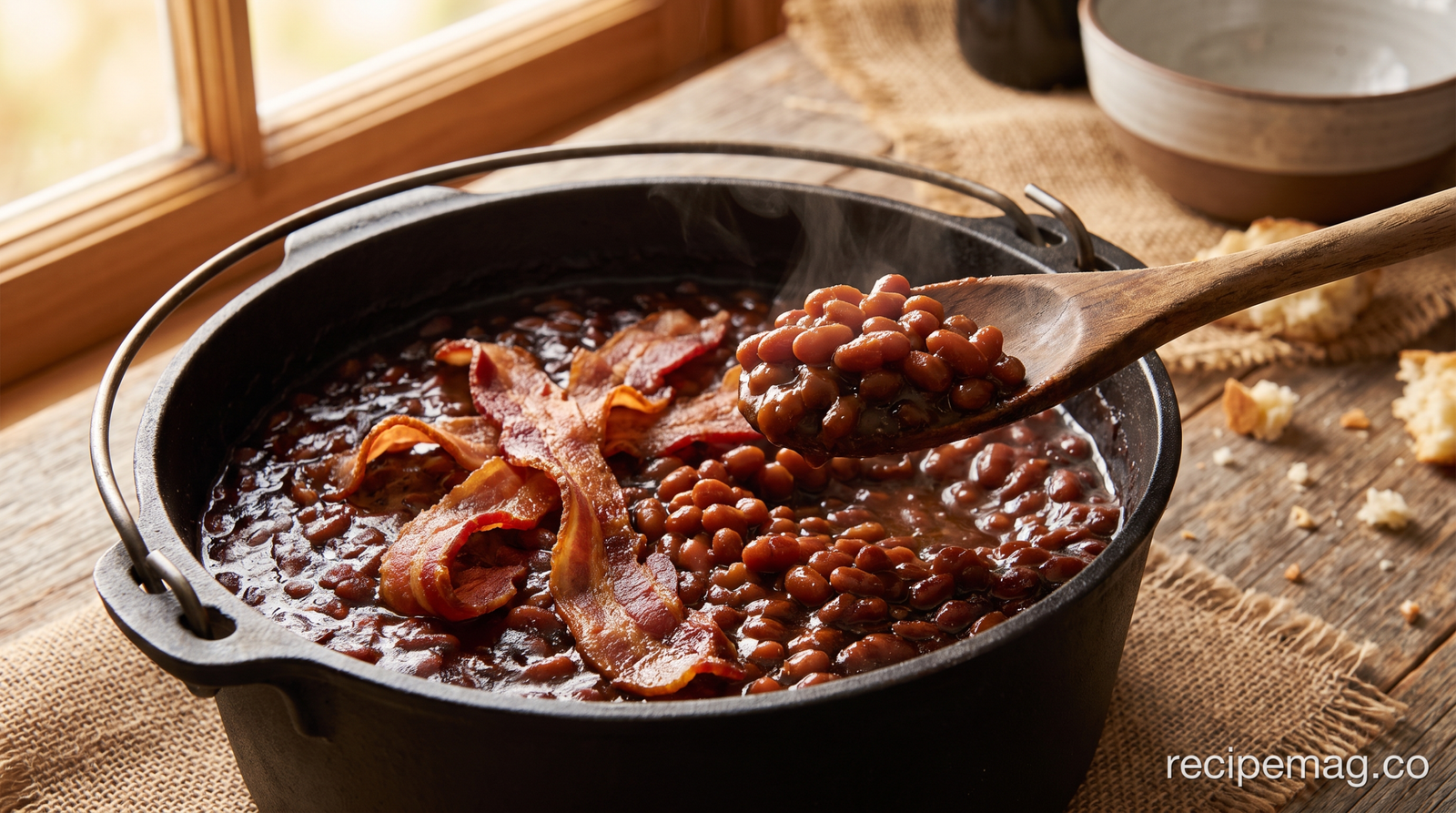
Baked beans are the rare side dish that is objectively better reheated, which makes them the most useful thing on a cookout prep list. A long, low bake gives the molasses and mustard time to work into the beans, and a night in the refrigerator finishes the job. USDA guidance allows cooked dishes to be held safely for three to four days at 40°F or below, so you can build these on Friday for a Monday party (USDA FSIS, 2023).
Key Takeaways
- Made from dried navy beans, not canned, for a texture that holds up to three hours in the oven.
- Add the molasses and mustard only after the beans are tender, since acid and calcium slow softening.
- Bakes uncovered for the last hour to build the dark, glossy crust that defines the dish.
- Best made two to three days ahead and reheated; the flavor genuinely deepens.
- Serves 10 to 12 as a cookout side.
Ingredients
Serves 10 to 12. Active time 30 minutes. Total time 4 hours plus overnight soak.
- 1 lb dried navy beans, soaked overnight
- 8 oz thick-cut bacon, cut into 1/2-inch pieces
- 1 large yellow onion, diced
- 4 garlic cloves, minced
- 1/2 cup dark molasses, not blackstrap
- 1/3 cup packed dark brown sugar
- 1/4 cup tomato paste
- 2 tbsp yellow mustard
- 2 tbsp apple cider vinegar
- 1 tbsp Worcestershire sauce
- 1 tsp smoked paprika
- 2 tsp kosher salt, plus more to taste
- Black pepper to taste
- 4 cups reserved bean cooking liquid or water
Use dark molasses rather than blackstrap. Blackstrap is aggressively bitter and will dominate everything else in the pot. Navy beans are traditional because they hold their shape through a long bake, but great northern beans work almost as well.
How to Make Them
1. Soak and simmer the beans. Drain the soaked beans, cover them with fresh water by two inches, and simmer for 45 to 60 minutes, until they are tender but not falling apart. Reserve four cups of the cooking liquid and drain the rest.
Do not shortcut this by simmering the beans in the sauce. Acid and calcium reinforce the pectin in bean skins, so molasses, vinegar, and tomato added early will leave you with beans that stay stubbornly firm no matter how long they bake.
2. Render the bacon. Heat a large Dutch oven over medium heat and cook the bacon until the fat renders and the edges crisp, about 8 minutes. Lift out about a third of it with a slotted spoon and set it aside for the top. Leave the rest and the fat in the pot.
3. Build the base. Add the onion to the bacon fat and cook until soft and translucent, 6 to 8 minutes. Add the garlic and the smoked paprika and cook one minute more, until fragrant. Stir in the tomato paste and let it darken for two minutes, which pulls out its sweetness.
4. Combine. Add the molasses, brown sugar, mustard, vinegar, Worcestershire, salt, and pepper. Stir in the drained beans and three cups of the reserved cooking liquid. The beans should be loosely covered; the liquid will reduce and thicken in the oven.
5. Bake. Cover and bake at 300°F for two hours. Check at the halfway mark and add more cooking liquid if the surface looks dry. Then uncover, scatter the reserved bacon over the top, and bake another 45 to 60 minutes until the top is dark, glossy, and slightly crusted at the edges.
6. Rest. Let them sit at least 20 minutes before serving. They thicken considerably as they cool.
Making Them Ahead
This is the entire reason to choose this recipe over opening cans. Cook the beans through step six, cool them, and refrigerate in the pot or in a sealed container for up to four days (USDA FSIS, 2023). Day two is measurably better than day one, and day three is arguably the peak.
To reheat, add a splash of water or stock, cover, and warm at 325°F for about 40 minutes, stirring once. They will have tightened up in the fridge, and that liquid brings them back. A slow cooker set to low for two hours works equally well and doubles as your serving vessel, which frees the oven on the day.
They also freeze cleanly for up to three months. Cool completely, portion into freezer bags, and lay them flat. Thaw overnight in the refrigerator before reheating.
In a full cookout plan, these belong in the three-days-out slot, which is exactly where our Labor Day cookout timeline puts them.
Variations and Substitutions
Vegetarian. Skip the bacon and start with two tablespoons of olive oil. Add an extra teaspoon of smoked paprika plus a teaspoon of soy sauce to replace the savory depth. The result is genuinely good, not a consolation prize.
Smoky and spicy. Add two minced chipotles in adobo along with the tomato paste. This pairs especially well with pulled pork.
Boston style. Increase the molasses to two-thirds of a cup, drop the tomato paste and smoked paprika, and swap the bacon for salt pork. The result is sweeter, darker, and closer to the New England original.
Bourbon. Add a quarter cup of bourbon with the molasses. The alcohol cooks off over three hours and leaves behind vanilla and oak, which plays nicely against the bacon.
Canned bean shortcut. If you are genuinely out of time, use four 15-oz cans of navy beans, drained and rinsed. Skip step one, use three cups of chicken stock instead of bean liquid, and cut the covered bake to one hour. The texture is softer, but it works.
What to Serve Them With
Baked beans want something smoky and something acidic next to them. Smoky is easy: they are the traditional partner for smoked baby back ribs, pulled pork, and smoked brisket.
Acidic is the part people forget. A rich, sweet bean dish flattens fast without something sharp on the plate, so put refrigerator pickles or a vinegary slaw beside them. A cucumber tomato salad with feta does the same job with less effort.
For a full spread built around them, our 12 best summer side dishes covers what else belongs on the table.
Getting the Texture and Timing Right
Baked beans fail in two directions, and both are fixable once you know which one you are looking at.
Too soupy. The beans went into the oven with too much liquid, or the final uncovered stage was cut short. The uncovered hour is what reduces the sauce into a glaze, so do not shorten it, and if the beans are tender but the sauce is thin, simply leave them in longer uncovered.
Too dry or scorched. The pot ran out of liquid partway through. Check at the one-hour mark and again at two, and add reserved bean liquid a half cup at a time. A heavy Dutch oven helps enormously here, since thin pots develop hot spots that burn the sugars against the bottom.
Bean age is the variable nobody controls for. Dried beans sold in supermarkets can be two or three years old, and old beans resist softening no matter what you do. If a batch simply will not turn tender after 90 minutes of simmering, the beans are the problem, not the technique. Buy from a store with turnover, or from a producer that dates the bag.
One more timing note: the beans will look slightly loose when you pull them from the oven and will tighten considerably as they cool. Judge the consistency after the 20-minute rest, not before, or you will over-reduce them into paste.
Scaling for a Crowd
Baked beans scale unusually well, which is part of why they are a cookout fixture. The recipe above serves 10 to 12 as one side among several. For a party of 25, double everything and use a large roasting pan rather than a Dutch oven, since surface area is what builds the crust.
Doubling changes the timing less than you would expect. The covered bake goes to about two and a half hours because there is more mass to heat, but the uncovered stage stays roughly the same, since it depends on evaporation from the surface rather than volume. Check the liquid level at the halfway point; a larger pan loses moisture faster and may need an extra cup of bean liquid.
Plan on roughly a half cup per person when beans are one of four sides, or three quarters of a cup if they are one of two. Hosts consistently underestimate beans, because unlike a salad they get eaten to the bottom of the pot.
If you are cooking for a genuinely large group, split the batch across two vessels rather than one very deep one. Deep pans steam in the middle and never develop the dark top that makes the dish, and the extra pan costs you nothing but oven space.
Frequently Asked Questions
Can I use canned beans instead of dried?
Yes, though the texture is softer. Use four 15-oz cans, drained and rinsed, skip the initial simmer, and reduce the covered bake to about one hour.
Why are my beans still hard after hours in the oven?
Almost always because the acidic ingredients went in too early. Molasses, vinegar, and tomato all slow bean softening, so the beans need to be fully tender before those hit the pot. Very old dried beans can also refuse to soften regardless of technique.
How far ahead can I make baked beans?
Up to four days refrigerated, or three months frozen. Two to three days ahead is the sweet spot for flavor.
Do I have to soak the beans overnight?
It shortens the simmer and gives more even cooking, but you can skip it. Unsoaked navy beans need roughly 90 minutes of simmering instead of 45 to 60.
Can I make these in a slow cooker instead?
Yes. Complete steps one through four, transfer everything to a slow cooker, and cook on low for six to seven hours. You will not get the baked crust, so finish under a broiler for five minutes if you want it.
What is the difference between dark molasses and blackstrap?
Blackstrap is the third boiling of sugarcane syrup and is markedly more bitter and mineral-heavy. Dark molasses is sweeter and rounder, and it is what this recipe is balanced for.
