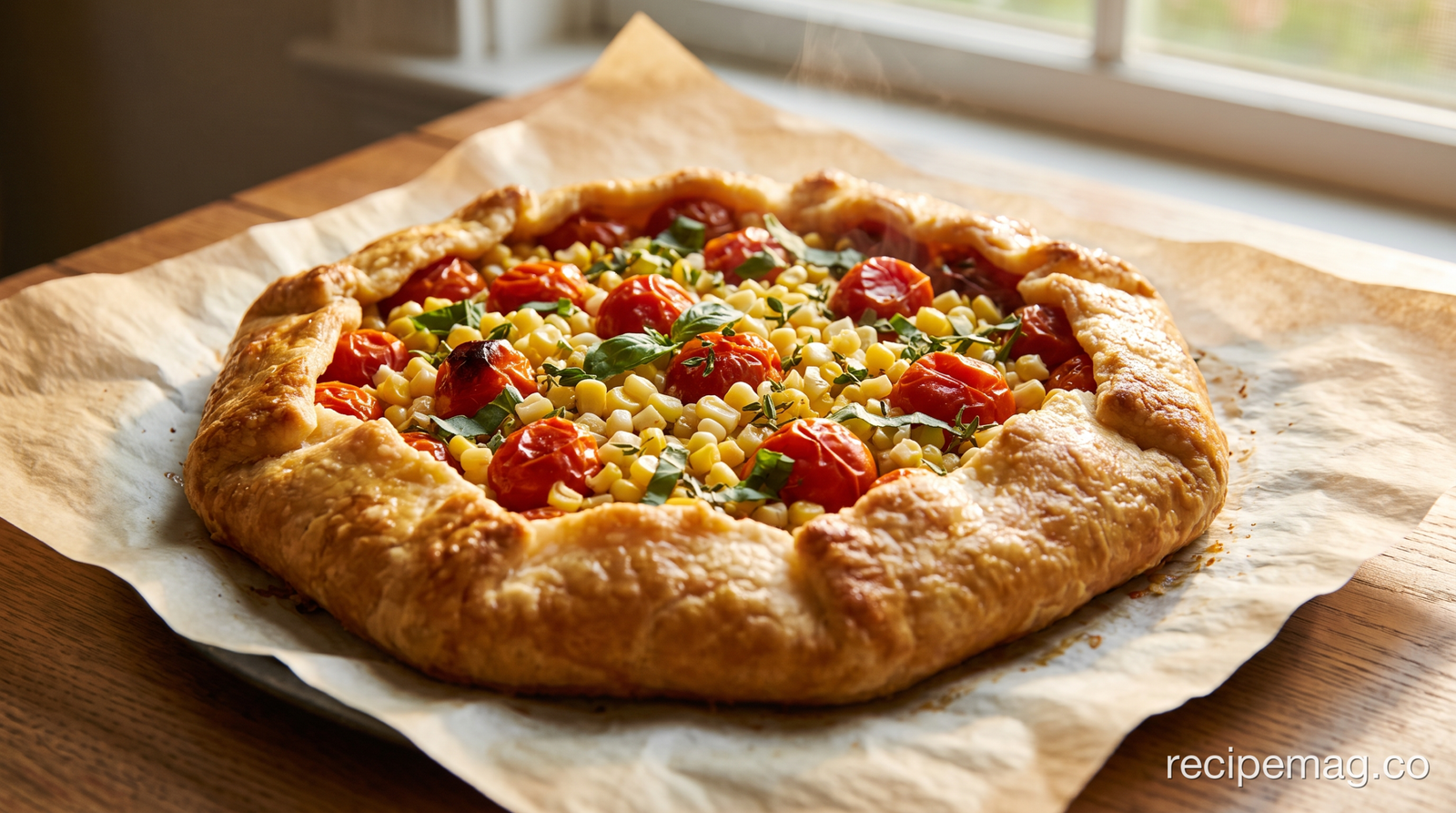
A galette is a pie without the commitment. No pan, no crimping, no blind baking, and the rustic folded edge is the point rather than a compromise. The one real challenge with a savoury summer version is water: tomatoes and corn both release a great deal of it, and a soggy base is the only way this goes wrong. Salting the tomatoes first solves it entirely.
Key Takeaways
- Salt and drain the tomatoes for 30 minutes; this is not optional.
- A layer of cheese between crust and filling acts as a moisture barrier.
- Keep the butter in visible pieces for a flaky, layered crust.
- Bake on a preheated sheet pan so the base sets fast.
- Rest 20 minutes before slicing so the filling sets.
Ingredients
Serves 6. Active time 30 minutes. Total time 2 hours including chilling.
For the crust:
- 1 1/4 cups all-purpose flour
- 1/2 tsp kosher salt
- 10 tbsp cold unsalted butter, cubed
- 1/4 cup ice water, plus more as needed
- 1 tsp apple cider vinegar
For the filling:
- 1 lb ripe tomatoes, sliced 1/4 inch thick
- 1 tsp kosher salt, for drawing water
- Kernels from 2 ears of corn
- 3/4 cup grated gruyère or sharp cheddar
- 1/2 cup ricotta
- 2 tbsp chopped basil, plus more to finish
- 1 garlic clove, grated
- 1 egg, beaten, for the wash
- Black pepper and flaky salt
How to Make It
1. Make the crust. Whisk the flour and salt. Cut in the cold butter with a pastry cutter or your fingertips until the largest pieces are the size of peas. Visible butter is what creates flakiness; a uniform sandy mixture gives you a crumbly, short crust instead.
2. Bring it together. Mix the ice water and vinegar, then add it a tablespoon at a time, tossing with a fork, until the dough just holds when squeezed. Flatten into a disc, wrap, and refrigerate at least an hour. The vinegar inhibits gluten development slightly and keeps the crust tender.
3. Drain the tomatoes. Lay the slices on a rack or paper towels, sprinkle with the teaspoon of salt, and leave 30 minutes. Blot them dry. You will be surprised how much water comes out, and every drop of it would otherwise have gone into your pastry.
4. Assemble. Heat the oven to 400°F with a sheet pan inside. Roll the dough into a rough 13-inch circle on parchment. Mix the ricotta with the garlic, basil, and pepper and spread it over the centre, leaving a 2-inch border. Scatter half the cheese over it, then the corn, then the tomato slices, then the remaining cheese.
The cheese layer directly on the pastry is doing real work: fat is hydrophobic and forms a barrier between the crust and whatever moisture the filling still releases.
5. Fold and wash. Fold the border up over the filling in overlapping pleats, pressing gently. Brush the pastry with the beaten egg and sprinkle with flaky salt.
6. Bake. Slide the galette on its parchment onto the preheated sheet pan. Bake 40 to 45 minutes, until the crust is deep golden and the base is set. The preheated pan gives the bottom an immediate blast of heat, which sets it before moisture can soak in.
7. Rest. Twenty minutes on a rack. Scatter fresh basil and serve warm or at room temperature.
Keeping the Base Crisp
Four defences, and using all four means you never have to think about it again.
Salt and drain the tomatoes. The single biggest factor. Thirty minutes removes most of the free water.
Fat barrier. Cheese, or ricotta, or even a scattering of breadcrumbs spread on the pastry before the wet filling. It physically separates dough from liquid.
Preheated pan. The base needs to set before it can absorb. A cold pan lets the pastry sit in a warming puddle for ten minutes.
Cold dough into a hot oven. Cold butter in a hot oven produces steam, which is what pushes the layers apart. If the dough has warmed while you assembled, chill the whole assembled galette for 15 minutes before baking.
Variations and Make-Ahead
Other fillings. Roasted courgette and goat cheese, caramelised onion and gruyère, or the last peppers with feta. The method is fixed; the filling is not. Anything wet needs the same salting treatment.
Sweet version. The same crust with less salt handles stone fruit beautifully; toss the fruit with sugar and a tablespoon of cornstarch instead of salting it.
Make-ahead. The dough keeps three days refrigerated and three months frozen. A fully assembled unbaked galette can be frozen solid and baked from frozen with about ten extra minutes.
Leftovers. Two days refrigerated. Reheat at 350°F for ten minutes; a microwave destroys the pastry.
If the tomatoes are still stacking up, our tomato glut roundup and ten ways to cook fresh summer corn cover the rest of the haul from our last farmers market guide.
Working With Cold Butter
Every flaky pastry depends on the same mechanism: solid pieces of butter suspended in dough melt in the oven, release steam, and push the surrounding layers apart. Butter that has softened and blended into the flour cannot do this, which is why temperature is the whole game.
Cube the butter and return it to the fridge for ten minutes before you start. On a warm late-August afternoon, freeze it for five. Some bakers grate frozen butter on a box grater straight into the flour, which is fast and keeps the pieces uniform.
Work quickly and with your fingertips rather than your palms, which are considerably warmer. If the dough starts to feel greasy or the butter smears rather than flattens, stop and refrigerate everything for fifteen minutes. Nothing is lost by pausing; a great deal is lost by pushing on.
The vinegar in the dough is doing quiet work too. Acid slightly inhibits gluten development, which keeps the crust tender when the dough is inevitably handled more than the ideal. It is insurance rather than magic.
Finally, chill the assembled galette before it bakes if the kitchen is warm or if assembly took a while. Fifteen minutes in the fridge re-firms the butter and is the difference between distinct flaky layers and a uniformly short crust.
Frequently Asked Questions
What is the difference between a galette and a tart?
A galette is free-form, folded on a flat sheet with no pan. A tart is baked in a ring or tin with formed sides. The galette is more forgiving and needs no blind baking.
Do I have to salt the tomatoes?
Yes, for a savoury tomato galette. It is the difference between a crisp base and a wet one, and thirty minutes is all it takes.
Can I use store-bought pastry?
Yes. All-butter shortcrust or even puff pastry works. Puff gives a lighter, less sturdy result that needs an even drier filling.
Why did my crust shrink?
Overworked dough or insufficient chilling. Gluten that has been developed and not rested contracts in the oven. Handle it minimally and give it the full hour cold.
Can I make it ahead for a party?
Yes. It is genuinely good at room temperature, which makes it one of the better make-ahead options. Bake it the morning of and leave it out.
Can I use frozen corn?
Yes. Thaw and pat it very dry first, since frozen corn carries a lot of surface water.
