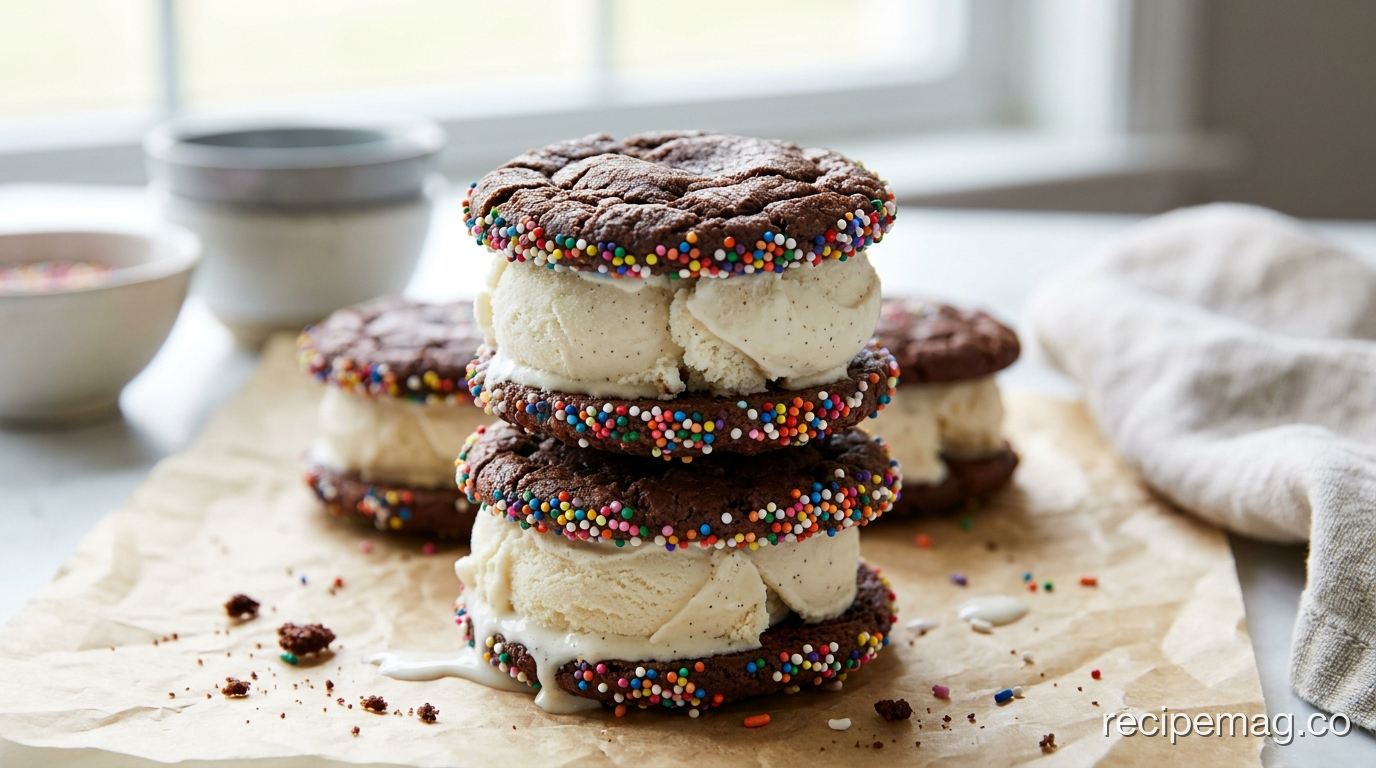
Homemade ice cream sandwiches come down to three things: a cookie soft enough to bite through frozen, ice cream softened just enough to spread, and a fast, cold assembly. Do those three well and the rest is easy. August 2 is National Ice Cream Sandwich Day, and it’s the ideal excuse to make a batch. Americans eat roughly 4 gallons of ice cream and frozen dessert per person each year, so the appetite is already there. (International Dairy Foods Association, 2023) This guide walks you through every step, from the cookie to the freezer.
Key Takeaways
- National Ice Cream Sandwich Day falls on August 2, a perfect reason to make a batch. (National Day Calendar, 2024)
- Soft, chewy cookies work best because they stay bendable straight from the freezer.
- Soften the ice cream to a spreadable, scoopable stage, not a soupy one, for clean sandwiches.
- Store a freezer at 0°F (-18°C) to keep sandwiches safe and firm long term. (FDA, 2023)
- Assembled sandwiches keep well wrapped for up to 2 weeks before quality dips.
What Makes a Great Homemade Ice Cream Sandwich?
A great homemade ice cream sandwich is built on contrast: a soft cookie that yields to the first bite and a firm, cold center that holds its shape. The U.S. produced about 1.31 billion gallons of ice cream and related frozen desserts in 2022, and the sandwich remains one of the most popular novelty formats. (International Dairy Foods Association, 2023) The magic is in the balance, not in any single fancy ingredient.
Texture is everything here. A crisp cookie shatters and pushes the ice cream out the sides the moment you bite. A chewy cookie bends with the ice cream and keeps each bite intact. That’s why bakery-style sandwiches almost always use a soft cookie or a cakey wafer rather than a snappy one.
Temperature is the other half. Ice cream that’s too hard tears the cookie. Ice cream that’s too soft slides out and melts down your wrist. The sweet spot is a spreadable stage, cold but pliable, the way frosting behaves at room temperature.
[UNIQUE INSIGHT] Most first-timers focus on the cookie and ignore the ice cream’s temperature. In our experience, temperature control matters more than the recipe. The same cookie and the same ice cream produce a clean, professional sandwich or a melting mess depending entirely on whether you softened and re-froze at the right moments.
What Ingredients and Tools Do You Need?
You need surprisingly little. A basic batch uses one cookie dough, one tub of ice cream, and something to roll the edges in. Homemade frozen desserts have grown steadily as a category, with the novelty and premium segments leading recent gains. (International Dairy Foods Association, 2023) The tools matter as much as the ingredients because cold work goes fast.
Core Ingredients
- 1 batch soft chocolate chip or sugar cookie dough (about 12 to 16 cookies)
- 1 pint to 1 quart ice cream (vanilla is the classic starting point)
- Optional edge coatings: mini chocolate chips, rainbow sprinkles, crushed cookies, or toasted nuts
- A pinch of flaky salt, if you want to sharpen the flavor
Helpful Tools
- Two sheet pans lined with parchment paper
- An offset spatula or the back of a spoon for spreading
- A round cookie cutter or wide glass, if you want perfectly matched sandwiches
- Plastic wrap or wax paper for wrapping individual sandwiches
- An airtight container or freezer bag for storage
Buy an ice cream you genuinely like eating on its own. The sandwich concentrates its flavor, so a bland vanilla stays bland between two cookies. A rich, real-vanilla ice cream carries the whole thing.
How Do You Make the Cookie Layer?
Soft, chewy cookies make the best sandwiches because they stay bendable when frozen. According to America’s Test Kitchen, cookies built on more brown sugar and melted butter retain more moisture and bake up chewier than versions using white sugar and creamed butter. (America’s Test Kitchen, 2022) That extra moisture is what lets a frozen cookie bend instead of crack.
Steps for the Cookie Layer
- Mix a soft dough. Lean on brown sugar and slightly underbake for a chewy result. A standard chocolate chip or sugar cookie recipe works perfectly.
- Portion evenly. Use a scoop so every cookie matches its partner. Mismatched cookies make lopsided sandwiches.
- Flatten slightly before baking. Ice cream sandwiches need flat, even cookies, not domed ones. Press each portion down gently.
- Bake until just set. Pull them when the edges are golden but the centers still look soft. They firm as they cool.
- Cool completely. This is non-negotiable. Any warmth melts the ice cream on contact and ruins the assembly.
[PERSONAL EXPERIENCE] We’ve found that baking the cookies a day ahead makes the whole process calmer. Cool cookies, stored airtight overnight, are firmer and easier to handle during the cold rush of assembly. Trying to bake, cool, and assemble in one afternoon usually ends with warm cookies and a puddle.
How Do You Assemble Ice Cream Sandwiches Without a Mess?
Clean assembly is a race against melting, so cold and speed win every time. Frozen dessert quality drops fast above the ideal storage temperature, which is why the FDA recommends keeping a home freezer at 0°F (-18°C). (FDA, 2023) Work with cold cookies, briefly softened ice cream, and a chilled pan, and the whole process takes minutes.
The Sheet-Pan Assembly Method
- Chill your cookies and pan. Put the baked, cooled cookies and a parchment-lined sheet pan in the freezer for 15 minutes before you start.
- Soften the ice cream just enough. Leave the tub on the counter for 5 to 10 minutes until it’s spreadable but not runny. It should feel like thick frosting.
- Match your cookies into pairs. Flip half of them bottom-side up so the flat sides face inward.
- Spread or scoop the ice cream. Add a generous layer to the flat side of one cookie, then top with its partner and press gently until the ice cream reaches the edges.
- Roll the edges. Press the exposed ice cream into a bowl of mini chips or sprinkles for the classic look.
- Freeze immediately. Set each finished sandwich back on the cold sheet pan and return it to the freezer at once.
Work in small batches if your kitchen is warm. Assemble three or four, freeze them, then do the next few. Racing to build a dozen at once is how the last few turn into soup.
How Long Should You Freeze and Store Them?
Freeze assembled sandwiches for at least 2 hours before serving so the ice cream fully re-firms and bonds to the cookies. The USDA notes that food held at a constant 0°F stays safe indefinitely, though quality slowly declines as ice crystals form. (USDA FSIS, 2023) Safe and delicious aren’t the same window, so plan to eat these within about 2 weeks.
Storage Steps
- Wrap each sandwich individually. Plastic wrap or wax paper prevents freezer burn and stops flavors from mingling.
- Stack in an airtight container. Add a layer of parchment between sandwiches so they don’t fuse together.
- Label the date. Quality peaks in the first 2 weeks, so a date on the container keeps you honest.
- Serve after a 2-minute rest. Let a sandwich sit at room temperature for a couple of minutes so the ice cream softens to the perfect bite.
What Are the Best Flavor Combinations?
The vanilla-and-chocolate-chip-cookie classic is popular for a reason, but the format is endlessly flexible. Novelty frozen desserts, the category that includes sandwiches, continue to be one of the strongest performers in retail freezer sales. (International Dairy Foods Association, 2023) Start with the classic, then branch out with confidence.
Cookie and Ice Cream Pairings
- Classic: Chocolate chip cookies with vanilla ice cream, edges rolled in mini chips.
- Mint chocolate: Chocolate cookies with mint chip ice cream for a cooling, minty bite.
- Peanut butter cup: Peanut butter cookies with chocolate ice cream, rolled in chopped peanuts.
- Snickerdoodle: Cinnamon-sugar cookies with coffee or dulce de leche ice cream.
- Summer berry: Sugar cookies with strawberry ice cream, edges rolled in freeze-dried berry crumbs.
- Oatmeal: Oatmeal cookies with butter pecan ice cream for a chewy, nutty combination.
A pinch of flaky salt pressed onto the ice cream edge before rolling sharpens sweet flavors and makes the whole sandwich taste more grown-up. It’s a tiny step with an outsized payoff.
Frequently Asked Questions About Homemade Ice Cream Sandwiches
Why do my cookies get rock-hard in the freezer?
Hard cookies almost always come from a recipe that’s too crisp to begin with. Choose a soft, chewy cookie built on brown sugar and slightly underbaked. Crisp cookies freeze solid and crack when you bite them. If your favorite cookie firms up too much, let each sandwich rest at room temperature for 2 to 3 minutes before serving so the cookie softens.
How far ahead can I make homemade ice cream sandwiches?
You can assemble them up to 2 weeks ahead for the best quality. The USDA notes that food kept at a constant 0°F stays safe indefinitely, but flavor and texture slowly fade as ice crystals form. (USDA FSIS, 2023) Wrap each sandwich individually and store them in an airtight container so they don’t pick up freezer odors or freezer burn.
What’s the best way to soften ice cream for spreading?
Leave the tub on the counter for 5 to 10 minutes until it’s spreadable, like thick frosting. Avoid the microwave, which melts the outside while the center stays frozen and creates an uneven, soupy mess. If you’re in a hurry, scoop the ice cream and mash it gently with a spatula to soften it evenly without adding heat.
Can I make these without an ice cream maker?
Absolutely. Store-bought ice cream works perfectly and skips the churning entirely. If you want homemade, a no-churn base made from whipped cream and sweetened condensed milk freezes firm enough to slice and needs no special equipment. Either way, the cookie and the assembly technique matter far more than whether you churned the ice cream yourself.
Why is August 2 associated with ice cream sandwiches?
August 2 is National Ice Cream Sandwich Day, a food holiday recognized on most calendars of unofficial observances. (National Day Calendar, 2024) It lands in the middle of peak summer heat, when frozen treats are most welcome. The date is a fun, low-stakes reason to gather friends, bake a batch of cookies, and build sandwiches together on a hot afternoon.
Make a Batch This August 2
Homemade ice cream sandwiches reward a little planning far more than any special skill. Bake soft cookies a day ahead, chill everything well, and soften the ice cream to just spreadable. Those three habits do almost all the work for you.
Start with the classic vanilla-and-chocolate-chip version to learn the rhythm, then experiment. Once you’ve built a batch, the flavor pairings become obvious and the whole process feels effortless. National Ice Cream Sandwich Day is the perfect deadline to try it.
Wrap a few extras individually and stash them in the back of the freezer. On the next hot night, you’ll be very glad they’re there.
