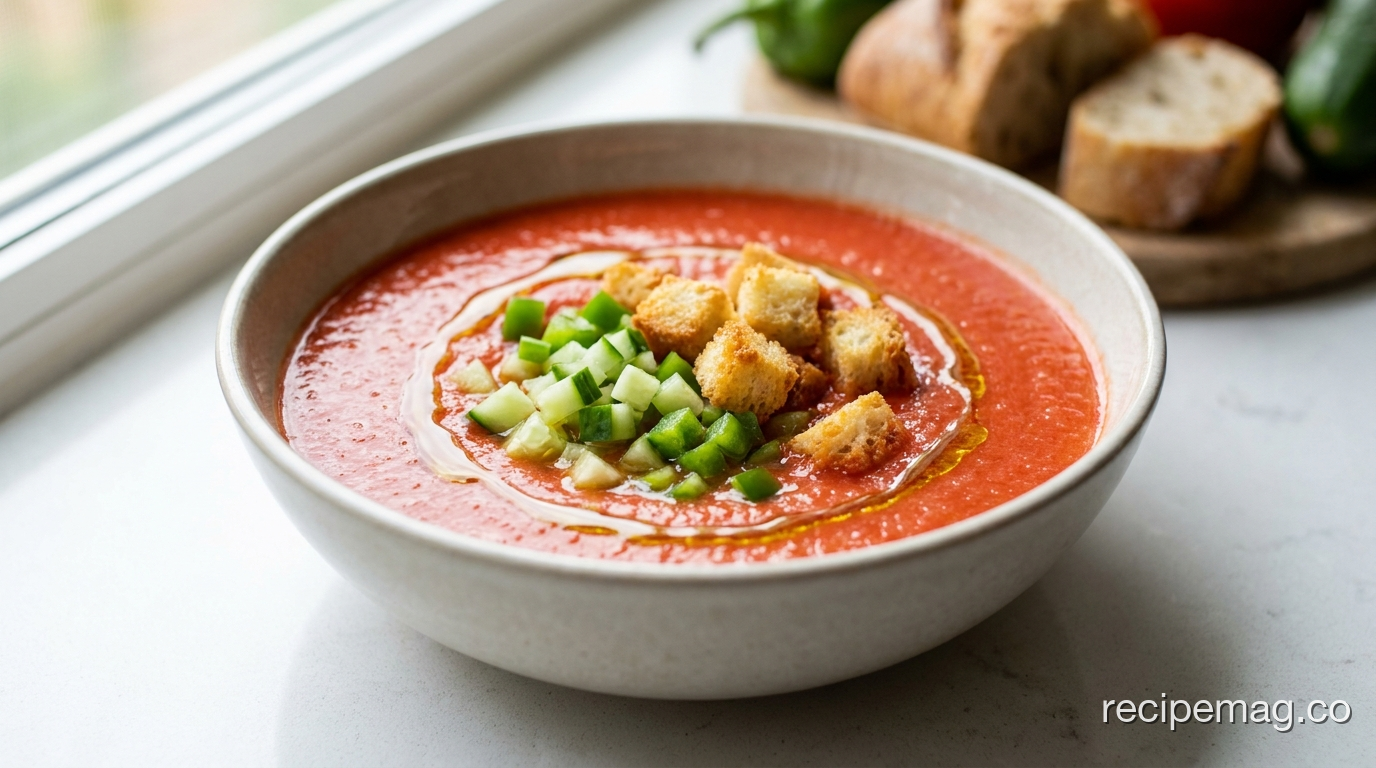
Authentic gazpacho Andaluz is a raw, blended Spanish soup made from ripe tomatoes, cucumber, pepper, garlic, bread, olive oil, and sherry vinegar, served ice-cold. There’s no cooking involved, which is exactly the point in a region where July temperatures regularly top 100°F. The dish traces to Andalusia, where the average summer high in Seville reaches 96°F, making a chilled, hydrating soup a matter of survival as much as pleasure (AEMET, Spain’s State Meteorological Agency, 2023). This version blends silky-smooth in 15 minutes.
Key Takeaways
- Gazpacho Andaluz is a no-cook soup, ready in about 15 minutes plus chilling time.
- Ripe, in-season tomatoes are non-negotiable: they carry the entire dish.
- A slice of stale bread gives authentic gazpacho its signature creamy body, no dairy needed.
- Sherry vinegar and good olive oil are the two ingredients that make it taste Spanish.
- Tomatoes deliver lycopene, an antioxidant linked to heart health (USDA FoodData Central, 2023).
What Makes Gazpacho Andaluz Authentic?
Authentic gazpacho is defined by what it leaves out as much as what it includes. The traditional Andalusian version is raw, blended, and thickened with bread, not cream or stock. UNESCO recognized the Mediterranean diet, gazpacho included, as intangible cultural heritage in 2010, citing dishes like this one as expressions of a whole way of eating (UNESCO, 2010). The soul of the recipe is simplicity done well.
The six foundation ingredients are tomato, cucumber, green pepper, garlic, bread, and olive oil, brought together with sherry vinegar and salt. Everything else, the chunky garnishes, the hard-boiled egg, the jamón, is optional dressing on top of a classic base.
[UNIQUE INSIGHT] The single detail most home cooks skip is the bread, and it changes everything. Bread isn’t a filler here. Blended into the soup, it emulsifies the olive oil and water into a smooth, faintly creamy body that clings to the spoon. Skip it and you get tomato juice. Include it and you get gazpacho.
The Bread Question
Use a day-old rustic white loaf with the crust removed, soaked briefly in water. Roughly a two-inch piece for four servings is plenty. It disappears completely once blended, leaving only that velvety texture behind.
Why Do Ripe Tomatoes Matter So Much?
In a cooked sauce, you can rescue mediocre tomatoes with time and heat. Gazpacho gives you no such safety net. Because nothing is cooked, the raw tomato flavor is the flavor. The USDA notes that one cup of raw tomato supplies about a quarter of the daily value for vitamin C and ranks among the best dietary sources of lycopene, the antioxidant that gives tomatoes their red color (USDA FoodData Central, 2023).
Buy the ripest tomatoes you can find, ideally at a farmers market in July or August. They should smell sweet at the stem and feel heavy for their size. Roma, beefsteak, and vine-ripened varieties all work. Pale, mealy winter tomatoes will produce a sad, watery soup no vinegar can fix.
If your tomatoes are good but not perfect, a pinch of sugar balances any tartness. Taste as you go. The finished soup should taste bright, savory, and rounded, never sharp.
How Do You Make Gazpacho Smooth and Silky?
The difference between rustic gazpacho and the glossy version served in San Sebastián restaurants comes down to technique. Serious Eats explains that streaming olive oil slowly into the running blender creates an emulsion, the same physics that thickens mayonnaise, giving the soup a creamy body with no dairy at all (Serious Eats, 2021). Two moves get you there.
First, blend long. A full two to three minutes on high breaks the vegetables and bread down completely. Second, emulsify the oil last. With the blender running, pour the olive oil in a thin, steady stream so it whips into the base rather than floating on top.
For a truly restaurant-smooth result, pass the blended soup through a fine-mesh sieve to catch skins and seeds. It’s an optional step, but it’s the one that turns a good gazpacho into a great one.
Ingredients for Authentic Gazpacho Andaluz
This recipe serves four as a starter or two as a light meal. Everything is raw, so weigh your effort toward buying well rather than cooking hard. Cold-pressed extra virgin olive oil and true sherry vinegar (vinagre de Jerez) are worth seeking out; they define the flavor.
- 2 pounds ripe tomatoes (about 6 medium), cored and roughly chopped
- 1 small cucumber, peeled and chopped (about 1 cup)
- 1 small green Italian or bell pepper, seeded and chopped
- 1 clove garlic (or 2 for a bolder soup)
- 2-inch piece of day-old rustic bread, crust removed
- 3 tablespoons extra virgin olive oil, plus more to finish
- 2 tablespoons sherry vinegar
- 1 teaspoon salt, plus more to taste
- Pinch of sugar (optional, if tomatoes are tart)
- Cold water, as needed to thin
For Garnish (Optional)
- Finely diced cucumber, pepper, and tomato
- Croutons or diced bread crisped in olive oil
- A drizzle of good olive oil
- Chopped hard-boiled egg or slivers of Spanish jamón
How to Make Gazpacho Andaluz (Step by Step)
The whole process is roughly 15 minutes of hands-on work, then time in the fridge. Gazpacho actually improves after a few hours chilling, as the flavors marry and the soup gets properly cold. Make it in the morning to serve at dinner.
- Soak the bread. Tear the crustless bread into pieces and cover with a little water for 5 minutes. Squeeze out the excess. This softens it for a seamless blend.
- Prep the vegetables. Core and chop the tomatoes. Peel and chop the cucumber. Seed and chop the pepper. No need to be precise; it all goes in the blender.
- Blend the base. Add tomatoes, cucumber, pepper, garlic, soaked bread, sherry vinegar, and salt to a blender. Blend on high for 2 to 3 minutes until completely smooth.
- Emulsify the oil. With the blender running on low, slowly stream in the 3 tablespoons of olive oil until the soup looks glossy and slightly lighter in color.
- Adjust and strain. Taste. Add salt, a pinch of sugar, or more vinegar as needed. Thin with cold water to your preferred consistency. For extra smoothness, pass through a fine sieve.
- Chill thoroughly. Refrigerate at least 2 hours, ideally 4. Gazpacho should be served very cold.
- Serve. Pour into bowls or glasses. Top with diced vegetables, croutons, and a final drizzle of olive oil.
Prep time: 15 minutes | Chill time: 2 to 4 hours | Serves: 4
Tips for the Best Gazpacho Every Time
[PERSONAL EXPERIENCE] After making this soup through several summers, we’ve learned the fixes for its most common problems. The number one issue people report is a thin, watery result, and it almost always traces back to under-blending or skipping the bread. Both are easy to correct.
- Serve it genuinely cold. Warm gazpacho tastes flat. Chill the bowls too if it’s a hot day.
- Salt more than you think. Cold dulls our perception of salt, so a chilled soup needs a firmer hand than a warm one.
- Balance the acid last. Add vinegar gradually and taste. You can always add more, but you can’t take it back.
- Don’t skip the olive oil finish. A drizzle on top adds aroma and a peppery finish the blender can’t replicate.
- Peel the cucumber. The skin can add bitterness and green flecks to an otherwise clean red soup.
Frequently Asked Questions About Gazpacho
How long does gazpacho last in the fridge?
Gazpacho keeps well for 2 to 3 days in a sealed container in the refrigerator. The flavor is often best on day two, once everything has melded. Give it a stir before serving, as some natural separation is normal. Because it contains raw garlic, the garlic flavor can intensify over time, so a fresh batch is milder than a three-day-old one.
Can I make gazpacho ahead of time?
Yes, and you should. Gazpacho actually improves after several hours of chilling as the flavors marry and it reaches the ice-cold temperature it’s meant to be served at. Make it in the morning for dinner, or the night before for lunch. Add the fresh garnishes just before serving so they stay crisp and colorful.
What is the difference between gazpacho and salmorejo?
Both are cold Andalusian tomato soups, but salmorejo is thicker, made with more bread and no cucumber or pepper. Salmorejo is typically served as a creamy dip-like soup topped with hard-boiled egg and jamón, while gazpacho is thinner, more vegetable-forward, and drinkable. Think of salmorejo as the richer, denser cousin of the lighter gazpacho.
Do I have to use sherry vinegar?
Sherry vinegar (vinagre de Jerez) gives gazpacho its authentic Spanish character, but you can substitute in a pinch. Red wine vinegar is the closest match, though slightly sharper. Use a little less and taste as you go. Avoid harsh white vinegar or sweet balsamic, which will pull the flavor away from the traditional profile. Good sherry vinegar is worth buying if you can.
Can I make gazpacho without bread?
You can, and it will still be refreshing, but the texture changes noticeably. Without bread, the soup is thinner and more like a savory tomato juice, since the bread is what emulsifies the oil into a creamy body. For a gluten-free version, blend in a small boiled potato or a handful of raw almonds to restore some of that thickness.
Pour a Glass and Cool Down
Gazpacho is proof that the best summer cooking is often no cooking at all. With a blender, a cutting board, and genuinely ripe tomatoes, you can put a bright, restaurant-quality Spanish soup on the table in the time it takes to preheat an oven you don’t even need.
Make it once and it becomes a hot-weather reflex. Keep a batch in the fridge and you have lunch, a starter, or a cold drink poured straight into a glass whenever the temperature climbs.
Start with the best tomatoes you can find this week. Everything else follows from there.
