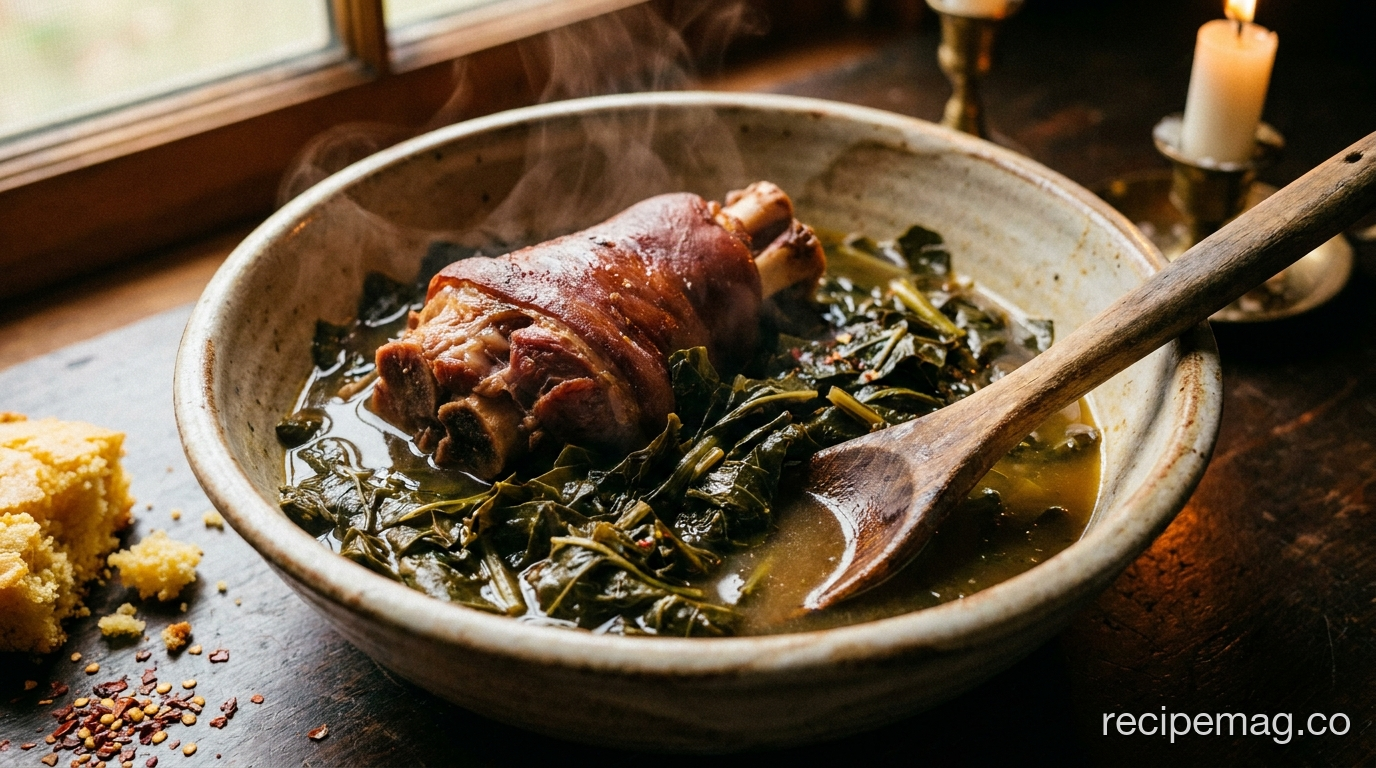
Real Southern collard greens are not complicated, but they are patient. This recipe simmers a meaty smoked ham hock low and slow with a big pot of washed, destemmed greens until they turn silky, savory, and tender. The cooking liquid, called pot likker, picks up smoke, salt, and a deep mineral richness you’ll want to sop up with cornbread. Collards are also a nutritional powerhouse: one cooked cup delivers more than 770% of the daily value for vitamin K. ([USDA FoodData Central](https://fdc.nal.usda.gov), 2023) The two rules that matter most: wash the grit out completely, and don’t rush the simmer.
Key Takeaways
- Wash collards in at least three changes of cold water; grit hides in the leaf folds and ribs.
- A low simmer for 1.5 to 2 hours is what turns tough leaves tender, not high heat.
- Save the pot likker; it’s the seasoned, nutrient-rich broth and the soul of the dish.
- One cooked cup of collards provides over 770% of your daily vitamin K. ([USDA FoodData Central](https://fdc.nal.usda.gov), 2023)
- A smoked ham hock builds smoky, salty depth that liquid smoke alone can’t match.
What Makes Southern Collard Greens So Good?
Southern collard greens earn their reputation through slow time and smoky pork. The greens themselves are tough, leathery, and faintly bitter when raw, so a long, gentle simmer is what transforms them into something tender and deeply savory. They’re also exceptionally good for you: one cooked cup provides over 770% of the daily value for vitamin K and about 5 grams of fiber. ([USDA FoodData Central](https://fdc.nal.usda.gov), 2023) That combination of comfort and nutrition is why collards anchor so many Southern tables.
The flavor comes from the marriage of two ingredients. Smoked ham hock gives up salt, smoke, and gelatin as it simmers. The greens drink all of it in. What you get back is a pot of tender leaves swimming in seasoned broth.
This dish carries real history. Collard greens trace back through Soul Food and West African cooking traditions, where simmering hardy greens with cured pork made the most of every ingredient. The result is a dish that tastes like patience, and it has fed families for generations.
[PERSONAL EXPERIENCE] We’ve cooked collards both fast and slow over the years, and the slow pot wins every time. Greens rushed at a hard boil stay chewy and stubbornly bitter. The batches we simmered gently for closer to two hours came out silky, mellow, and far less bitter, with pot likker worth drinking on its own.
How Do You Clean Collard Greens to Remove Grit?
Cleaning is the step most people underestimate, and skipping it ruins the whole pot. Collard leaves grow close to the ground and trap sand deep in their folds and along the central rib. Food-safety guidance is clear that leafy greens should be rinsed thoroughly under running water to remove soil and debris before cooking. ([FDA](https://www.fda.gov/food/buy-store-serve-safe-food), 2023) For collards, that means more than a quick rinse. Plan on at least three full changes of cold water.
Step-by-Step Washing
- Fill a clean sink or large bowl with cold water. Submerge the whole leaves and swish them around vigorously with your hands.
- Lift the greens out, don’t pour them. Grit sinks to the bottom. If you drain through a colander, you pour the sand right back over the leaves.
- Drain the dirty water and repeat. Refill with clean cold water and wash again. Do this until the water at the bottom runs clear, usually three times.
- Check the ribs. Run a thumb along each central stem to dislodge any sand trapped where the leaf meets the rib.
If you have time, a 10-minute soak in cold water before the first wash helps loosen stubborn dirt. Just don’t soak so long that the leaves go limp. The goal is clean greens, not waterlogged ones.
How to Destem and Cut Collard Greens
The thick central stem of a collard leaf stays tough no matter how long you cook it, so it has to come out. Culinary authorities recommend removing the fibrous central rib from hardy greens like collards and kale before cooking for the best texture. ([Serious Eats](https://www.seriouseats.com), 2022) Once the stems are gone, the leaves cook evenly and turn fully tender in the same window of time.
The Fastest Destemming Method
- Fold the leaf in half along the stem so the two halves of the leaf meet, shiny side in.
- Cut along the stem with a sharp knife to slice the leafy part away from the rib in one stroke. Discard the stems or save them for stock.
- Stack the destemmed halves, roll them into a tight cylinder, and slice crosswise into ribbons about an inch wide.
- Give the cut greens one final rinse if you saw any grit during cutting.
An inch-wide ribbon is the sweet spot. Cut them too thin and they collapse into mush. Leave them too wide and they’re awkward to eat. A loose, hand-torn approach works too if you prefer rustic over uniform.
The Smoked Ham Hock and Pot Likker
The ham hock is the engine of this recipe. It’s the smoked, cured joint from a pig’s lower leg, full of connective tissue, marrow, and bark-deep smoke flavor. As it simmers for an hour or more, collagen melts into gelatin and seasons the liquid with body and richness. Cured smoked pork products also contribute significant sodium and that signature smoky taste. ([USDA FSIS](https://www.fsis.usda.gov), 2023) That’s why you season the pot lightly at first and adjust salt only at the end.
Pot likker is the name for the savory broth left behind after the greens cook down. Don’t pour it out. It’s loaded with smoke, salt, and the water-soluble vitamins that leach from the greens during the long simmer. Southern cooks have always treated it as a prize.
Serve the greens with their likker spooned right over the top, and keep cornbread nearby to soak up every drop. If you can’t find a ham hock, a smoked turkey leg, a few slices of thick-cut bacon, or a smoked ham bone all work as substitutes. Each brings smoke and salt to the pot.
[UNIQUE INSIGHT] The most common collard greens mistake isn’t undercooking, it’s drowning the flavor in too much liquid. You want just enough water or stock to come about halfway up the greens, not cover them. The leaves wilt down dramatically and release their own moisture. Start with less liquid, and your pot likker comes out concentrated and intensely flavored instead of thin and watery.
Ingredients
This is a humble list, and that’s the point. Collard greens have long been one of the most economical vegetables in the South, and the smoked ham hock stretches a small amount of pork across a huge pot of greens. Collards are also widely available and inexpensive year-round, with peak field-grown season running from fall through early summer in much of the Southeast. ([USDA Agricultural Marketing Service](https://www.ams.usda.gov), 2023)
- 2 large bunches collard greens (about 2 to 2.5 pounds), washed and destemmed
- 1 smoked ham hock (about 1 to 1.5 pounds)
- 1 medium yellow onion, diced
- 3 to 4 garlic cloves, minced
- 6 cups water or low-sodium chicken stock
- 1 tablespoon olive oil or bacon fat
- 1 to 2 teaspoons apple cider vinegar (plus more to serve)
- 1 teaspoon red pepper flakes (optional, for heat)
- 1/2 teaspoon black pepper
- Salt to taste (add at the end)
- Pinch of sugar (optional, to balance bitterness)
Hold the salt until the very end. The ham hock releases a lot of sodium as it cooks, and the pot likker concentrates as it simmers. Salting early is the fastest way to end up with greens that are too salty to fix.
How to Make Southern Collard Greens Step by Step
The whole method is built around one principle: low and slow. A gentle simmer over 1.5 to 2 hours is what breaks down the tough cell walls in collard leaves and renders them tender. America’s Test Kitchen recommends long, low-temperature braising for hardy greens to develop both tenderness and deep flavor. ([America’s Test Kitchen](https://www.americastestkitchen.com), 2022) Resist the urge to crank the heat. A rolling boil makes greens chewy and bitter, not tender.
Step-by-Step Instructions
- Build the base. Heat the olive oil or bacon fat in a large heavy pot over medium heat. Add the diced onion and cook until soft and translucent, about 5 minutes. Add the garlic and cook for 1 minute more until fragrant.
- Add the ham hock and liquid. Nestle the smoked ham hock into the pot and pour in the water or stock. Add the black pepper and red pepper flakes. Bring to a gentle boil, then reduce to a low simmer.
- Simmer the hock first. Cover and simmer the ham hock alone for about 45 minutes to 1 hour. This builds the pot likker before the greens ever go in.
- Add the greens. Pile the washed, cut collards into the pot. They’ll look like far too much. Press them down with a spoon and let them wilt for a few minutes, then stir so they’re coated in the liquid.
- Low and slow. Cover partially and simmer gently for 1 to 1.5 hours, stirring occasionally, until the greens are dark, silky, and completely tender. The liquid should bubble lazily, never hard-boil.
- Pull the meat. Remove the ham hock, let it cool slightly, then shred any tender meat off the bone. Return the meat to the pot and discard the bone, skin, and fat.
- Season at the end. Stir in the apple cider vinegar and a pinch of sugar if using. Taste, then add salt as needed. The vinegar brightens the whole pot and cuts the richness.
You’ll know the greens are done when a piece melts easily between your fingers with no chew left. If they still feel firm, they simply need more time. Collards are forgiving; you cannot really overcook them within reason.
Tips for the Best Collard Greens
Small choices separate good collards from great ones. The biggest levers are washing thoroughly, simmering low, and seasoning at the right moment. Beyond that, a few practiced habits round out the pot. The acid you add at the end matters more than people expect: a splash of vinegar balances the natural bitterness of the greens and the richness of the pork, which is why nearly every traditional recipe finishes with it.
- Add acid at the end, not the start. Vinegar added early can toughen the greens and dull the color. Stir it in during the final few minutes for brightness.
- Don’t drown the greens. Use just enough liquid to come halfway up the pot. The greens release moisture as they wilt, and less water means richer pot likker.
- Taste before you salt. The ham hock does most of the seasoning work. Salt only at the very end, once the broth has concentrated.
- A pinch of sugar tames bitterness. If your greens taste sharp, a small pinch of sugar rounds them out without making them sweet.
- Make them a day ahead. Collard greens taste even better the next day. The flavors settle and deepen overnight in the fridge.
- Serve hot with their likker. Spoon the seasoned broth over each portion. Hot sauce, extra vinegar, and cornbread on the side complete the plate.
—
Southern Collard Greens with Smoked Ham Hock
Prep Time: 25 minutes | Cook Time: 2 hours | Serves: 6
Ingredients
- 2 large bunches collard greens (2 to 2.5 lbs), washed and destemmed
- 1 smoked ham hock (1 to 1.5 lbs)
- 1 medium yellow onion, diced
- 3 to 4 garlic cloves, minced
- 6 cups water or low-sodium chicken stock
- 1 tablespoon olive oil or bacon fat
- 1 to 2 teaspoons apple cider vinegar, plus more to serve
- 1 teaspoon red pepper flakes (optional)
- 1/2 teaspoon black pepper
- Salt to taste
- Pinch of sugar (optional)
Instructions
- Wash collards in at least 3 changes of cold water, lifting them out each time. Destem and cut into 1-inch ribbons.
- Heat oil in a large heavy pot over medium heat. Cook onion until soft, about 5 minutes. Add garlic and cook 1 minute more.
- Add the ham hock, water or stock, black pepper, and red pepper flakes. Bring to a gentle boil, then reduce to a low simmer.
- Cover and simmer the ham hock alone for 45 minutes to 1 hour to build the pot likker.
- Add the collards, pressing them down to wilt. Stir to coat in the liquid.
- Partially cover and simmer gently for 1 to 1.5 hours, stirring occasionally, until silky and tender.
- Remove the ham hock, shred the tender meat, return it to the pot, and discard the bone.
- Stir in apple cider vinegar and a pinch of sugar if using. Taste and add salt as needed. Serve hot with pot likker spooned over.
Notes
- No ham hock? Substitute a smoked turkey leg, a smoked ham bone, or 4 to 5 slices of thick-cut bacon.
- Save the pot likker. It freezes well and makes an excellent base for beans or soup.
- Greens taste even better the next day. Store covered in the fridge for up to 4 days.
- Wash thoroughly. Grit hides in the leaf folds and along the central rib; three water changes is the standard.
—
Frequently Asked Questions About Southern Collard Greens
How long do you cook collard greens until tender?
Plan on 1 to 1.5 hours of gentle simmering once the greens go into the pot, or closer to 2 hours total including the ham hock. A low, slow simmer is what breaks down the tough leaves. They’re done when a piece melts between your fingers with no chew left. High heat makes them chewy and bitter, so keep the pot at a lazy bubble.
What is pot likker and should I keep it?
Pot likker is the seasoned broth left after collard greens simmer with smoked pork. Absolutely keep it. It carries smoke, salt, and the water-soluble vitamins that leach from the greens during cooking. Spoon it over each serving and use cornbread to soak up the rest. Leftover pot likker also freezes well and makes a flavorful base for beans or soup.
How do I get all the grit out of collard greens?
Wash them in at least three changes of cold water. Submerge the leaves in a sink or large bowl, swish vigorously, then lift them out rather than pouring through a colander, since grit sinks to the bottom. Drain, refill with clean water, and repeat until the water runs clear. Run a thumb along each central rib to dislodge any sand trapped where the leaf meets the stem.
Can I make collard greens without a ham hock?
Yes. A smoked turkey leg, a smoked ham bone, or 4 to 5 slices of thick-cut bacon all deliver the smoke and salt that define the dish. For a vegetarian version, use smoked paprika, a splash of liquid smoke, and vegetable stock, plus extra olive oil for richness. The texture and tenderness come from the long simmer, not the meat itself.
Why are my collard greens bitter?
Bitterness usually means the greens were undercooked or cooked too fast at high heat. A long, low simmer mellows the natural bitterness dramatically. A splash of apple cider vinegar and a small pinch of sugar at the end also balance any sharpness. Finally, removing the tough central rib helps, since the stems hold more of the bitter, fibrous flavor than the tender leaves.
Southern collard greens reward patience more than skill. Wash the grit out completely, pull the tough ribs, then let a smoked ham hock and a low simmer do the slow work of turning leathery leaves into something silky and rich. There’s nothing fussy about it, just time and attention.
When the greens are tender and the pot likker is dark and savory, you’ve made something with real Southern roots. Spoon that broth generously, keep the cornbread close, and add a few dashes of hot sauce or vinegar at the table to suit your taste.
Make a big pot. Collards only get better the next day, and that seasoned likker is too good to waste.
