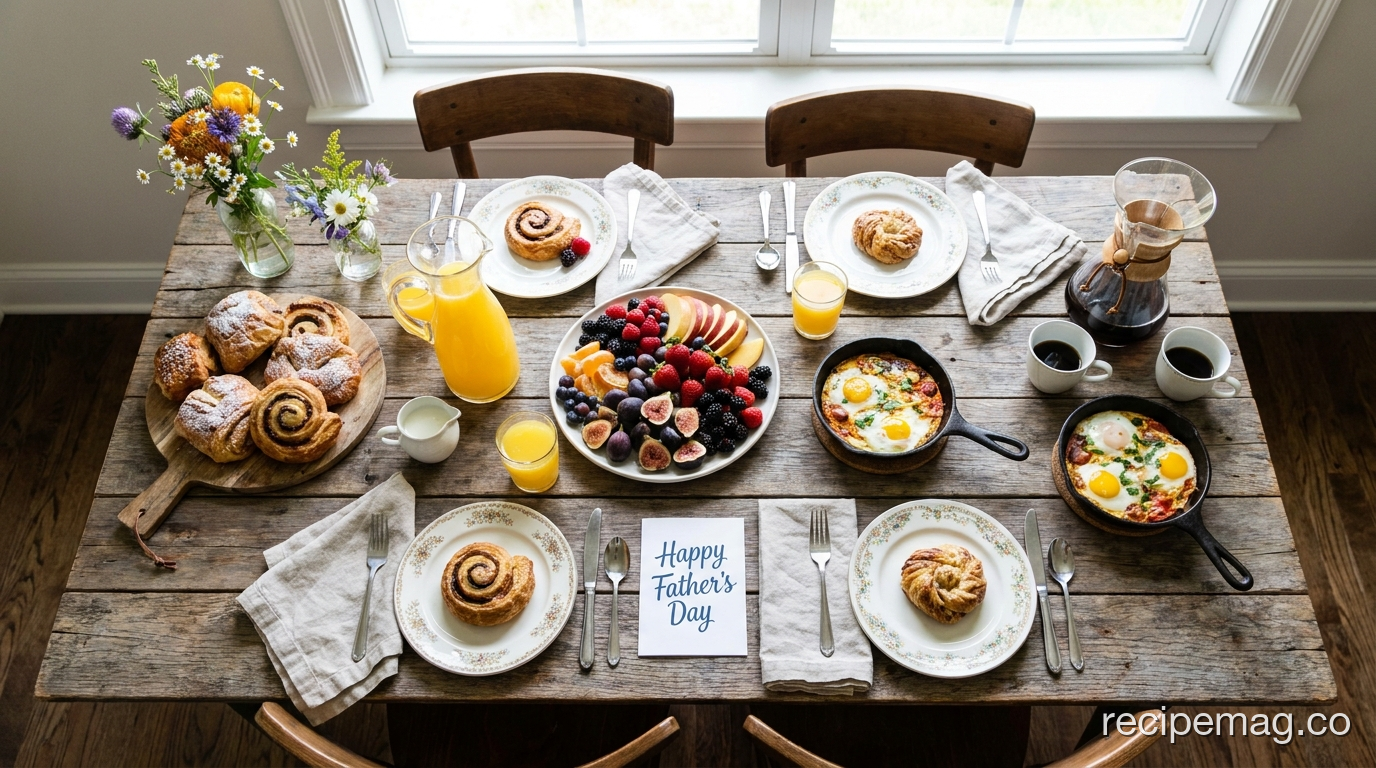
Setting up a Father’s Day brunch table comes down to three things: a menu that’s mostly made ahead, a self-serve drink station, and a timeline that gets you out of the kitchen before guests arrive. Father’s Day ranks as the fourth-most-popular holiday for dining out and at-home celebrations, with roughly 75% of Americans planning to celebrate, according to the National Retail Federation. ([National Retail Federation](https://nrf.com), 2023) Plan for one savory main, two sides, a bread, fruit, and one signature drink, and you’ll have a table that looks generous without keeping you stuck at the stove.
Key Takeaways
- Build the menu around one make-ahead main (a strata or casserole), two sides, fruit, and bread so you cook less the morning of.
- Plan for about 1.5 to 2 servings per guest across the spread, since people graze at brunch rather than eat one plated portion.
- A self-serve drink station with coffee, juice, and one batched cocktail or mocktail cuts your hosting work dramatically.
- Roughly 75% of Americans celebrate Father’s Day, making it one of the year’s busiest brunch days. ([National Retail Federation](https://nrf.com), 2023)
- A simple morning timeline, with the main assembled the night before, lets you sit down with everyone instead of plating to order.
What Should You Put on a Father’s Day Brunch Menu?
A balanced Father’s Day brunch menu needs one substantial savory main, two supporting sides, something carby, and fruit. Eggs anchor most American brunch tables for good reason: one large egg delivers about 6 grams of complete protein for roughly 70 calories, making it the most economical centerpiece you can build a spread around. ([USDA FoodData Central](https://fdc.nal.usda.gov), 2023) Build out from there with sides that feed a crowd cheaply.
Here’s a menu structure that works for almost any group size. Scale the quantities up or down, but keep the categories.
The Five-Category Menu Framework
- One savory main: a baked egg strata, a frittata, or a breakfast casserole. This is your make-ahead hero.
- One protein side: bacon, breakfast sausage, or a smoked salmon platter. Pick based on what Dad actually likes.
- One carb: a coffee cake, a tray of muffins, bagels, or a stack of pancakes kept warm in the oven.
- Fresh fruit: a big platter of whatever’s in season. June means berries, melon, and cherries at their peak.
- One signature drink: a batched mimosa, a coffee bar, or a non-alcoholic spritzer.
Resist the urge to add a sixth and seventh dish. A focused spread looks more generous than a scattered one, and it keeps your morning sane. If you want more variety, add it to the fruit platter or the bread basket, not to the cooking list.
[PERSONAL EXPERIENCE] We’ve hosted enough family brunches to learn that the savory main is the only dish worth stressing over. Everything else can be store-bought or assembled cold. A good strata pulled from the oven golden and puffed does more for the table than three fussy dishes that all need the stove at the same time.
Which Dishes Can You Make Ahead vs. the Day Of?
The make-ahead rule for brunch is simple: assemble anything custard-based or baked the night before, and reserve only quick-finish tasks for the morning. The USDA Food Safety and Inspection Service confirms that assembled casseroles and cooked egg dishes store safely for three to four days when refrigerated at 40°F or below. ([USDA Food Safety and Inspection Service](https://www.fsis.usda.gov), 2023) That means your strata can sit assembled overnight and go straight into the oven at wake-up.
Make the Night Before
- Egg strata or casserole: assemble fully, cover, and refrigerate. An overnight rest actually improves a strata, letting the bread soak up the custard evenly.
- Coffee cake or muffins: bake completely and store at room temperature in a sealed container.
- Fruit prep: wash and cut melon, pineapple, and sturdy fruit. Keep berries whole and unwashed until morning.
- Batched drinks: mix juice blends or cocktail bases (minus any fizz) and chill.
- The table: set plates, glasses, flatware, and serving dishes out the night before.
Finish the Day Of
- Bake the strata: straight from the fridge, allowing an extra 10 to 15 minutes since it starts cold.
- Cook the bacon or sausage: sheet-pan bacon at 400°F is hands-off and frees the stovetop.
- Rinse and add berries to the fruit platter so they look fresh and bright.
- Brew coffee and add fizz to drinks right before guests arrive.
[UNIQUE INSIGHT] The dishes people think they must make fresh, scrambled eggs, pancakes to order, are exactly the wrong ones for hosting. Anything cooked à la minute chains you to the stove while everyone else eats. A baked main does the opposite: it cooks itself while you pour coffee and actually talk to your guests.
How Do You Set Up the Brunch Table?
A good brunch table setup uses height, flow, and zones to keep a crowd moving without a bottleneck. Buffet-style service is the practical default for groups: it lets people serve themselves at their own pace and works for nearly any headcount. The principle most home hosts miss is flow. Arrange the table so guests move in one direction, plates first, food in the middle, drinks at a separate station entirely.
Arrange the Table in Order of Use
- Plates and napkins first. Place them at the start of the line so guests pick them up before reaching the food.
- Mains in the center. Put the hot strata and protein side in the middle where they’re easy to reach from both sides.
- Sides and bread next. Cluster muffins, fruit, and bread after the mains.
- Flatware at the end. Counterintuitive but smart: people grab utensils last so their hands are free while serving.
- Drinks off the main table. A separate drink station prevents a traffic jam at the food.
Add Height and Texture
Flat tables read as boring. Use cake stands, overturned bowls under a tablecloth, or a wooden riser to lift a dish or two. A small jar of June flowers, peonies, or whatever’s in the garden, adds color without crowding the serving space. Keep centerpieces low or narrow so they don’t block the food or conversation across the table.
[PERSONAL EXPERIENCE] In our experience, the single biggest table upgrade costs nothing: clear the clutter. Remove the everyday salt shaker, the mail pile, the spare chargers. A brunch table with three well-arranged dishes and clean space around them looks far more inviting than a crammed one. Negative space is part of the presentation.
How Do You Build a Self-Serve Drink Station?
A self-serve drink station is the highest-impact, lowest-effort upgrade for any brunch. Set it up away from the food table so guests can refill without crossing the serving line. America’s Test Kitchen has long recommended batching brunch cocktails in advance for both consistency and host freedom, and the math is friendly: one standard 750ml bottle of sparkling wine pours roughly six mimosas. ([America’s Test Kitchen](https://www.americastestkitchen.com), 2022) Build the station around one signature drink plus the basics.
The Three-Layer Drink Station
- The hot layer: a coffee carafe or thermal urn, plus a small kettle or hot water for tea. Set out milk, cream, and sugar.
- The cold layer: a pitcher of orange juice, a jug of ice water with citrus or cucumber, and the signature drink.
- The signature drink: a self-serve mimosa setup (chilled sparkling wine plus a carafe of juice) or a batched non-alcoholic spritzer.
Keep It Self-Serve and Stocked
Pre-chill everything. Warm sparkling wine and lukewarm juice ruin a mimosa fast. Put the sparkling wine in an ice bucket and the juice in a chilled carafe so guests build their own at the ratio they like. Label a non-alcoholic option clearly so kids and non-drinkers have something that feels just as festive. Set out more glasses than you think you need; people set drinks down and lose track of them.
How Much Food and Drink Do You Need Per Guest?
For a brunch buffet, plan about 1.5 to 2 servings per guest across the whole spread, not per dish. Event-planning research from hospitality programs consistently points to roughly 1.5 servings per person on a buffet, since guests graze across several dishes instead of eating one full plate. ([Cornell University, School of Hotel Administration](https://sha.cornell.edu), 2021) Use these per-guest amounts as a starting point and round up for a hungry crowd.
Per-Guest Quantities (Brunch Buffet)
- Eggs (in a strata or casserole): about 1.5 to 2 eggs per person. A dozen eggs feeds roughly 6 to 8.
- Bacon or sausage: 2 to 3 pieces per person.
- Bread or pastry: 1.5 pieces per person (muffins, bagels, slices of coffee cake).
- Fruit: about 1 cup per person.
- Coffee: 2 cups per coffee drinker; plan on roughly 1.5 cups of brewed coffee per guest overall.
- Juice: about 1 to 1.5 cups per person.
- Sparkling wine for mimosas: one 750ml bottle per 3 to 4 guests (each bottle makes about 6 mimosas).
Quick Math for Common Group Sizes
- 6 guests: one 9×13 strata (about a dozen eggs), 1 lb bacon, a dozen muffins, 6 cups fruit, 2 bottles sparkling wine.
- 10 guests: one and a half stratas, 1.5 lb bacon, 18 muffins, 10 cups fruit, 3 bottles sparkling wine, a full pot of coffee.
- 12+ guests: double everything and add a second drink option so the line never stalls.
One caution on coffee: it’s the thing hosts under-make most often. A standard 12-cup coffee maker yields fewer servings than the label suggests once mugs and refills enter the picture. For groups over eight, brew a full pot early and keep it hot in a thermal carafe rather than relying on the machine to keep pace.
What’s a Realistic Morning Timeline?
A workable Father’s Day brunch timeline starts the night before and front-loads everything that can possibly be done early. The goal is to be finished, not rushing, by the time the first guest knocks. Assuming an 11 a.m. brunch, here’s a timeline that leaves you relaxed instead of frazzled. Adjust the clock to your start time and bake time.
The Night Before
- Assemble the strata and refrigerate it covered.
- Bake muffins or coffee cake; store sealed at room temperature.
- Cut sturdy fruit; mix juice and chill drinks.
- Set the table and lay out serving dishes.
Morning Of (11 a.m. Brunch)
- 9:00 a.m. Pull the strata from the fridge to take off the chill. Preheat the oven.
- 9:20 a.m. Bake the strata. Start the bacon on a sheet pan in the same oven if there’s room.
- 9:45 a.m. Brew the first pot of coffee; transfer to a thermal carafe.
- 10:00 a.m. Rinse berries and finish the fruit platter. Set out bread and pastries.
- 10:30 a.m. Set up the drink station; ice the sparkling wine.
- 10:50 a.m. Pull the strata to rest. Add fizz to drinks. Light a candle, breathe.
- 11:00 a.m. Guests arrive to a finished table.
[UNIQUE INSIGHT] The hidden trick in any brunch timeline is the rest period. A strata or casserole pulled from the oven needs 10 to 15 minutes to set before slicing, and that window happens to be exactly when guests arrive. Build it into the plan on purpose. That rest isn’t dead time; it’s the buffer that lets you greet people instead of standing guard at the oven.
Frequently Asked Questions About Father’s Day Brunch
What time should a Father’s Day brunch start?
Late morning works best, typically between 10 a.m. and 11:30 a.m. That window gives you time to bake a make-ahead main without a pre-dawn start, and it lets brunch flow naturally into a relaxed afternoon. If you’re serving alcohol like mimosas, an 11 a.m. start feels appropriate and pairs well with a midday wind-down rather than an early one.
How far ahead can I assemble a breakfast strata?
You can assemble a strata up to 24 hours ahead and refrigerate it covered. An overnight rest is actually ideal: it gives the bread time to fully absorb the egg custard for an even, set texture. The USDA Food Safety and Inspection Service notes that assembled egg casseroles keep safely for three to four days refrigerated at 40°F or below. ([USDA FSIS](https://www.fsis.usda.gov), 2023) Bake it straight from the fridge, adding 10 to 15 minutes.
How many mimosas does one bottle of sparkling wine make?
One standard 750ml bottle makes about six mimosas at a roughly even split of wine and juice. For a group of six, plan on at least two bottles so everyone can have a refill. Set out the chilled sparkling wine in an ice bucket beside a carafe of orange juice and let guests mix their own to taste. Always offer a non-alcoholic juice spritzer alongside it.
What’s the easiest make-ahead brunch main for a crowd?
A baked egg strata is the easiest main to scale and make ahead. You assemble it the night before with bread, eggs, cheese, and any add-ins, then bake it in one dish the next morning. It feeds six to eight from a single 9×13 pan, requires no plating to order, and improves with an overnight rest. A breakfast casserole or large frittata works the same way.
How do I keep brunch food warm on a buffet?
Use the oven’s lowest setting (around 200°F) as a holding zone for cooked dishes until serving. For the table itself, a slow cooker on warm holds egg bakes and breakfast potatoes well, and a covered casserole dish retains heat for 20 to 30 minutes on its own. Serve bacon and pastries at room temperature, since they don’t need to stay hot and free up your warming space.
Bring It All to the Table
A great Father’s Day brunch isn’t about cooking more. It’s about cooking smarter and setting up so you actually get to sit down. Pick one make-ahead main, surround it with easy sides and fruit, batch one good drink, and let the buffet do the serving for you.
Use the per-guest quantities to shop with confidence, and follow the night-before prep so the morning is mostly assembly. The timeline gives you a finished table by the time the doorbell rings, with a built-in rest period that doubles as your breathing room.
Most of all, remember who the day is for. The point isn’t a flawless spread; it’s time at the table with Dad. Set it up the easy way, then put the apron down and join everyone.
