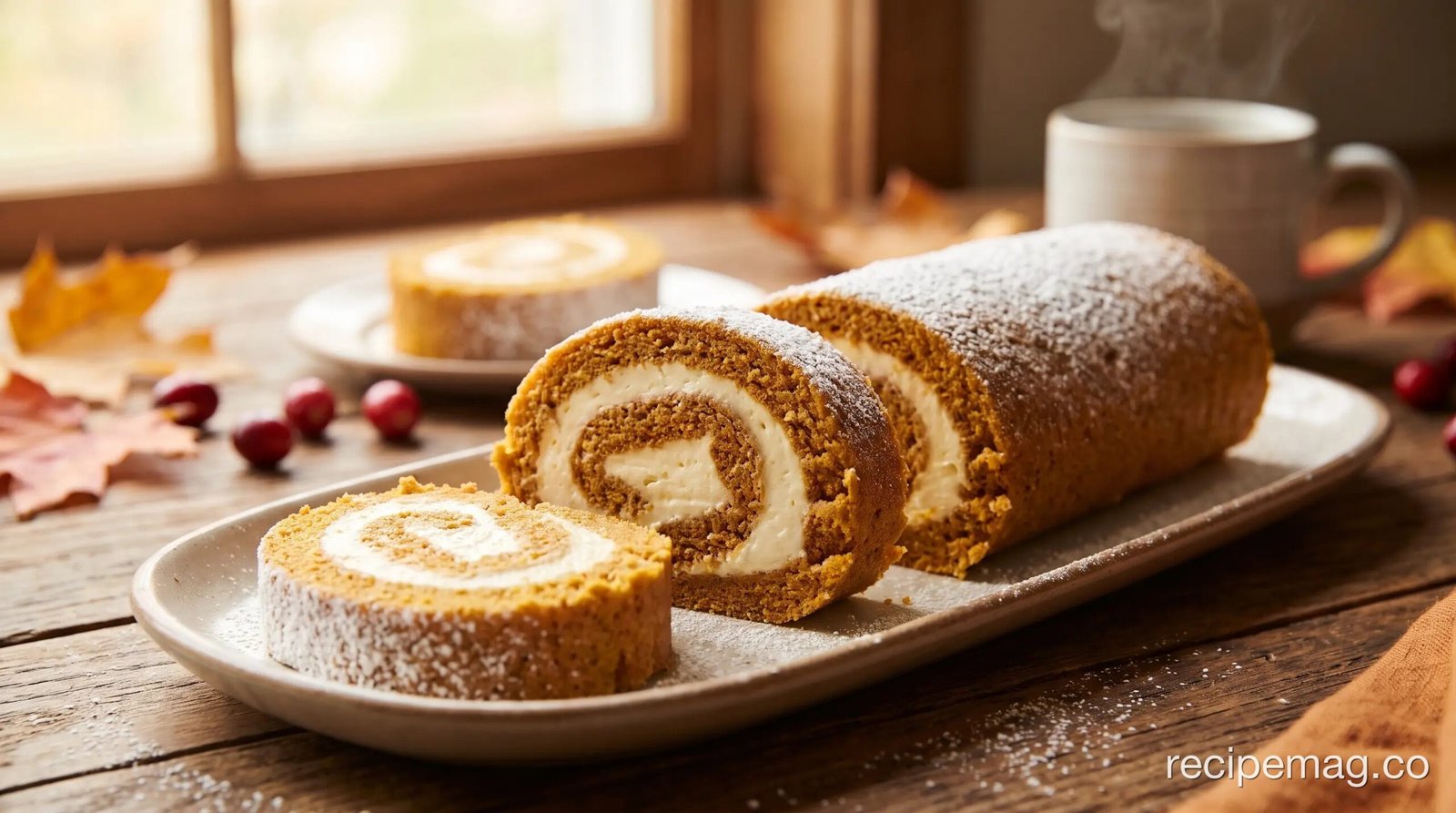
A pumpkin roll is a thin, spiced pumpkin sponge rolled up in a towel while it’s hot, then unrolled, spread with cream cheese filling and rolled again. The cake bakes in about 15 minutes, and rolling it warm keeps it from cracking. Because the filling is perishable, keep it chilled: USDA FSIS says perishable food shouldn’t sit out longer than 2 hours (USDA FSIS, 2026).
Key Takeaways
- Roll the cake in a sugared towel the moment it leaves the oven.
- Cool it completely before filling, or the cream cheese melts.
- Chill the filled roll at least 2 hours for clean, tight spirals.
- It keeps 3 to 4 days in the fridge, per USDA FSIS, and freezes for a month.
Prep Time: 30 minutes | Cook Time: 15 minutes | Cool and Chill: 3 hours | Total Time: 3 hours 45 minutes | Servings: 10 slices
Why Do You Roll a Pumpkin Roll While It’s Hot?
A warm sponge bends, and a cold one snaps. Rolling the cake in a towel straight out of the oven lets it cool in a curl, so it rolls back up around the filling later without cracking. Pumpkin helps, too: USDA FoodData Central lists canned pumpkin at about 90 percent water (USDA FoodData Central, 2026), and that moisture keeps the thin cake supple.
Use a thin flour-sack or cotton towel dusted with powdered sugar. It keeps the cake from sticking and lets steam escape slowly. Terry cloth leaves lint and a waffled surface.
In our kitchen, the rolls that crack are almost always the ones that sat in the pan while we hunted for a towel, so we sugar the towel before the batter goes in the oven. Prefer no rolling at all? Our list of Thanksgiving desserts that aren’t pie has 17 more ideas.
Ingredients for Pumpkin Roll
Use canned pure pumpkin puree, not pumpkin pie filling, which is already sweetened and spiced. You need ⅔ cup, a little more than a third of a 15-ounce can, so measure it. Extra pumpkin makes a wetter sponge that sticks to the parchment.
For the Cake
- ¾ cup (95 g) all-purpose flour, spooned and leveled
- ½ teaspoon baking powder
- ½ teaspoon baking soda
- 1½ teaspoons ground cinnamon
- 1 teaspoon ground ginger
- ¼ teaspoon ground nutmeg
- ⅛ teaspoon ground cloves
- ¼ teaspoon fine salt
- 3 large eggs, at room temperature
- 1 cup (200 g) granulated sugar
- ⅔ cup canned pure pumpkin puree
- 1 teaspoon pure vanilla extract
- ½ cup finely chopped pecans or walnuts (optional)
- Softened butter or nonstick spray, for the pan
For Rolling and Dusting
- ¼ cup powdered sugar, for the towel
- 1 to 2 tablespoons powdered sugar, for dusting
For the Cream Cheese Filling
- 8 ounces full-fat brick cream cheese, softened
- 6 tablespoons unsalted butter, softened
- 1 cup (120 g) powdered sugar, sifted
- 1 teaspoon pure vanilla extract
- Pinch of fine salt
Equipment: a 10-by-15-by-1-inch jelly roll pan, parchment paper, a thin, clean kitchen towel (flour-sack style), a hand or stand mixer, a wire rack, an offset spatula, plastic wrap and a serrated knife.
How to Make a Pumpkin Roll
- Prep the pan and towel. Heat the oven to 375°F with a rack in the center. Grease the jelly roll pan, line it with parchment and grease the parchment. Lay the towel flat and sift ¼ cup powdered sugar evenly over it.
- Mix the dry ingredients. Whisk the flour, baking powder, baking soda, cinnamon, ginger, nutmeg, cloves and salt in a medium bowl.
- Whip the eggs. Beat the eggs and granulated sugar on medium-high speed for 3 to 4 minutes, until pale, thick and about doubled in volume.
- Add the pumpkin. On low speed, beat in the pumpkin and 1 teaspoon vanilla just until combined.
- Fold in the flour. Add the flour mixture and fold gently with a spatula just until no dry streaks remain.
- Spread and bake. Spread the batter evenly into the pan, right into the corners, and sprinkle with the nuts, if using. Bake 13 to 15 minutes, until the top springs back when lightly pressed.
- Roll it hot. Right away, run a knife around the edges and turn the cake out onto the sugared towel. Peel off the parchment. Starting at a short end, roll the cake up snugly with the towel inside.
- Cool completely. Set the rolled cake seam side down on a wire rack and let it cool completely, about 1 hour.
- Make the filling. Beat the cream cheese and butter on medium speed until completely smooth, about 2 minutes. Add the 1 cup powdered sugar, 1 teaspoon vanilla and the pinch of salt, and beat until fluffy, 1 to 2 minutes more.
- Fill. Gently unroll the cake. It will keep a curve. Spread the filling evenly, leaving a ½-inch border along the far short end.
- Roll again. Roll the cake back up without the towel, using light, even pressure. Wrap it tightly in plastic wrap and set it seam side down.
- Chill. Refrigerate at least 2 hours, or overnight, until the filling is firm.
- Slice and serve. Unwrap, trim the ends and dust with 1 to 2 tablespoons powdered sugar. Cut into 1-inch slices with a serrated knife. Refrigerate leftovers within 2 hours.
How Do You Keep a Pumpkin Roll from Cracking?
Most cracks come from a dry, overbaked cake or from rolling it too late.
- Start checking at 12 minutes. An overbaked sponge is dry and brittle, so pull it as soon as the top springs back.
- Spoon and level the flour. Scooping straight from the bag packs in extra flour and makes a stiffer cake.
- Roll from a short end. The thicker spiral is more forgiving, and the 10-inch log slices into 10 even pieces.
- Use brick cream cheese. Tub-style spread is softer and oozes out of the spiral.
- Soften, don’t melt. The cream cheese and butter should press easily but hold their shape. Warm, greasy filling slides.
Here’s the part most recipes rush: the chill sets the spiral, not the rolling. Cream cheese and butter firm up as they get cold, so a roll sliced after 30 minutes squashes under the knife, while one chilled 2 hours or overnight cuts into clean, tight spirals.
Can You Make a Pumpkin Roll Ahead or Freeze It?
Yes, and it’s one of the best make-ahead desserts for Thanksgiving. USDA FSIS says refrigerated leftovers keep 3 to 4 days (USDA FSIS, 2026), so you can bake the roll as early as Monday, November 23, and serve it Thursday. The Thanksgiving make-ahead guide shows where it fits in the week.
- Refrigerator: Wrap tightly in plastic and refrigerate up to 3 days. Dust with powdered sugar just before serving, since it dissolves in the fridge.
- Freezer: Wrap the chilled, unsliced roll in plastic, then foil, and freeze up to 1 month for best quality. USDA FSIS notes food kept at 0°F stays safe indefinitely (USDA FSIS, 2026).
- Thawing: Thaw overnight in the fridge, still wrapped. Slice it while it’s very cold for the neatest spirals.
- Traveling: Carry it in a cooler with ice packs. Bringing it to a potluck? Our Friendsgiving potluck plan helps the host organize who brings what.
Frequently Asked Questions About Pumpkin Roll
Why did my pumpkin roll crack?
Usually the cake was overbaked or rolled after it started to cool, and a dry, cool sponge snaps instead of bending. Pull it as soon as the top springs back, turn it onto the sugared towel right away and roll from a short end. Small cracks are fine, since powdered sugar hides them.
Can I use fresh pumpkin instead of canned?
Yes, but drain it first. Roast a small sugar pumpkin, puree it and let the puree drain in a cheesecloth-lined sieve until it’s as thick as canned, the same method we use for our classic pumpkin pie. Fresh puree is usually wetter than canned, and extra water makes the sponge stick to the parchment and tear.
Does pumpkin roll need to be refrigerated?
Yes. The cream cheese filling is perishable, so keep the roll in the fridge and don’t leave it out longer than 2 hours, or 1 hour if the room is above 90°F, as USDA FSIS advises. Tightly wrapped and refrigerated, it keeps 3 to 4 days.
How do I get clean slices?
Chill the roll at least 2 hours so the filling is firm, then slice with a serrated knife, using a gentle sawing motion instead of pressing down. Wipe the blade between cuts. Trim about ½ inch from each end first; the ends are always a little ragged, and they’re the cook’s reward.
Bake It Monday, Slice It Thursday
A pumpkin roll looks like the hardest dessert on the table, but the method is simple: whip, bake for 15 minutes, roll it hot and let the fridge finish the job.
Bake it early next week and wrap it tight. On Thanksgiving, all that’s left is a dusting of powdered sugar and a serrated knife.
