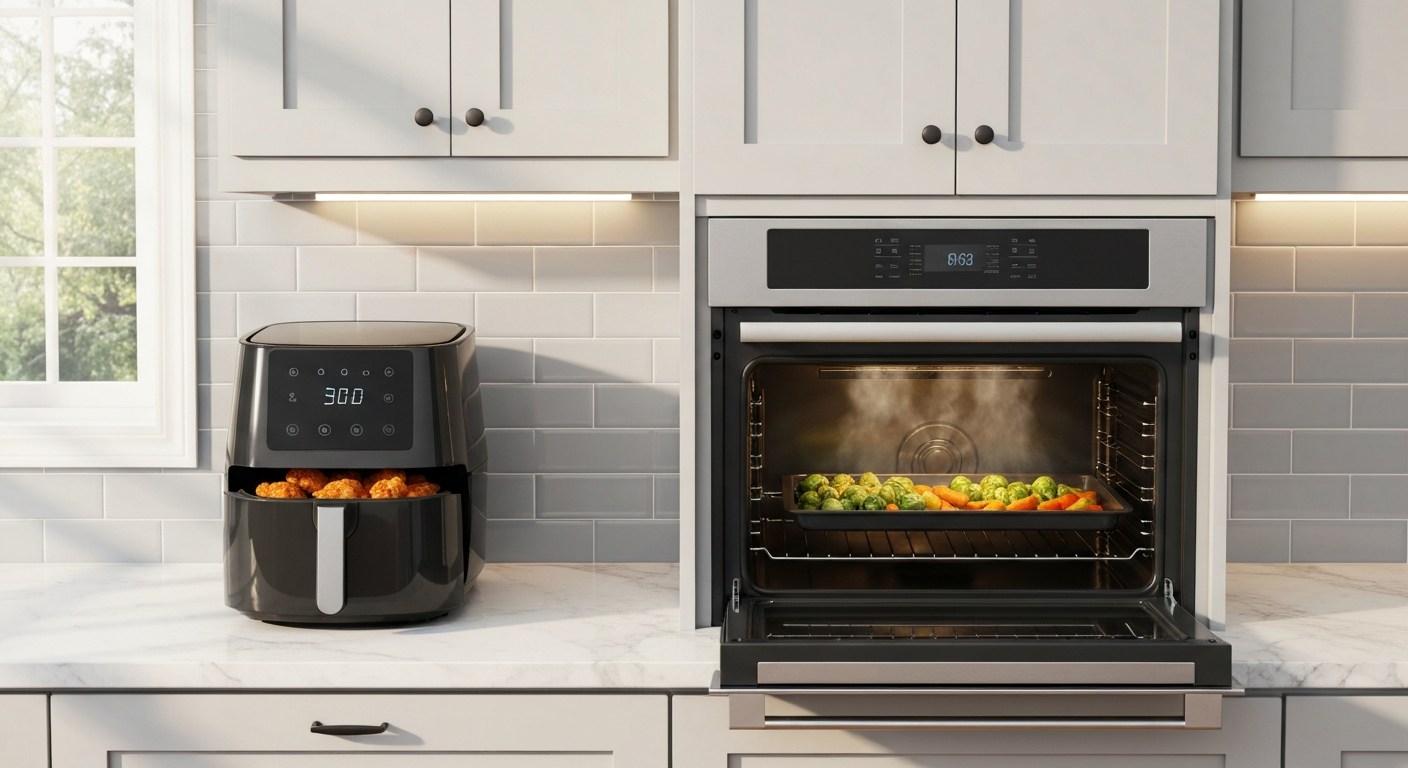
Air Fryer vs Oven: The Real Comparison You Need
Thinking about buying an air fryer but wondering if it’s worth it? Or maybe you already have one and aren’t sure when to use it versus your regular oven. Let’s cut through the marketing hype and look at the real differences between air fryers and conventional ovens.
Here’s the short answer: Air fryers are fantastic for small batches and crispy textures, while ovens excel at large meals and baking. The smartest kitchens use both strategically.
TL;DR: Quick Comparison
| Feature | Air Fryer | Conventional Oven |
|---|---|---|
| Energy Use | 1,500-1,800 watts | 2,000-5,000 watts |
| Preheat Time | 2-5 minutes | 10-15 minutes |
| Cooking Speed | 20-30% faster | Standard time |
| Capacity | 2-6 quarts | 18+ cubic feet |
| Temperature Range | 200°F-400°F | 170°F-550°F |
| Annual Cost (5 hrs/week) | ~$35 | ~$100 |
| Best For | Crispy small batches | Large meals & baking |
Energy & Cost Comparison: By the Numbers
The Real Cost Breakdown
Here’s what actually matters for your wallet:
Electricity Usage:
– Air fryer: ~1,500-1,800 watts
– Conventional oven: ~2,000-5,000 watts
At $0.14/kWh (average US electricity rate):
– Air fryer: ~$0.12 per hour
– Oven: ~$0.40 per hour
Real-world savings (cooking 5 hours per week):
– Air fryer: ~$35/year
– Oven: ~$100/year
– Annual savings: ~$65
“For small households, the air fryer can replace the oven 70% of the time, saving significant energy and time.” — Paul Hope, Home & Appliance Editor, Consumer Reports
Preheating Makes a Huge Difference
Air fryer: 2-5 minutes to preheat
Oven: 10-15 minutes to preheat
Those 8-10 minutes of preheating your oven? That’s wasted energy and time. Air fryers heat up faster because there’s less air to warm up.
Break-Even Point
If you cook frequently (5+ times per week), an air fryer pays for itself in 2-3 years through energy savings alone. Factor in the time savings and better results on certain foods, and the payoff is even faster.
Cooking Performance: What Actually Tastes Better?
Where Air Fryers Win
1. Crispy Textures
Air fryers excel at creating that crave-worthy crispy exterior. The rapid air circulation creates superior browning through the Maillard reaction (that delicious flavor and color development when food is cooked).
Perfect for:
– Frozen foods (fries, nuggets, fish sticks)
– Chicken wings (get restaurant-quality crispy skin)
– Reheating pizza (crisps up the crust perfectly)
– Roasted vegetables (charred edges, tender inside)
2. Speed
Air fryers cook 20-30% faster on average:
– French fries: 15-20 min (air fryer) vs 25-35 min (oven)
– Chicken wings: 20-25 min vs 40-50 min
– Roasted vegetables: 10-15 min vs 20-30 min
3. Convenience
– No preheating for most foods
– Smaller footprint on counter
– Easy cleanup (most baskets are dishwasher-safe)
– Less heat generated in your kitchen
Where Ovens Win
1. Large Quantities
– Air fryer: 2-6 quarts (about 1-2 lbs of food)
– Oven: 18+ cubic feet (multiple large pans)
2. Temperature Range
– Air fryer: 200°F-400°F
– Oven: 170°F-550°F
Need to bake at 450°F? Slow-roast at 200°F? Your oven can do it. Your air fryer can’t.
3. Moisture Retention
Ovens are better for:
– Large roasts (whole chicken, beef tenderloin)
– Casseroles and lasagnas
– Baking (cakes, breads, cookies)
– Anything that needs to stay moist
4. Versatility
– Broiling
– Baking multiple racks
– Using different pan sizes
– Cooking multiple dishes at once
“The air fryer’s advantage isn’t that it’s healthier than oven cooking—it’s that it makes food that tastes deep-fried with a fraction of the oil.” — Lisa McManus, Executive Testing Editor, America’s Test Kitchen
The Health Benefit Myth
Let’s clear up the biggest misconception:
Air Frying vs Deep Frying
Winner: Air fryer (by a mile)
– 70-80% less oil than deep frying
– Similar crispy texture
– Fewer calories and less fat
Air Frying vs Oven Baking
Winner: It’s a tie
– Same oil usage
– Similar nutritional profile
– Air fryer is just a mini convection oven
The truth: Air fryers aren’t inherently healthier than regular ovens. They’re just better than deep fryers. If a recipe calls for tossing vegetables in 1 tablespoon of olive oil, that’s the same whether you use an air fryer or oven.
“People misunderstand air fryers as a health appliance. They’re actually a texture appliance—excellent for crispiness, not magic for nutrition.” — J. Kenji López-Alt, Chief Culinary Advisor, Serious Eats
When to Use Each (And When to Use Both)
Perfect for Air Fryer
Frozen Foods
– French fries, tater tots, onion rings
– Chicken nuggets, fish sticks
– Mozzarella sticks
– Why: Superior crispiness, faster than oven
Small Batches
– 1-2 chicken breasts
– Single serving of roasted vegetables
– Reheating leftovers (especially pizza)
– Why: No preheating, faster cooking
Crispy Appetizers
– Chicken wings (get them perfectly crispy)
– Potato wedges
– Jalapeño poppers
– Why: Concentrated heat creates better browning
Perfect for Oven
Large Meals
– Whole roasted chicken
– Lasagna or casseroles
– Multiple side dishes at once
– Why: Capacity and versatility
Baking
– Cakes, cookies, breads
– Pizza (homemade dough)
– Why: Precise temperature control, even heat
Low & Slow Cooking
– Braised short ribs
– Slow-roasted pork shoulder
– Why: Consistent low temperature
The Hybrid Strategy: Use Both Together
Smart multi-course meals:
Example: Sunday Dinner
– Oven: Roasting a whole chicken at 375°F
– Air fryer: Crisping up Brussels sprouts as a side
– Result: Perfectly cooked moist chicken + crispy vegetables, done faster than using the oven for everything
Example: Taco Tuesday
– Oven: Warming tortillas at 300°F
– Air fryer: Cooking seasoned chicken strips
– Result: Warm tortillas + crispy chicken, ready at the same time
“The rapid air circulation in air fryers creates superior crispiness on frozen foods and reheated items compared to conventional ovens.” — Sohla El-Waylly, Culinary Expert, Bon Appétit
So, Should You Buy an Air Fryer?
Get an Air Fryer If…
✅ You cook for 1-2 people
✅ You love crispy foods (wings, fries, roasted veggies)
✅ You want faster cooking times
✅ You cook 5+ times per week (energy savings add up)
✅ You have limited counter space but use your microwave/toaster oven more than your big oven
✅ You reheating leftovers often (air fryers revive food better than microwaves)
Stick with Your Oven If…
✅ You cook for 4+ people regularly
✅ You bake frequently (breads, cakes, cookies)
✅ You make large one-pot meals (casseroles, lasagnas)
✅ You have limited counter space
✅ You only cook a few times per month
✅ You’re on a tight budget (good air fryers cost $80-200)
Consider Both If…
✅ You cook frequently and entertain
✅ You want maximum flexibility
✅ You have the counter space
✅ You’re serious about cooking efficiency
Real-World Capacity: What Fits in an Air Fryer?
2-Quart Air Fryer (1-2 servings)
– 1 lb chicken wings (8-10 pieces)
– 1 medium chicken breast
– 2 cups french fries
– Best for: Singles, couples
4-6 Quart Air Fryer (2-4 servings)
– 2 lbs chicken wings (16-20 pieces)
– 2-3 chicken breasts
– 4 cups french fries
– Small whole chicken (3-4 lbs)
– Best for: Small families
Oven Comparison
– Full-sized chicken (5-7 lbs)
– Multiple baking sheets
– Large casseroles (9×13 pan)
– Best for: Families, entertaining, meal prep
Pro tip: If you’re cooking for more than 2-3 people, you’ll likely need to cook in batches in an air fryer. At that point, your oven might be more efficient.
Related Reading
- Air Fryer Salmon Bites: Crispy, Quick, and Delicious
- Is Sillicon Okay to Use in the Air Fryer? Safety Guide
- 15+ Air Fryer Potato Recipes: Crispy Fries, Wedges & Baked
Frequently Asked Questions
Do air fryers actually fry food?
No. Air fryers are essentially small convection ovens. They use hot air circulated by a fan to cook food, similar to a convection oven. The “air frying” term is marketing—they don’t submerge food in oil like traditional frying.
Are air fryers healthier than ovens?
No. Air fryers and ovens produce similar nutritional results. The health advantage comes from comparing air frying to deep frying, not oven baking. If you’re already baking your food, switching to an air fryer won’t make it healthier.
Can I put foil in an air fryer?
Yes, but carefully. Use foil only to line the bottom basket to catch drips. Never cover the entire basket or block airflow, as this can damage the appliance and create fire hazards.
Do air fryers really save money?
Yes, if you cook frequently. Average savings are $50-150/year depending on:
– Your local electricity rates
– How often you cook
– What you’re replacing (oven vs deep fryer)
Most air fryers pay for themselves in 2-3 years through energy savings alone.
What can’t you cook in an air fryer?
- Large whole birds (turkeys, large chickens)
- Batters (wet batters drip off before setting)
- Very light foods (lettuce leaves can blow around)
- Anything needing boiling water (pasta, rice)
- Multiple large pans at once
Can an air fryer replace an oven?
For some households, yes. If you’re:
– Single or couple
– Don’t bake frequently
– Cook simple meals
– Live in a small space
An air fryer + microwave can replace a traditional oven for about 70% of cooking tasks. For families and avid bakers, it’s a supplement, not a replacement.
The Bottom Line
Air fryers aren’t a gimmick—they’re a specialized tool that excels at specific tasks.
Think of it this way:
– Oven = Your all-purpose chef’s knife
– Air fryer = Your precision paring knife
You wouldn’t use a paring knife to carve a turkey, and you wouldn’t use a chef’s knife for delicate tasks. Both have their place in a well-equipped kitchen.
The smartest approach? Use both strategically based on what you’re cooking. Your air fryer for quick weeknight dinners and crispy snacks. Your oven for weekend roasts, baking, and feeding a crowd.
Your energy bill—and your taste buds—will thank you.
Published: March 2026
Author: RecipeMag Team
Category: Kitchen Equipment & Tips
Tags: #airfryer #oven #kitchentips #cooking #appliancecomparison
