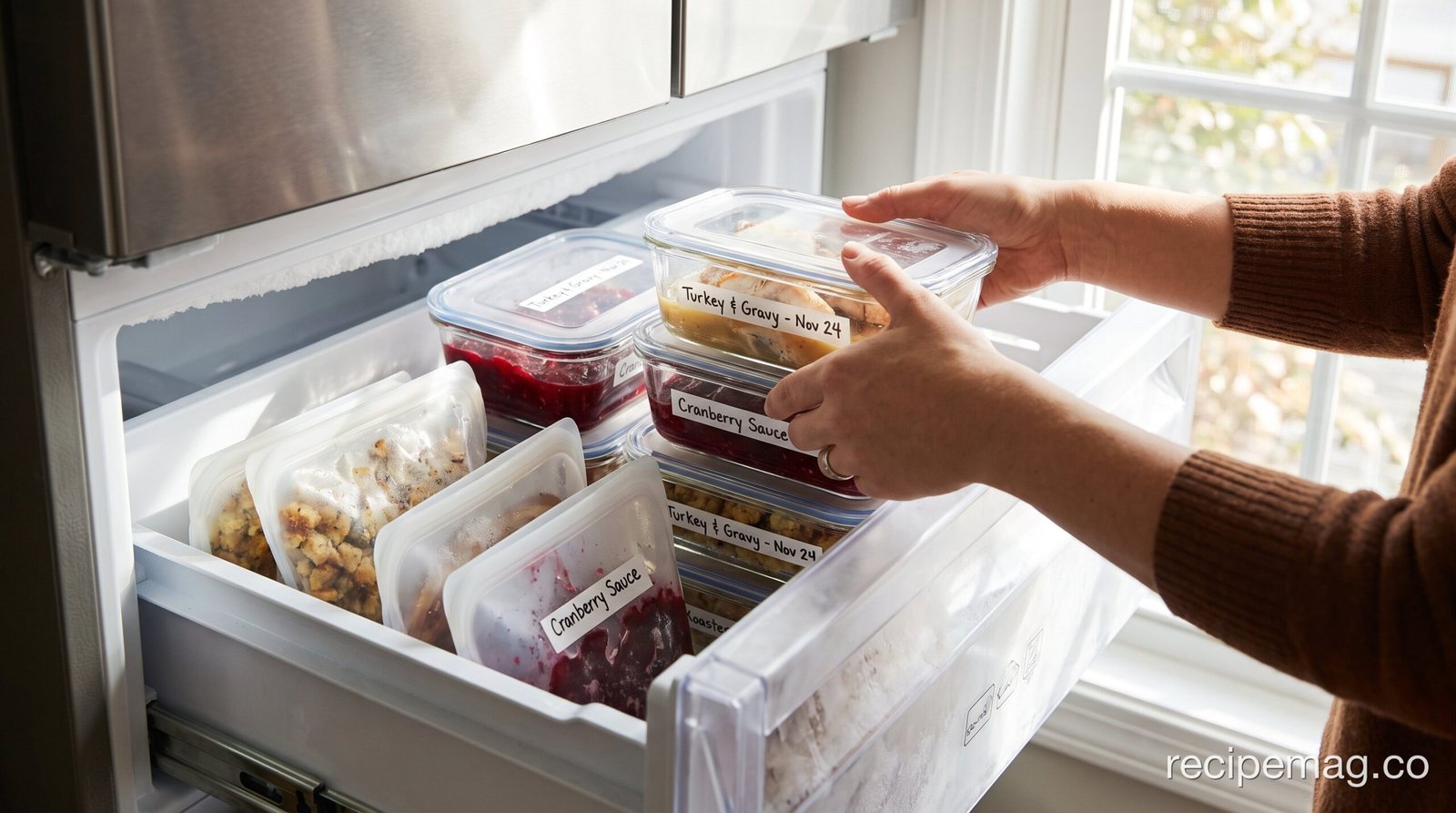
Freeze Thanksgiving leftovers within 3 to 4 days of cooking, and get them into the fridge within 2 hours of leaving the oven first. USDA FSIS says food kept at a steady 0°F stays safe indefinitely, though quality slowly declines (USDA FSIS, 2025). Most of the meal freezes well. A few dishes turn watery or soggy, so they need a different plan.
Key Takeaways
- Refrigerate leftovers within 2 hours, then freeze within 3 to 4 days, per USDA FSIS.
- Turkey, stuffing, gravy, cranberry sauce and rolls freeze best. Freeze them in meal-sized portions.
- Skip freezing raw-vegetable salads, crisp toppings and whipped cream.
- Thaw in the refrigerator when you can, then reheat to 165°F.
- Label every bag with the dish and the date. Our guidance: eat within 2 to 3 months for the best flavor.
When Should You Freeze Thanksgiving Leftovers?
Freeze leftovers as soon as the food has chilled, ideally the day after the meal. USDA FSIS says to refrigerate leftovers within 2 hours and use them within 3 to 4 days (USDA FSIS, 2025). Anything you won’t eat by then belongs in the freezer, not at the back of the fridge.
The 2-hour rule exists because bacteria multiply fastest between 40°F and 140°F, which FSIS calls the danger zone. Our dinner usually ends around 4 p.m., so the clock gets tight. Set a phone timer when the last plate is cleared.
If you already sorted your containers on Thursday night, you’re ahead. Our guide to storing and reheating Thanksgiving leftovers covers the fridge side of this plan in detail.
Fridge First, Freezer Second
Here’s how we split it. Whatever you’ll eat in the next two days stays in the fridge. Everything else goes straight to the freezer on Friday morning. That way you aren’t gambling on day four and you’re not freezing food that has already sat out for hours.
How Do You Prepare Leftovers for the Freezer?
Cool the food fast, portion it small, and wrap it airtight. Shallow containers chill quicker than deep pots, and USDA FSIS advises dividing large amounts of food into shallow containers so they cool quickly (USDA FSIS, 2025). Smaller portions also thaw faster and reheat more evenly later.
Follow this sequence for almost every dish:
- Strip the carcass. Carve all the meat off the bones within 2 hours of serving. Save the bones for turkey carcass soup with homemade stock.
- Portion. Pack food in amounts your household eats in one meal, usually 1 to 2 cups. A family of four might freeze turkey in 2-cup bags.
- Chill. Spread hot dishes in a shallow layer, or set the container in a sink of ice water, until no longer steaming. Don’t leave anything out past the 2-hour mark.
- Pack tight. Press out as much air as you can. Air dries food and causes freezer burn.
- Label. Write the dish and the date on masking tape or directly on the bag.
- Freeze flat. Lay bags flat on a baking sheet until solid, then stack them like books.
In our kitchen, flat-frozen bags of gravy and turkey meat have saved us more weeknights than any other trick. They thaw in a bowl of cold water in about an hour, which matters on a Tuesday evening.
What Containers Work Best?
Use freezer-grade zip-top bags for turkey, gravy and cranberry sauce. Rigid containers work better for stuffing and casserole-style dishes that you don’t want crushed. Leave about half an inch of headspace in any container holding liquid, because gravy and soups expand as they freeze.
Which Thanksgiving Leftovers Freeze Well?
Most of the plate freezes well: sliced turkey, stuffing, gravy, cranberry sauce, dinner rolls and mashed potatoes made with plenty of fat. Safety isn’t the limit here. USDA FSIS says food at 0°F stays safe indefinitely, so the time limits below are about flavor and texture (USDA FSIS, 2025).
The times in this table are our own guidance for best quality, not USDA limits. For more detail on home freezing, the National Center for Home Food Preservation is a solid reference.
| Dish | How to Pack It | Best Quality (Our Guidance) |
|---|---|---|
| Sliced or shredded turkey | Bags with a splash of broth or gravy, air pressed out | 2 to 3 months |
| Gravy | Cool, then freeze flat in bags or in ice cube trays | 2 to 3 months |
| Stuffing or dressing | Rigid container or foil-wrapped portions | 2 to 3 months |
| Cranberry sauce | Jar with headspace or a freezer bag | Up to 6 months |
| Mashed potatoes | Scoops on a tray, then bagged | 1 to 2 months |
| Dinner rolls and cornbread | Cooled completely, wrapped, then bagged | 2 to 3 months |
| Turkey stock or soup | Cooled, in rigid containers with headspace | 2 to 3 months |
| Baked sweet potatoes, plain | Mashed, then bagged flat | 2 to 3 months |
Turkey and Gravy
Turkey dries out in the freezer unless it’s moist when you pack it. Add a few tablespoons of broth or gravy to each bag so the meat reheats juicy. Our make-ahead turkey gravy freezes the same way, so you can treat leftover gravy like a planned batch.
Stuffing and Cornbread Dressing
Stuffing freezes beautifully because it’s already full of fat and starch. Pack it in meal-sized portions, and wrap each one in foil inside a freezer bag. Frozen stuffing is also the best candidate for turning into waffles, which we cover in a recipe later today.
Potatoes and Sweet Potatoes
Mashed potatoes freeze best when they’re rich with butter and cream, since fat helps protect the texture. Even so, they can turn a little grainy. Reheat them gently with a splash of milk and stir well to bring the texture back.
What Shouldn’t You Freeze?
Skip anything crisp, fresh or whipped. These foods are still safe to freeze, but they come out limp, weepy or separated. USDA FSIS notes that freezing affects quality rather than safety (USDA FSIS, 2025), so what follows is our own kitchen judgment.
- Crisp toppings. Fried onions on green bean casserole and the crunchy pecan layer on sweet potatoes turn soggy. Freeze the casserole base and add fresh topping after thawing.
- Raw vegetable salads. Lettuce, cucumbers and raw celery go limp and watery.
- Whipped cream and meringue. Both weep as they thaw. Whip fresh cream when you serve.
- Marshmallow toppings. They turn sticky and shrink. Add them fresh and brown under the broiler.
- Cream-pie fillings. Our Thanksgiving pie guide explains which pies freeze and which should stay in the fridge.
- Crisp turkey skin. It turns rubbery. Remove it, or eat it Friday.
Here’s what most freezer guides miss. The problem with freezing leftovers is rarely the first meal. It’s the fourth. People freeze everything and then forget it. Freeze only what you genuinely plan to eat, and you’ll waste less than if you freeze every scrap out of guilt.
How Do You Thaw and Reheat Frozen Leftovers Safely?
Thaw in the refrigerator, in cold water, or in the microwave, and reheat everything to 165°F. USDA FSIS lists those three safe thawing methods (USDA FSIS, 2025), and says leftovers should be reheated to 165°F (USDA FSIS, 2025). Never thaw on the counter.
The Three Safe Thawing Methods
- Refrigerator. Slowest and easiest. Move the bag to the fridge the night before. Small portions thaw overnight.
- Cold water. Keep the food in a leak-proof bag, submerge it in cold tap water and change the water every 30 minutes. Cook it right after thawing.
- Microwave. Use the defrost setting and cook immediately, since parts of the food may begin to warm.
Reheating Without Drying Things Out
Reheat covered, with a splash of liquid. Warm turkey in a 325°F oven or a skillet with a few spoonfuls of gravy. Bake stuffing covered with foil, then uncover for the last 10 minutes to re-crisp the top. Check the center with a thermometer: 165°F means it’s ready.
Don’t use a slow cooker to reheat frozen or refrigerated leftovers. FSIS advises against it because the food spends too long in the danger zone (USDA FSIS, 2025). Use the stove, oven or microwave instead.
What Can You Make From Frozen Thanksgiving Leftovers?
Frozen leftovers become fast weeknight meals when you plan for it. Turkey turns into pot pie, soup, tetrazzini and sandwiches, and a handful of recipes use the stuffing, cranberry sauce and mashed potatoes you froze. Planning those meals while you pack makes the freezer a menu instead of a mystery.
- Turkey: browse our 25 leftover turkey recipes and pack turkey in the portion sizes those recipes call for.
- Turkey bones: simmer them into stock and freeze it in 2-cup containers for soup.
- Stuffing: bake it again as a side, or press it into a waffle iron.
- Cranberry sauce: stir into oatmeal, spread on sandwiches or bake into thumbprint cookies.
- Mashed potatoes: thicken soup, or fry into crisp pancakes.
A simple rule keeps the freezer honest: put a “use by” date, three months out, on every bag. Anything past it gets cooked first.
Frequently Asked Questions About Freezing Thanksgiving Leftovers
How long can Thanksgiving leftovers stay in the fridge before freezing?
USDA FSIS says to eat or freeze leftovers within 3 to 4 days, and to refrigerate them within 2 hours of cooking. Freezing sooner gives better quality. We freeze anything we won’t finish within 2 days, usually on Friday morning, so nothing sits until the last safe moment.
Can you freeze cooked turkey?
Yes. Carve the meat off the bones, add a splash of broth or gravy, press out the air and freeze flat in bags. USDA FSIS says food at 0°F stays safe indefinitely. For best flavor, our guidance is to use it within 2 to 3 months.
Can you refreeze leftovers after thawing?
It depends on how you thawed them. FSIS guidance says food thawed in the refrigerator can be refrozen without cooking, though quality drops. Food thawed in cold water or the microwave should be cooked and eaten right away. Our advice is to freeze small portions so you never need to refreeze.
Do mashed potatoes freeze well?
They freeze acceptably if they’re rich in butter and cream, but the texture can turn grainy after thawing. Reheat them gently with a splash of milk and stir well. We also like turning frozen mash into pancakes or soup thickener, where a slightly changed texture doesn’t matter.
What’s the best way to reheat frozen turkey?
Thaw it in the fridge overnight, then warm it covered in a 325°F oven or in a skillet with broth or gravy until it reaches 165°F. USDA FSIS recommends that temperature for all leftovers. Avoid slow cookers for reheating, since they warm food too slowly.
Make Your Freezer Work for You This Week
The best freezer plan is a short one. Cool fast, portion small, label clearly and freeze within 3 to 4 days. Keep the 165°F reheating rule in mind, and thaw in the fridge whenever you can.
Next, put those portions to work. Later today we’re building a leftover sandwich and a batch of stuffing waffles, two quick ways to use what you packed away.
