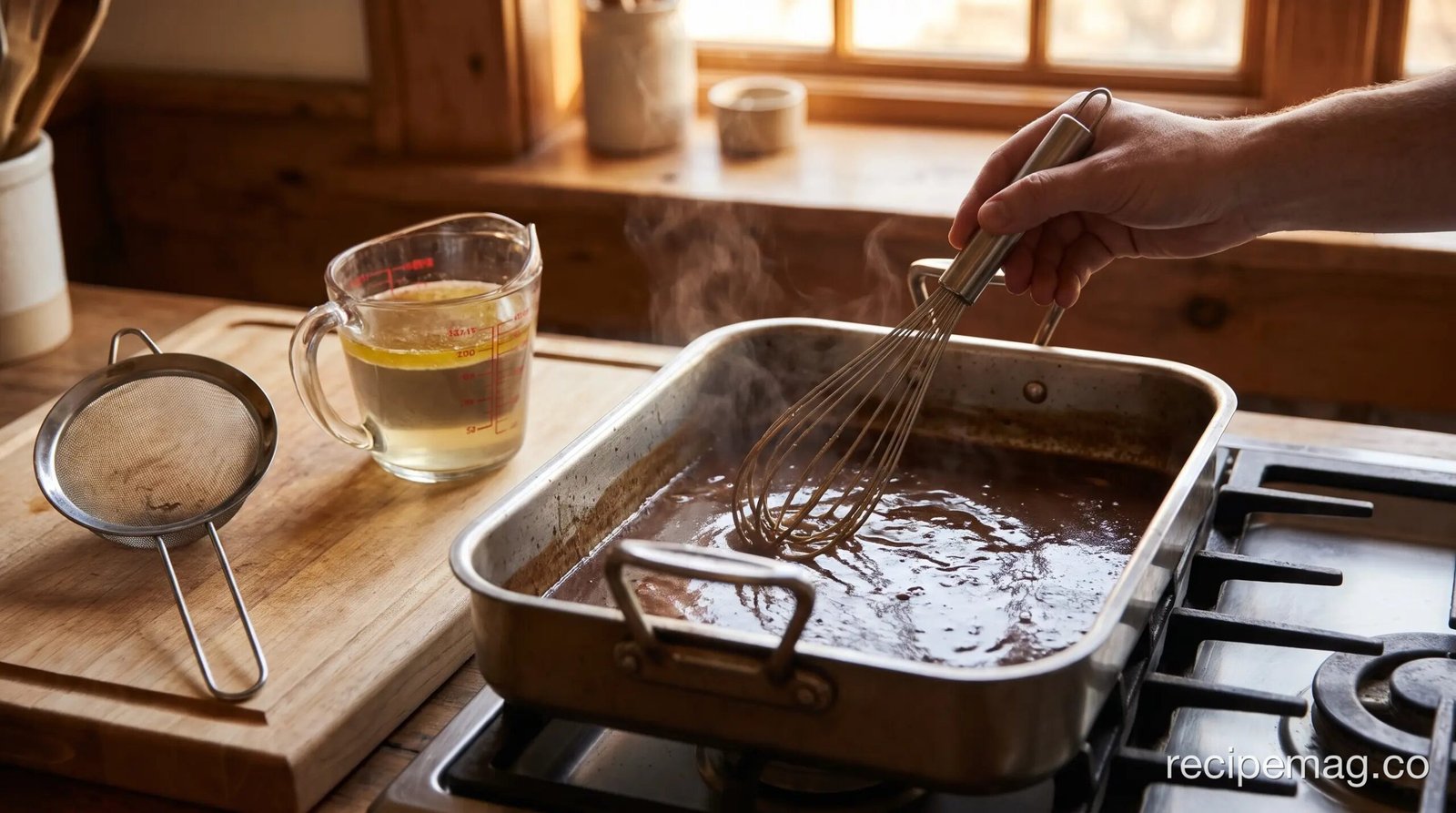
Turkey gravy from pan drippings takes about 20 minutes, and you make it while the turkey rests. USDA FSIS recommends letting a roast turkey stand 20 minutes before carving (USDA FSIS, 2026), which is just enough time to skim the fat, cook a quick roux and whisk in the juices. This recipe makes about 4 cups, enough for 8 to 12 people.
Key Takeaways
- The browned bits in the pan carry more flavor than the liquid, so always deglaze.
- Use 1½ tablespoons each of fat and flour for every cup of liquid.
- Drippings from a brined turkey run salty, so taste first and salt last.
- Refrigerate leftover gravy within 2 hours and use it within 3 to 4 days (USDA FSIS, 2026).
Why Make Gravy from Pan Drippings?
Because the roasting pan holds the most concentrated turkey flavor in the house: juices that dripped, reduced and browned on hot metal. Our make-ahead turkey gravy is a smart backup, but with a turkey in the oven on Thursday, the best gravy is already in the pan.
The liquid isn’t really the prize. Pan juices are mostly water and fat. The flavor lives in the fond, the sticky brown layer glued to the pan, which is why this recipe never skips the deglazing step.
Drippings also vary. In our kitchen, a 14-pound turkey has given us anywhere from 1 cup of juices to 3. So you measure what you have and top up with broth, using our classic herb-butter roast turkey or any other bird.
Ingredients
Makes about 4 cups (8 to 12 servings). Prep: 10 minutes. Cook: 20 to 25 minutes after the turkey comes out, plus 1 to 1½ hours of hands-off broth simmering. Total: about 2 hours, mostly while the turkey roasts.
For the Quick Neck Broth
- Neck, heart and gizzard from the turkey (skip the liver, which turns gravy bitter)
- 5 cups low-sodium chicken or turkey broth, plus more as needed
- 1 small yellow onion, quartered
- 1 celery rib, cut into 3 pieces
- 3 fresh thyme sprigs
- 1 bay leaf
For the Gravy
- Pan drippings from 1 roast turkey (12 to 16 pounds)
- ½ cup dry white wine, apple cider or water, for deglazing
- 6 tablespoons turkey fat, skimmed from the drippings
- Unsalted butter, as needed to make up the fat (up to 6 tablespoons)
- 6 tablespoons all-purpose flour
- 1 teaspoon finely chopped fresh sage
- ½ teaspoon freshly ground black pepper
- Kosher salt, to taste
Equipment: a fine-mesh strainer, a fat separator, a second measuring cup, two saucepans (medium and 3-quart), a whisk and a spatula.
How to Make Turkey Gravy from Drippings, Step by Step
- Start the broth. Once the turkey is in the oven, combine the neck, heart, gizzard, 5 cups broth, onion, celery, thyme and bay leaf in the medium saucepan. Bring to a boil, then simmer gently, partly covered, for 1 to 1½ hours.
- Strain. Strain the broth and return it to the saucepan, adding more broth if needed to make about 4 cups. Keep it warm over low heat. Save the neck and giblets.
- Rest the turkey. When it reads 165°F in the breast, thigh and wing, move it to a board and tent it loosely with foil.
- Pour off the drippings. Strain the pan liquid into the fat separator, leaving the browned bits in the pan. Let it settle 5 minutes so the fat rises.
- Deglaze. Set a stovetop-safe roasting pan over two burners on medium. Add the wine, cider or water and scrape for 1 to 2 minutes, until the browned bits dissolve. Strain it into the drippings.
- Separate the fat. Pour the juices from the separator’s spout into the second measuring cup, stopping at the fat. Put 6 tablespoons of fat in the 3-quart saucepan, making up any shortfall with butter.
- Taste and top up. If the juices taste pleasantly seasoned, add warm neck broth to make 4 cups of liquid. If they’re very salty, use half and make up the rest with broth.
- Cook the roux. Heat the fat over medium heat and whisk in the flour. Cook, whisking constantly, 3 to 5 minutes, until golden brown and nutty.
- Add the liquid slowly. Whisk in about 1 cup of the warm liquid; it will seize into a paste. Keep whisking, adding the rest a cup at a time.
- Simmer and season. Simmer 5 to 8 minutes, whisking often, until it coats a spoon. Stir in the sage and pepper, then add salt to taste. Thin with warm broth if needed.
- Add the giblets (optional). Chop the heart and gizzard, pull the neck meat and stir them in.
- Serve hot. Pour into a warmed gravy boat. Refrigerate leftovers within 2 hours.
How Much Fat, Flour and Liquid Do You Need?
Use 1½ tablespoons each of fat and flour for every cup of liquid. That gives a medium-bodied gravy that coats a spoon. Go to 2 tablespoons each for thick gravy, or 1 for a looser one. Plan on ⅓ to ½ cup per guest.
| Gravy Yield | Fat | Flour | Total Liquid | Serves |
|---|---|---|---|---|
| 2 cups | 3 tbsp | 3 tbsp | 2 cups | 4 to 6 |
| 4 cups | 6 tbsp | 6 tbsp | 4 cups | 8 to 12 |
| 6 cups | 9 tbsp | 9 tbsp | 6 cups | 12 to 18 |
Tips and Fixes for Tricky Drippings
Taste the drippings before measuring, and salt only at the end, since simmering concentrates salt.
- Salty drippings. Wet-brined and dry-brined birds, like our apple cider brined turkey and dry-brined turkey, leave salty juices. Use low-sodium broth, start with half the juices, and never boil the gravy down to thicken it.
- Too salty already? In our experience, simmering a raw potato in it barely helps. Dilution works: more unsalted broth, plus the butter-flour paste below to keep the body.
- Burnt fond. Dark brown is flavor; black and acrid is bitter. If the pan smells burnt, skip deglazing and rely on the neck broth. Next time, keep ½ cup of liquid in the pan.
- Barely any drippings. A turkey breast or spatchcocked bird may leave just a few spoonfuls. Make up the fat with butter and the liquid with broth, and scrape up every bit of fond.
- Too thin. Mash 1 tablespoon soft butter with 1 tablespoon flour, whisk the paste into the simmering gravy and cook 2 minutes.
How Do You Keep Gravy Hot and Store Leftovers?
Keep gravy at 140°F or above on the table, refrigerate it within 2 hours, and use it within 3 to 4 days (USDA FSIS, 2026). Reheat it to a rolling boil, as FSIS advises for sauces and gravies (USDA FSIS, 2026).
- Holding: keep it covered on the lowest burner, or in a small preheated slow cooker on warm. Our Thanksgiving buffet guide covers the rest.
- Fridge: chilled gravy sets almost like jelly. That’s gelatin, and it melts back with heat.
- Freezer: freeze it flat in zip-top bags for up to 3 months for best quality. Food kept at 0°F stays safe indefinitely (USDA FSIS, 2026).
Frequently Asked Questions About Turkey Gravy from Drippings
Can I make gravy right in the roasting pan?
Yes, if the pan is heavy and stovetop-safe. Set it across two burners on medium, deglaze, then make the roux and whisk in the liquid right there. Never put a disposable foil pan on a burner, though. Deglaze it off the heat with warm liquid, then make the gravy in a saucepan.
Do I need a fat separator?
No. Pour the strained drippings into a tall glass measuring cup, wait 5 minutes for the fat to float, and spoon it off. A turkey baster works too: slip the tip under the fat and draw the juices up from below.
How do I make gluten-free turkey gravy?
Skip the roux. Simmer the 4 cups of drippings and broth, then whisk in 3 to 4 tablespoons cornstarch stirred into ⅓ cup cold broth. Cook 1 to 2 minutes, until glossy, and stir in a spoonful of turkey fat. Check that your broth is gluten-free, and serve it fresh.
Why is my gravy lumpy?
Usually the liquid went in too fast for the roux to absorb it. Whisk the first cup in slowly until smooth before adding more. Already lumpy? Pour it through a fine-mesh strainer, pressing with a spoon, or blend it briefly with an immersion blender. The flavor won’t suffer.
Save Every Drop, Then Start Whisking
Pan gravy feels like a last-minute scramble, but it’s a short sequence: strain, deglaze, measure, whisk. Start the neck broth when the turkey goes in, and half the work is done.
On Thursday, set out the strainer, measuring cups and a whisk before the timer goes off. Taste the drippings, salt at the end, and the gravy will be on the table before anyone picks up a carving knife.
