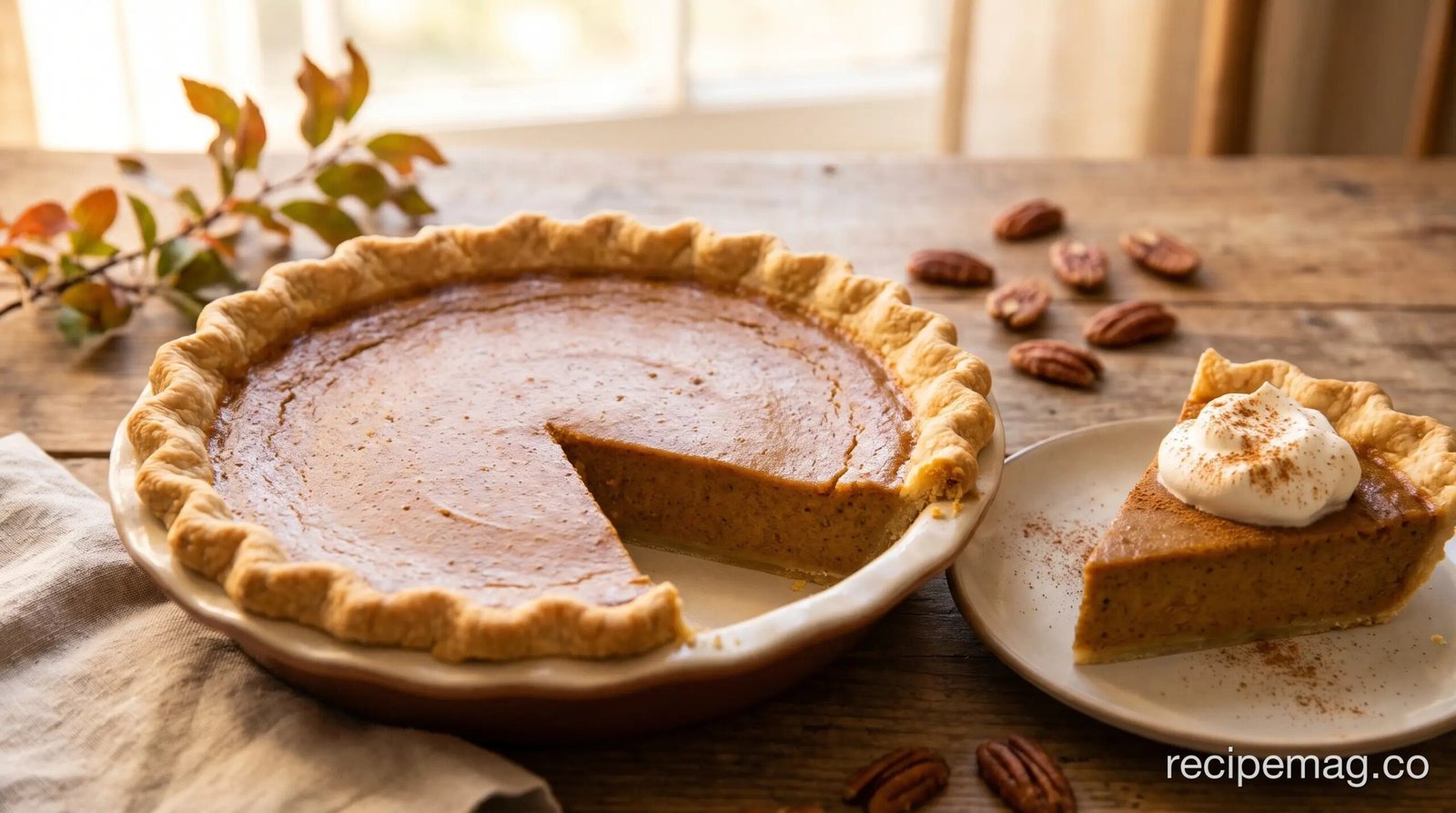
A smooth, crack-free pumpkin pie comes down to a blind-baked crust, a warm filling, and taking the pie out before the custard overcooks. America’s Test Kitchen pulls pumpkin pie when the center reaches 175°F (America’s Test Kitchen, 2026), and that number is the difference between a glossy top and a canyon down the middle. This recipe bakes low at 325°F and can be made two days before Thanksgiving.
Key Takeaways
- Pull the pie at 175°F, while the center still wobbles slightly.
- Cooking the pumpkin with sugar and spices first drives off water and deepens flavor.
- A blind-baked crust and a warm filling prevent a soggy bottom.
- Baked pie keeps 3 to 4 days in the fridge and 1 to 2 months frozen (USDA FoodKeeper, 2026).
Prep Time: 30 minutes | Chill Time: 1 hour 30 minutes | Cook Time: 1 hour 25 minutes | Cooling Time: 3 hours | Total Time: 6 hours 25 minutes | Servings: 8
Why Do Pumpkin Pies Crack?
Pumpkin pie cracks because the custard got too hot. USDA FSIS recommends cooking egg dishes to 160°F (USDA FSIS, 2026), and pumpkin custard sets cleanly a little above that. Push it much further and the egg proteins tighten, squeeze out moisture, and split the surface as it cools.
The fix is gentle heat and an early exit. A 325°F oven cooks the custard evenly, and you take the pie out while the center still trembles. Carryover heat finishes the job. In our experience, most other cracks come from cooling too fast, so skip the cold porch and use a wire rack at room temperature.
Ingredients for Classic Pumpkin Pie
Use canned pure pumpkin puree, not pumpkin pie filling, which is already sweetened and spiced. Illinois grows more pumpkins than any other state, and most of that crop is canned (University of Illinois Extension, 2026). Canned puree is consistent, which is what a custard needs.
For the Crust (one 9-inch deep-dish crust)
- 1¼ cups (160 g) all-purpose flour, plus more for rolling
- 1 tablespoon granulated sugar
- ½ teaspoon fine salt
- ½ cup (1 stick) cold unsalted butter, cut into ½-inch cubes
- 3 to 5 tablespoons ice water
For the Filling
- 1 can (15 oz) pure pumpkin puree
- ½ cup packed dark brown sugar
- ¼ cup granulated sugar
- 1½ teaspoons ground cinnamon
- 1 teaspoon ground ginger
- ¼ teaspoon ground nutmeg
- ⅛ teaspoon ground cloves
- ½ teaspoon fine salt
- ¾ cup heavy cream
- ½ cup whole milk
- 2 large eggs plus 1 large egg yolk
- 1 teaspoon pure vanilla extract
For the Whipped Cream
- 1 cup cold heavy cream
- 1 tablespoon powdered sugar
- ½ teaspoon pure vanilla extract
- Ground cinnamon, for dusting
Equipment: a 9-inch deep-dish pie plate, parchment, pie weights or dried beans, a fine-mesh sieve and an instant-read thermometer.
How to Make Classic Pumpkin Pie
- Make the dough. Whisk the flour, sugar and salt. Cut in the butter until the largest pieces are pea-size. Toss in 3 tablespoons ice water with a fork, adding more a tablespoon at a time until the dough holds when squeezed. Shape into a disk, wrap and refrigerate at least 1 hour.
- Line the pan. Roll the dough on a floured counter into a 12-inch round and ease it into the pie plate without stretching. Trim to a ½-inch overhang, fold under and crimp. Refrigerate 30 minutes.
- Blind-bake. Heat the oven to 375°F with a rack in the lower-middle position. Line the crust with parchment, fill to the top with pie weights, and bake 20 minutes.
- Finish the crust. Remove the parchment and weights. Bake 8 to 10 minutes more, until the bottom looks dry and lightly golden. Lower the oven to 325°F.
- Cook the pumpkin. Meanwhile, combine the pumpkin, both sugars, cinnamon, ginger, nutmeg, cloves and salt in a saucepan. Cook over medium heat, stirring, 5 to 6 minutes, until thick and glossy.
- Add the dairy. Off the heat, whisk in the heavy cream and milk until smooth.
- Temper the eggs. Whisk the eggs, yolk and vanilla in a bowl. Whisk in about 1 cup of the warm pumpkin mixture, then whisk it all back into the saucepan.
- Strain. Press the filling through a fine-mesh sieve into a large measuring cup. This removes fibers and any bits of cooked egg.
- Fill. Set the warm crust on a rimmed baking sheet and pour in the warm filling.
- Bake. Bake at 325°F for 45 to 55 minutes, rotating halfway, until the edges are set, the center 2 inches wobble slightly and the center reads 175°F. Shield the crust edge with foil if it browns too fast.
- Cool. Cool on a wire rack at room temperature for at least 3 hours, until set.
- Whip the cream. Beat the cold cream, powdered sugar and vanilla to soft peaks, 2 to 3 minutes.
- Serve. Slice, top with whipped cream and dust with cinnamon. Refrigerate leftovers within 2 hours.
Cooking the puree first does two jobs: it drives off water, so the custard is denser and less likely to weep, and it blooms the spices. A warm filling in a warm crust also starts setting before it can soak into the dough.
How Far Ahead Can You Make Pumpkin Pie?
You can bake pumpkin pie up to 2 days ahead. The USDA FoodKeeper (2026) puts baked pumpkin pie at 3 to 4 days in the fridge and 1 to 2 months in the freezer. For Thanksgiving on November 26, bake it Tuesday or Wednesday and refrigerate it once completely cool.
- Dough: Refrigerate up to 2 days or freeze about 3 months. Thaw frozen dough overnight in the fridge.
- Filling: Make it a day ahead, refrigerate covered, and rewarm gently before filling the crust.
- Baked pie: Cover loosely and refrigerate. Take it out 30 minutes before serving.
- Freezing: Freeze uncovered until firm, then wrap in plastic and foil. Thaw overnight in the fridge and blot the top.
- Whipped cream: Whip up to 4 hours ahead and rewhisk briefly.
Baking more than one dessert? Our Thanksgiving pie guide has a day-by-day bake schedule, and the Thanksgiving make-ahead guide fits it into the rest of the meal.
Tips for a Smooth, Crack-Free Pumpkin Pie
- Trust the thermometer. Ovens vary. Start checking at 40 minutes and pull the pie at 175°F.
- Don’t skip the strain. Thirty seconds with a sieve is what makes the texture silky.
- Use a deep-dish plate. This filling overflows a standard 9-inch plate. Bake any extra in a ramekin.
- Swap the spices if you like. Replace the four ground spices with 2¾ teaspoons pumpkin pie spice.
Want pumpkin without rolling a crust? Our pumpkin Basque cheesecake bakes in one pan, and its top is meant to look burnished.
Frequently Asked Questions About Pumpkin Pie
How do I know when pumpkin pie is done?
The edges look set and slightly puffed, while the center 2 inches still wobble gently when you nudge the pan. An instant-read thermometer in the center should read about 175°F, the point America’s Test Kitchen recommends (2026). It will look a little underdone, and it finishes setting as it cools on the rack for 3 hours.
Does pumpkin pie need to be refrigerated?
Yes. It’s an egg and milk custard, so refrigerate it once cooled. USDA FSIS advises against leaving perishable food at room temperature for more than 2 hours (2026). Refrigerated pumpkin pie keeps 3 to 4 days, according to the USDA FoodKeeper, and it freezes for 1 to 2 months if you want to bake it earlier.
Can I use fresh pumpkin instead of canned?
Yes, but use a small sugar pumpkin, not a carving pumpkin. Roast the halves at 400°F until very tender, puree them, then drain the puree in a cheesecloth-lined sieve until it’s as thick as canned. You’ll need 1¾ cups. Fresh puree is wetter and less consistent, so cooking it with the sugar matters even more.
Why did my pie crack if I didn’t overbake it?
Cooling too fast is the usual cause. A hot pie moved to a cold spot contracts quickly and splits, so cool it on a rack at room temperature, away from open windows and doors. If a small crack still appears, whipped cream covers it, and the flavor is exactly the same.
Bake It Wednesday, Relax Thursday
This pumpkin pie is classic on purpose: warm spices, silky custard, crisp buttery crust. The method makes it reliable. Blind-bake, cook and strain the filling, bake low, and pull it at 175°F.
Make the dough this weekend and bake the pie on Wednesday, November 25. On Thursday, all that’s left is whipping the cream. For the rest of the menu, start with our Thanksgiving dinner planning guide.
