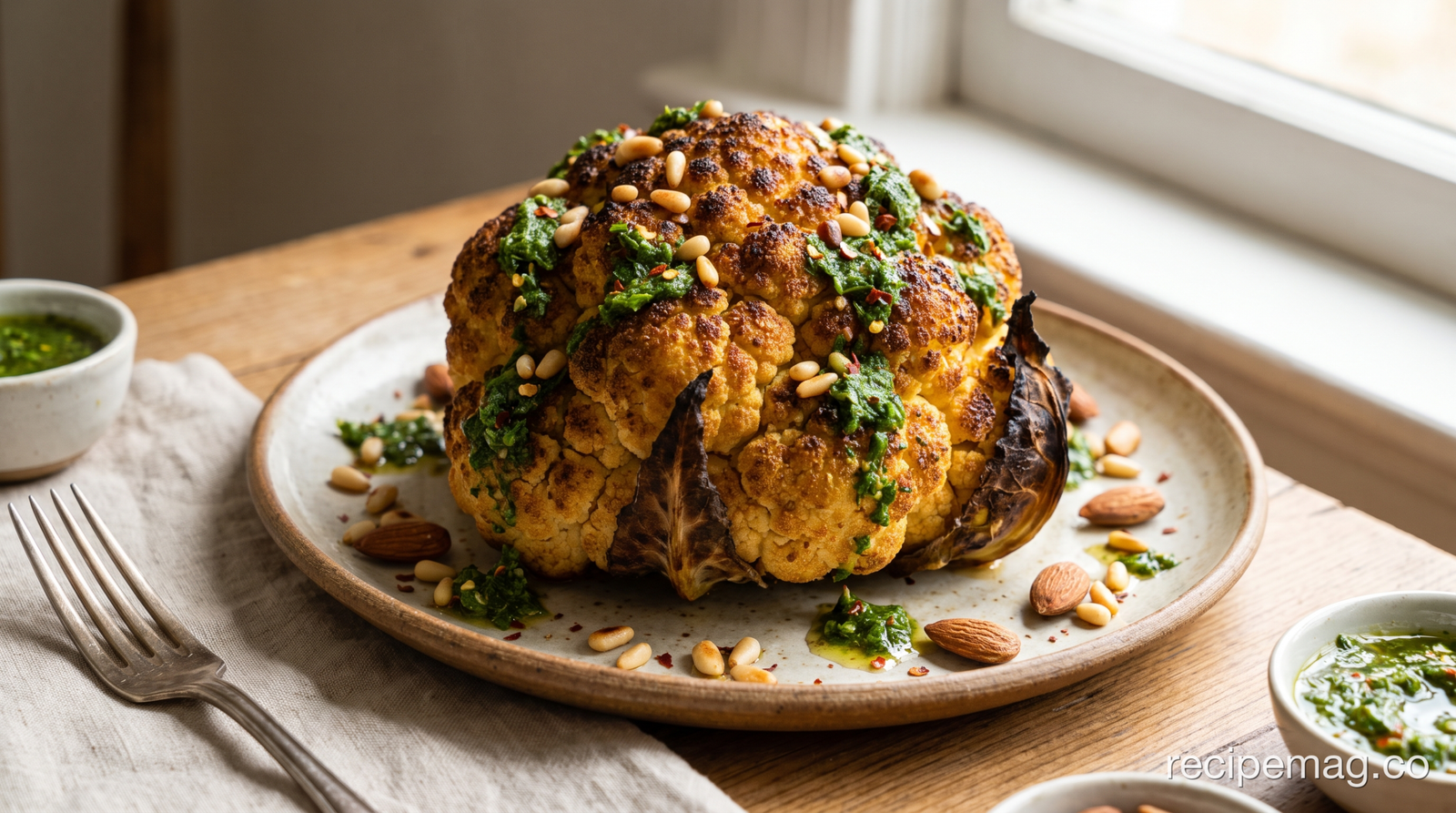
A whole roasted cauliflower is the cheapest impressive thing you can put on a table. The technique that makes it work is parboiling before roasting: a head roasted from raw browns on the outside long before the dense core is tender, and you end up with a charred exterior around a raw middle. Ten minutes in boiling salted water fixes the timing completely and seasons it through at the same time.
Key Takeaways
- Parboil 10 minutes in heavily salted water before roasting; this is the whole technique.
- Salt the water like pasta water — it seasons all the way through.
- Roast hot, 425°F, for real browning rather than pale beige.
- Cauliflower browns through the Maillard reaction, which needs a dry surface.
- Serves 4 as a main, 6 as a side, and costs a fraction of any roast.
Ingredients
Serves 4 as a main. Active time 20 minutes. Total time 1 hour 10 minutes.
- 1 large cauliflower, about 2.5 lbs, leaves trimmed
- 1/4 cup kosher salt, for the water
- 3 tbsp olive oil
- 1 tsp ground cumin
- 1 tsp smoked paprika
- 1/2 tsp black pepper
For the herb sauce:
- 1 cup packed parsley
- 1/2 cup packed mint or cilantro
- 2 tbsp capers, rinsed
- 1 garlic clove
- 1/2 cup olive oil
- 2 tbsp lemon juice
- 1/2 tsp kosher salt
To finish: toasted almonds or pine nuts, pomegranate seeds, and a spoonful of yoghurt.
How to Make It
1. Parboil. Bring a large pot of water to a boil and add the quarter cup of salt; it should taste like seawater. Lower the whole cauliflower in, stem down, and simmer 10 minutes. A knife should meet moderate resistance at the core, not slide in freely.
2. Drain and dry. Lift it out carefully and set it stem down on a rack to drain for 10 minutes. Then pat it thoroughly dry, including into the crevices. Surface water prevents browning, so this step decides the colour of the finished dish.
3. Season. Heat the oven to 425°F. Mix the olive oil with the cumin, smoked paprika, and pepper, and brush it all over the head, working some down between the florets.
4. Roast. Place stem down in a cast-iron pan or on a lined sheet and roast 40 to 45 minutes, until deeply browned, almost mahogany in places, and a knife slides into the core with no resistance. If it is browning too fast, tent it with foil for the last ten minutes.
5. Make the sauce. Blend all the sauce ingredients until it is a coarse, vivid green. Leave some texture; this is a salsa verde, not a purée.
6. Serve. Rest 5 minutes, then spoon the herb sauce over, scatter nuts and pomegranate, and add a spoonful of yoghurt on the plate. Cut into wedges at the table.
Why It Browns and Why It Matters
Cauliflower is roughly 92 percent water, and that water has to leave the surface before any browning can begin. Until it does, the surface cannot rise above 212°F, which is well below the temperature at which the Maillard reaction produces the nutty, savoury compounds that make roasted cauliflower taste completely unlike boiled cauliflower.
That gives you three practical rules. Dry the surface thoroughly. Use a hot oven, 425°F rather than 375°F. And do not cover it, which traps steam and guarantees a pale result.
The parboil looks like it contradicts this, but it does not. It cooks the core, and the subsequent draining and drying removes the surface water it added. What you are buying is the ability to roast hot without burning the outside.
Deep browning is not cosmetic. A cauliflower pulled at pale gold tastes noticeably flatter than one taken to mahogany, and the extra ten minutes is where most of the flavour lives.
Variations and Serving
Whipped feta base. Spread whipped feta on the platter and set the cauliflower on top. Our whipped feta dip works exactly as written.
Harissa. Replace the spice rub with two tablespoons of harissa mixed into the oil for a North African version.
Tahini instead of herbs. A lemon-tahini sauce is the Middle Eastern route, and it suits the smoked paprika particularly well.
Parmesan. Scatter grated parmesan over the head for the final ten minutes for a savoury crust.
Serve it as a vegetarian main with bread and a grain, or as a side with roast meat. It also pairs well with charred broccolini on a vegetable-forward table, and the herb sauce is essentially the same idea as the one in our green goddess roast chicken.
Leftovers keep three days, and cold roasted cauliflower chopped into a grain bowl is genuinely better than it sounds.
Serving It as a Centrepiece
A whole cauliflower reads as an occasion dish in a way that florets never do, and presenting it properly costs nothing.
Bring it to the table whole and cut it there. The reveal is most of the effect, and wedges cut in front of people look far better than anything you can arrange in the kitchen. A serrated knife handles it best; press straight down through the stem rather than sawing sideways.
Build the plate in layers. Sauce or whipped cheese on the platter first, cauliflower on top, then the herb sauce, then the crunchy and sharp elements. Nuts and pomegranate go on last so they stay distinct rather than sinking into the sauce.
Portion realistically. A 2.5 lb head serves four as a main with a grain and bread alongside, or six as a side. If it is genuinely the centre of the meal for more than four, roast two heads rather than one very large one; oversized cauliflowers cook unevenly no matter how long you parboil them.
It also holds well, which is unusual for a roast. It is good hot, very good warm, and perfectly acceptable at room temperature, so it can come out of the oven twenty minutes before people sit down without any penalty.
Frequently Asked Questions
Do I have to parboil the cauliflower?
For a whole head, effectively yes. Without it the outside burns before the dense core cooks. Florets cut small can go straight into a hot oven.
Why so much salt in the boiling water?
It is the only opportunity to season the interior. Most of the salt stays in the water; what penetrates is what makes the inside taste of something.
How do I know when it is done?
A knife or skewer should slide into the core with no resistance, and the exterior should be deeply browned. Pale cauliflower is underdone in flavour even if it is cooked through.
Can I prepare it ahead?
Parboil and dry it up to a day ahead and refrigerate. Bring it to room temperature, season, and roast when you need it.
What can I do with the leaves and stem?
Both are edible and good. Toss the leaves in oil and roast them alongside until crisp; chop the stem and roast it with the head or save it for soup.
Can I make this in an air fryer?
A small head, yes. Parboil as directed, then cook at 375°F for about 25 minutes, checking often, as the exterior browns much faster in the confined space.
