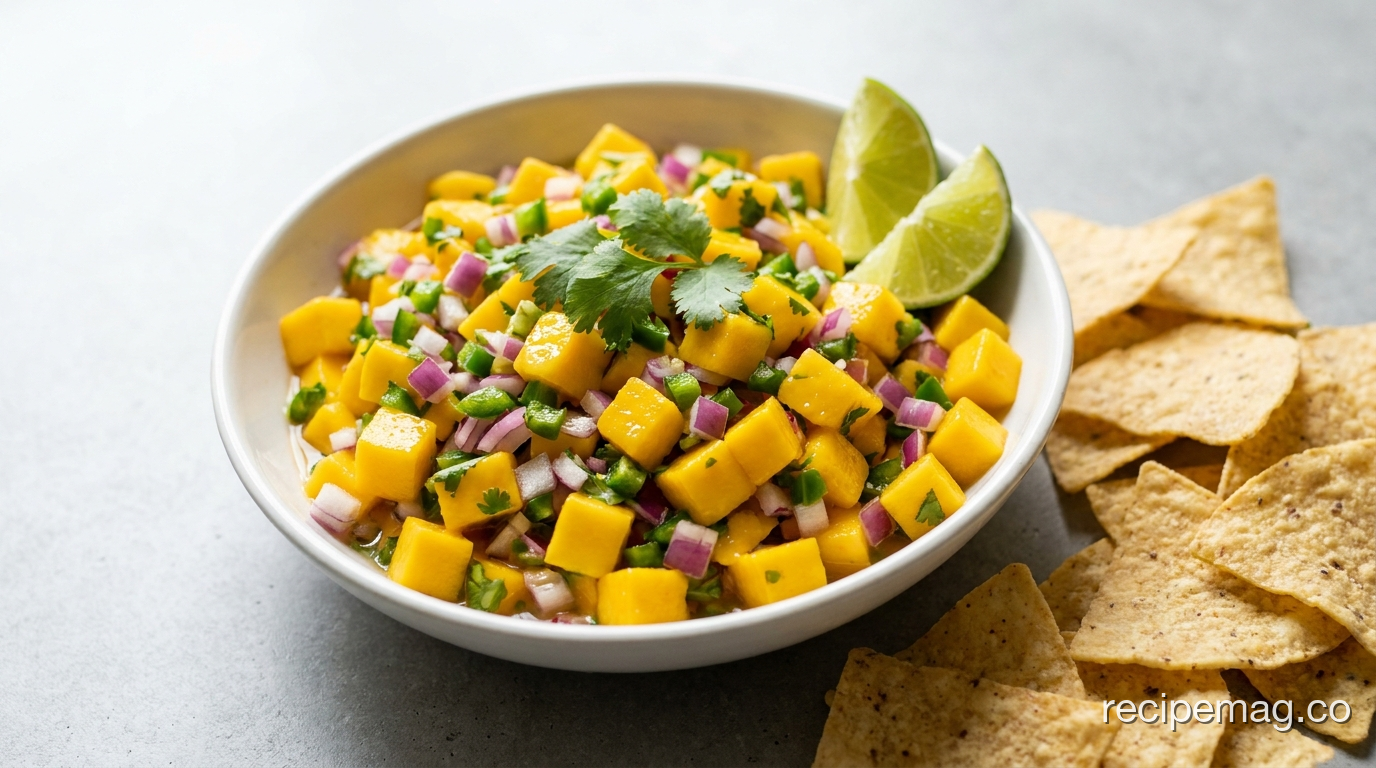
Mango pico de gallo is a fresh, no-cook salsa that swaps in ripe mango for a sweet-and-spicy twist on the classic. It takes about 15 minutes, no heat, and just one bowl. Mango is one of the most consumed fruits on the planet, with global production topping 55 million metric tons a year (FAO, 2022). Dice everything small, toss with lime and salt, and let it rest ten minutes before serving.
Key Takeaways
- Ready in 15 minutes with no cooking and one bowl.
- Ripe mango adds sweetness that balances the jalapeño’s heat and the lime’s acidity.
- A single cup of mango delivers about 67% of your daily vitamin C. ([USDA FoodData Central](https://fdc.nal.usda.gov), 2023)
- Let it rest 10 minutes so the salt draws out juices and the flavors meld.
- Great on fish tacos, grilled chicken, chips, or a spoon straight from the bowl.
Why Does Mango Pico de Gallo Work So Well?
The magic of this salsa is balance. Ripe mango brings sweetness that softens the jalapeño’s bite, while lime and salt keep it from tasting like dessert. Beyond flavor, mango is genuinely good for you: one cup provides about 67% of the daily recommended vitamin C (USDA FoodData Central, 2023). It’s a salsa that tastes indulgent but reads as fresh.
Texture matters as much as taste here. When you dice everything to a uniform, small size, each scoop delivers a bit of soft mango, crisp onion, juicy tomato, and a whisper of chili. That consistency is what separates a great pico from a sloppy one. Take a minute with your knife and the whole thing comes together.
[PERSONAL EXPERIENCE] We’ve made this dozens of times across a summer of testing, and the biggest lesson is patience with the mango. An underripe mango is starchy and sour and no amount of lime fixes it. A properly ripe mango, one that yields gently like a ripe avocado, transforms the entire bowl.
What Ingredients Do You Need?
Every ingredient here is fresh and raw, which means quality is everything. There’s nowhere for a mealy mango or a watery tomato to hide. The University of California, Davis notes that Ataulfo (honey) mangoes have smoother, less fibrous flesh than the common Tommy Atkins variety, making them ideal for dicing into salsa (UC Davis Postharvest Technology Center, 2022). Pick the ripest fruit you can find.
The Ingredient List
- 2 ripe mangoes, peeled and diced small (about 2 cups)
- 1 cup diced ripe tomato (Roma works well; seed it first)
- ½ cup finely diced red onion
- 1 jalapeño, seeded and minced (leave seeds in for more heat)
- ⅓ cup chopped fresh cilantro
- Juice of 2 limes (about 3 tablespoons)
- ½ teaspoon fine salt, plus more to taste
- Optional: 1 diced avocado, or a pinch of Tajín for the rim
A quick note on the onion. Red onion looks beautiful and tastes milder than yellow, but if raw onion bothers you, soak the diced pieces in cold water for five minutes and drain. That rinses away the harsh sulfur compounds while keeping the crunch. It’s a small step that makes the salsa friendlier to sensitive palates.
How Do You Cut a Mango for Salsa?
Cutting a mango intimidates people, but it’s simple once you know where the pit sits. The pit is a large, flat oval running lengthwise through the center. Slice down each side of it to free two rounded “cheeks,” then handle those. Getting this right gives you clean cubes instead of a mangled, juicy mess, and it’s the step that most affects your final texture.
Step-by-Step
- Stand the mango upright on its stem end and find the narrow profile. The pit is widest in that direction.
- Slice down both sides of the pit, about a quarter inch off center, to create two cheeks.
- Score each cheek in a grid, cutting down to the skin but not through it.
- Push the skin inward so the cubes pop outward, then slice them off into your bowl.
- Trim the flesh from around the pit and dice any remaining pieces.
Aim for cubes around a quarter inch. Any larger and the mango dominates every bite; any smaller and it turns to mush when tossed with lime. Uniform pieces across every ingredient is the goal, so match your tomato and onion dice to the mango.
How Do You Make Mango Pico de Gallo?
Assembly is almost too easy. There’s no cooking, no blending, and no special equipment beyond a knife and a bowl. The only real technique is the resting step, which lets the salt pull juices out of the produce and marry the flavors. Skip it and the salsa tastes like separate ingredients sitting next to each other rather than one cohesive thing.
Instructions
- Combine the produce. Add diced mango, tomato, red onion, jalapeño, and cilantro to a medium bowl.
- Dress it. Squeeze in the lime juice and sprinkle the salt over the top.
- Toss gently. Fold everything together with a spoon, taking care not to crush the mango.
- Rest 10 minutes. Let it sit at room temperature so the flavors meld and the salt draws out the juices.
- Taste and adjust. Add more salt, lime, or jalapeño until it sings. Fold in avocado last if using.
[UNIQUE INSIGHT] Most recipes tell you to serve pico immediately, but mango pico is the exception. A 10 to 20 minute rest genuinely improves it, because mango’s sugars and lime’s acid need a few minutes to balance. Beyond about an hour, though, the tomato weeps and the mango softens, so make it the same day you serve it and don’t prep it too far ahead.
What Do You Serve With Mango Pico de Gallo?
This salsa is a natural partner for anything mild and rich. Its sweet-tart brightness cuts through fatty or lean proteins alike, which is why fruit salsas keep showing up on restaurant menus year after year (National Restaurant Association, 2023). Spoon it over fish tacos, pile it on grilled chicken, or just set it beside a bowl of chips.
Best Pairings
- Grilled fish tacos: the classic match. Mango and white fish were made for each other.
- Grilled chicken or shrimp: spoon it on warm off the grill.
- Tortilla chips: serve as a fresh alternative to standard salsa.
- Pork carnitas or grilled pork chops: the sweetness offsets the richness.
- Grain bowls and salads: use it as a bright, chunky dressing.
Tips for the Best Mango Pico de Gallo
A few small habits take this salsa from good to unforgettable. Most come down to ingredient ripeness and dicing discipline, the two things that raw salsas live and die by. Here’s what we’ve learned makes the biggest difference.
- Use truly ripe mango. It should give to gentle pressure and smell sweet at the stem. Ripen firm mangoes on the counter for a few days first.
- Seed the tomato. Removing the watery seeds keeps the salsa from turning soupy.
- Control the heat. Seed the jalapeño for mild, leave the seeds and ribs for a real kick, or swap in serrano for more punch.
- Salt in stages. Add half the salt at first, then adjust after resting, since flavors shift as juices release.
- Add avocado last. Fold it in gently right before serving so it doesn’t brown or turn to paste.
Mango Pico de Gallo
Prep Time: 15 minutes | Rest Time: 10 minutes | Serves: 6 (about 4 cups)
Ingredients
- 2 ripe mangoes, peeled and diced small (about 2 cups)
- 1 cup diced ripe Roma tomato, seeded
- ½ cup finely diced red onion
- 1 jalapeño, seeded and minced
- ⅓ cup chopped fresh cilantro
- Juice of 2 limes (about 3 tablespoons)
- ½ teaspoon fine salt, plus more to taste
- Optional: 1 diced avocado or a pinch of Tajín
Instructions
- Dice the mangoes, tomato, and red onion to a uniform quarter-inch size. Mince the jalapeño and chop the cilantro.
- Combine all the produce in a medium bowl.
- Squeeze in the lime juice and add the salt. Fold together gently to avoid crushing the mango.
- Let rest at room temperature for 10 minutes so the flavors meld.
- Taste and adjust with more salt, lime, or jalapeño. Fold in avocado last if using. Serve the same day.
Notes
- Store leftovers covered in the fridge for up to 1 day. The texture softens over time.
- For less raw onion bite, soak the diced onion in cold water for 5 minutes, then drain.
- Swap serrano for jalapeño for more heat, or add a pinch of Tajín for a tangy, chili-lime edge.
Frequently Asked Questions About Mango Pico de Gallo
How long does mango pico de gallo last?
It’s best the day you make it. Stored covered in the refrigerator, it keeps for about 1 day before the tomato weeps and the mango softens. The USDA recommends keeping fresh cut produce at or below 40°F and using it promptly. For the freshest texture and brightest flavor, make it a few hours before serving rather than the day before.
Can I make mango pico de gallo ahead of time?
You can dice the components a few hours ahead and store them separately, then combine with lime and salt about 30 minutes before serving. Avoid mixing everything the night before, since the salt and acid soften the produce over time. A short rest of 10 to 20 minutes improves the flavor, but many hours in the fridge dulls the fresh crunch.
How do I pick a ripe mango?
Squeeze gently rather than judging by color, since mango varieties differ widely in skin tone. A ripe mango yields slightly to pressure, much like a ripe avocado, and smells sweet and floral near the stem. Ataulfo (honey) mangoes turn deep golden and wrinkle slightly when ready. If your mango is firm, ripen it on the counter for two to four days.
Is mango pico de gallo spicy?
It’s as spicy as you make it. Seeding the jalapeño keeps it mild and family-friendly, since most of the heat lives in the seeds and white ribs. Leave them in, or swap in a serrano, for a noticeable kick. The mango’s sweetness naturally balances the chili, so even the spicier version stays approachable rather than overwhelming.
What can I use instead of cilantro?
If cilantro tastes soapy to you, a genetic trait affecting a meaningful share of people, swap in flat-leaf parsley for a clean, herbal note, or fresh mint for a brighter twist that pairs beautifully with mango. You can also leave the herb out entirely. The salsa still works on the strength of its mango, lime, onion, and chili.
Make a Bowl This Weekend
Mango pico de gallo is the kind of recipe that earns a permanent spot in your summer rotation. It takes 15 minutes, needs no cooking, and turns a stack of tacos or a bowl of chips into something people remember. The only skill required is a sharp knife and a ripe mango.
Start with the base recipe, then make it yours: more heat, a scoop of avocado, a dusting of Tajín on the rim. Once you’ve made it a couple of times, you’ll stop measuring and start eyeballing, which is exactly how a good salsa should be.
Grab two ripe mangoes on your next grocery run and give it a try. It might just become the thing your friends ask you to bring to every cookout.
