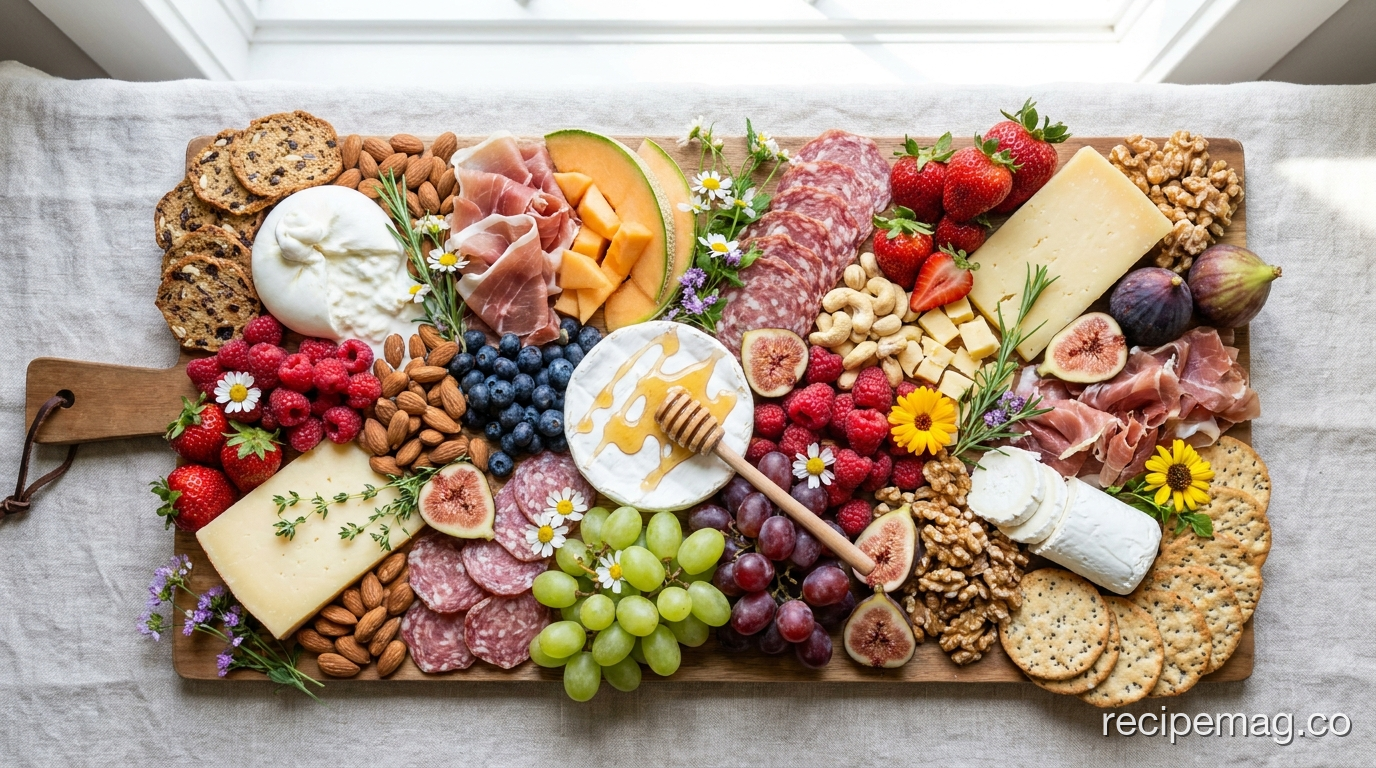
To build the perfect summer grazing board, start with a 3-2-1 framework: three cheeses, two proteins, and one anchoring spread, then fill the gaps with peak-season fruit and crunch. Plan roughly 2 ounces of cheese and 2 ounces of cured meat per person for a snack board, per USDA serving guidance (2023). Build it cold, build it generous, and let summer produce carry the color.
Key Takeaways
- Use the 3-2-1 ratio: three cheeses, two cured meats, one spread, then layer in fruit, crunch, and something briny.
- Budget about 2 oz of cheese and 2 oz of meat per guest for grazing, more if the board is the meal.
- Assemble in order: bowls first, cheese second, meat third, produce and fillers last.
- Serve cheese at room temperature; the FDA limits perishable boards to 2 hours out, 1 hour above 90°F.
- Swap stone fruit, figs, and berries by month to keep the board at peak flavor all summer.
What Goes on a Summer Grazing Board?
A great summer grazing board balances six building blocks: cheese, cured meat, fresh fruit, crunch, something briny, and a spread. The USDA counts roughly 2 ounces as one cheese serving, which makes a clean per-guest measuring stick (USDA MyPlate, 2023). Get the categories right and the rest is just arrangement.
The 3-2-1 Core
Three cheeses give range without crowding the board. Pick one soft (brie or a fresh goat cheese), one firm and aged (cheddar, manchego, or gruyere), and one with character (blue, or a peppered chevre). Two cured meats are plenty: a thin, delicate one like prosciutto and a firmer salami you can fan into rows. One spread, honey, fig jam, or a stone-fruit preserve, ties the sweet and savory sides together.
The Summer Fillers
This is where the season shows up. Fresh figs, halved apricots, cherries, blueberries, and torn peaches bring color no plastic garnish can match. Add crunch with toasted almonds, crackers, and a torn baguette. Finish with something briny, like marinated olives or cornichons, to cut the richness. The goal is contrast in every bite: creamy against crisp, sweet against salty.
How Much Food Do You Need Per Person?
Portioning is the part most people get wrong, usually by under-buying. As a snack before dinner, plan about 2 ounces of cheese and 2 ounces of meat per guest, in line with USDA serving sizes (2023). If the board is the meal, double it to 4 to 6 ounces of each, and lean harder on bread and fruit to fill plates.
Here’s a quick build for common group sizes. Round up rather than down; leftovers keep, but a bare board mid-party does not.
| Guests | Cheese | Cured Meat | Fruit | Crackers/Bread |
|---|---|---|---|---|
| 4 (snack) | 8 oz | 8 oz | 2 cups | 1 sleeve + ½ baguette |
| 8 (snack) | 1 lb | 1 lb | 4 cups | 2 sleeves + 1 baguette |
| 8 (meal) | 2 lb | 1.5 lb | 6 cups | 3 sleeves + 2 baguettes |
| 12 (snack) | 1.5 lb | 1.5 lb | 6 cups | 3 sleeves + 2 baguettes |
How Do You Assemble a Grazing Board Step by Step?
Assembly order matters more than artistry. Work from anchors outward and the board almost arranges itself. The whole process takes about 15 minutes once your ingredients are prepped, and the layered approach keeps the board looking full as guests dig in.
- Place the bowls first. Set small dishes for olives, jam, and honey on the board before anything else. They anchor the layout and stop loose items from rolling.
- Add the cheeses. Space your three cheeses in a triangle across the board. Pre-slice the firm cheese, wedge the soft one, and leave the blue whole with a knife.
- Arrange the meats. Fold prosciutto into loose ribbons (flat slices look limp) and fan the salami into overlapping rows or a simple rosette.
- Build with fruit. Cluster cherries, halved figs, and apricots in the open spaces. Group by color and type rather than scattering.
- Fill every gap. Tuck crackers, almonds, and torn baguette into remaining space. A board should look abundant, with no bare wood showing.
- Garnish last. A few sprigs of fresh mint or basil add color and a summer scent. Add them right before serving so they stay perky.
The One Rule That Changes Everything
[PERSONAL EXPERIENCE] We’ve built hundreds of these boards, and the single best habit is to overfill on purpose. A board that looks 20% too full at the start looks perfect after ten minutes of grazing. The most common mistake is spacing items out evenly across bare wood, which reads as sparse the moment guests start eating.
How Do You Keep a Summer Board Food-Safe in the Heat?
Heat is the real enemy of a summer board. The FDA warns that perishable foods left above 40°F should be discarded after two hours, and after just one hour once it tops 90°F (FDA, 2023). For an outdoor July party, treat one hour as your limit and plan to refresh the board rather than leave it out all afternoon.
A few tricks buy you time. Build on a chilled platter, or nest your board over a hidden sheet pan of ice for soft cheeses. Better yet, split your ingredients in half: put one board out, keep the backup in the fridge, and swap them when the first goes warm. This keeps everything fresh without a single sad, sweating wedge of brie.
Cheese flavor, though, needs warmth. Pull cheeses from the fridge 30 to 45 minutes before serving so they soften and open up. The balance is simple: cheese tastes best near room temperature, but the clock starts the moment it leaves the fridge. Serve, enjoy, and don’t let it linger.
What Are the Best Seasonal Swaps Through Summer?
The fastest way to keep a board exciting all season is to swap the fruit by month. USDA harvest calendars show cherries peaking in June, peaches and plums hitting their stride in July and August, and figs arriving late summer (USDA AMS, 2023). Match the board to the calendar and you’re always serving fruit at its best.
June: Berries and Cherries
Early summer leans bright and tart. Pile on strawberries, dark cherries, and the first blueberries. Pair them with fresh goat cheese and honey, and lean on prosciutto, whose salt plays beautifully against tart fruit. A handful of sugar snap peas adds an unexpected, crisp green note.
July: Stone Fruit Peak
This is the board’s golden month. Torn peaches, halved apricots, and red plums bring jammy sweetness that loves a sharp aged cheddar or manchego. Swap in a spicy soppressata, and trade honey for a peach or apricot preserve. Grilled peach halves, cooled, are a standout addition here.
August: Figs and Melon
Late summer turns lush. Fresh figs, cubed watermelon, and the last of the plums shine alongside creamy blue cheese and salty serrano. A drizzle of balsamic glaze over the figs adds depth. [UNIQUE INSIGHT] Most boards treat melon as a garnish, but a slab of feta with cubed watermelon and torn mint turns a corner of the board into a full salad, and it’s usually the first thing to vanish.
Frequently Asked Questions About Summer Grazing Boards
How far in advance can I make a grazing board?
You can prep components up to a day ahead, but assemble within an hour of serving. Slice firm cheeses, portion meats, and wash fruit the night before, then store each separately in the fridge. Cut fruit like peaches and figs is best done the day of, since it browns and softens quickly once exposed to air.
What is the best board to use for grazing?
Any food-safe surface works: a wooden cutting board, a marble slab, or even a parchment-lined sheet pan for big crowds. Marble has one advantage in summer, it stays cool and helps soft cheese hold its shape. Whatever you use, size up. A board that looks slightly too large is easier to fill generously than one that’s crowded.
How do I keep cheese from sweating outdoors?
Serve cheese in smaller portions and replenish from a chilled backup rather than putting everything out at once. Nesting the board over a hidden tray of ice helps soft cheeses, and shade is your friend. Per FDA guidance, anything perishable should come off the table within an hour once it’s above 90°F, so plan to swap rather than leave it out.
What can I use instead of meat for a vegetarian board?
Marinated artichoke hearts, roasted red peppers, herbed white beans, and grilled halloumi all deliver the salty, savory weight that cured meat usually provides. Add extra crunch with spiced nuts and seeded crackers, and bump up the cheese to three or four varieties. A vegetarian board can be just as generous; it simply leans harder on briny and roasted elements.
How many cheeses should a grazing board have?
Three is the sweet spot for most boards: one soft, one firm and aged, and one bold like blue. Three gives guests range without overwhelming the layout or your budget. For a large party of 12 or more, four works, but past that you’re better off building a second board than crowding a single one.
Build Your First Board This Weekend
A summer grazing board is the easiest impressive thing you can make, because the season does most of the work. Peak fruit, good cheese, and a few thin slices of cured meat need almost nothing from you beyond smart arrangement. Start with the 3-2-1 core, fill every gap, and let the colors of July fruit do the talking.
Keep the practical rules close. About 2 ounces each of cheese and meat per guest, bowls and cheese placed first, fruit and fillers last. Pull cheese out early so it softens, and watch the clock once the board hits a warm patio. Swap the fruit as the months turn, and the same board never feels the same twice.
Grab a board this weekend, hit the farmers market, and build one. The first one teaches you more than any guide can, and by the second you’ll be improvising swaps of your own. That’s the whole point: a generous, colorful spread that brings people around the table on a warm evening.
