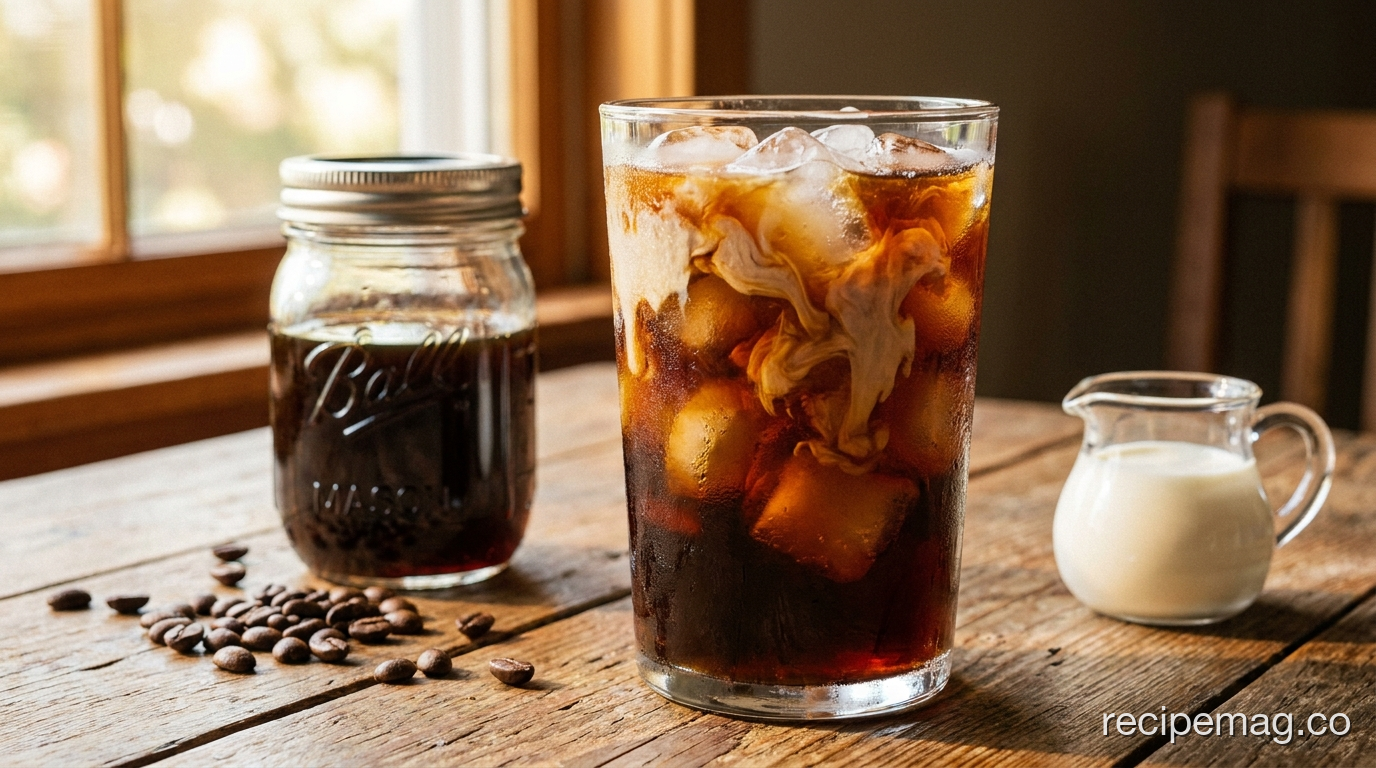
Cold brew coffee at home comes down to four things: a coarse grind, roughly a 1:8 coffee-to-water ratio for concentrate, a 12 to 18 hour steep at room temperature or in the fridge, and proper dilution before you drink it. Steeping cold instead of hot pulls out far less acid, which is why cold brew tastes smoother and gentler on the stomach. One batch of concentrate keeps for about two weeks refrigerated. Cold brew now accounts for a meaningful share of iced coffee sales, with the U.S. cold brew market valued in the billions and still climbing (Grand View Research, 2023).
Key Takeaways
- Use a coarse grind and a 1:8 coffee-to-water ratio to make a concentrate you dilute later.
- Steep 12 to 18 hours at room temperature or in the fridge, then strain.
- Cold brew is lower in acidity than hot brew because cold water extracts fewer acidic compounds. ([Thomas Jefferson University](https://www.jefferson.edu), 2018)
- Dilute concentrate roughly 1:1 with water or milk before drinking.
- Stored as concentrate in a sealed container, cold brew keeps about 2 weeks in the fridge.
What Is Cold Brew Coffee, and How Is It Different From Iced Coffee?
Cold brew and iced coffee are not the same drink. Cold brew steeps coarse grounds in cold or room-temperature water for many hours, with no heat at any stage. Iced coffee is simply hot-brewed coffee poured over ice. That single difference, heat versus no heat, changes the flavor completely. A chemistry study from Thomas Jefferson University found that cold brew is generally lower in acidity than hot brew, because cold water extracts fewer acidic compounds (Thomas Jefferson University, 2018).
The result is a coffee that tastes smoother, sweeter, and rounder. Hot water extracts acids and bitter notes fast. Cold water works slowly and selectively, so it pulls sugars and pleasant aromatics while leaving much of the sharp acidity behind. People who find regular coffee too harsh on their stomach often tolerate cold brew far better.
There’s also a texture difference. Cold brew tends to feel fuller and a little syrupy, especially as a concentrate. Iced coffee, by contrast, can taste thin or watered down as the ice melts. That’s why so many home coffee drinkers switch over once summer hits.
What Grind, Ratio, and Steep Time Should You Use?
Three variables decide whether your cold brew is great or muddy: grind, ratio, and time. Get them right and the method is nearly foolproof. The Specialty Coffee Association notes that grind size is one of the most influential factors controlling extraction across every brewing method (Specialty Coffee Association, 2023). For cold brew, that means going coarse on purpose.
Grind: Go Coarse
Use a coarse grind, roughly the texture of raw sugar or coarse sea salt. Fine grounds over-extract during a long steep and turn the brew bitter and silty. Coarse grounds extract slowly and evenly, which is exactly what you want over 12 to 18 hours. They also strain out far more cleanly, leaving less sediment in your final concentrate.
Ratio: Aim for 1:8 for Concentrate
For a concentrate, use about 1 part coffee to 8 parts water by weight. A practical starting point is 1 cup of coarse grounds to roughly 4 cups of water. This makes a strong base you’ll dilute later. Prefer ready-to-drink cold brew instead? Use a gentler ratio closer to 1:15 and skip the dilution step entirely.
Steep Time: 12 to 18 Hours
Steep for 12 to 18 hours. Shorter steeps taste weak and underdeveloped. Push much past 18 to 20 hours and you risk over-extraction, with woody, bitter notes creeping in. Room temperature steeping runs faster, so aim for the lower end, around 12 to 14 hours. Fridge steeping is slower and gentler, so lean toward 16 to 18 hours.
What Equipment Do You Need to Make Cold Brew at Home?
You don’t need anything fancy to make excellent cold brew. A large jar and a way to strain are genuinely enough. Cold brew’s popularity has driven a wave of dedicated home gear, with cold brew consistently ranking among the fastest-growing coffee categories tracked by the National Coffee Association (National Coffee Association, 2023). Still, the simplest setup works just as well as a purpose-built maker.
The Bare Minimum
- A large jar or pitcher. A 1-quart or 2-quart mason jar is ideal. It seals, fits in the fridge, and is easy to clean.
- A fine strainer plus a filter. A fine-mesh sieve lined with a coffee filter, cheesecloth, or a clean kitchen towel catches the grounds and most of the sediment.
- A second container. You’ll strain the finished concentrate into a clean jar for storage.
Optional Upgrades
- A dedicated cold brew maker. Most include a built-in mesh filter basket you lift straight out, which makes straining nearly effortless.
- A burr grinder. Grinding fresh and coarse, right before steeping, noticeably improves flavor over pre-ground coffee.
- A kitchen scale. Weighing coffee and water gives you a repeatable ratio every single time, which is how you dial in your perfect batch.
[PERSONAL EXPERIENCE] We’ve made cold brew dozens of ways, and the humble mason-jar-and-sieve method holds up against every dedicated gadget we’ve tried. The one upgrade that genuinely changed our results was a burr grinder. Pre-ground coffee is almost always too fine for cold brew, and that single switch cleaned up the cloudiness and bitterness more than any special maker did.
How Do You Make Cold Brew Coffee Step by Step?
The process is mostly waiting. Active hands-on time is under ten minutes; the rest is patience. According to the National Coffee Association, cold brew and other cold coffee drinks have driven much of the recent growth in U.S. coffee consumption, especially among younger drinkers (National Coffee Association, 2023). Once you see how easy this is, store-bought bottles start to feel overpriced.
Step-by-Step Instructions
- Grind coarse. Grind 1 cup of coffee beans to a coarse texture, like raw sugar. If using pre-ground, choose the coarsest available.
- Combine coffee and water. Add the grounds to your jar, then pour in 4 cups of cold, filtered water. Stir gently to make sure every ground is fully saturated.
- Cover and steep. Seal the jar. Leave it on the counter for 12 to 14 hours, or in the fridge for 16 to 18 hours.
- Strain once. Pour the mixture through a fine-mesh sieve to remove the bulk of the grounds.
- Strain again. Run it through a coffee filter, cheesecloth, or clean towel to catch the fine sediment. Don’t squeeze the grounds; let it drip to keep the brew clean.
- Store the concentrate. Pour the finished concentrate into a clean, sealed jar and refrigerate.
How Do You Dilute and Serve Cold Brew Concentrate?
Concentrate is too strong to drink straight, and that’s by design. Diluting lets you control strength every single time. A roughly 1:1 mix of concentrate to water or milk is the standard starting point, and you adjust from there to taste. Cold brew’s smoother, less acidic profile is exactly why it pairs so well with milk and simple syrups without turning sour (Thomas Jefferson University, 2018).
Basic Dilution
- Standard: Mix 1 part concentrate to 1 part water or milk, then pour over ice.
- Stronger: Use 2 parts concentrate to 1 part water if you want a bigger kick.
- Lighter: Use 1 part concentrate to 2 parts water for an easygoing afternoon glass.
[UNIQUE INSIGHT] Here’s something most guides skip: ice is also dilution. If you fill a glass with ice and pour concentrate straight over it, the melt will water it down within minutes, leaving you with weak, sad coffee. We dilute the concentrate first with cold water or milk, then pour it over ice. Your last sip tastes as good as your first.
Serving Ideas
- Classic iced. Diluted concentrate over ice with a splash of milk or cream.
- Sweetened. Stir in simple syrup rather than granulated sugar, which won’t dissolve in cold liquid.
- Cold brew latte. Equal parts concentrate and cold milk over ice, no water at all.
How Long Does Cold Brew Last, and How Should You Store It?
Cold brew keeps remarkably well, which is part of its appeal for batch brewing. Stored as an undiluted concentrate in a sealed container in the fridge, it stays fresh for about two weeks. The FDA recommends keeping the refrigerator at or below 40°F to slow microbial growth and keep prepared foods and beverages safe for longer (FDA, 2023). At that temperature, a single Sunday batch can cover most of two weeks.
- Store as concentrate. Undiluted concentrate lasts longest, roughly 2 weeks refrigerated in a sealed jar.
- Dilute per glass. Once you add water or milk, drink it within a few days. Diluted cold brew loses brightness faster than concentrate.
- Keep it sealed. An airtight container preserves flavor and keeps the brew from picking up fridge odors.
- Freeze for later. Pour concentrate into an ice cube tray and freeze. Coffee ice cubes chill your glass without watering it down.
- Trust your senses. If it smells sour or off, or tastes flat and stale, it’s done. Start a fresh batch.
What Are the Best Cold Brew Variations to Try?
Once you’ve nailed the base recipe, cold brew becomes a playground. The same concentrate adapts to dozens of drinks with almost no extra effort. Cold coffee beverages have been one of the strongest growth areas in the coffee market, a trend the National Coffee Association links directly to consumers experimenting at home (National Coffee Association, 2023). These variations all start from the concentrate you already made.
Vanilla Cold Brew
Add a small splash of vanilla extract or a spoonful of vanilla simple syrup to your diluted glass. The vanilla rounds out cold brew’s natural sweetness and softens any lingering edge. It’s the easiest upgrade in this whole list.
Cold Brew Latte
Skip the water and dilute the concentrate with cold milk instead, about 1:1. Whole milk or oat milk both add body and a creamy finish. Pour over ice and you have a coffee-shop drink for a fraction of the price.
Spiced Cold Brew
Add a cinnamon stick or a few cardamom pods to the jar before steeping. The spices infuse slowly alongside the coffee over the long steep, giving the finished concentrate a warm, aromatic depth that pairs beautifully with milk.
Cold Brew Tonic
Pour concentrate over ice and top with tonic water for a fizzy, slightly bitter, refreshing drink. A squeeze of orange or lemon brightens it further. It sounds odd, then becomes a summer favorite fast.
Frequently Asked Questions About Cold Brew Coffee at Home
Is cold brew stronger than regular coffee?
Cold brew concentrate is much stronger than regular coffee before you dilute it, thanks to that 1:8 ratio. Once diluted to drinking strength, caffeine content lands in a similar range to regular coffee, though it varies with how heavily you dilute. The bigger difference is acidity: cold brew tastes smoother and less sharp because cold water extracts fewer acidic compounds during the long steep.
Why is my cold brew bitter or sour?
Bitterness usually comes from a grind that’s too fine or a steep that ran too long. Both cause over-extraction. Switch to a coarse grind and keep your steep under 18 to 20 hours. Sourness, on the other hand, often signals an under-extracted or aging batch. If a properly made brew tastes sour after a week or more, it’s likely past its prime, so start fresh.
Can I make cold brew with pre-ground coffee?
Yes, but choose the coarsest grind available, and know that most pre-ground coffee is milled for drip machines, which is too fine for cold brew. Finer grounds make a cloudier, more bitter, sediment-heavy result. It will still work in a pinch. For the cleanest, smoothest cup, though, grinding your own beans coarse right before steeping makes a clear difference.
Do I steep cold brew at room temperature or in the fridge?
Both work well; they just need different timing. Room temperature steeping is faster, so 12 to 14 hours is plenty. Fridge steeping is slower and gentler, so aim for 16 to 18 hours. Room temperature tends to produce a slightly bolder, fuller extraction, while fridge steeping yields a cleaner, more delicate flavor. Try both and see which one suits your taste.
How much caffeine is in homemade cold brew?
It depends entirely on your ratio and dilution. Concentrate is highly caffeinated because of the strong 1:8 brew. Once you dilute it to drinking strength, an 8-ounce serving lands roughly in the range of a standard cup of coffee, often somewhere around 100 to 200 milligrams. If you’re watching your intake, dilute a little more heavily or use less concentrate per glass.
Start Your First Batch Tonight
Cold brew rewards almost no effort with a genuinely better glass of summer coffee. Grind coarse, use a 1:8 ratio for concentrate, steep 12 to 18 hours, strain twice, and refrigerate. That’s the whole method. The first batch you make will likely cost less than a single bottle from the store.
The beauty of it is the head start. Brew a jar of concentrate on Sunday and you’ve got smooth, low-acid coffee ready for the better part of two weeks. Dilute it your way, add milk or vanilla or tonic, and freeze the leftovers into coffee ice cubes.
Set a jar going before bed tonight. By tomorrow afternoon, you’ll have homemade cold brew waiting in the fridge, and you may never reach for the store-bought version again.
