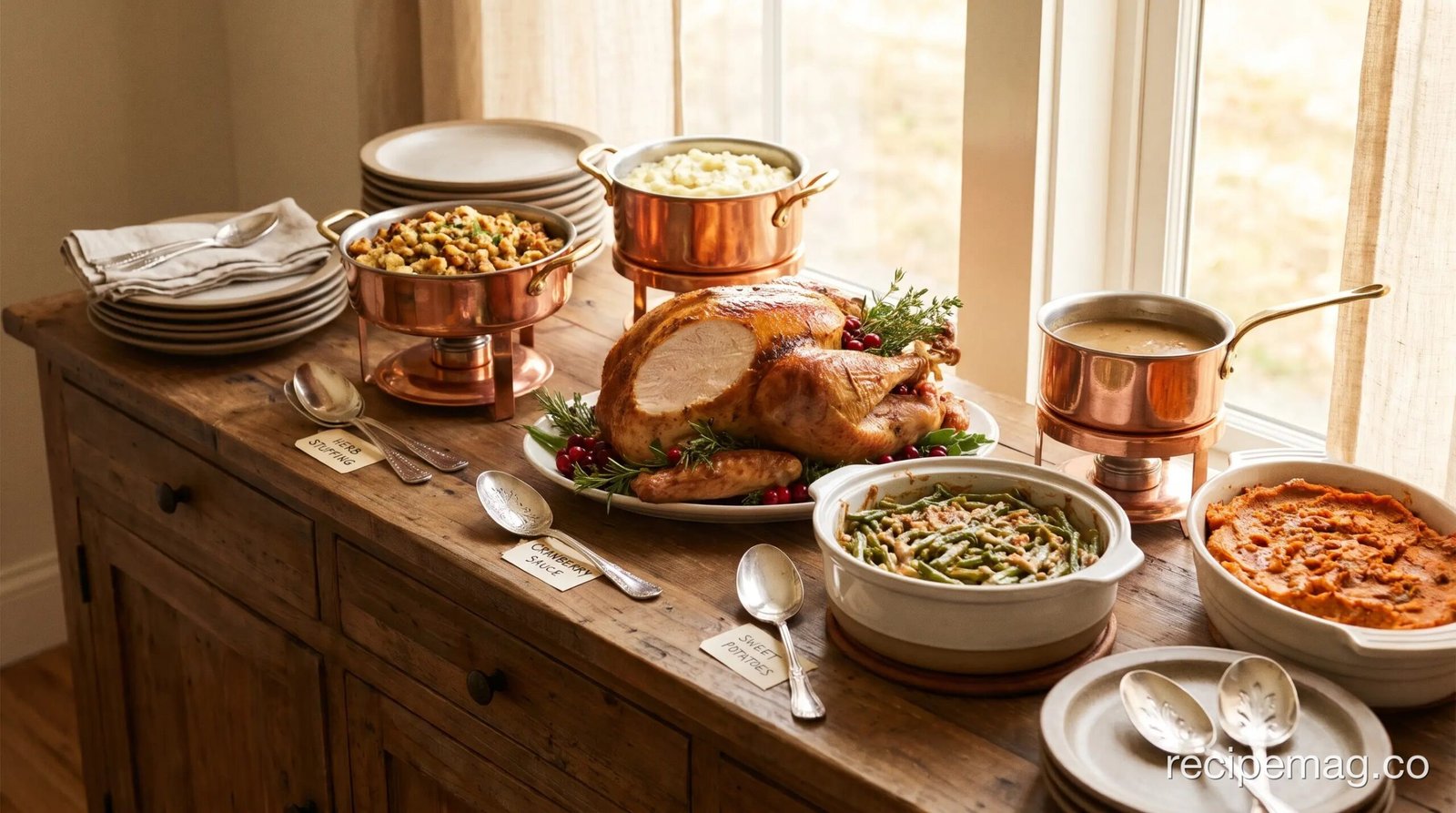
A Thanksgiving buffet works when the line moves in one direction, hot dishes stay at 140°F or above, cold dishes stay at 40°F or below, and nothing sits out longer than 2 hours. That last rule matters more than most hosts realize: USDA FSIS says bacteria can double in as little as 20 minutes between 40°F and 140°F (USDA FSIS, 2026). Here’s how to lay out the table, hold every dish at a safe temperature and time the whole spread.
Key Takeaways
- Run the line in eating order: plates first, then the turkey, sides and gravy, with napkins and cutlery at the very end.
- Hold hot food at 140°F or above, and reheat it to 165°F before it goes into a slow cooker (USDA FSIS, 2026).
- Keep cold dishes at 40°F or below by setting them in ice and refilling small bowls from the fridge.
- Clear perishable food within 2 hours, or 1 hour if the room tops 90°F.
How Should You Lay Out a Thanksgiving Buffet?
Lay the food out in the order people build a plate, from plates at the start to cutlery at the end, so nobody doubles back. Pick a spot where a line can form without blocking the kitchen, ideally near an outlet. For roughly 20 or more guests, pull the table off the wall and set the same dishes down both sides. Two lines move about twice as fast as one.
The Order That Keeps the Line Moving
- Plates. Stack 10 or 12 at a time, with more nearby.
- The turkey and any second main. Carved ahead, with tongs. Nobody should carve in line.
- Starches. Mashed potatoes, stuffing, mac and cheese.
- Hot vegetables and casseroles. Green beans, Brussels sprouts, sweet potato casserole.
- Gravy. Last of the hot dishes, so it lands on top of everything.
- Cold sides. Cranberry sauce and salads, set in ice.
- Rolls and butter. Bread sits on top of a full plate.
- Napkins and cutlery. Last, so both hands stay free for serving spoons.
Put drinks on a separate table across the room. In our experience, a drink station at the end of the food line stalls everyone behind it. Dessert comes later, once the savory food is cleared.
Height is the cheapest way to add space. Cake stands or sturdy boxes under the tablecloth lift rolls and cold platters, leaving the flat surface for heavy hot dishes. Give each dish its own serving utensil and a small plate to rest it on. Shared spoons carry food, and allergens, from dish to dish.
Label Every Dish
A folded card with the dish name and a short “contains” line answers questions before guests ask them. The FDA recognizes nine major food allergens, including milk, eggs, wheat, peanuts, tree nuts and sesame, so flag those first, plus hidden meat like sausage in the stuffing. Hosting a potluck? Our Friendsgiving potluck plan covers the rest of the organizing.
How Do You Keep Buffet Food Hot and Safe?
Keep hot food at 140°F or warmer. USDA FSIS points to chafing dishes, preheated steam tables, warming trays and slow cookers, or an oven set hot enough to hold that temperature (USDA FSIS, 2026). Holding gear keeps hot food hot, but it can’t heat lukewarm food quickly enough, so everything goes in hot.
Reheat First, Then Hold
FSIS doesn’t recommend reheating leftovers in a slow cooker, since food can linger in the danger zone on the way up. Reheat it on the stove, in the microwave or in the oven to 165°F, then move it to a preheated slow cooker to stay at 140°F or above (USDA FSIS, 2026).
The turkey’s rest is your reheating window: USDA FSIS recommends letting a roast turkey stand 20 minutes before carving (USDA FSIS, 2026). Our hour-by-hour Thanksgiving Day timeline and Thanksgiving oven schedule show how to fit the reheating around one oven.
Slow Cookers, Warming Trays and Chafing Dishes
- Slow cookers suit soft sides like mashed potatoes, gravy and mac and cheese. Preheat on low, add the hot food, then switch to warm, stirring every 30 minutes.
- Warming trays handle casseroles in their baking dishes. Keep foil on top between rushes.
- Chafing dishes need hot water in the pan and fuel lit about 15 minutes ahead. Buy enough fuel for the whole meal, and keep the flames away from napkins and garlands.
- Outlets are the hidden limit. Several slow cookers on one circuit can trip a breaker, so spread them out and tape down cords that cross a walkway.
Keep the Turkey Hot and Juicy
Carved turkey dries out fast. Carve it close to serving, fan the slices into a warmed baking dish, ladle about ½ cup of hot broth over them and cover with foil. Set the dish on a warming tray. Our step-by-step guide to carving a turkey covers the knife work.
No room in the oven? We preheat a clean cooler with hot tap water for 10 minutes, drain it, line it with towels and pack covered casseroles inside. It makes a good hot box while the rolls bake; just check it with a thermometer.
How Do You Keep Cold Dishes Cold on a Buffet?
Keep cold food at 40°F or colder, which on a buffet usually means a bed of ice. It’s the same line the FDA sets for your refrigerator (FDA, 2026). A bowl of cranberry sauce parked beside a chafing dish warms up faster than you’d think, so cold food needs a plan of its own.
- Set bowls in ice. Put each serving bowl inside a larger bowl or rimmed tray of crushed ice, and pour off meltwater as it collects.
- Serve small, refill often. Put out half the salad or deviled eggs and keep the rest in the fridge.
- Give cold food its own zone. Group it at the far end of the line or on a small side table.
- Know what’s perishable. Dips, dressed salads, deviled eggs, whipped cream and custard pies like pumpkin all need cold holding.
Placement matters as much as ice. A row of chafing burners and slow cookers gives off real heat, and whatever sits beside them pays for it. In our kitchen, moving the cold dishes just a few feet away kept them colder than doubling the ice ever did.
How Long Can Thanksgiving Food Sit Out?
No more than 2 hours at room temperature, or 1 hour if the room is above 90°F (USDA FSIS, 2026). Start the clock when the dish leaves the oven or fridge, not when everyone sits down. Food held at 140°F or above, or on ice at 40°F or below, stays out of the danger zone.
Check instead of assuming: if a hot dish reads below 140°F, reheat it to 165°F or pull it. When in doubt, throw it out.
Three Habits That Make the 2-Hour Rule Easy
- Write the time down. A sticky note on each dish (“out at 3:05”) ends the guessing.
- Swap, don’t top off. Bring out a fresh dish rather than adding new food to old, which inherits the old food’s clock.
- Set an alarm. A phone timer for 2 hours after serving tells you when to clear.
Buffet Holding Cheat Sheet
| Dish | Hold At | Best Way to Hold |
|---|---|---|
| Carved turkey | 140°F or above | Warm covered dish with hot broth, on a warming tray |
| Fully cooked ham | Reheat to 140°F, then hold at 140°F or above | Covered dish on a warming tray |
| Mashed potatoes, stuffing, casseroles | 140°F or above | Slow cooker, chafing dish or warming tray, after reheating to 165°F |
| Gravy | 140°F or above | Small slow cooker or lowest burner, after a rolling boil |
| Cranberry sauce, salads, deviled eggs | 40°F or below | Set in ice, refilled from the fridge |
| Rolls and bread | Room temperature | Basket under a clean towel |
The reheating targets come from the federal safe minimum temperature chart: 165°F for leftovers and casseroles, and 140°F for reheating a fully cooked ham packaged in a USDA-inspected plant (FoodSafety.gov, 2026).
The Thanksgiving Buffet Equipment Checklist
The one tool you can’t skip is an instant-read thermometer, because every buffet rule is a temperature: 165°F to reheat, 140°F to hold hot and 40°F to hold cold. Our meat thermometer guide explains which types read fast enough. The rest can be borrowed.
- Slow cookers, one per soft side (tape a name on borrowed ones)
- A warming tray, or chafing dishes with fuel and a long lighter
- A bag or two of ice, plus large bowls or rimmed trays
- One serving utensil per dish, with spoon rests
- Risers, such as cake stands or boxes under the tablecloth
- Folded cards and a marker for labels
- Plates and napkins for about 1½ times your guest count
- A power strip or heavy-duty extension cord rated for the load
- Shallow containers, foil and zip-top bags for leftovers
Clearing the Buffet: Leftovers Within 2 Hours
Get leftovers into the fridge within 2 hours, packed in shallow containers, and eat them within 3 to 4 days (USDA FSIS, 2026). Reheat them to 165°F, and bring gravy to a rolling boil. Anything that sat out past the 2-hour mark goes in the trash, not a container.
- Strip the turkey. Carve the remaining meat off the bones so it cools fast, and save the bones for stock.
- Go shallow. Split big batches into containers about 2 inches deep.
- Freeze the extras. Food kept frozen at 0°F stays safe indefinitely, according to USDA FSIS (2026), though quality is best within a few months.
- Pack take-home plates from the fridge, not from a table that’s been out all evening.
Frequently Asked Questions About a Thanksgiving Buffet
How do you keep mashed potatoes warm for a buffet?
Reheat them on the stove or in the microwave until they reach 165°F, then move them into a slow cooker preheated on low and switch it to warm. USDA FSIS recommends that order, since a slow cooker shouldn’t do the reheating. Stir every 30 minutes, loosen with a splash of hot milk, and keep them at 140°F or above.
How long can turkey sit out after carving?
No more than 2 hours at room temperature, or 1 hour if the room is above 90°F, per USDA FSIS. Holding the slices at 140°F or above, in a covered dish with a little hot broth on a warming tray, keeps them safe and moist for longer.
Do I need chafing dishes for a Thanksgiving buffet?
No. Slow cookers, a warming tray and a low oven handle most home buffets, and many casseroles can stay in their baking dishes. Chafing dishes help when you have more hot dishes than outlets, or when the buffet sits far from the kitchen. Keep their flames away from napkins and decorations.
How do I keep a buffet line from backing up?
Carve the turkey ahead, give every dish its own serving spoon, and put cutlery at the end of the line. Move drinks to a separate station. For about 20 or more guests, pull the table from the wall and mirror the dishes down both sides.
Sketch Your Buffet Tonight
The best buffet plan fits on an index card. Draw the table, write each dish in eating order, and mark which ones need a slow cooker, a warming tray or a bowl of ice. You’ll spot a missing outlet or serving spoon days before it matters.
Then stick three numbers on the fridge: 165°F to reheat, 140°F to hold hot and 40°F to hold cold. Set a 2-hour alarm when the food goes out, and the safety side takes care of itself. Then enjoy the meal.
