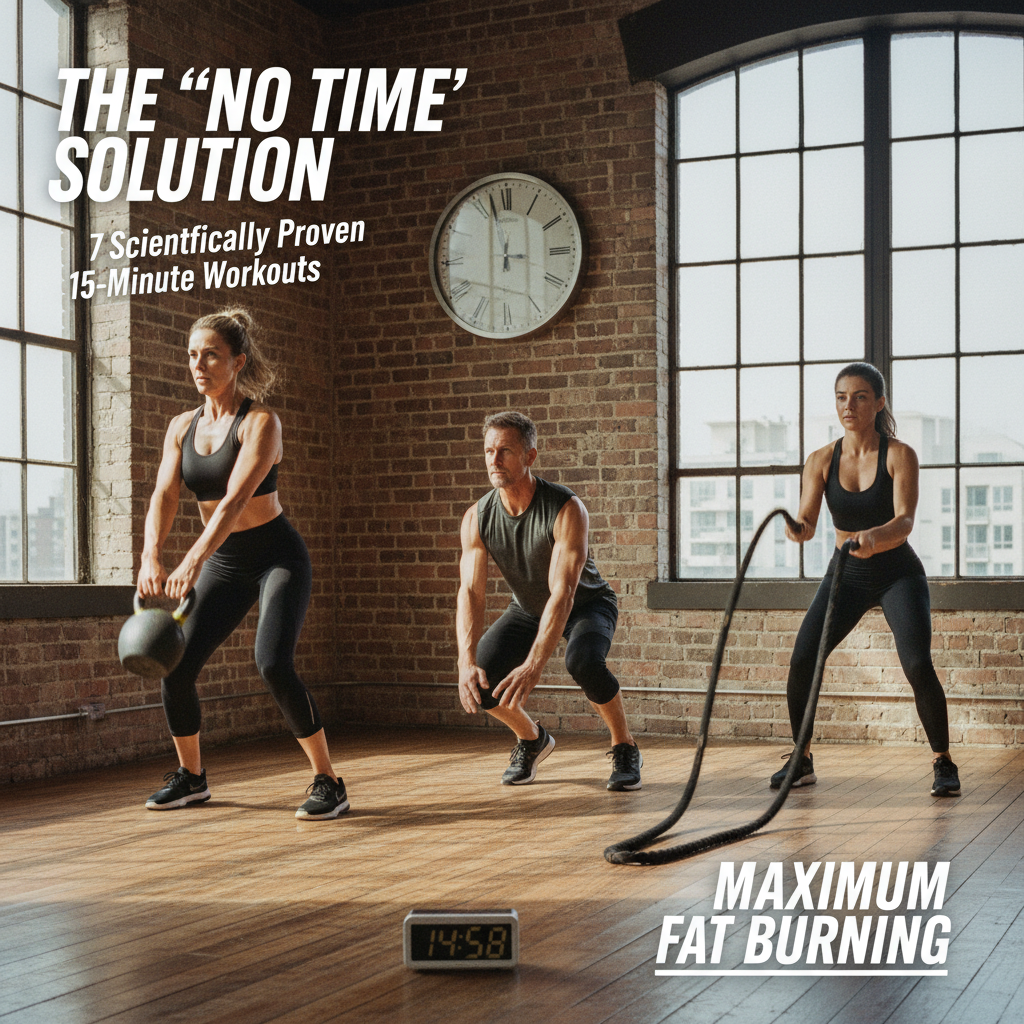
Introduction: The ‘No Time’ Solution for Sustainable Fat Loss
The most effective way to burn fat when short on time is to utilize high-intensity interval training (HIIT) and metabolic resistance training (MRT). These protocols condense the benefits of hour-long gym sessions into 15 minutes by elevating your heart rate to 80-95% of its maximum capacity. By prioritizing intensity over duration, you trigger a physiological response known as EPOC (Excess Post-exercise Oxygen Consumption), which forces your body to burn calories at an accelerated rate for up to 24 hours after the workout ends.
Modern life often makes finding 60 minutes for the gym impossible, leading many to abandon exercise entirely. However, research confirms that micro-workouts are not just a compromise; they are a potent solution for fat loss. This guide breaks down exactly how to leverage intensity to maximize caloric expenditure in minimum time.
Direct Answer: How to Burn Maximum Fat in 15 Minutes
Burning maximum fat in a quarter of an hour requires a shift from “calorie counting” during the workout to “metabolic disturbance” for the hours following it. To achieve this, you must eliminate passive rest and focus on compound movements that recruit the largest muscle groups simultaneously.
The secret lies in performing work at a threshold where your body cannot intake oxygen fast enough to fuel the activity aerobically. This creates an oxygen deficit. The following sections define the specific methodologies and biological mechanisms that make this possible.
The Definition: Metabolic Resistance Training & HIIT
- Metabolic Resistance Training (MRT) and High-Intensity Interval Training (HIIT)* are the gold standards for short-duration fat loss. While traditional cardio is aerobic (using oxygen for fuel), these methods are largely anaerobic.
- HIIT: Involves short bursts of near-maximal effort cardio (like sprinting) followed by brief rest periods.
- MRT: Applies the same interval concept to weight lifting. You use moderate weights with high reps and minimal rest to keep the heart rate elevated while damaging muscle fibers for growth.
The Mechanism: Triggering the EPOC ‘Afterburn’ Effect
The primary driver of fat loss in 15-minute workouts is EPOC, often referred to as the “afterburn effect.” When you push your body into an anaerobic state, you deplete its energy stores and disrupt its homeostasis more severely than steady-state cardio does.
To return to a resting state, your body must work overtime to replenish oxygen, repair muscle tissue, and flush out lactate. This recovery process requires energy. Consequently, your metabolic rate remains elevated for hours, burning fat long after you have left the shower.
Key Takeaways: 3 Pillars of Effective Short Workouts
Not all 15-minute workouts are created equal. To ensure you are stimulating fat loss rather than just moving around, your session must be built on three specific pillars. Without these, a short workout will not provide sufficient stimulus for body composition changes.
[GRAPH: A bar chart comparing “Traditional Cardio” vs “15-Min HIIT”, showing Traditional Cardio burning more calories during exercise, but HIIT burning significantly more total calories over a 24-hour period due to EPOC.]
- Uncompromising Intensity: You cannot coast. Because the duration is short, the effort must be near-maximal. You should be unable to hold a conversation.
- Compound Movements: Isolation exercises like bicep curls are inefficient here. You must use multi-joint movements (squats, pushups, burpees) that engage the entire body to maximize caloric demand.
- Incomplete Rest: Rest periods are strictly controlled. They should be just long enough to catch your breath, but short enough that your heart rate never fully recovers until the workout is over.
The Science: Why 15 Minutes is Enough for Weight Loss
Skeptics often argue that 15 minutes isn’t enough to burn a significant number of calories. While true that a 15-minute walk burns negligible energy, 15 minutes of metabolic conditioning operates on a different mathematical and hormonal plane.
The science supports the concept that density of work (work done per unit of time) is a better predictor of fat loss than the total duration of the session.
Intensity vs. Duration: The Caloric Math
In a standard hour-long weightlifting session, you might spend 40 minutes sitting on a bench resting. In a 15-minute metabolic workout, you are moving for roughly 12 to 13 of those minutes.
Studies have shown that high-intensity intervals can burn up to 15-20 calories per minute. A 15-minute session can burn 200-300 “active” calories. However, when you factor in the EPOC effect, the total caloric expenditure can increase by an additional 15-25% over the next day, rivaling the total burn of a 45-minute jog.
Hormonal Benefits: Boosting HGH and Managing Cortisol
Short, intense workouts optimize your hormonal environment for fat loss better than long-duration cardio. Long sessions of steady-state cardio can elevate cortisol, a stress hormone that encourages muscle breakdown and belly fat storage.
Conversely, 15-minute high-intensity bursts have been shown to stimulate the production of Human Growth Hormone (HGH). HGH is vital for lipolysis (fat burning) and muscle preservation. This dual effect helps you keep lean muscle—the engine of your metabolism—while stripping away fat.
The 7 Scientifically Proven 15-Minute Workouts
These workouts are designed to require minimal equipment and maximum effort. Choose one based on your available equipment and current fitness level. Always use a timer.
Workout 1: The Classic Tabata Protocol (20/10 Split)
- Tabata* is the most famous HIIT protocol. It consists of 20 seconds of all-out work followed by 10 seconds of rest. A standard Tabata is 4 minutes, so we will stack four rounds to hit our time frame.
- Structure: 4 minutes per circuit x 3 circuits (1-minute rest between circuits).
- Exercises:
- Bodyweight Squats
- Push-ups
- Jump Lunges
- Burpees
- Execution: Perform 20s work/10s rest for Squats (8 rounds). Rest 1 min. Repeat for Push-ups. To fit 15 mins, mix the 4 exercises into one 4-minute block and repeat the block 3 times.
Workout 2: The ‘Density Builder’ AMRAP (As Many Rounds As Possible)
AMRAPs are excellent for metabolic conditioning because they force you to manage your fatigue. The goal is to complete as much work as possible in a fixed 15-minute window.
- Timer: Set for 15 Minutes.
- The Circuit:
- 5 Pull-ups (or Inverted Rows)
- 10 Push-ups
- 15 Air Squats
- Goal: cycle through these three movements with zero rest. If you need to rest, pause briefly, then continue. Record your total rounds to track progress.
Workout 3: The Full-Body Dumbbell Metabolic Complex
A complex involves using one pair of dumbbells (or a barbell) and performing a series of exercises without letting go of the weights. This increases time under tension significantly.
- Structure: Perform 6 reps of each move. Rest 90 seconds after the full circuit. Repeat for 15 minutes (aim for 5-6 rounds).
- The Complex:
- Dumbbell Roman Deadlift
- Dumbbell Bent Over Row
- Dumbbell Front Squat
- Dumbbell Push Press
- Note: Your limiting factor is the weakest lift (usually the Push Press), so choose your weight based on that.
Workout 4: The ‘Death by Burpees’ EMOM (Every Minute on the Minute)
- EMOMs* keep you honest. You have a set amount of work to do at the start of every minute; whatever time remains in that minute is your rest.
- Structure: 15 Minutes total.
- Protocol:
- Minute 1: Perform 8 Burpees. Rest the remainder of the minute.
- Minute 2: Perform 9 Burpees.
- Minute 3: Perform 10 Burpees.
- Continue adding 1 burpee per minute.
- Failure: If you cannot complete the required reps within the minute, start over at 8 reps for the remaining minutes to finish the workout.
Workout 5: The Kettlebell Swing Ladder
This workout focuses on the posterior chain (glutes and hamstrings) and cardiovascular endurance using a “breathing ladder” structure.
- Equipment: 1 Kettlebell (moderate to heavy).
- Protocol:
- Perform 1 Swing. Place bell down. Take 1 breath.
- Perform 2 Swings. Place bell down. Take 2 breaths.
- Perform 3 Swings. Place bell down. Take 3 breaths.
- Work up to 15 reps (or as high as you can in 7.5 mins), then work your way back down to 1.
- Why it works: The rest scales with the effort, allowing you to maintain high power output.
Workout 6: Sprint Interval Training (SIT) for Pure Cardio
- SIT* is a more aggressive form of HIIT. It involves maximal sprinting speed. This can be done running, on a rowing machine, or an assault bike.
- Warm-up: 2 minutes light jog.
- The Interval:
- 30 Seconds: 100% Max Effort Sprint.
- 90 Seconds: Very slow walking or total rest.
- Repeats: Complete 6-7 rounds.
- Note: The long rest is essential to allow you to hit 100% intensity on the next sprint.
Workout 7: The Bodyweight Plyometric Shock Circuit
Plyometrics rely on explosive movements to recruit fast-twitch muscle fibers, which consume enormous amounts of energy.
- Structure: 45 seconds work / 15 seconds rest.
- Exercises:
- Jump Squats
- Mountain Climbers
- High Knees (Running in place)
- Plyometric Push-ups (or hand-release push-ups)
- Lateral Skater Jumps
- Rounds: Complete the circuit 3 times.
Data Breakdown: Estimated Calorie Burn by Workout Type
Understanding the potential output of these workouts helps in selecting the right one for your goals. Note that “Total Burn” includes the estimated EPOC afterburn.
| Workout Type | Primary Mechanism | Est. Active Burn (15 mins) | Afterburn (EPOC) Potential | Difficulty Level |
|---|---|---|---|---|
| Tabata | Anaerobic Capacity | 180 – 220 kcal | High | Advanced |
| AMRAP | Muscular Endurance | 150 – 200 kcal | Moderate | Intermediate |
| DB Complex | Resistance/Tension | 160 – 210 kcal | Very High | Intermediate |
| EMOM | Pacing/Threshold | 170 – 230 kcal | High | Scalable |
| KB Swing | Posterior Power | 200 – 250 kcal | High | Intermediate |
| Sprinting | Max Power Output | 220 – 300 kcal | Very High | Advanced |
| Plyometric | Explosive Power | 190 – 240 kcal | Moderate | Advanced |
Expert Analysis: Scaling Intensity for Your Fitness Level
A 15-minute workout is only effective if the intensity matches your current capabilities. Too easy, and you won’t trigger EPOC. Too hard, and you risk injury or burnout.
Proper scaling ensures consistency, which is the ultimate driver of results. Whether you are a novice or an elite athlete, the workout structure remains the same, but the variables change.
Modifications for Beginners to Avoid Injury
Beginners should focus on mechanics before intensity. Do not rush into explosive plyometrics if your joints aren’t ready.
- Reduce Impact: Swap Jump Squats for standard Air Squats. Swap Sprints for fast uphill walking.
- Increase Rest: Change 20s work/10s rest to 20s work/20s rest.
- Simplify Movements: Instead of a complex Burpee, do a “Sprawl” (no push-up, no jump).
Progressive Overload Techniques for Advanced Athletes
For those who find the base workouts too easy, simply adding time defeats the purpose of the “No Time” solution. You must increase density or load.
- Increase Load: Use heavier dumbbells for the complex.
- Increase Density: Try to beat your previous rep count in the AMRAP or EMOM.
- Reduce Rest: Cut rest periods in the Sprint intervals from 90s to 60s.
Common Mistakes That Sabotage Quick Workouts
Because the workout is so short, there is zero room for error. A sloppy 15-minute workout is effectively useless.
The two most common pitfalls involve how you start the workout and what you do during the breaks.
The Warm-Up Fallacy
Thinking “I only have 15 minutes, I can’t waste 5 minutes warming up” is a recipe for injury. However, you don’t need a long warm-up.
Use a 2-minute dynamic flow integrated into the 15 minutes. Perform jumping jacks, arm circles, and bodyweight lunges to lubricate joints and raise body temperature. Do not start sprinting cold; you will pull a hamstring.
Rest Interval Errors
Checking your phone during rest intervals is a critical mistake. In these workouts, rest is not “leisure time”; it is strategic recovery.
If you check emails during a 30-second rest, you lose focus, your heart rate drops too low, and you lose the metabolic intensity. Stay focused, breathe deeply, and prepare mentally for the next set.
Conclusion: Integrating Micro-Workouts for Long-Term Results
The “No Time” solution validates that consistency beats perfection. Three 15-minute high-intensity sessions per week are infinitely better than zero “perfect” hour-long sessions. By triggering the EPOC effect through scientifically structured HIIT and MRT protocols, you can achieve significant fat loss and cardiovascular health improvements. Start with one of the 7 workouts above, track your numbers, and watch your body transform in a fraction of the time.
