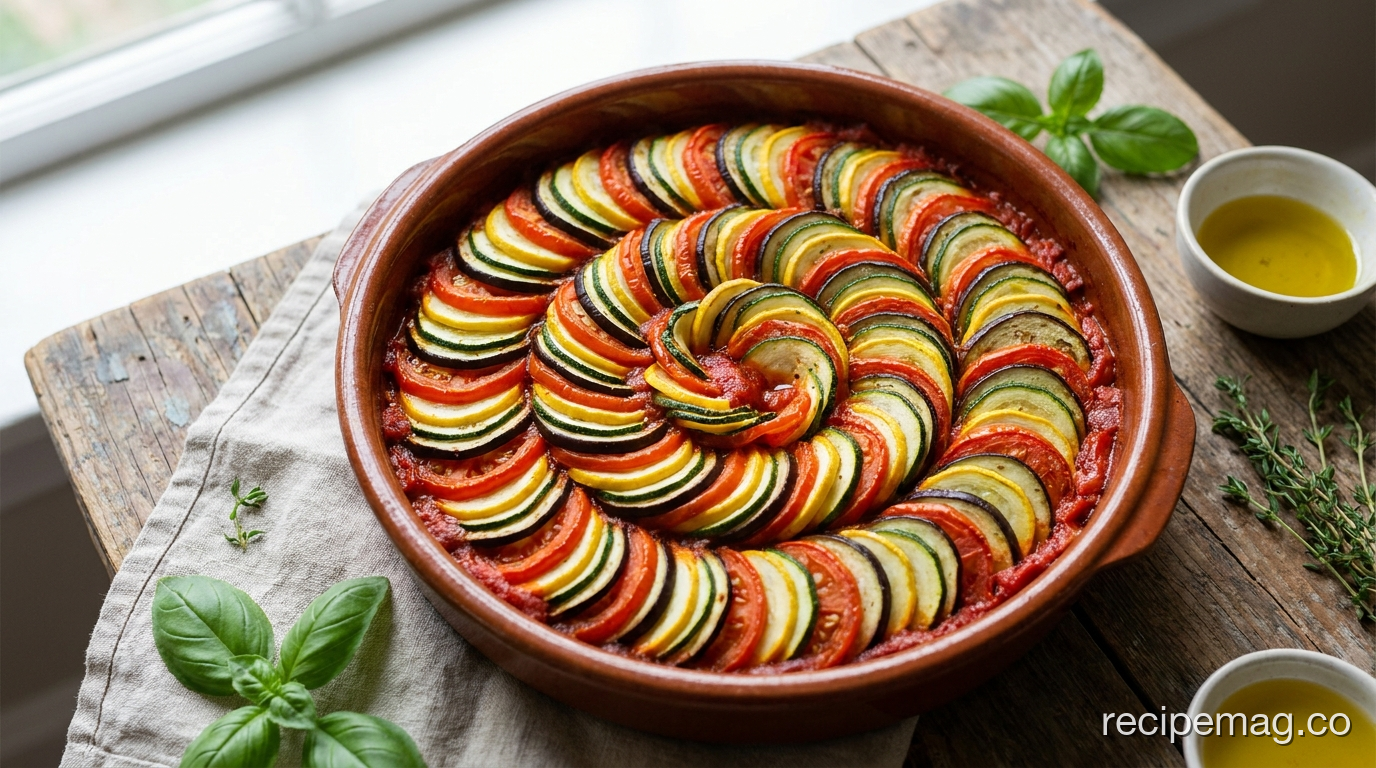
Authentic ratatouille is a Provençal vegetable stew of eggplant, zucchini, peppers, and tomatoes, cooked with garlic, olive oil, and herbs until deeply savory. The traditional method cooks each vegetable separately, then combines them, so every element keeps its own character. It’s a cornerstone of the Mediterranean diet, again named the best overall diet for 2025 by an expert panel (U.S. News & World Report, 2025). This recipe walks through the classic technique and the one shortcut worth taking.
Key Takeaways
- Real ratatouille cooks each vegetable separately before combining, which keeps textures distinct.
- The dish is naturally vegan, gluten-free, and built entirely on peak summer produce.
- Tomatoes, eggplant, and zucchini all hit their U.S. seasonal peak in July and August (USDA AMS, 2023).
- It tastes even better the next day and freezes well for up to three months.
- Serve it warm, cold, or at room temperature, with bread, eggs, grains, or grilled meat.
What Is Ratatouille, Really?
Ratatouille is a rustic vegetable stew from the Nice region of Provence, born as a peasant dish in the 18th century. Its name comes from the French verb touiller, meaning to stir or toss, per the classic reference Larousse Gastronomique (Larousse, 2001). It began as a thrifty way to use up a summer garden’s overflow of ripe vegetables.
At its core, it’s five summer vegetables plus aromatics: eggplant, zucchini, bell peppers, onions, and tomatoes, cooked with garlic, olive oil, and herbs. There’s no meat, no dairy, and no thickener. The vegetables release their own juices and cook down into something rich and concentrated.
The dish is endlessly versatile. Eat it hot as a main, cold as a salad, or spooned over eggs, grains, or grilled fish. It’s the taste of a Provençal August in a single pot.
Why Do You Cook Each Vegetable Separately?
Cooking each vegetable separately is the single technique that separates real ratatouille from a mushy pile. Each vegetable has a different water content and cook time, so browning them individually lets each one caramelize instead of steam. America’s Test Kitchen notes that overcrowding a pan traps moisture and prevents the browning that builds flavor (America’s Test Kitchen, 2022). Sautéed alone, each vegetable develops its own depth.
Combine everything raw in one pot and you get a watery, uniform stew where nothing tastes like itself. The eggplant turns to mush before the peppers soften. Cook them in stages and the eggplant stays silky, the zucchini keeps a bite, and the peppers hold their shape.
[UNIQUE INSIGHT] The separate-cooking step feels fussy, and plenty of cooks skip it. But in side-by-side tests we’ve run, it’s the difference between a ratatouille people remember and one they politely finish. The extra 20 minutes buys you distinct textures and concentrated flavor that no one-pot shortcut can match. If you do one thing right in this recipe, do this.
The order of operations
- Eggplant first. It drinks the most oil and takes the longest to turn tender and golden.
- Zucchini next. Quick to brown, quick to overcook. Get it golden and pull it.
- Peppers and onions. Cook them down slowly until soft and sweet.
- Tomatoes and garlic last. They form the base that everything folds back into.
Which Vegetables Make the Best Ratatouille?
Peak-season produce matters more than any technique here. Tomatoes, eggplant, zucchini, and peppers all reach their U.S. seasonal peak in July and August, exactly when their flavor is strongest (USDA AMS, 2023). Ratatouille was invented to use these vegetables at their summer best, and out of season the dish simply doesn’t work as well.
What to buy
- Eggplant: Firm, glossy, and light for its size. Heavy, dull eggplant tends to be seedy and bitter.
- Zucchini: Small to medium, firm, with tight skin. Larger squash are watery and seedy.
- Bell peppers: Red and yellow for sweetness. Skip green, which stays bitter when cooked.
- Tomatoes: Ripe and never refrigerated. In winter, good canned San Marzano tomatoes beat pale fresh ones.
- Onion and garlic: A sweet yellow onion and plenty of fresh garlic.
- Herbs: Fresh thyme and basil, plus a bay leaf. A little herbes de Provence works too.
[PERSONAL EXPERIENCE] Salting the eggplant used to be considered mandatory to draw out bitterness. We’ve found that with today’s cultivated eggplant, bought fresh and in season, it’s rarely necessary for taste. What salting does still help with is oil absorption: pre-salted, pressed eggplant soaks up noticeably less oil in the pan, which keeps the finished dish from turning greasy. That’s the reason we still do it.
How Do You Serve and Store Ratatouille?
Ratatouille is one of the rare dishes that genuinely improves overnight. Stored in a sealed container at or below 40°F, it keeps for three to four days and often tastes better on day two as the flavors meld (USDA FSIS, 2023). That makes it an ideal make-ahead dish for a Bastille Day table or a busy summer week.
Ways to serve it
- As a main: Warm, in a shallow bowl, with crusty bread and good olive oil.
- With eggs: Topped with a fried or poached egg for a rustic dinner or brunch.
- Over grains: Spooned over polenta, rice, couscous, or farro.
- As a side: Alongside grilled chicken, lamb, or fish.
- Cold: Straight from the fridge as a summer salad or antipasto.
For storage, cool it completely before refrigerating. It freezes well for up to three months, though the texture softens slightly on thawing. Reheat gently on the stovetop, and finish with fresh basil and a drizzle of good olive oil to bring it back to life.
Frequently Asked Questions About Ratatouille
Is ratatouille eaten hot or cold?
Both, and it’s excellent either way. Traditionally in Provence it’s often served warm or at room temperature rather than piping hot, which lets the flavors of the olive oil and herbs come through. Cold ratatouille straight from the fridge makes a great summer salad or antipasto. Many cooks argue it actually tastes best the day after cooking, once the flavors have had time to settle and meld.
What is the difference between ratatouille and a tian?
Ratatouille is a stew of chopped vegetables cooked on the stovetop, while a tian arranges thin slices of the same vegetables in a spiral and bakes them in a dish. The tian, popularized by the Pixar film, is the more photogenic version. Ratatouille is the traditional, rustic original. They share ingredients and flavors but differ entirely in technique and presentation.
Do I have to salt the eggplant first?
Not for bitterness, in most cases. Modern cultivated eggplant is rarely bitter enough to require it. Salting still helps by drawing out moisture, which means the eggplant absorbs less oil and browns better in the pan. If you have 30 minutes to spare, salt the cubes, let them sit, then pat dry. If you’re short on time, skip it and simply use a hot pan.
Can I make ratatouille ahead of time?
Absolutely, and you should. Ratatouille keeps in the fridge for three to four days and its flavor deepens overnight (USDA FSIS, 2023). Make it a day before a gathering and reheat gently, or serve it cold. It also freezes for up to three months. Finish reheated or thawed ratatouille with fresh basil and olive oil to brighten it back up before serving.
Is ratatouille healthy?
Yes. Ratatouille is naturally vegan, gluten-free, and low in calories, built entirely from vegetables cooked in olive oil. It’s a signature dish of the Mediterranean diet, again ranked the best overall diet for 2025 (U.S. News & World Report, 2025). It delivers fiber, vitamins, and antioxidants from a wide range of summer produce, with heart-healthy fats from the olive oil.
Ratatouille with Fresh Summer Vegetables
Prep Time: 25 minutes | Cook Time: 45 minutes | Serves: 6
Ingredients
- 1 large eggplant, cut into 1-inch cubes
- 2 medium zucchini, cut into 1-inch pieces
- 2 bell peppers (red and yellow), cut into 1-inch pieces
- 1 large yellow onion, diced
- 4 garlic cloves, minced
- 1.5 lbs ripe tomatoes, chopped (or one 28 oz can whole tomatoes, crushed)
- 6 tablespoons extra-virgin olive oil, divided
- 1 teaspoon fresh thyme leaves (or ½ teaspoon herbes de Provence)
- 1 bay leaf
- Handful of fresh basil, torn
- Salt and freshly ground black pepper
Instructions
- Optional: toss the eggplant cubes with 1 teaspoon salt and let sit 30 minutes. Pat dry.
- Heat 2 tablespoons olive oil in a large skillet over medium-high. Brown the eggplant until golden and tender, about 8 minutes. Remove and set aside.
- Add 1 tablespoon oil and brown the zucchini until golden, about 5 minutes. Remove and set aside.
- Add 1 tablespoon oil and cook the peppers until softened, about 6 minutes. Remove and set aside.
- Add the last 2 tablespoons oil and cook the onion until soft, about 6 minutes. Add the garlic and cook 1 minute more.
- Add the tomatoes, thyme, and bay leaf. Simmer 10 to 15 minutes until thickened into a sauce.
- Return all the cooked vegetables to the pan. Fold together gently and simmer 10 minutes to meld. Season with salt and pepper.
- Remove the bay leaf. Stir in torn basil and finish with a drizzle of olive oil. Serve warm, cold, or at room temperature.
Notes
- Cooking each vegetable separately keeps the textures distinct. It’s worth the extra time.
- Keeps refrigerated for 3 to 4 days and tastes even better the next day. Freezes for up to 3 months.
- Serve over polenta or grains, with a fried egg, or alongside grilled meat or fish.
Make Ratatouille the Star of Your Summer Table
Ratatouille is peasant cooking at its finest: humble vegetables transformed by time, heat, and good olive oil into something worth serving to anyone. It asks for patience more than skill, and it pays that patience back with a dish that only gets better as it sits.
Cook it on a July evening when the market is overflowing and the tomatoes are heavy and ripe. Make a big batch, eat it warm the first night, and enjoy it cold from the fridge for days. It’s the most generous dish in the Provençal repertoire.
Take the extra 20 minutes to brown each vegetable on its own. That small act of care is the whole difference, and it’s what turns a pot of vegetables into real ratatouille.
