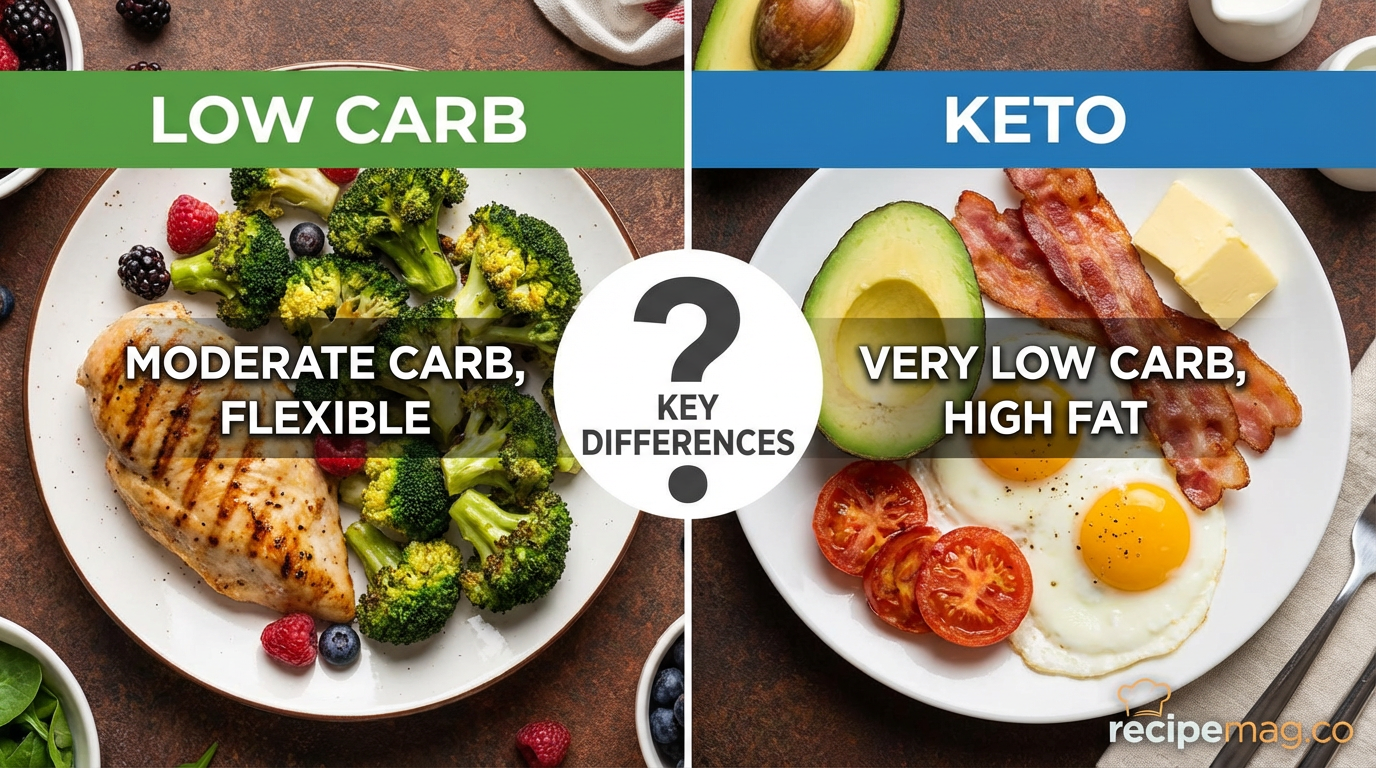
Standing in the grocery store staring at diet labels, you’ve almost certainly wondered what actually separates these two popular eating styles. Low Carb vs. Keto: Understanding the Key Differences is not just diet trivia—it will save you months of frustration picking the wrong plan for your goals.
Too many people treat these diets as interchangeable, and that’s one of the most common mistakes new dieters make. While they share core principles, they operate on completely different metabolic rules, produce different results, and work for very different people.
By the end of this guide, you’ll know exactly which diet fits your lifestyle, health goals, and personal tolerance. We’ll break down carb limits, science, side effects, and real world performance for both approaches.
What Actually Defines A Low Carb Diet?
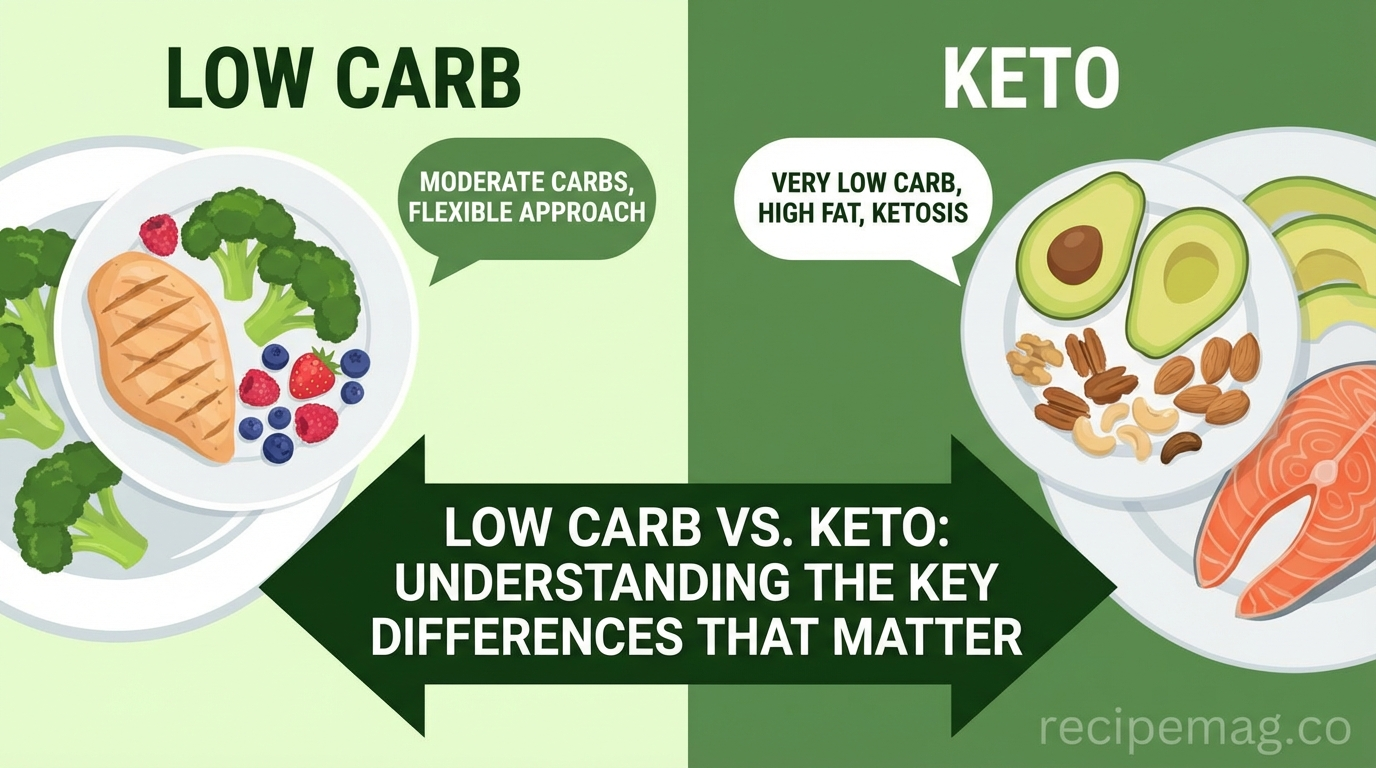
Official Carbohydrate Limits For Low Carb Plans
Most people don’t realize there is no single universal low carb diet. Unlike keto, general low carb eating is an entire category of eating plans, not one specific protocol.
Standard low carb diets typically restrict daily carbs to between 100 and 150 grams per day. Some more moderate plans go as high as 200g, while stricter low carb plans fall between 50 and 100g daily.
This is the biggest difference most people miss: low carb is flexible. You don’t have to hit an exact number every single day. You just avoid excess refined carbs, sugar, and processed grains.
If you are brand new to reduced carb eating, start with our beginner’s comprehensive overview of low carb diets to build your foundation.
How General Low Carb Metabolism Works
General low carb diets work first and foremost by reducing blood sugar spikes and insulin output. When you cut out large amounts of refined carbs, your body stops experiencing the energy crashes that trigger overeating.
You will still primarily burn glucose for energy on a standard low carb diet. You will not enter ketosis, and that is completely intentional for this style of eating.
For most people, this moderate restriction produces consistent sustainable weight loss of 1-2 pounds per week, with very few negative side effects. It is well tolerated by almost all body types and activity levels.
Common Low Carb Diet Variations
General low carb includes many popular diet plans you already know. This category includes Atkins phase 3 and 4, South Beach, Zone Diet, Mediterranean low carb, and most generic doctor recommended reduced carb plans.
All of these plans share the same core rule: limit refined carbs, prioritize whole foods, and adjust intake based on your activity. None require strict macronutrient tracking long term.
Many people stay on general low carb eating for years or permanently, as it is designed to be a sustainable lifestyle rather than a short term intervention.
The Strict Science Behind The Ketogenic Diet
Exact Keto Carb Limits And Macronutrient Rules
Unlike low carb, keto is one very specific, tightly defined protocol. There is almost no flexibility on the core rules if you want to achieve the intended metabolic state.
Standard therapeutic keto requires you to eat less than 50 grams of total carbs per day. Most people following keto for weight loss aim for 20-30 grams of net carbs daily, which means subtracting fiber from total carb counts.
Macronutrient ratios are strictly controlled: approximately 70-75% of calories from fat, 20-25% from protein, and only 5% from carbohydrates. Even small deviations can kick you out of ketosis.
What Is Ketosis, And How Does It Work?
Ketosis is the entire point of the keto diet. When you restrict carbs far enough, your liver runs out of stored glucose to burn for energy.
After approximately 2-7 days of consistent strict carb restriction, your liver will begin breaking down body fat into ketone bodies. These ketones become the primary fuel source for your brain and entire body.
This metabolic shift produces very different effects than standard low carb eating. Many people report reduced appetite, steady mental focus, and accelerated fat loss once fully adapted to ketosis.
Original And Modern Uses For Keto
Most people don’t know keto was never originally designed for weight loss. It was developed in the 1920s as a medical treatment for drug resistant epilepsy in children.
Today it is still used therapeutically for epilepsy, type 2 diabetes management, PCOS, and certain neurological conditions. Weight loss is a very popular secondary effect of the diet.
Unlike general low carb, keto is usually intended as a medium term intervention, not a permanent lifelong diet for most people.
Side By Side Comparison Of Low Carb And Keto
Low Carb vs. Keto: Understanding the Key Differences becomes very clear once you look at actual real world performance data for both plans.
Below is a complete side by side comparison of all core factors for both diets. This reference will help you quickly compare the two approaches at a glance.
| Factor | General Low Carb | Ketogenic Diet |
|---|---|---|
| Daily Carb Limit | 50 – 150g total carbs | 20 – 50g net carbs |
| Metabolic State | Burns glucose for fuel | Burns ketones for fuel |
| Flexibility | Very flexible, occasional carbs allowed | Very strict, small deviations break ketosis |
| Average Weight Loss Rate | 1 – 2 lbs per week, steady | 2 – 5 lbs first 2 weeks, 1 – 3 lbs weekly after |
| Adaptation Period | 1 – 3 days, minimal side effects | 2 – 7 days, possible keto flu |
| Exercise Performance | Excellent for all activity levels | Reduced high intensity performance until fully adapted |
| Long Term Sustainability | Very high for most people | Moderate, ~15% stay on longer than 12 months |
Which Diet Is Right For Your Personal Goals?
When You Should Choose General Low Carb
General low carb is the best choice for most people most of the time. It is the right choice if your primary goal is sustainable long term weight loss and general health improvement.
Choose low carb if you exercise regularly, especially if you do high intensity training, team sports, or heavy manual labour. You will have far better energy and performance with moderate carb intake.
This is also the right choice if you value flexibility, enjoy occasional social meals, and don’t want to track every single gram of food you eat. For long term permanent habits, low carb almost always wins.
For a complete breakdown of how to structure your plan, read our ultimate guide to low carb dieting with full food lists and sample meal plans.
When You Should Choose The Keto Diet
Keto is the better choice for very specific circumstances. You should consider keto if you have type 2 diabetes, PCOS, or have struggled with extreme hunger and cravings on other diets.
It is also a good option if you have a short term weight loss goal, such as losing weight for an event. The rapid initial weight loss can provide strong motivation for many people.
Never start keto without doing proper research first. This is not a beginner diet, and it requires careful planning to avoid nutrient deficiencies and side effects.
Pro Tips For Success With Either Diet
Regardless of which plan you choose, these proven tips will help you avoid common mistakes and get consistent results.
- Always start slow. Don’t jump from 300g carbs to 20g overnight. Reduce intake by 50g per week to minimise withdrawal symptoms.
- Prioritise fibre first. Most people fail not because they eat too many carbs, but because they eat too little vegetable fibre.
- Drink 3-4 litres of water daily. Both diets increase water excretion, and dehydration is the number one cause of bad side effects.
- Track for the first 30 days only. You don’t need to log food forever. Tracking just long enough to learn portion sizes is enough.
- Test and adjust. No diet works perfectly for everyone. Adjust carb limits up or down based on your energy, sleep and results.
- Never eliminate entire food groups without good reason. Both diets work perfectly well including whole food carbohydrates in moderation.
Frequently Asked Questions about Low Carb vs. Keto: Understanding the Key Differences
Is low carb the same thing as keto?
No, keto is a very strict type of low carb diet, but not all low carb diets are keto. All keto diets are low carb, but the reverse is not true.
This is the single most common misconception about these two eating styles. Most diet content online incorrectly uses the terms interchangeably.
Can you lose weight faster on keto or low carb?
Keto produces faster initial weight loss, mostly due to water weight loss in the first two weeks. After the first month, long term weight loss rates are almost identical between the two diets.
Multiple independent studies have found no statistically significant difference in 12 month weight loss between properly followed keto and low carb diets.
Is keto healthier than general low carb?
There is currently no high quality long term evidence that keto provides better general health outcomes than moderate low carb eating.
For specific medical conditions keto may be superior, but for otherwise healthy adults both diets produce very similar health markers when followed correctly.
Do I need to enter ketosis to burn fat?
No, this is an extremely common myth. Your body burns body fat perfectly well on a moderate low carb diet, without ever entering ketosis.
Ketosis is just one possible metabolic state for fat burning, not a requirement. A consistent calorie deficit is always the most important factor for fat loss.
How long can you safely stay on keto?
Most leading nutrition authorities agree that properly formulated keto is safe for periods of up to 2 years for most adults. There is very limited research on safety beyond this time frame.
General low carb eating is considered safe for permanent lifelong use by all major global health organisations.
Can I switch between low carb and keto?
Yes, many people successfully cycle between the two diets. You can do keto for 1-3 months to break a plateau, then switch back to moderate low carb for maintenance.
Always transition gradually between the two carb levels to avoid energy crashes and digestive issues.
Which diet is better for beginners?
General low carb is always the better starting point for absolute beginners. It is far more forgiving, has almost no side effects, and teaches good habits without extreme restriction.
Only move to keto after you have successfully followed a moderate low carb diet for at least 4 weeks.
Will I get the keto flu on regular low carb?
Almost never. The keto flu is caused by the extreme carb restriction required to enter ketosis. Moderate low carb reduction will not produce this effect for 99% of people.
Any mild tiredness when starting low carb will usually pass within 1-2 days.
Low Carb vs. Keto: Understanding the Key Differences is the first step to stopping diet guessing and finally getting results that last. Neither diet is universally better, and both can work incredibly well when matched to the right person and the right goals.
Start with moderate low carb first, give it 30 days, and only consider keto if you have specific needs that low carb doesn’t address. Always prioritise sustainability over speed, and build habits you can actually keep for years, not just weeks.
