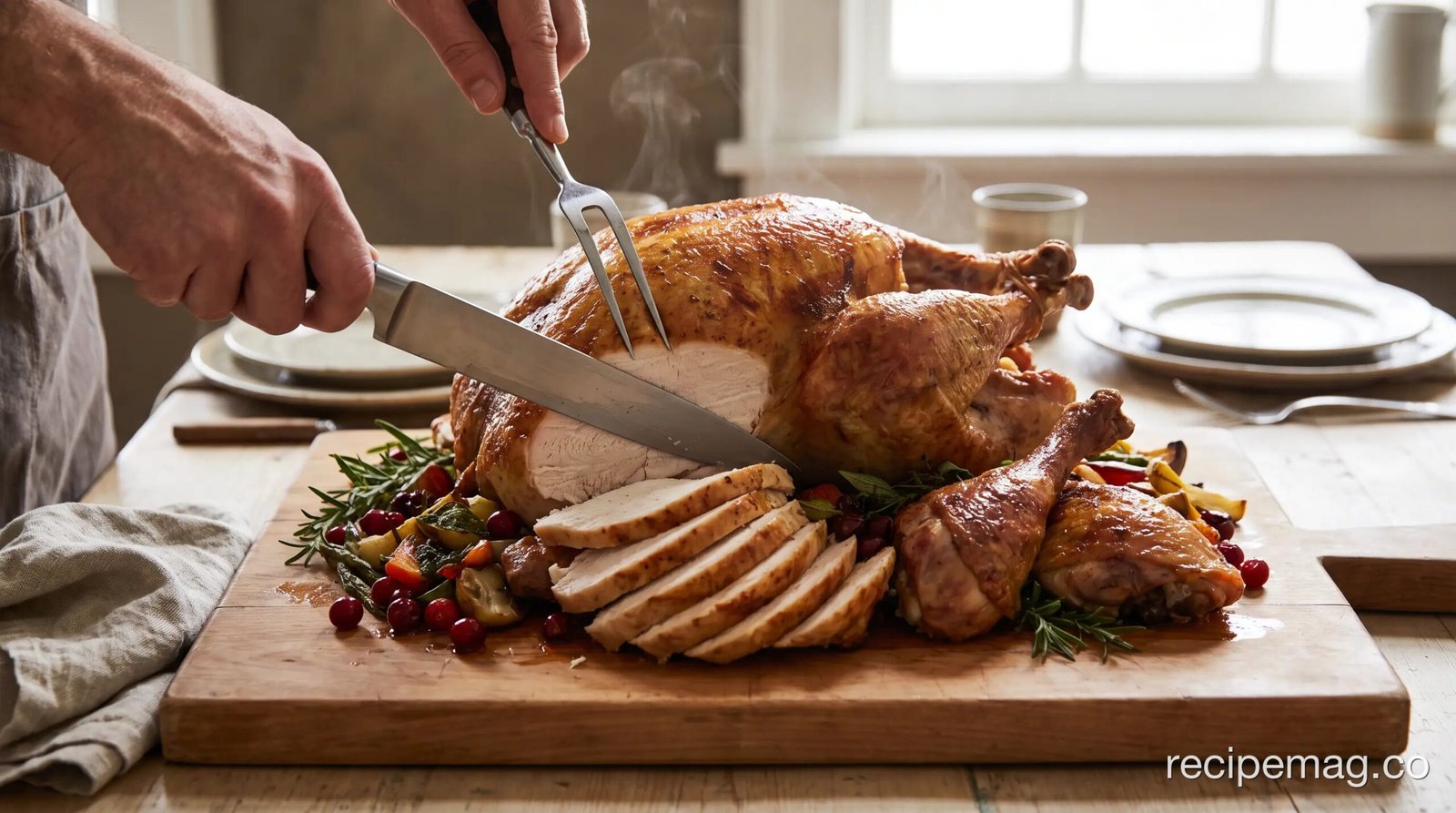
To carve a turkey, let it rest, take off the legs and wings, then lift each breast half off the bone in one piece and slice it crosswise on the board. USDA FSIS advises letting a roasted turkey stand for 20 minutes before carving (USDA FSIS, 2025), and that pause is what makes clean slices possible. With a sharp knife and a big board, the whole job takes about 15 minutes, and nobody has to watch you do it.
Key Takeaways
- Rest the turkey 20 to 40 minutes. USDA FSIS calls for at least 20 (USDA FSIS, 2025).
- Carve in the kitchen in this order: legs, wings, then each breast half in one piece.
- Slice the breast across the grain, about ½ inch thick, so every slice keeps its skin.
- A sharp 8- to 10-inch knife matters more than a fancy carving set.
- Refrigerate leftovers within 2 hours and eat them within 3 to 4 days.
What Do You Need to Carve a Turkey?
You need less than a carving set suggests: one sharp knife, a big board and somewhere to put the meat. Before any of it, confirm the bird is done. USDA FSIS puts the safe minimum for turkey at 165°F, checked in the thickest part of the breast and the innermost thigh and wing (USDA FSIS, 2025).
- A sharp 8- to 10-inch knife. A long, thin carving knife helps with breast slices, but a well-honed chef’s knife handles every cut here.
- A carving fork or tongs. Use it to steady the bird, not to stab it over and over.
- A large cutting board with a juice groove. Set a damp kitchen towel underneath so it can’t slide.
- A rimmed sheet pan. Park carved pieces on it while you work. It catches juice for the gravy, too.
- A warm platter and paper towels. Ten minutes in a 200°F oven warms the platter; the towels are for greasy hands and a slippery handle.
How Long Should a Turkey Rest Before Carving?
Rest a whole turkey for at least 20 minutes, the minimum USDA FSIS recommends before carving (USDA FSIS, 2025). For a 12- to 16-pound bird, 30 to 40 minutes is better. The meat firms up as it settles, so it slices cleanly instead of shredding, and less juice runs out onto the board.
It won’t go cold. A big bird holds its heat for a long time under a loose sheet of foil. Skip a tight wrap, which traps steam and softens the skin. If crisp skin is your priority, rest it uncovered.
Just don’t let the rest drift into hours. FSIS says perishable food shouldn’t sit between 40°F and 140°F for more than 2 hours (USDA FSIS, 2025), and dinner counts toward that clock.
In our kitchen, the rest is the busiest half hour of the day. The rolls bake, the sides reheat and the gravy comes together. If you made our make-ahead turkey gravy, this is when you whisk in the fresh drippings.
How to Carve a Turkey, Step by Step
Carving comes down to three moves: legs off, wings off, breast off. Work in the kitchen, where you have room and light, with the bird breast side up and the drumsticks pointing toward you. These steps fit any whole roast, including our classic herb-butter roast turkey.
- Clear the cavity. Snip off the twine and lift out any lemon, onion or herbs with tongs. If the bird was stuffed, spoon the stuffing into a dish; FSIS says it must reach 165°F at the center, too.
- Cut the skin at the leg. Pull one drumstick gently away from the body and slice through the skin between the thigh and the breast.
- Pop the hip joint. Press the whole leg down and outward until the thigh bone pops out of its socket. Cut through the joint, keeping the knife close to the backbone so the small, tender “oyster” of meat comes away with the thigh. Repeat on the other side.
- Split the thigh and drumstick. Lay the leg skin side down. Find the thin line of fat where the two pieces meet, wiggle the drumstick to locate the joint and cut straight down through it. Hit bone? Move over a little.
- Bone the thighs. With the thigh still skin side down, cut along both sides of the bone and lift it out. Turn the meat over and slice it across into ½-inch pieces.
- Remove the wings. Pull a wing out from the body to find the shoulder joint, then cut through it. Serve it whole or split it into a flat and a drumette.
- Find the breastbone. Feel for the ridge running down the center of the bird. Cut straight down along one side of it, from the neck end to the tail, keeping the blade against the bone.
- Release the breast half. Ease the meat away from the center with your free hand. Follow the rib cage down with long, shallow strokes, then make a horizontal cut at the base, just above the wing joint. Lift the whole half away and repeat on the other side.
- Slice across the grain. Set each breast half skin side up and cut crosswise into slices about ½ inch thick, keeping the shape together. Slide the knife underneath and move the whole row to the platter at once.
- Build the platter. Fan the breast slices down the middle, with thigh meat on one side and drumsticks and wings at the ends. Spoon a little warm broth over the white meat.
- Save the carcass. Pick off any meat left on the back and neck, then set the bones aside for stock.
Why Carve the Breast Off the Bone Instead of Slicing It on the Bird?
Because the slices come out better and faster. Taking each breast half off whole lets you cut across the grain, and every slice keeps a strip of skin. Shaving thin slices off a standing bird, the way old magazine covers show it, runs the knife along the fibers and leaves long, stringy pieces with the skin peeled away.
Here’s what most carving guides skip: grain direction matters more on turkey breast than on almost any other holiday roast. The breast fibers run lengthwise, from the neck toward the tail. Slice parallel to them and each bite is a bundle of long strands, which tastes dry even when the meat is cooked right. Cut across them and the same meat feels tender.
The breast also stays in two thick pieces until the last minute, so it holds its heat. Want the tableside moment anyway? Show off the whole bird for a photo, then carry it back to the kitchen to carve.
How Do You Carve a Spatchcocked Turkey, a Turkey Breast or a Smoked Bird?
The same three moves work on any turkey; only the starting shape changes. Flattened and breast-only birds are actually easier. As always, check for 165°F in the thickest part first.
Spatchcocked Turkey
With the backbone gone, the legs come off in a couple of cuts at the hip and the wings follow. Cut down the center of the flattened breastbone to split the breast, then slide the knife along the ribs to free each half. Our spatchcock turkey shows how the bird gets flat in the first place.
Bone-In Turkey Breast
Skip to step 7. Run the knife down one side of the breastbone, follow the ribs and lift each half off in one piece, as in our herb-roasted turkey breast. Slice crosswise and you’re done.
Smoked, Brined or Glazed Turkey
These birds have darker, stickier skin, so wipe the blade with a paper towel every few cuts. A smoked turkey can also show a pink ring under the skin even at 165°F. That’s normal for smoked meat. Color was never a doneness test anyway; the thermometer is.
How Do You Keep Carved Turkey Warm and Juicy?
Carve close to serving time, and keep the slices hot and moist. USDA FSIS advises holding hot food at 140°F or warmer (USDA FSIS, 2025), and thin turkey slices fall below that quickly on a cold plate. These habits help:
- Add a splash of broth. Ladle ¼ to ½ cup of hot broth or strained pan juices over the breast slices just before serving.
- Slice the breast last. Dark meat holds heat and moisture better, so carve the white meat after everything else is ready.
- Hold it low and covered. A foil-covered dish in a 200°F oven bridges a short wait. Check that the meat stays at 140°F or above.
What Should You Do With the Leftovers and the Carcass?
Refrigerate leftovers within 2 hours of cooking and eat them within 3 to 4 days, per USDA FSIS (USDA FSIS, 2025). The quickest way there is to keep carving: strip the last meat off the bones right after dinner and pack it into shallow containers, which chill faster than a whole bird.
- Add a spoonful of broth. It keeps sliced breast from drying out in the fridge.
- Freeze what you won’t eat by Monday. Food held at 0°F stays safe indefinitely, FSIS says, though quality fades with time (USDA FSIS, 2025).
- Reheat to 165°F. Warm slices covered, with a splash of broth, in a 325°F oven.
Don’t toss the carcass. Break it up, cover it with cold water in a big pot, add an onion, a carrot and a celery rib, and simmer gently for 3 to 4 hours. Strain the stock and refrigerate it in shallow containers. Too tired on Friday? Freeze the bones in a zip-top bag and make stock in December.
Frequently Asked Questions About How to Carve a Turkey
Should you carve a turkey at the table or in the kitchen?
In the kitchen, for most hosts. You get counter space, good light and a sheet pan for the juices, and you can take each breast off whole and slice it across the grain. If the tableside tradition matters to your family, present the whole bird first, then carve it in the kitchen. Nobody minds waiting a few minutes for better slices.
What knife is best for carving a turkey?
A long, thin, straight-edged knife, 8 to 10 inches. A carving knife is ideal, and a sharp chef’s knife works almost as well. Sharpness matters more than shape, since a dull blade tears skin and crushes the meat. Hone it the day before, and skip the serrated bread knife, which saws ragged breast slices.
Can you carve a turkey ahead of time?
Yes. Carve it up to an hour before dinner, cover the platter loosely with foil and hold it in a 200°F oven, spooning broth over the breast. For a day-ahead plan, refrigerate the carved meat within 2 hours, then reheat it covered with broth at 325°F until it reaches 165°F. You’ll lose the crisp skin, but the meat stays moist.
Why is my turkey still pink near the bone?
Pink meat doesn’t mean undercooked. USDA FSIS notes that safely cooked poultry can stay pink, especially near the bone, in young birds and in smoked turkey. Go by temperature: 165°F in the thickest part of the breast and the innermost thigh and wing means it’s done. If a piece reads lower, return it to the oven until it gets there.
Hone the Knife Before Thursday
Carving is the last job of a long day, and it’s the one everyone sees on the platter. Give the turkey its rest, take the legs and wings off first, and lift each breast away whole before you slice. That order works on every bird, from a 20-pounder to a bone-in breast.
Sharpen or hone your knife this week and clear a corner of counter for the board. Then pencil the rest and carving into your Thursday schedule; our Thanksgiving dinner planning guide shows where those 30 minutes fit. And save the carcass. Friday’s stock is the last good thing the turkey gives you.
